Category Archives: Books

Flashback Friday: The Cheerleader and the Bookworm

Standard

Sunday, May 21, 2006


Once a month when the bill is due, I go to the gym. I can’t say it does much for muscle tone or weight loss, but I am dedicated even though I don’t see results. Once a month. Like clock work. I go to the gym at 10:00. This is the perfect time to go because the only people who are there are usually older people who have either had strokes and are rehabilitating or older people who are healthy and trying to ward off the strokes. Nobody is there who looks like they’ll be on the next series of Real World in other words. There is no spandex or neon. The older people don’t really work the machines right. They do things in a lopsided fashion. I say this not to make fun of them but to point out that in order for me to feel good about the hour I sometimes spend in a gym requires me to be surrounded by people bent over with osteoporosis and propping themselves up with canes. I am not what you would call a natural.

When I was in high school, I was one of those girls who always had her nose stuck in a book and who was always the last one in from the mile run around the track in gym class. Because there were no books involved with gym, I considered it a waste of my time. I didn’t particularly like my body (though I would certainly like to have access to that version of myself again) and so tended towards maximum coverage in oversized Amy Grant sweatshirts and army jackets. Gay men loved me. Boys who read The Lord of the Rings found me a worthy enough companion.

On the other end of the mind/body spectrum was a girl, let’s call her Trixie, who wore her parachute pants so tight that little was left to the imagination. She was spoiled and cute with a horrible reputation though I was never clear if it was warranted or created by jealous girls and hopeful boys. She was just someone in general math and English classes whose wardrobe and body were enviable, who had gone out with a lot of different guys, and who had a contagious laugh. Also, she was a cheerleader.

Yesterday when I got the gym, there on the steppy-uppy machine I haven’t the stamina to use, was not one of the geriatric regulars, but Trixie, chewing gum, reading a celebrity gossip magazine, and talking to a trainer. She saw me and greeted me warmly, as she always does though we were never friends, and we talked about school and old acquaintances and life. She was sheepish because the last time I saw her was at a restaurant where her eleven-year-old son announced across the aisle separating us that she’d been married and divorced twice and that he and his brother had different fathers. This announcement caused her to clam up and me to eat the rest of my deep friend dinner in uncomfortable silence.

At the gym, we were able to laugh this off. Obviously, this is her domain. She effortlessly talked to me as she climbed an invisible K-2 while I huffed and puffed on the 0% incline of the treadmill. She told me how good her boys are—how they are so much better than she was. She said she wished I had a kid that would spill MY secrets to her in restaurants, and it struck me how sad it is that we humans go through our lives worrying about what other people think of us. Trixie thinks I sit in judgment of her because she’s been married twice, didn’t go to college, and knew how to have a good time. Meanwhile, I think Trixie is judging the size of my treadmilling backside, judging me for my lack of mate or children, and poverty of fashionable workout clothes.

Why do we torture ourselves this way? I allowed myself about 120 seconds of masochism (Why don’t I go to the gym more so I too can speak without huffing and puffing? Why don’t I wear something more attractive than my relaxi pants and “Guinness is Good for You” T-shirt?) and then forced myself to focus on her and what she is: a thing of beauty. Not just because she is firm or tan or has long blond hair or looks ten years younger than I do, but because she still cracks her gum and giggles and tells you she likes your shoes instead of mentioning how you look fatter or older or more single than you did in 1985.

As we were getting ready to leave, the trainer she had been talking to earlier was rubbing a kink out of her back. In six years of semi-irregular gym attendance, no trainer has bothered to smile at me let alone rub a kink out of any of my muscles, but here was Trixie, getting a post-workout backrub and telling the trainer that she thought perhaps she was so tense because she hadn’t had sex for so long.

Gum crack. Gigggle.

Elegy to a Mentor

Standard
Gibb (with Beth and her 80s hair).

Gibb (with Beth and her 80s hair).

Today would have been the 80th birthday of my college mentor. All afternoon I’ve been having “Gibb flashes” and was surprised to look on my perpetual birthday calendar and see his name in parentheses (parentheses being the only indication I am ever willing to give that someone on my calendar is now dead). Somewhere on one of my often-confused brain cells, there must have been some Gibb info stored and an impulse got released to remind me to send him a greeting today.

Only sadly, I have to send it to the general populace since he died in 2006.

When I went to college, I was an art major. My whole life until then I’d either had a pen in my hand for writing or a pen in my hand for drawing, so it’s easy to see now why I was confused about what I should do with my life back then. For the first six weeks of college, I dutifully carried my art supplies to the Fine Arts building and tried not to be intimidated by the girl who wore a beret or the guy who carried a paisley purse, both of whom looked like artists while I was wearing polo shirts and sweaters with shoulder pads. I also tried to ignore how loathe I was to use the mandatory charcoal because the feel of it dragging across the paper set my nerves on edge and I preferred the delicate, fine strokes of a pen. Eventually it became apparent that the joy I felt going into the classroom beneath the art studio for my Valuing Through Literature course when compared to the glumness I felt about Drawing 101, probably meant something significant. Possibly, I would have come to this realization without Gibb at the helm of that class I’d accidentally been placed in by a disinterested advisor, but I like to think it was destiny that put me in his class and that led me to the registrar’s office before the term was up to change my major to English.

Gibb was in his 50s, balding, and had this air of an Englishman even though he was 100% American. (When I say “air” I don’t mean that he put on airs. He was just so caught up in British literature and history, that he gave off an English vibe, so much so that his perfectly American English would start to sound like English English in your ear.) More than once, the actor Anthony Hopkins has reminded me of Gibb, though not so much when he played Hannibal Lecter.

Gibb had this habit of lecturing into his yellow legal pad, as if he were talking to himself in an empty room, only occasionally looking up at one of us with a slight smile or a squinted eye if he’d said something particularly poignant about a poem or essay. He moved his coffee cup around as he talked, as if he couldn’t find the exact right spot for it, and his lectures, while full of the expected details about literature, were also chock-full of anecdotes that you’d miss if you weren’t listening, such as his  memory of the first ball point pen and how the advertisements  had said, “It can write on butter!” as if writing on butter was something everyone would want to do, or his disappointment that inaugurations never looked as good as they did after the Kennedy presidency, which he blamed on the lack of top hats. One of my favorites was about the Wedgwood China he’d won in a puzzle contest that he enjoyed because with it came a trip to England. When he told us about it, he shook his head at the memory of his daughter, who was concerned about how much each piece of it had cost. He said, “How does the price of a gravy boat make the gravy taste any better?” In his mind, it was somehow tied to what we were learning to value through literature, but to some of my classmates, he just seemed like an old guy who rambled. It was these anecdotes of his—dutifully copied in my notes right next to dates and themes of Bride of Lammermoor—that led me to the understanding that literature was life, and vice versa.

He loved pigs and had had a pet one named Jipper when he was a boy, and it would meet him after school each day. Various pig trinkets dotted the shelves which were filled with books about and by Romantic and Victorian British authors, including a tea towel with pigs on it dancing around some building blocks that spelled out ENGLISH. (My friend Bunz, once said, “Until I met Gibb, I had no idea that pigs and English had anything to do with each other.”  I’m still curious about where one would find such a tea towel.)

My fellow English majors liked him fine, but he was not one of the campus personalities around whom students flocked, those intellectual celebrity-profs who spent as much class time talking about themselves and their vast stores of knowledge and accomplishments as they did the subject at hand. Nor was he like the psychology prof in the tight Levis who was popular despite a rather crabby disposition. Gibb amused students, if anything, both because of his odd lecturing manner and the quiet jokes he’d crack in the classroom. Did my classmates respect him? I don’t really know but I have to believe they did because I can’t really stand the thought that they might not have.

Friends who were English majors were aware of my devotion to him and how I hung on his every word, and they sometimes teased me about being in love with him. It was in good fun, but it got under my skin…like being accused of having the hots for Mr. Chips or Yoda or, well, Buddha or Jesus. You just don’t do that. It wasn’t about that. Mostly, I just wanted to scoop out what was in his brain and put it into mine.

One of the regular requirements for his classes were journals, an activity that I loathed for other professors, but I knew Gibb was reading mine because he regularly praised me for the quality, and so I began writing them with more vigor because it was clear I had an audience. It was the perfect communication style for two introverts. His written commentary gave me insight into the work I was writing about, his praise gave me a little more faith in my abilities, and on one occasion when he chastised me, his words burned deep and I spent weeks mentally twisting while I tried to figure out if I had been misunderstood or if I needed to alter my perspective to align more with his.

I remember the satisfaction I felt, when I brought Helene Hanff’s books, 84, Charing Cross Road and The Duchess of Bloomsbury Street to his attention. He’d never heard of her, devoured the books, and one day when I was working in the English Department at my job as a student secretary, I overheard him suggesting the books to someone else. I felt like I’d accomplished something, to carry these two small books to this man who had introduced me to so much fine literature, the way a cat leaves a mouse on a doorstep for its master.

My junior year, he and his wife, took a group of students to England for a week. It was my first trip outside of the U.S., and the idea of seeing the England that Gibb had lectured about with him (and with my friends), really was a dream come true. Our first full day there he led us to the Tower of London, and I can still remember the sort of naïve shock I felt when I realized that the places I’d spent my life reading about were real, the historical figures were real, and even the fictional characters and places were real­-ish.

For some reason, one of my fondest memories from that trip was at Windsor Castle where I overheard his wife pointing out that St. George’s chapel was closed, and Gibb said to her, with the most irritation (and disappointment) I had ever heard from him, “Of course it is closed. Whenever we are here it is closed. Why would it be open today?” Years later when I managed to be there on a day when it was open, I was sure to remember the details of what struck me there—the photo and light burning by the tomb of the current queen’s father, what it felt like to stand directly over Henry VIII’s bones, the checkered floor, the banners—so I could give him the details in case he never did get to see it for himself.

After my graduation, we kept in touch with letters and regular Christmas cards, in which we’d always promise to get together in the near future, though we never did. I wanted to be able to report to him that I had become the next Erma Bombeck or Mike Royko (his two suggested futures for me, as if these were job openings I was likely to see an ad for), and so I kept putting off seeing him maybe, and instead reported less grand things in my letters: a new degree, a trip to Ireland, a new job teaching. In my  memory, I thanked him for what he’d taught me when I started teaching my own students, but I’m not sure I did. I hope I did. Certainly, some percentage of what I said and did in the classroom was because of Gibb.

One year his wife signed the Christmas card and there was no letter. Instead of feeling glad to hear that they were both well, I felt annoyed. Within the year, he had died.  A few weeks later, I found the previous year’s Christmas card and realized it wasn’t his wife who had signed it. It was Gibb. His handwriting looked less like itself, less sure, and the message was short, “Please come and see us!” And I wept because of those things we desperately want “do-overs” on but can’t have.

His voice cracked once when he talked about aging love in Robert Burns’s poem “John Anderson, my Jo” and it has stuck with me all of these years, how much the words on the page were alive for Gibb and should have been alive for all of us, young things that we were, so sure we’d never age.

Stacked

Standard
My desk (fantasy version)

My desk (fantasy version)

I used to have students who would say to me, “I’m a writer, but I hate to read.” Whenever I’d hear that—and I heard it too much—I’d always want to do one of those obnoxious cough talks, where you hold your hand over your mouth, bark a cough, and simultaneously say something rude. But I was a good teacher, so instead I’d suggest a book I was sure would capture their interest.

You can’t write and not read. I mean, I suppose you can, but I don’t really want to have to read what you write. And frankly, it seems a little rude to me to write something you think other people should read when you refuse to read yourself. I suppose you could be a chef who doesn’t like to eat anyone else’s food, but where would you get your inspiration and style?

I have no idea if I would have thought of myself as a writer if my mother hadn’t made being a reader non-negotiable. Maybe I would have been like those old students of mine, enamored with the idea of having my name on a book or a story or a poem published with my byline without having bothered to study craft or let someone else’s words inspire my own. It’s one of those unanswerable nature vs. nurture debates. I grew up in an apartment that was filled, floor to ceiling, with books crammed into a brick-and-board shelving system. I saw my mother reading and I was read to nightly. I had my own library card the moment I was allowed to have one, and I knew how to use it. (Brief aside: one of the saddest losses to me in this barcode age is the absence of the satisfying “Ka-chunk” sound when you checked out a book.) My childhood was spent at garage sales, used bookstores, and in the book sale section of the musty Salvation Army store, where Mom’s early collection got its start. Though I might have gotten bored during these lengthy browsing sprees at times, I was resigned. Books were holy and when you were in the presence of some that were for sale, you kept quiet and waited for selections to be made and the ting of the cash register that signaled the benediction.

I had my own bookcases before I had my own room. They were full of Little Golden Books, Dr. Seuss, the Little House on the Prairie Series, Trixie Belden mysteries, and all manner young adult books. The shelves grew. First three small ones, and then a desk set with adjoining shelves that were later cut in two, turned sideways, and had boards put across the short ends, giving my own library room to grow. When my  mother and step-father got married and bought a house, it wasn’t long before we’d enlisted him into building floor-to-ceiling shelves in my bedroom. When I was constructing my library, my belief was that it was something I’d carry with me for life, like scars and family photos. You might weed out the baddies, but even if you outgrew a book, you didn’t casually release it into the wilds. You hung on to it because it was part of the literary canon of your life.

* * * * *

When you think of me, I’d like for you to have the above photo in mind: my tidy desk with a row of writing books in front of me at the ready, should I need to find an answer about style or read a line for inspiration. These are all books that I’ve read in total or in part and know to be useful. When I look at my desk, these books bring me joy because this is the sort of person I always imagined I’d be: organized, controlled, and like a good Girl Scout, prepared.

But I’ve got a book problem. They multiply like rabbits. Despite the fact that I culled the herd when I moved here, and left half of my collection back in Indiana at my folks’ house, I’m operating at near maximum capacity here. When I was cleaning out my office this past spring after I resigned from my teaching position, I weeded extensively. There were a lot of books there that I had bought when I was just starting my collection, thinking that my life wouldn’t be complete if I hadn’t read the complete works of  ________________________________, but two decades later I no longer felt compelled. I’m beginning to recognize that I don’t have an infinite amount of reading days ahead of me, and so I’m trying to be choosey. (Which begs the question, why was I up until four a.m. last night finishing the latest Dan Brown novel.) But even with the weeding, every time I’m back home, a few more books leap into my suitcase, desperate to be reunited with their siblings.

rgsofficeshelves

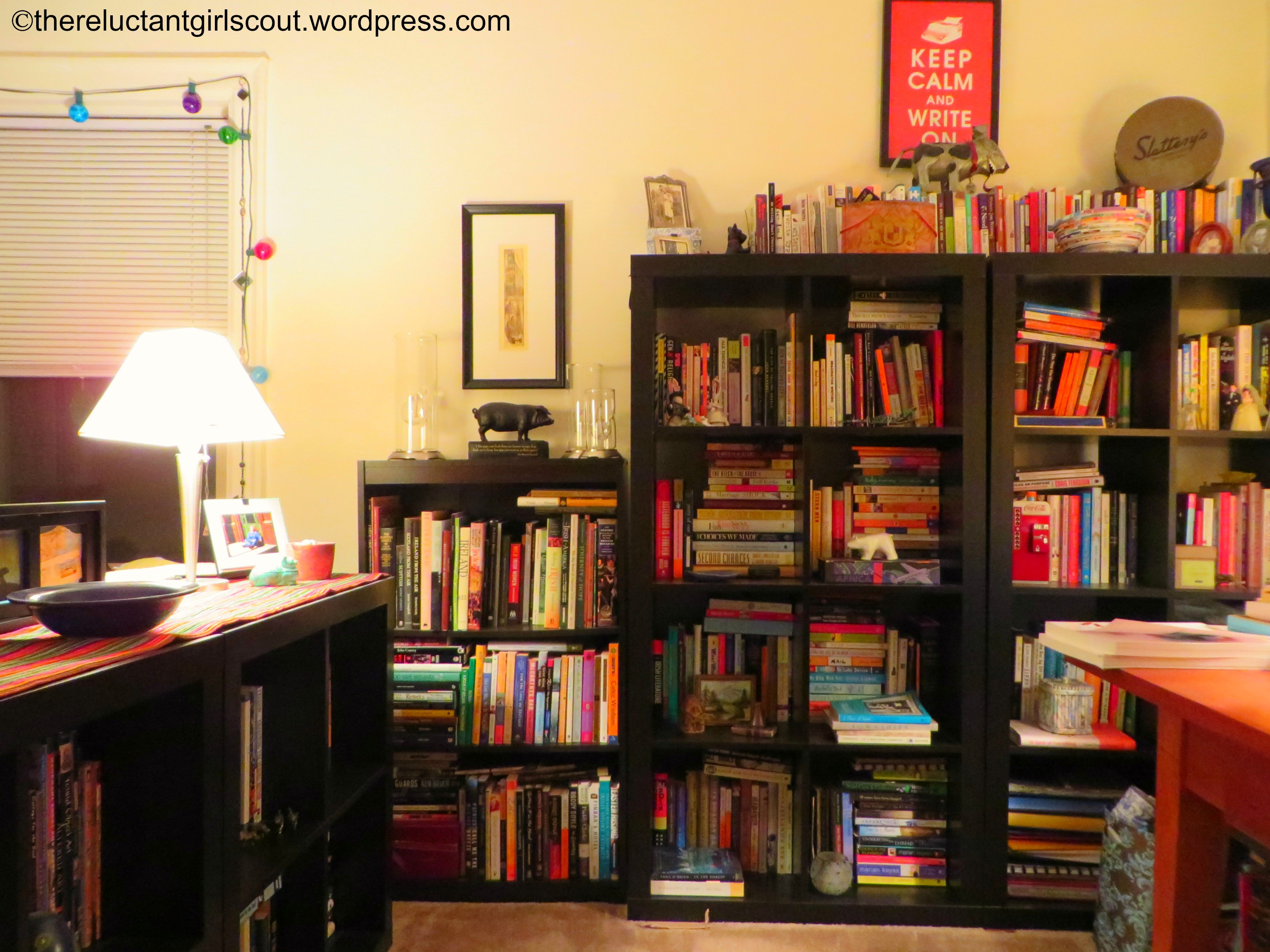
So this is what my writing studio looks like, plus another set of shelves on the opposite wall where the books are double-stacked. Plus, a small set of cubes to go on top of these just as soon as Z and I figure out how to secure the shelves to the wall without wrecking our chances of getting our deposit back.

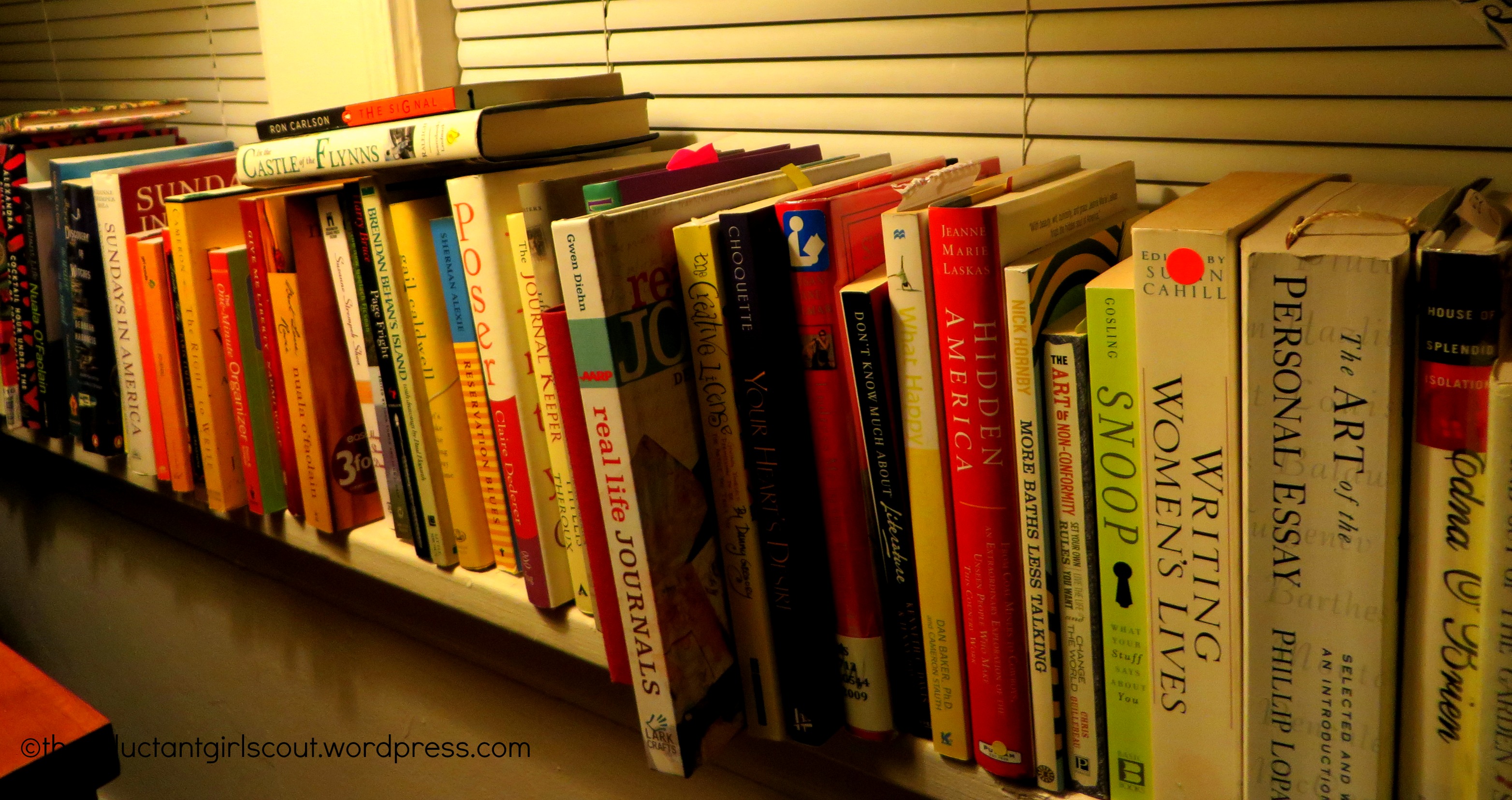
There wasn’t room for bookshelves in our living room, so for the first year or so that we were married, it was largely book free, give or take a coffee table book. Then I started getting books that I was planning to read “next.” So I put them on the windowsill behind the sofa. At first, it was just a few books and I definitely would be getting to them shortly, but then I went to a bookstore, used up an Elliott Bay Books gift card, went to a reading and felt compelled to buy the author’s latest title, had a birthday, and the next thing I knew, my “next” collection ran the length of the double windowsill. While the books in my studio are arranged in a very specific but intuitive fashion so I can easily find what I need, on the windowsill it is a free-for-all. I put books there as they come to me, so race car driver Janet Guthrie’s biography is right next to National Geographic’s Scenic Highways and Seven Secrets of the Prolific.

Book chaos

Book chaos

Books crept into the weird bar space behind our TV. Some appeared under my little wooden stool. We won’t speak of my nightstand, where the stack is currently so high, it threatens to block out my light. Nor will we speak of Z’s poor books, which I always relegate to hidden corners and alcoves. Any of these books could go live in the studio, where they might be more at home and so I would have more surfaces in my living room on which to set Zimbabwean objet d’art (read: stone hippos and wart hogs made of scrap metal), but I know as soon as I take them there, they’ll be lost to me. I’ll forget about them, find them in ten years and wonder what made me ever think I wanted to read a memoir about a Seattle mom who loves yoga or an American family who lived in Berlin before World War II.

And don’t even get me started on why it is I think I need to own every book about writing that was ever written. I’ve got so many books on how to be a productive writer, that I refuse to buy another unless the first line is: In order to be a more  productive writer, quit reading books about how to be more productive. It’s a sickness I have.

What I'm reading NEXT.

What I’m reading NEXT.

This is my most recent stack of books, compliments of Z and my folks. They came for both Christmas and my birthday. The desk behind them will open. Right now. But as soon as I cash in those holiday gift cards? Forget about it.

I know the world of e-reading makes for tidier living spaces, but I’ve got five books on my iPad and I can’t remember to read them. An iPad, to me, is not a book; it is a place to check my mail, watch Downton Abbey, and play “Ticket to Ride.” My brain doesn’t hear the start-up ping of an electronic device and think, “Oh boy! Time to read!”

So here’s my 2014 challenge to myself. I am going to show up to those books on the windowsill (and my new books, of course!) read as many of them as I am able, and report back to you.

If it were a real challenge, I’d make some outlandish promise about how they’d all be read and removed by December 31st, but I’m not crazy. Some books will probably always need to live there so I have easy access: The Art of the Personal Essay, The One-Minute Organizer, and You Can Heal Your Life (because sometimes I need to know what negative thought pattern I have that might be causing my big toe to hurt). That’s 68 books, plus the top two on my nightstand that I’ve got  to finish, which rounds it off to a solid 70.  And maybe, for good measure, I’ll read all the magazines I’ve been stockpiling since I got married. Joan Didion has been staring at me from the cover of Poets & Writers for two years now.

What are you reading? Oh, don’t tell me. The windowsill is already full.

rgsstool