Category Archives: Urban Life

A Tale of Two (or more) Christmases

Standard

IMG_2224

It’s that time of year when I drag out all the Christmas videos that put me in a happy, Christmas space, and force Z to watch them. I don’t always watch all of them—Little Women often gets a miss because I end up in tears when Beth dies—but, like clockwork, there will be a viewing of Christmas in Connecticut, A Child’s Christmas in Wales, A Holiday Affair, While You Were Sleeping, A Christmas Story, and eventually, my favorite, Moonstruck, which, honestly, I sometimes forget is set at Christmas because it’s also one of my favorite non-holiday movies. The script is great, the writing is tight, the scenery is wonderful, and the acting really was worthy of those Oscars back in 1988. The main thing all of these movies have in common though is the promise of a two-hour block of time when Christmas is exactly how you imagine it should be.


As you may be aware, I do my fair share of complaining about city life, but this is the time of year that while I miss home—the city…any city really—comes alive for me.

I first discovered this love for city-life-at-the-holidays in Chicago in the mid 1990s when I’d stand for an hour studying the window displays at Marshall Field’s and Carson Pirie Scott. The displays at Field’s were themed and you’d wait anxiously to see what would be revealed each year: Cinderella, Pinocchio, Wizard of Oz? I could easily get teary-eyed talking about Macy’s take-over of the main Marshall Field’s on State Street and subsequent refusal to retain the historical name and traditions and the bland, seen-it-before holiday decorations that are the new normal, or the Target logo that now hovers over the beautiful ironwork on the Carson Pirie Scott building. So don’t mention those stores to me please. Seriously. Can we just pretend it’s still 1997 and all is as it should be on State Street?


When I was in Chicago, I somehow didn’t mind the cold. I’d stand outside, purposeless, watching the ice skaters, guessing what might be in the bags and stacks of boxes people were carrying around on the Magnificent Mile as horns honked in what seemed like a less aggressive, more festive way than at other times of the year. I’d make time to go to one of the free weekly concerts at Fourth Presbyterian, staring up at the decorated sanctuary that was meant to look like the hull of a Viking ship, and listen with pleasure to carols and concertos. Then I’d get cocoa on the second floor of the now defunct Borders bookstore and stare down at the historic Water Tower and watch the carriages there, carting tourists around with horses sporting Santa hats. I was meant to be in the city for a man, but he was often at work or disinclined to venture out of his Bat Cave, so my time there was solitary and oddly delightful. I didn’t need to be doing the carriage riding or the ice skating; I was content to observe it, to walk amongst the revelers, to soak it in. There was nothing about Christmas in that snowy, blustery city that I didn’t love; even the labored breathing from the icy temperatures and difficulty walking on the snow-packed side streets seemed magical.


Rockefeller Center, 2010

Rockefeller Center, 2010


Chicago set the bar high. Four years ago, Z and I had a blizzard-induced flight delay when we were headed to Zimbabwe, and thus we ended up spending a few nights in New York City. For the first time ever, I finally got to see—in the flesh and electric lights—those famous windows at Macy’s, the tree at Rockefeller Center, wreaths on St. Patrick’s Cathedral. It made our interrupted—and thus shortened—trip to Africa almost worth it. Christmas in New York certainly rivals that of Chicago, but for me, it doesn’t quite win. Maybe a tie. I’ve seen Dublin, Galway, Rome, New Orleans, Harare, Seattle and the closer, Midwestern cities of my youth decorated for the holidays, but Chicago will always be the city that lives inside the flurry-filled snow globe in my brain. I try not to hold that against Seattle, which even managed to produce a few tiny patches of snow this year and get cold enough to keep little driftlets at the bases of about three trees.


But it’s no Chicago.


December hasn’t impressed me much this year. It’s my favorite month usually, but it seems like the whole world is coming unhinged. Normally, it’s the time of year when you can safely insulate yourself from the ugliness out there so long as you toss some money in the Salvation Army pot outside the door at the grocery and feel grateful for your own bounty. But it’s harder this year. People are mad and unhappy and in pain. There have been nightly protests in downtown Seattle to remind us of this. On the one hand, I want to be annoyed that the protestors made a bunch of kids at a choral concert at the tree-lighting ceremony cry at the beginning of the month, but on the other hand, I am sympathetic to the frustration of a faulty system. I am in awe of people who are inclined to let their voices be heard en masse. When I get outraged about something, I send an email and write in my journal or whine to Z, so this level of commitment and the possibility of being on the receiving end of violence—or at least pepper spray and handcuffs—is something to behold. Certainly, it’s making for a different sort of holiday season.


At the beginning of the month, Z and I made our first trip to Benaroya Hall, home of the Seattle Symphony, to hear the Pacific Lutheran University choir and orchestra perform a Christmas concert. We were excited to finally get into the building that for the last eight years has only served as backdrop while we wait for the #12 bus to pick up our tired backsides and cart us up the hill. I admit that I even had some Moonstruck fantasies that I was Cher and Rick was the (pre-crazy) Nicolas Cage, decked out in our finery, going to see La Bohème at the New York Metropolitan Opera, never mind Z’s lack of tux and my clomping around in Danskos and slacks instead of high heels and red velvet dress. We had box seats which we’d been assured were “awesome” by Hudge, and we were imagining something similar to the seats Princess Di used to sit in, looking down on everyone with a clear view of the stage. The view was good, though not Royal-Family private, but my seat was not befitting a princess or any other human. Possibly a potted plant would have found reasonable purchase there. For the duration of the concert my knees were pressed against the banister, my feet had to be tucked far beneath my chair, and during the portions where the audience had to stand up to sing carols, Z had to help me over to one side so I could stand without toppling over, which made me feel even less like Cher (or Princess Diana) and more like someone’s clumsy, ancient, slightly drunk aunt.
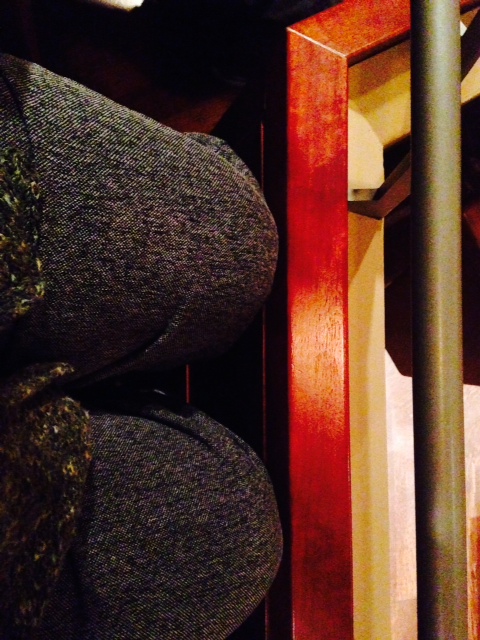
No Leg Room for a Princess

No Leg Room for a Princess

Still, the music drifted up to the rafters and the choir members sang their way out of the auditorium while holding electric candles, and we were both feeling extra Christmassy as we walked home. The flashing lights of cop cars monitoring another night’s protest were at the periphery, blending in with the other twinkling lights of the city. Everything appeared peaceable even if discontent.


The following night we went downtown with Hudge and friends of hers to experience the Figgy Pudding Caroling Competition, a yearly event in Seattle, wherein a variety of groups sing for donations that support a food bank and a senior center, and at the end of the evening the loot in the pots is counted and the “winner” determined. Though it is just a few blocks from our apartment, the streets were packed with, according to some accounts, 10,000 or more people. It was fun, in that it was nice to see so many denizens of Seattle happily bumping against each other in Santa hats, happily dropping money into buckets for a worthy cause. But it was overwhelming to my highly sensitive self. All those people! All those sounds clashing somewhere just above my ears so nothing sounded particularly melodious but more like an aural war being waged, or at least a border skirmish. The police were in full force for crowd control and also because there were rumored to be more protests (later, we learned the protestors and organizers worked out a deal since the event was for a charitable cause, so the protest happened later), but it was jarring to see so many cops at such a happy occasion. And then other little wars started happening inside of me, wherein I wanted to tell them to be safe and that I respected how hard their jobs must be while at the same time I wanted to give little smacks to the ones I thought looked most likely to be trigger-happy racial profilers. (Granted, I had no real data to determine who were the good cops and who were the potentially bad cops, but still, my brain raged to various choruses of “Angels We Have Heard on High” and I came to no solution other than to smile at anyone who made eye contact with me.)


Figgy Pudding crowd, 2014

Figgy Pudding crowd, 2014

The following day, Z and I had rented a car and found ourselves with some leftover Christmas spirit that we were uncertain how to expend. We tried eating pie, but that wasn’t enough to sate us, so at the last minute, we drove onto a ferry destined for the Kitsap Peninsula for an ill-planned visit to Poulsbo’s tree-lighting ceremony. It was so ill-planned we weren’t sure we would even make it as it was meant to happen as soon as the sun went down, and the sun was sinking rapidly as we dozed in our car, bobbing across across Puget Sound. (Ferry sleep is the best sleep you will ever have, fyi).


You may remember my earlier description of Poulsbo, the little Viking-inspired village that was founded by Scandinavians who arrived in the late 19th century for the fishing. It sits right on the Sound and has a quaint downtown with Viking murals and Scandinavian building facades and signs that are in Norse (or an English version of Norse). Z and I arrived just in time, and as we were racing down the hill to the city park by the waterfront, we saw a group of people in a wooded lot, standing around a fire in Viking headdress and furs, making plans for the ceremony. Though we knew during the day they were probably computer programmers or carpenters, it was easy enough to pretend we’d happened upon an encampment of soon-to-be marauding Vikings.


We left them where they were and continued down the hill and got to the city park, just in time to see Miss Poulsbo light the village tree. We were imagining some massive fir tree, because the trees grow big and plentiful in western Washington, but no, the tree in question was only about a foot taller than Miss Poulsbo herself, who Z briefly mistook for a snowman because she was wrapped so tightly in a white cape. We’d been imagining something much grander and briefly considered we’d made an error in choosing our evening’s destination. But there was a huge stack of wood in front of us that was intriguing and talk of Vikings escorting Saint Lucia in to light it, so we stood around with the townsfolk waiting. Compared to the night before in downtown Seattle, this group was much smaller, maybe 200 or so people, and many seemed to know each other. Some little boys dressed in skins raced around the wood and a young bulldog made friends with everyone who walked past. We’d recently binged on all seven seasons of “Gilmore Girls” on Netflix, and frankly, Poulsbo felt very Stars Hollow-esque. (Even the emcee was reminding us a little of the insufferable Taylor Doose.)


Z and I stood by the waterfront looking at the lighted houses across the Sound. And then, off in the distance, we saw flames coming towards us as the Vikings approached on the river walk, brandishing torches. (A kid behind us thought they were bringing us all giant, roasted marshmallows to help celebrate.)

Saint Lucia? Is that you?

Saint Lucia? Is that you?


The anticipation grew as they got closer and people made way for them to get to the wood that would become a proper big bonfire. As they arrived, in their midst were a variety of girls and young women, and we’d be hard pressed to tell you which one was St. Lucia, but my money is on the one with candles on her head because she looked the most regal. (The crowd surged towards the wood and we couldn’t see if Candle Head did the actual bonfire lighting, so I’m still none the wiser.)


Vikings lighting the jule fire, Poulsbo, WA

Vikings lighting the jule fire, Poulsbo, WA

Before the torches came down in unison to light the bonfire, one of the Vikings spoke about the meaning of the celebration, the importance of light reaching out in the darkness at a time of the year when the darkness is so vast. Even though it was a fun, silly sort of activity akin to going to a Renaissance Festival, I felt tears threaten because it seemed like the most apt of metaphors this dark, dark year when the world seems to be extra violent and angry and brokenhearted. Maybe this is why it is my favorite time of year despite the crowds and the way my eye starts twitching because I let myself get stressed about buying subpar presents or the guilt I feel that while I’m having a perfectly lovely Christmas, a score of people are depressed or hungry or victimized or not able to be with their families. Z, for instance, will be with me this year instead of in Zimbabwe with his family, and while I’m thrilled that we are together and thrilled that I’m destined for an Indiana Christmas, there is still a certain sadness that we are not with his people too.


But as the bonfire got higher and higher, illuminating the darkness around us (and some of the ash threatening to set those of us in nylon jackets ablaze), I was able to push those trickier aspects of the holiday season out of my mind and focus instead on the light, on the freshness of the impending new year and the possibility of the world getting brighter and kinder.


It was the best kind of holiday night. Maybe even better than a mid-December on Chicago’s wintry streets.

 

Viking winter bonfire, Poulsbo, WA

Viking winter bonfire, Poulsbo, WA


Flashback Friday: Secret World

Standard

Wednesday, October 25, 2006

[FYI, this entry covers my inaugural trip to Seattle to help my friend Z celebrate his birthday. Keep in mind, at this point, I’d resigned myself to the notion that he wasn’t interested in me as anything other than “good buddy.” I’d been in love with him for four years and the boy just would not budge.]

There’s a reason why Meredith Grey’s hair is so flat and lifeless on Grey’s Anatomy. It turns out, everyone’s hair, especially mine, is flat and lifeless here. I assume it is the weather (rainy with a chance of rain), yet it seems like that would lend itself more to frizz.

I’m here visiting my Zimbabwean. I like saying that. It makes me feel like Meryl Streep in Out of Africa when she refers to the people she makes work on her farm as my Kikuyu. He’s teaching here, and I am in his bed. Before you get notions of me, spent from a night of international passion, you should know that while I was in his bed, he was on the an egg-crate mattress on the floor of his living room.

I ruin all the best romantic scenarios I create for you by telling the truth.

My college friend Jane emailed that her eleven-year-old son came home from school yesterday and said, “I’m just starting to realize that girls have their own secret world, and it’s FREAKY!” The Zimbabwean and I laughed and laughed over that last night when I read it aloud, but I could tell he has no idea. No idea despite advanced academic degrees that we women have secret communication-interpretation skills no Navajo code-breaker could ever crack. So when you open his refrigerator and see he has two Cokes and a package of Dubliner cheese, just for you, you swoon a little even though you’ve sworn off swooning over this particular man. When you lament how awful and Meredith Grey-y your hair looks and he says, “I don’t think so” it is, after several mental contortions, the equivalent of his saying, “Your hair is as the sun shining on the Zambezi, and I wish to spend my days basking in both the glow and beauty of it.” When he refers to his apartment as “our apartment” it is as if he has said, “I want to share my living space for the rest of my days with no one but you.” When he says, “I took off the roll of scratchy toilet paper and bought you the kind that those bears use” it’s as if he said, “I love you so profoundly that I want only the very best—softness, absorbency, and four-ply bathroom experiences—for you.” In this sick, sad world, even his choosing to sleep on egg crates instead of in his own bed with you seems like a declaration of love.

Poor eleven-year-old boy. How can he ever learn to cope in a world where half the population is this indirect, this given to fancy. . . this freaky?

So, Seattle. We walked over half the city last night and so I’m reserving judgment until we rent a car tomorrow and investigate it when my feet don’t hurt. It’s nice. Lots of coffee. The people are friendly. Somehow I had in my head that it would look and feel like Vancouver, but it turns out it’s a whole different place. Yesterday, my Zimbabwean took me to Pike Place Market. While I don’t like fish and do not like to smell them, eat them, watch them, or see them manhandled by the stall vendors, it was a unique experience. Also, there is a lot there that is not fish. Like huge bundles of fresh flowers for $4, and hippies selling art, and little dogs in plaid raincoats, and jam sampling, and fudge sampling, and street musicians singing protest songs (just protesting in general, with an undertone of “This war is unconscionable” and “George Bush sucks” thrown in for good measure), and all sorts of useless crap you don’t need like Oscar Wilde action figures, “Aunt Flo’s Tampon Case,” and cardboard cutouts of William Shatner. From there, we went to Ye Olde Curiosity Shoppe, where you can buy other useless things and see oddities like mummified human remains and a stuffed two-headed calf. We took a bus to the Space Needle but opted not to go up because it cost $14 and was cloudy. My cousin G suggested I go up not because the views are spectacular or because it is a piece of post-Populuxe history, but because she didn’t go up when she visited in the spring and apparently the only thing people ask youwhen they hear you visited Seattle is, Did you go up in the Space Needle? I will wait for a sunny day. Or at least a day when there is a chance of sun.

Last night we walked up a San Francisco style hill to see his university. He wanted decorating suggestions for his office as some big wigs are coming to campus today, but it is a hopeless cause. I suggested he buy a plant and an Edgar Allen Poe action figure from Pike Market, but other than adding some doo-dads like that, it is a hopeless sea of glass and giant industrial office furniture in the space of a broom closet. While there, I met the man who hired Z, and he tried to entice me to their wine and cheese reception this afternoon. I will, instead, be buying a birthday card and maybe a cake or some gift-ish thing for Z’s birthday. Extroverts never seem to get that the invitation to spend three hours with total strangers whom you will never see again is like a prison sentence.

After that, we walked up Broadway in search of food and so I could see, as Z put it, “the freak show.” It’s a street that apparently delights in the counter-culture, so in the space of a single block you can see goths, hipsters, drag queens, the heavily made-up, heavily tattooed, significantly pierced and spiked, as well as people randomly dressed like super heroes.

Sadly, the freaks were not out, either because it was too early in the evening or two middle-of-the-week. I will have to save those human oddities for another day, though clearly I’ve got my own little freakshow happening right inside my head and don’t have to walk up any hills to get a front row seat.


Snapshots of a Summer

Standard
Alki Point, West Seattle. A beloved escape.

Alki Point, West Seattle. A beloved escape.


It’s been a summer of little rain here in Seattle. Many summers are like this and are the reason why you can’t swing a cat without hitting a fair-weather tourist between Memorial Day and Labor Day. Yesterday, we escorted another batch of much anticipated visiting cousins to Pike Market—a place we know to avoid during tourist season—and I’ve never seen it so crowded. At one point, the foot traffic was at a total standstill because there was such a bottleneck by the booth selling lavender sachets. Once people started moving again, if you dared stop to look at any of the other handmade wares, you were in danger of being trampled. We are a family of introverts, so I think all of us were thrilled when we finally pushed our way through and burst into the open. We stood in the park across from the market under the two totem poles breathing deeply and then taking tourist-style photos, because that’s what you do in Seattle on a beautiful day. (And even in the chaos of the market, my cousin did score a bag of morel mushrooms that she was clutching to her chest like Golum because she comes from a dry, mushroom-less place.)


I don’t know who is running the rest of the country because everyone seems to be here. Two weeks ago, Z and I rented a car and decided to take our favorite drive down Lake Washington Boulevard, only to discover we couldn’t because President Obama was in one of the fancy houses there on the shore of the lake, doing a little fundraising. The place was on lock down with lots of barriers and a strong police presence. Before moving to Seattle, I can’t say I ever had an opportunity to glance at the POTUS limousine, and now at least twice a year, if I stand on the right corner at the right time, I can flash a peace sign (or a thumbs up if he’s had a hard week) at the Commander in Chief.


So I spend a lot of time in summer marking off the days until the strangers who have descended here go home and the still-crowded city becomes more habitable. But then suddenly—because the cousins were arriving, because I knew I’d be going home to Indiana soon, because the temperature and the sunlight were just right—I fell completely and utterly in love with the city. It’s a fleeting love because I am a fickle woman; I know that. I care deeply for Seattle, yet it will never be my soul mate, like a Chicago or a Galway. But I’ve had a couple of perfect weeks where I’ve spent more time delighting in summer in the city than I meant to. And because you hear me whine too much  about this city I  have fond feelings for, I thought you deserved to see a few random delights.

A local gardener attempts to make the place more colorful.

A local gardener attempts to make the place more colorful.


This woman had the brightest, yellowest hair I’ve ever seen and she was working on a little corner garden near the grocery where Z and I walk a couple of times a week. When you live in a neighborhood of apartment buildings, seeing this sort of suburban domestic scene with urban flair is a joy.


Seattle First Baptist Church

Seattle First Baptist Church

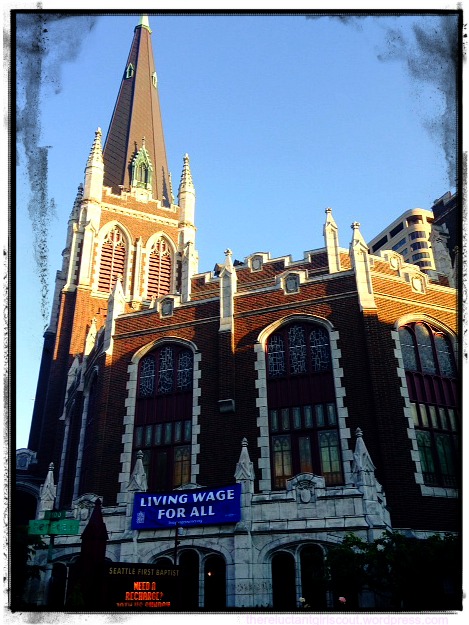
This church spire in our neighborhood always makes me happy. It’s especially beautiful at night. One of the things I love about it is that it makes me feel a certain level of humility/shame because for the first two years we lived here, when we walked past it, I would sneer at it as I made assumptions about what the people inside believed. I was once terrified (and, let’s face it, oppressed, because I was a girl) in a church of this same denomination as a child. But it turns out I was the one being judgmental because this church was the first in the city to marry same-sex couples free of charge when it became legal in Washington to do so. Before that, they hung out rainbow banners about acceptance, insisting that all were welcome. Currently, they have a banner out demanding a living wage for everyone. It is a church committed to social justice, and therefore, a church that makes me feel hope. So whenever we walk past it, it’s a little poke at me to remember to remove the plank from my own eye before I go kvetching about the splinter in someone else’s.


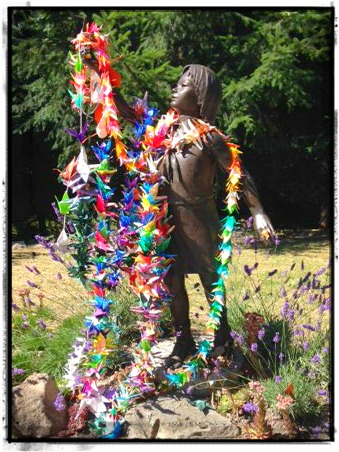
Peace Child Statue, Seattle

Peace Child Statue, Seattle

This statue entitled Peace Child draped with paper cranes stands overlooking Portage Bay where it spills into Lake Union. We drive this route a lot and I’ve never seen it, but because we were on foot one day, (and I was growling about our lack of car) we caught a glimpse and stopped to see her. I love surprises like this.


University Bridge

University Bridge

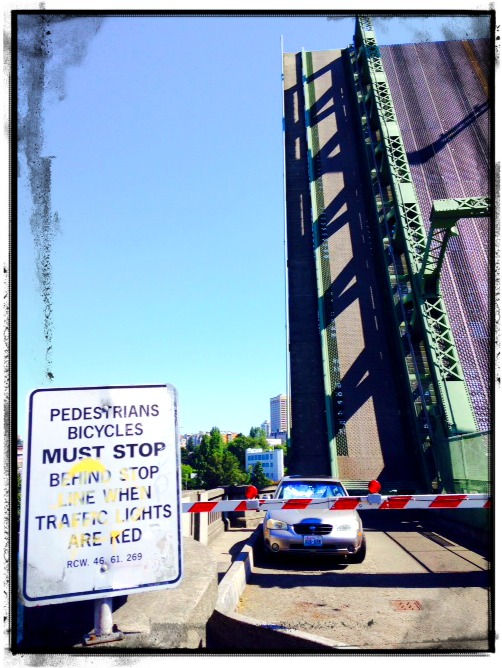
On the same walk, Z and I had to stand and wait for the University Bridge to go up to allow a sailboat to pass through into Portage Bay. We stood on the bridge and looked out at all the activity on the water, and it was hard not to feel lucky to live in a place where bridges aren’t static and water abounds.


Deck, Eastlake Bar & Grill, East Lake Union

Deck, Eastlake Bar & Grill, East Lake Union

After our walk, we ate at Eastlake Bar & Grill, which has, arguably, one of the best outdoor decks of any place in the city. The views of Lake Union are excellent both from the deck and inside the restaurant and the food and atmosphere is good too. When G was here in June, we ended up eating here three times because, well, look at it!


Market Pig

Market Pig

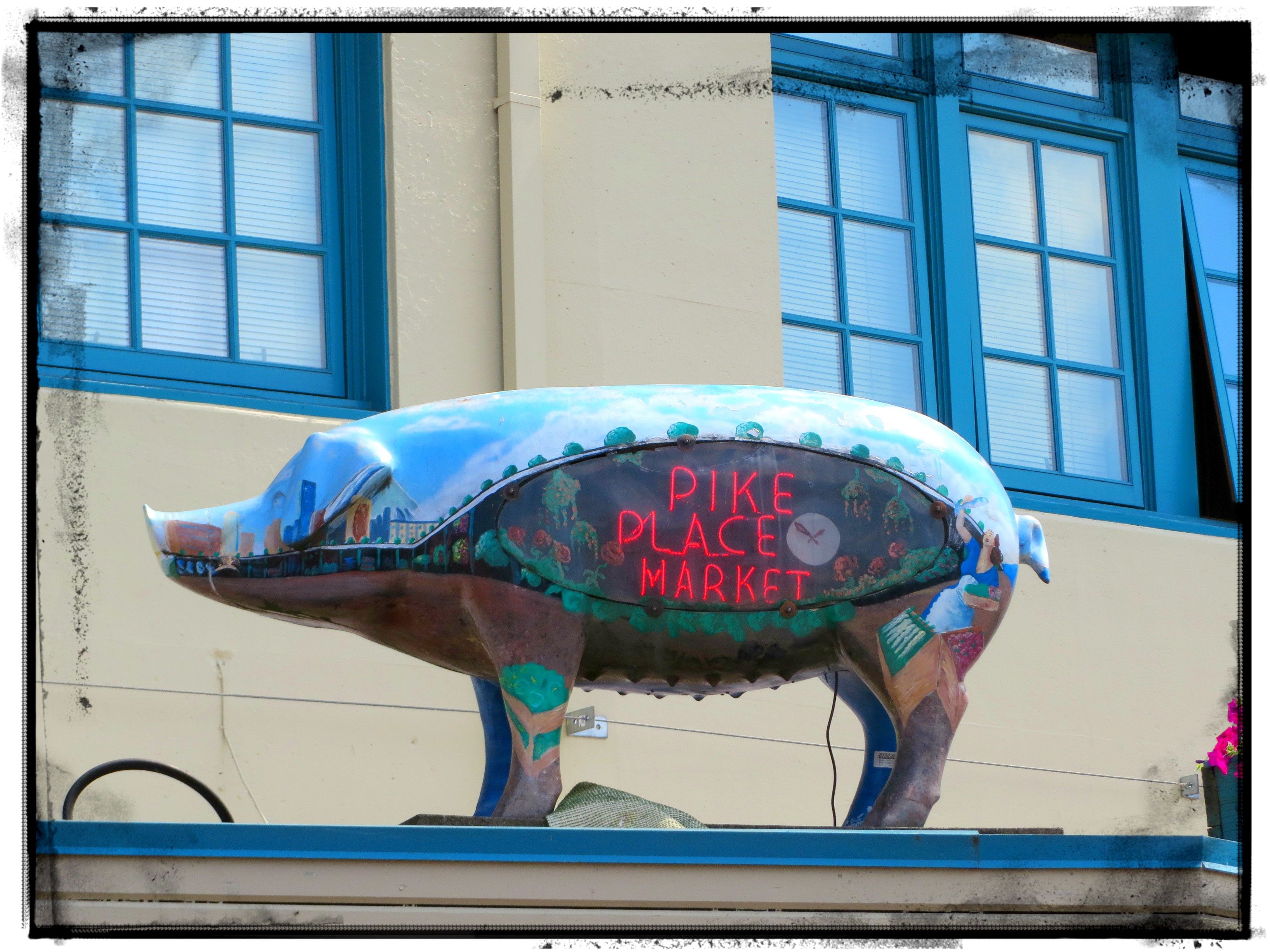
When Z first moved here, there had been one of those competitions—like there are in a lot of cities with different animal shapes—called Pigs on Parade to kick off the centennial celebration of Pike Market. (Rachel the Pig, a big metal piggy bank sits outside of the market and is oft photographed.) So my first days in the city were punctuated with different colorful and clever pigs. (I particularly liked the chocolate one in front of the Chocolate Box.) While the cousins were here, I saw this one still hanging out on a roof near the Market and it made me feel all warm inside, remembering the early days here with Z.


Baroness, Best Neon Sign in All of Seattle

Baroness, Best Neon Sign in All of Seattle


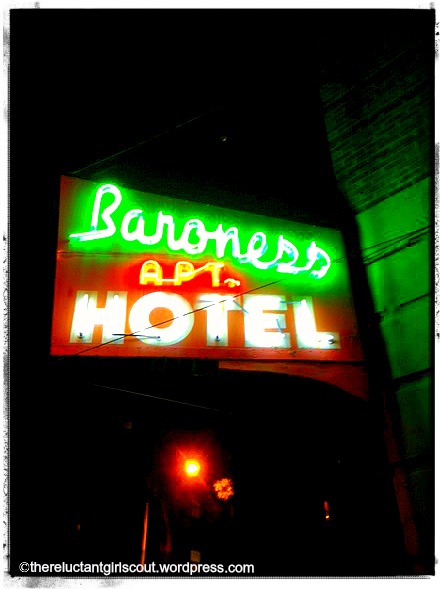
This is my favorite neon sign in all of Seattle. There are many in my second place list, but this one is on top and is up the hill from where I live so I see it regularly. It’s a little residential hotel across from a hospital. I appreciate that the hotel hasn’t felt compelled to install a more subdued, tasteful sign.


Photo 452 of the Space Needle

Photo 452 of the Space Needle


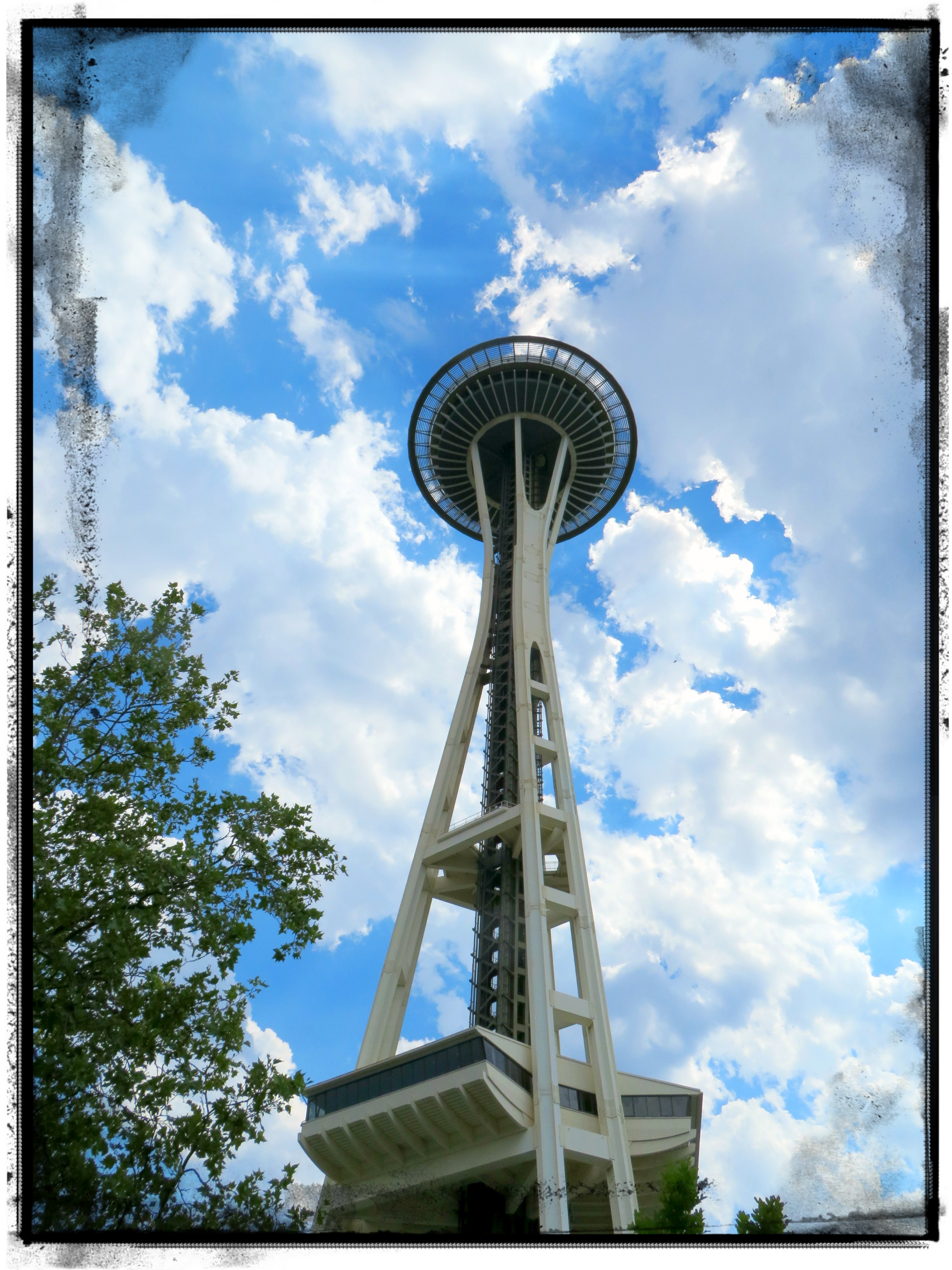
When friends of mine who’d been living in New York City moved back to Indiana, one of their last purchases (if I remember the story rightly) as they bugged out of the city that had just been traumatized, was a little replica of the Statue of Liberty that took up residence on the mantel of their new house in Indianapolis. I loved seeing it—that integration of their old life and their new one. A sort of symbol of the few years they’d lived in an iconic place during a (sadly) historical moment. If Z and I ever leave Seattle, I think a statue of the Space Needle—probably one constructed of Legos—will decorate our life wherever we land. Seeing it—even on days when I’m homesick—never doesn’t make me happy. Is it an overpriced tourist icon unworthy of my affection? I don’t care. I love the history and aesthetics of it, including the weird, steampunk-ish elevators that look like they belong on a completely different structure. I love this weird human drive to build a huge, elevated viewing platform (see Tower, Eiffel) to celebrate a spectacle like a World’s Fair, and I love that we live in a city that has such a place on its landscape.


For me, it isn’t about going up the Space Needle to look out, it’s about seeing it when the skyline comes into view as we drive up I-5 from the airport after a few weeks away, or when we’re taking the ferry back home or when we’re driving back into town from a trip north. There it is, looking all optimistic and otherworldly and a little…delicate, marking “X” on the map of our life.


Capitol Hill in the rain

Capitol Hill in the rain


And finally, after many weeks of sun, there was a torrential, Midwestern-style rainstorm. Z and I worked at his campus and stopped periodically to look fondly at the blurry outlines of cars and houses, and teasing ourselves with the promise of damper, less crowded days. When we trudged home past our favorite bits of the neighborhood, it didn’t occur to us to complain.

Flashback Friday: Little Brownstone on the Prairie

Standard

rgsroom

[Oh, the irony of this post from eight years ago, particularly when bumped against the one from earlier this week.]

 15 July 2006

Last night I was feeling “troubled” about my silly life as I went to sleep, which is a fairly frequent occurrence. Usually the troubledness has to do with my age, my living situation, my marriage/partner/dating and motherhood status. Other things get factored in based on the latest magazine article I’ve read or Dateline exclusive I’ve watched. Last night, after messing with a picture shelf my mother and I were hanging above my desk and trying to figure out which of my 20 works of art I was going to hang on the little hunk of wall that is left in my room, I was feeling particularly freaky. I have friends who are bitter because their houses aren’t brand new and don’t have granite countertops or swimming pools or room for a home office, but all of them have managed to get more than four walls to hang things on.


This isn’t about some people being luckier or having more than me. I know if I wanted to make it a priority I could maybe get myself eight walls, so I’m not talking about jealousy here. If I wanted to give up the frequent flying and the handmade furniture and the Sundance catalog jewelry, I could buy a little house and hopefully have enough money left over to pay a boy (preferably a shirtless one) to come and do things for me like hang picture shelves. I could.

Anyhow, I woke up this morning, looked at all my stuffed-full bookshelves and realized, I’m living in a brownstone circa 1945. I always imagined living a writer’s life in a big city where I couldn’t afford anything but a bedsit so all of my worldly possessions would be in the one room, and for reasons that are unclear, I always imagined doing this in the post war era. And now I realize that’s what I’ve got. Only without the city, without radiators (thank you, Jesus), without loud neighbors, and without a book contract. I AM Helene Hanff. I am whatever the bookish sister’s name was in My Sister Eileen. I just can’t go walk my dog in Central Park (partly because I don’t have my own dog), and I still have not developed a taste for coffee and cigarettes, both of which figure prominently into my 1945 brownstone fantasy.

Also, in this fantasy, I have a throaty laugh and I know how to dance.

I really am amazed by people who figure out how to settle into a place. At almost 40, I’m still trying on locations for size. For instance, I now know I do not want to live in Aspen, even if I do become a billionaire. In fact, you can scratch ‘anywhere in Colorado’ and ‘the Rockies’ right off the list of possibilities. It’s gorgeous there. The quality of life is good. I understand the fervor of John Denver’s Rocky Mountain High, but it is not my place in this world. There is too much sun and too many people happy to be outdoors, risking their lives on guardrail-less roads, in treacherous rapids, and while battling wildfires.

While I was at Aspen Summer Words, my friend Heather drove me up Independence Pass so I could see the Continental Divide. On the way up I told her how beautiful the landscape was and she said, “I know. When I see these mountains my heart just opens right up.” My heart wasn’t opening–not for those mountains–but I liked the emotion with which she spoke. It’s how I feel about the West of Ireland, Chicago, East Tennessee, London. There are places you belong and places you don’t belong and I live in fear that I’ll accidentally end up in a place where I don’t belong, where my heart not only won’t open up but instead will seize because of the ugliness or inhospitably of the people or landscape. For instance, the two hours I was waiting for my return flight from Phoenix, I kept thinking, “This is a dead place. People aren’t supposed to live here.” Yet people do. And some people love it. My grandparents loved it. But they sure didn’t pass those genes down to me. (Nor the genes that would make camping seem like a good idea, for that matter. Nor the ones that would make me good with money or able to cook.)

When I figure out how to get myself to 1940s Manhattan, I’ll let you know.

Curmudgeons in the City

Standard
Not Treme. The French Quarter.

Not Treme. The French Quarter.

It got a little warm in Seattle this past week. There was virtually no humidity and were it in the 80s in Indiana with no humidity, it would be considered a nice summer’s day, but here, it is too hot. I believe you are familiar with my policy on summer and heat.


Few people here have air conditioning because it’s needed so rarely, and those who do don’t use it right, which leaves a girl clammy and gasping for breath. How we know it is hot in our place is if we have to open the bedroom window, which remains shut about eleven months out of the year because evenings here are generally cool. It’s been a week with the window open.


Our bedroom window is next to the intercom for the building. When Z moved in, the old intercom was loud and made horrible honking noises, so we were excited when they replaced it, but the new one is worse. For no good reason, it makes an electronic beep—like an alarm trying to wake you—as a guest scrolls through each name trying to find the person she knows. Beep, beep, beep, beep, beep. And then, finally, blessedly, the sound of a phone ringing and the longer beep that lets the person in. Most of the visitors seem to be friends with people whose last name begins with V and the names are sadly listed in alphabetical order, which means a whole lot of beeping. It’s a very inefficient system both for the buzzee and for the people trying to sleep next to the buzzer. In the winter, it’s just kind of a distant mosquito wing of a sound, but when the window is open, the intercom might as well be attached to a bullhorn.


The surprise of this summer when I opened the window for the first time to prop the fan in it was that our screen was missing. I have this idea that someone who wanted a screen performed some acrobatics to jerk it out of our crooked windowsill. Z has this idea— and probably the correct one because his world view is less dark and twisty than mine—that the screen became loose, fell out, and the maintenance woman removed it from where it fell. We have one of those accordion-style fans that sits in the window, so it’s sort of like having a screen, but I swear, it makes everything outside even louder because we’re down one layer of mesh between us and the noise of the city.


Z and I have been binging on Treme episodes this past week. We are late coming to the show, so there won’t be any spoilers here, wrecking anyone’s goodtime. While watching it, I’ve been feeling envious of the folks in the show, which is no mean feat because post-Katrina New Orleans where the series is set was no kind of place to be. But there is something about the uniqueness of New Orleans and all that place-specific culture that makes me extra envious. They have a parade, I feel envious. They eat a bowl of gumbo, I feel envious. They have a jazzy funeral procession, I feel envious. I didn’t eat gumbo when I was in New Orleans three years ago, I don’t particularly like jazz, and a funeral, no matter how festive, is still sad, so I’m not sure exactly what I’m envious of other than this very specific sense of belonging and culture that seems to come from the location. You’ve heard me whine about Indiana and how much I miss it, but a lot of the things I miss from there would be the same in Ohio or Northern Kentucky or Illinois. I can’t even get ten Hoosiers to agree with me that John Mellencamp is a better musician and lyricist than Bruce Springsteen. Z is used to having students who hear him and say, “I wish I had an accent” or who say, “I wish I had a culture” and he always laughs and points out to them that they do have accents, they do have a culture. At the risk of sounding like one of his students, when I watch Treme, I feel the same way. I wish I had a specific, discernible, place-specific culture.


For those of you who don’t know, much of Treme is set in a neighborhood of the same name that is musically and culturally rich. It’s a cacophonous place where you shouldn’t plan to find peace and quiet. There is music. There is hooting and hollering. There is life being lived, loudly. In one scene in the first episode, Steve Zahn’s character, Davis McAlary, a New Orleanian musician-cum-dj, turns his speakers outward to blast his neighbors, a couple who have recently moved in to gentrify the neighborhood and whom, he believes, have called the cops on him. He gets in an argument with the couple about the justification of the noise, explaining everything he believes they don’t know about the neighborhood they’ve moved into. He says to them, “You’re living in the Treme. Gotta deal with that shit.” Because we like the character and we are suspicious of all the ways our own neighborhood has “gentrifically” changed in the eight years since Z moved in, we both felt a sort of righteous kinship with Davis and his speech. That’s right. The city is about tolerance of other people. Amen, Davis.


And then later that night, the people sitting on the stoop right outside our bedroom window showed no sign of moving their party indoors. It’s a favorite place for our young neighbors to hang out with friends, smoking the cigarettes they don’t want stinking up their apartments and talking animatedly as they sip on beer, stroking their own neck tattoos thoughtfully while they solve the world’s problems. It’s mildly annoying at 10 p.m., but at 3:30 a.m. on a Sunday night, it feels criminal. So Z pulls on his relaxi pants and stuffs his feet into his Crocs and shuffles out to the front door to tell them, very dad-like, that it’s time for their party to move indoors or quiet down. They apologize and start whispering, which was, frankly, not the scenario I was imagining after hearing Davis blast his neighbors for being uptight fuddy-duddies.I thought, perhaps, there would be vocal retaliation.


The next day, Z and I walked down to the waterfront. It was a gorgeous day, as most days in the summer are. Blue, clear skies. The Olympic Mountains showing themselves in ways they rarely do in winter. Everyone happy not to be under an umbrella, avoiding puddles. But it was hot. And there were so many tourists, gawping in the middle of the street, so we had to navigate around them as if it were an obstacle course. People were hacking and spitting and riding skateboards right in front of us. Everyone seemed dirty and sweaty and loud. I complain too much about Seattle, particularly to Z whose general dispensation is about ten clicks more content than mine, so I was determined not to whine about how much I hate the city in summer, how much I hate not having a car so we can escape it when we want, how much I think if I hear one more siren or horn honk or late-night howl from a drunk that I will lose my mind. So I sweated and huffed and puffed as we started our assent up the hill to home. A man we passed hawked a loogie on the pavement in front of us.


Z looked at me and said, “I’m not loving the city today. It occurs to me, that we would not be happy living in Treme.”


I’ll probably always get a thrill when I hear John Boutté’s Treme Song playing. I’ll always have this idea that if I lived in the Crescent City I’d embrace it and feel fully alive there (and those four years studying French would finally kind of pay off). But the truth is, I’m thinking we need to start buying more lottery tickets so we can have a small fuel-efficient car and an island house where we can spend quiet, peaceful weekends. Some place with screens and neighbors on our distant margins.


A Cure for the Simple Life

Standard

rgsdesk


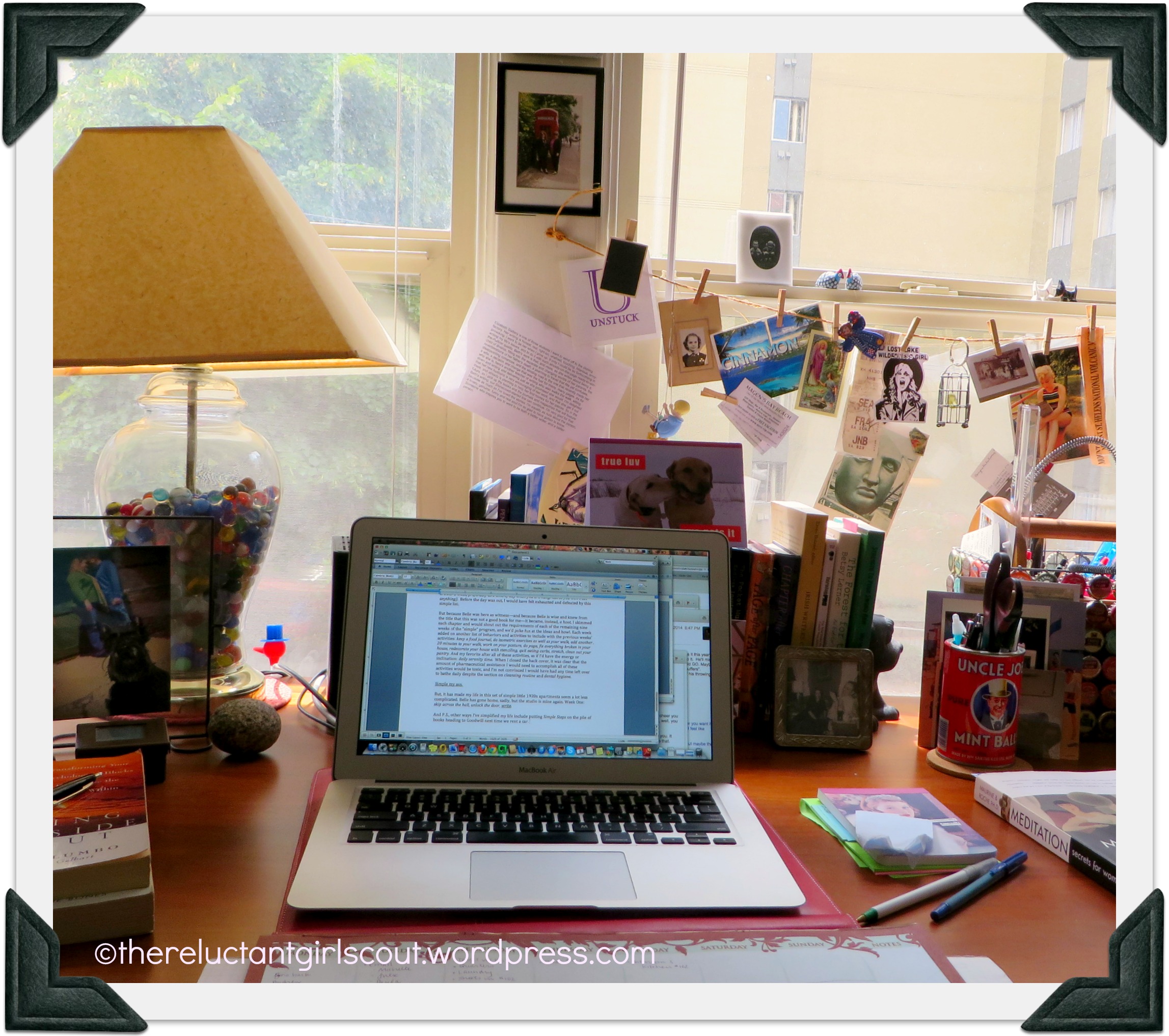
When we got engaged, we looked at two-bedroom rentals within walking distance of campus because we needed more space than Z’s little 1920s one-bedroom apartment offered. With his three pieces of Craig’s List furniture and five batik wall hangings from Zimbabwe, the place looked spacious, but I come with a certain amount of baggage. I wasn’t prepared to begin a new life in a new city without my precious things: Amish-built furniture, objet d’art, childhood sock monkey, a herd of bulky Irish sweaters (too hot to wear in Seattle, fyi, but I like having them available should the weather take a turn), and the cloud of paper that follows me wherever I go, like Pig Pen’s dust. If we had stuffed all of my things into his apartment, we would have instantly been candidates for Hoarders: Newlywed Edition.


I loved Z’s apartment. Loved the woodwork and the big bank of windows overlooking a shady tree, how it felt to live smack in the middle of things, but most importantly, I loved its oldness, its crookedness, its sense of history. I imagined a bevy of nurses living here in the 1930s, walking to work at one of the many hospitals here on First Hill. I imagined what it might have been like for them to look out our windows and down to Elliott Bay, a sight we can’t see now because of a high rise full of partying youth that sits between us and the ferry-laden waters. It seemed like a simpler time, and I liked being in Z’s apartment pretending we would be living a simpler life together.


Neither of us are that strong at math, but when the apartment across the hall from his became available, it didn’t take a genius to figure out that it was cheaper to rent an entire bonus apartment in an old building whose only modern conveniences are electricity and running water than it was to rent one of those new, two-bedroom places with leather furniture and cappuccino machines in the lobby, triple-paned glass, walk-in closets, dishwashers, and personal washer-dryers that aren’t shared by the building’s inhabitants in a basement that some days smells like Satan’s backside. We decided immediately that the apartment across the hall would be a writing studio for me, a place to keep our newly acquired Kitchen-Aid mixer for our “baking center” (a use that had “failure” written on it before I ever tried my first batch of cookies—I’m not that strong a measurer, and it turns out a ring on a finger does not instantly make a woman domestically inclined), and guest quarters should family or friends decide to trek across the globe to see us. My only concern was that should Immigration Services ever get wind of our two-apartment lifestyle, they might make assumptions about our marriage that are untrue. (Though if they stopped by for tea and saw how often the bonus apartment is used as a storage facility, then they would believe! It is often nearly uninhabitable because of picnic gear, off-season clothing, stacks of finished books waiting to find homes, half-finished craft projects, and the other detritus of our life together. Plus Hudge parks her bike there when she rides over for a visit.)


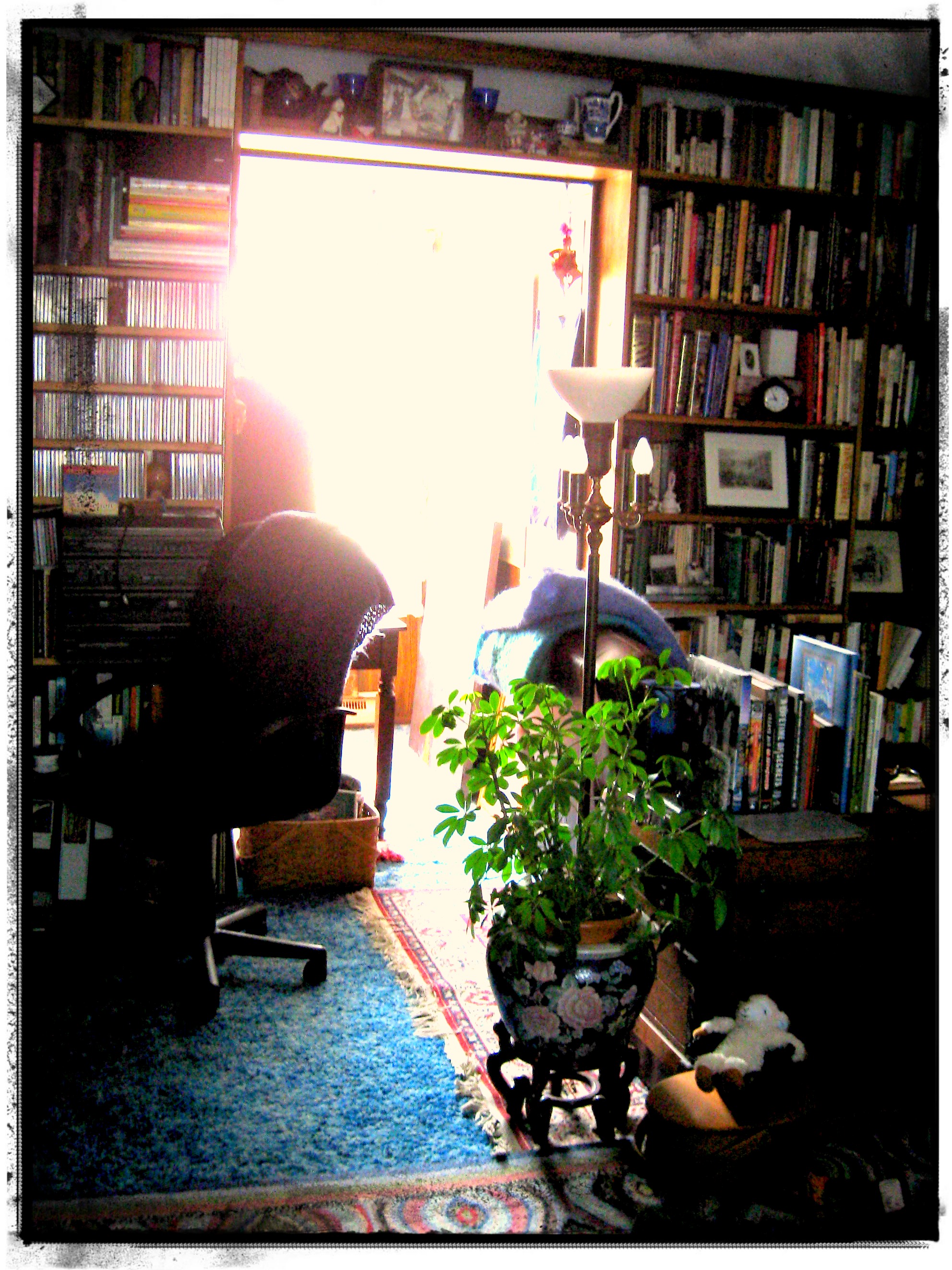
The problem with having two living spaces separated by two locked doors is that often I simply forget to go to the other space. The apartment where we live our lives is like a Nest of Inertia, and I often find it nearly impossible to lift myself off the sofa and walk across the hall to write at my desk, as if there are 100 lb. weights holding me down. I have this idea in mind that if those locks did not exist, I would wake up every morning and skip across the hall, plop down at my desk, and write for a giddy eight hours before skipping back “home” to greet Z when he returns at the end of the day. Instead, I think about going to the studio. I think about the light I love and how much I want to be there at the desk, and still, I sit under the weight of the identical apartment that feels more like home. It seems lonelier in the studio that has less of Z in it, which makes no sense. Both apartments are empty—Z is at work. What’s more, I LOVE my writing space. I feel like myself—my pre-married self, my childhood self, the self I was before I was born—when I am at this desk, yet too many days I deny myself the joy of being here and instead curl up in a ball on my corner in the Nest of Inertia and write. Or worse, I don’t write and instead just think about writing and hate myself a little. Or even worse still, I don’t write, don’t think about writing, and instead, invent things to do that have nothing to do with writing at all, like reorganizing the cutlery drawer.


There is no time I like my writing studio more than when we have a house guest who takes up residence in it and so being in it to write is no longer a viable option for me. My brain becomes electric with ideas. My fingers physically ache to be on a keyboard that is sitting on my desk. The books that surround the desk suddenly feel like all the books I should be reading right this minute. I’m very nearly jealous of our guests because they “get” to live in a space that I have access to  every other day of my life but too often ignore. Their presence, perhaps, frees it from being a lonely place where I am meant to face myself on the page every day and suddenly becomes a vacation getaway, where my ideas suddenly seem 100% more creative. The guests sit on the sofa, and I sit in my desk chair, spinning around while we talk, noticing things on which my eyes would not even land if this were one of my solitary writing days.


Last week Belle was here, and we spent time in my studio talking about her latest poetry manuscript and the pile of papers I’m trying to turn into a memoir if only the fog would clear in my brain. While we talked, I spun and scanned like a cheeky six year old sitting in Daddy’s Office Chair, feet off the floor, twirling. The chair would slow and I’d zero in on a particular book I felt a need to steal away from Belle’s domain and drag back to my lair across the hall. One such book was one I bought exactly 24 hours after declaring to Z that I would never, with God as my witness, buy another self-help book again. It is called Simple Steps, and promises on the cover that in ten simple weeks you can gain complete control over your life. It joins a host of other books that promise peace of mind to the Highly Sensitive INFP #4 Child of Divorce who is also an Anxiety-Ridden, Meditative, Mystic Disorganized Writer with big plans to start and maintain an illustrated journal. But this one—only TEN weeks to a healthy, more organized, thinner, stronger, de-cluttered, spiritual lifestyle?–who wouldn’t want that?


I remember when I bought the book three years ago, Z just shook his head in amusement. Not only was I already back-peddling on my no-more-self-help-books proclamation, but we’d just gotten married and while Z knows I’m not perfect, he really does not understand why I’m constantly trying to change these inherent parts of my personality. I’ll never be particularly tidy. I’m never going to be the housekeeper my mother is. I’m always going to nod off when I try to meditate. Why can’t I just accept myself the way he does?


Who knows. Each self-help book is like a little bundle of hope about the person I could become.


Had I been alone in the studio when I re-found this as yet un-read book, what would have happened is I would have started another journal with the plan of changing my life. I would have spent the first week following the authors’ simple steps (Week #1: drink 64 ounces of water a day, walk 20 minutes a day, save $2 a day, and clean out a drawer a week, preferably at a time of day when you are hungriest so you won’t eat anything). Before the day was out, I would have felt exhausted and defeated by this simple list, probably while I was drinking a Coke, and sitting amidst the contents of a half-decluttered drawer.


But because Belle was here as witness—and because Belle is wise and knew from the title that this was not a good book for me—it became, instead, a hoot. I skimmed each chapter and would shout out the requirements of each of the remaining nine weeks of the “simple” program, and we’d poke fun at the ideas and howl. Each week added on another list of behaviors and activities to include with the previous weeks’ activities: keep a food journal, do isometric exercises as well as your walk, add another 20 minutes to your walk, work on your posture, do yoga, fix everything broken in your house, redecorate your house with stenciling, quit eating carbs, stretch, clean out your pantry. And my favorite after all of these activities, as if I’d have the energy or inclination: daily serenity time. When I closed the back cover, it was clear that the amount of pharmaceutical assistance I would need to accomplish all of these activities would be toxic, and I’m not convinced I would have had any time left over to bathe daily despite the section on cleansing routine and dental hygiene.


Simple my ass.


But, it has made my life in this set of little 1920s apartments seem a lot less complicated. Belle has gone home, sadly, but the studio is mine again. Week One: skip across the hall, unlock the door, write.


And P.S., other ways I’ve simplified my life include putting Simple Steps on the pile of books heading to Goodwill next time we rent a car.


In Praise of a Rainy Memorial Day Weekend

Standard
Lake Washington, Seattle

Lake Washington, Seattle


I once had a student who claimed to be psychic tell me that I had a problem with jealousy. “You’re a jealous person,” she said. “You should work on that.” I stood in front of her gawping, trying to imagine a scenario where I might have given a college prof unsolicited psychic advice. But then again, I’m not clairvoyant.


I wanted to give the student an automatic D for cheekiness but quickly banished the thought before she could intuit my intentions. She was, after all, a good student. Even if she had it wrong.


I’m not jealous so much as I am given to small fits of envy, which is, I think, an entirely different animal. Jealousy makes you scheme and plot and try to steal things away from other people that you want and believe to be rightfully yours. Envy just makes you miserable because you have this notion that you are lacking something other people have managed to provide for themselves.


For the last several years, basking here in Z’s love and all of our glorious freedom and good times, a lot of the things I used to be envious of don’t even phase me now. Someone gets a new house? Good for them! Someone has a new baby? How exciting and life affirming! Someone goes on vacation? What was it like? Someone gets a new dog? When can I see it, please?


But then a summer holiday like last week’s Memorial Day rolls around, and my green eyes get greener. On any given day when Z and I are sitting beside Lake Washington in our relaxi chairs, reading, I’m happy. Any time we score an hour or two on Hudge’s houseboat on Portage Bay, I’m pretty content. But if it is a summer holiday, I can only assume that everyone we see is with family or a big group of old, close friends, cooking out, playing croquet, sailing. Living some version of the American Dream that I’ve failed to provide for myself.


It didn’t help this year that I came home from Indiana feeling six degrees more homesick than usual. And I was already crabby because of the weekend-long, self-congratulatory posts on Facebook that imply the poster knows how to patriotically observe Memorial Day (which they believe is three days long), while I must surely be an ingrate who needs reminding and barely deserves my American citizenship. It also didn’t help that I’ve had a stomach thing going on that’s had me on the world’s blandest food for two weeks.


It really, really didn’t help on Saturday when Z and I tried to go to Golden Gardens, one of our favorite city parks with gorgeous views of Puget Sound, only to discover the parking lots were full and the place was crawling with people who had a similar idea. (We were reminded of the time two years ago when we took my mother there for a quiet picnic in a stand of trees by ourselves, only to soon be surrounded by fools balancing on slacklines and blocking our views, hula hoopers gyrating in front of us, and, I kid you not, someone with fire batons that they tossed in the air dangerously close to us. It was as if we’d accidentally set up our picnic blanket in the middle of a circus.) Last Saturday, as we drove around hoping to score a parking spot, Z and I looked at each other and one of us said, “I forgot how much I hate summer in Seattle,” and the other one concurred. It’s a refrain we’ll be repeating until September, especially when the cruise ships roll into town, crowding things up even more than they already are.


And so I thought about how if only we were in Indiana (though not by the Speedway where the Indy 500 would be running) we wouldn’t have to jockey for a park bench and we could rest our eyes on a landscape not littered with humans. My homesickness was compounded.


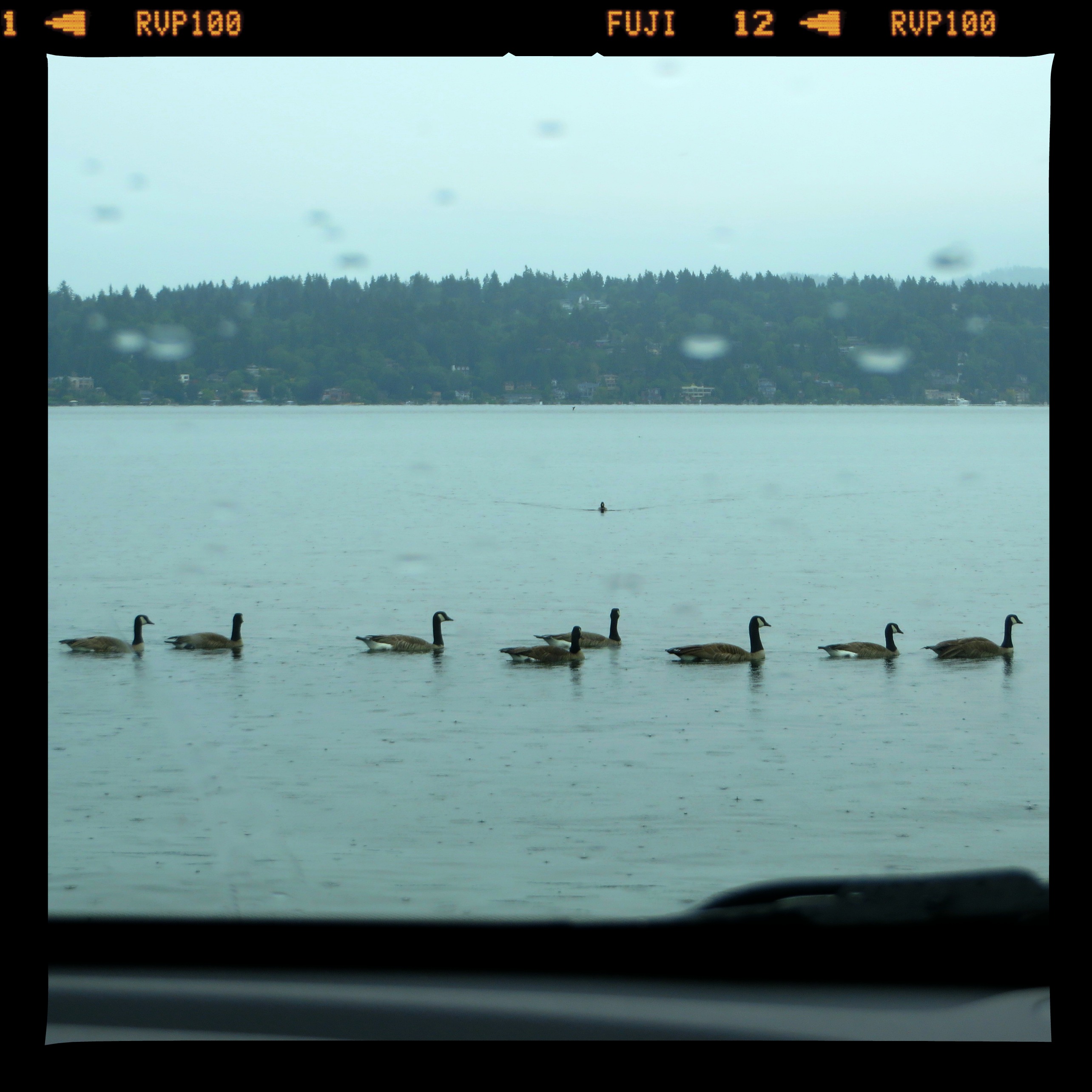
On Sunday, when I woke up to one of those hard rains that had set in for the whole day, the corners of my mouth twitched into a small smile. When Z and I decided to drive to Lake Washington and we did not have to dodge any cyclists or fight for a parking space, the smile got larger. We parked at a boat dock, where no boats were bothering to venture out so miserable was the day, and we sat listening to the rain on the roof of our rental car. We watched a gaggle of geese, wave patterns, a soggy Labrador being walked by his soggier owner. I napped.


There was a tiny, naughty part of me that delighted in the notion of other people’s fabulous plans being ruined, but I instantly felt a smidgen of guilt and did quick penance of saying to no one in particular, “Sorry about your plans.”


No. It wasn’t a good day because other people’s plans were ruined; it was a good day because there were no expectations by anyone, including myself, that the day should be more fabulous than it was. There was no reason for envy.


And the rain on that roof was so soothing.


Where Beauty Goes to Die

Standard
Ugliness.

Ugliness.


Where I grew up on the edge of Old Richmond (before the neighborhood had “Old” attached to it or fresh coats of paint slapped on the brick cottages and Italianate two-stories to make it seem like an enchanting destination), there were century-old houses in various states of disrepair depending upon the age of the residents and whether they rented or owned, and attached to these houses were long narrow-ish backyards. The yards often had some sort of fencing to delineate one from another, or, in some cases, just forsythia bushes or shrubbery. Our yard had a high wooden fence with alternating boards that made it nearly impossible to look out, though you could press your eye to one of the slats for a narrow peek at the alley that sat behind the yard.


I wasn’t allowed to run wild, so my primary exposure to the alley were these peeks, or watching Mom carry our trash out once a week as I stood on a chair and looked out the kitchen window because I wasn’t wild about her being out of my sight. On maybe two occasions I crossed the alley into the backyard belonging to some neighbor kids who had an elaborate swing set, but because I was an introverted kid, I never really understood the thrill of playing with my peers and preferred instead my books or lurking on the edges of adult conversations, taking notes for future reference of things that really mattered. Plus, Mom never seemed too happy about me taking those few steps across the alley from the safety of our yard to the unknown dangers in the yard of the Joneses. (And there were neighboring dangers.)


So the alley mostly remained a mystery.


As a kid, I didn’t quite understand that the backs of the houses were connected to the fronts of the houses on the next block, so the kids that were growing up on South 8th, to me, were from a whole different neighborhood than I was on South 7th, simply because their houses faced a different avenue. If I started thinking about how our across-the-street neighbors, who seemed much closer than our across-the-alley neighbors, had a whole different set of alley neighbors than I did—people completely unknown to me—well, it was probably as close as a six year can get to tripping on acid. I didn’t need to travel to France; the world seemed vast as it stretched past the borders of our second-story apartment.


It wasn’t until I was much older and had friends who started moving into subdivisions with gorgeously manicured lawns whose ambience was wrecked by the presence of utility boxes or garbage cans out front that I realized what purpose an alley had served and the glorious city planning of yesteryear, creating a warren of pathways in which all the ugliness of human habitation could be hidden. Why would such a wonderful plan be abandoned? Now, unless you live in one of these neighborhoods from the 19th or early 20th century, everyone knows what you got for Christmas when you haul your overflowing Rubbermaid rolling garbage down your drive on December 26th (and they are judging you for using non-recyclable gift wrap).


Then I moved to Seattle, and because our apartment building is perched on a hill, it often makes more sense to enter the building from the alley, so I’ve grown more familiar with it. Because we share it with a hotel that has a restaurant we can’t afford in it, we sometimes open the back door only to find we have to squeeze past a produce truck to get where we’re going. On cold days, one down-and-out guy might be seen warming himself by the hotel vent, his hood up and cinched tight around his face to keep out the rain. We might say hi to each other. One day, I gave him a donut. But usually the inhabitants of the alley are hotel employees, standing around on their breaks, talking animatedly, maybe smoking a cigarette or texting, looking a little sad that they have to go back in for the remainder of their shift.


Until recently, we had a building manager for whom we had some real fondness even though she was odd. She once banged on our window at one in the morning because she’d locked herself out after chasing a surly character down the street who was loitering too near the building. Her apartment in our building was at the back, overlooking the alley. I read some reviews online that talked about how insane she was, hollering out her windows at people rummaging through the dumpsters, chasing people away. While I never witnessed it first hand, it didn’t sound like behavior outside her wheelhouse.


I hadn’t connected these online rumors with the nearly pristine nature of the alley back then, but the first three and a half years I lived here, walking through our alley was little different than walking on the street in front of our building. Though I wouldn’t choose to use it at night alone—mainly because I wouldn’t want to be surprised by someone who was taking shelter from the rain in the covered space where our trash bin resides—I had no opinions about the alley. It was just the quickest route up the hill.


Then, mysteriously, our building manager got replaced by someone younger and more polished. She has a college degree and a poodle and very classic fashion sense. Suddenly, our building has lots of “welcome neighbor” signs dotted around the common areas, though if you bump into her, she either blinks at you like she isn’t even sure you are a tenant or she turns her head to avoid conversation entirely. Her first sin against us was charging us a late fee for underpaying our rent for three months even though she’d never told us our rent had gone up. (It was the holiday and our powers of intuition weren’t up to snuff.) Even so, I’ve been trying to remain neutral about her until more data can be collected. She’s young, I keep telling myself. She’s just learning the job. And then she ignores us when she passes us on the street and I purse my lips.


Other than the new hallway art and area rug and the random monthly newsletters we get with generic health and shopping tips, the only real change I’ve seen since she arrived is the quality of the alley. I can’t imagine “police alley of all misbehavior” was anywhere on her job description and she doesn’t look the sort to chase down any unseemly types wreaking havoc there (nor does her poodle, for that matter), but now at least half the time I leave the apartment I’m greeted with someone standing in the trash, hip deep, digging for treasure. At first I thought it was one of the many homeless people and I chastised myself for feeling annoyed by this. But then I noticed the shoes on one who was hanging over the edge of the bin looked a little too hip. The Levis a little too fresh. These were just dumpster divers. On the one hand, I want to applaud them for finding uses for something someone else has declared useless, but on the other, I want them not to be there, scaring the bejeezus out of me as they pop out of the dumpster like some kind of hipster jack-in-the-box. More importantly, I want them to be tidy about their diving, so plastic bags and bits of cardboard and wrappers aren’t blowing up and down the alley like tumbleweeds.


I have no idea how the old building manager did it, but before her departure, we rarely saw mattresses or old arm chairs losing their stuffing waiting for a trash pick-up that will never come. Now? Our alley has become the place where beauty goes to die. It looks like a used furniture store lining our building and the building across from ours. Often, I think up reasons not to go out the back door, not because I’m “scared” of the alley, but because it’s just too hideous to look at.


Last week, I posted the above photo on Facebook and an old co-worker of Z’s commented: “I think we share an alley, Beth!” It turns out, he’s in the apartment building twenty steps up the hill from us, next to the hotel. Three-quarters of the time I feel insular and a little isolated in this city of over 600,000, but when I saw his comment, I felt like I was back on South 7th.


Maybe we should have a block party out there this summer and get to know our neighbors. There’d be plenty of (discarded) seating.


Blind Taste Testing

Standard
Spoonbridge and Cherry, Minneapolis Sculpture Garden

Spoonbridge and Cherry, Minneapolis Sculpture Garden


Probably I signed something tonight before I participated in a two-hour focus group or collected the $100 gift card for my time that swore I wouldn’t divulge the nature of the product being studied. I can’t remember. Mostly, I think what I signed meant if they gave me something that made me break out in hives (or die) I wouldn’t sue them. It’s only the second time I’ve done one of these things. The last time was more fun because it was about trailers for a cable-style TV show and they were clearly trying to figure out how middle aged women felt about guns, rock music, and women in pasties and G-strings. Tonight’s study, alas, was nothing so exciting. Instead, it was all about various non-dairy milk products and what would make us buy one, and then, as the coup de grâce, a taste test so we could say definitively which one we liked most.

I’m an almond milk user and they didn’t foist any cow’s milk on us this evening, but as I write this—after having had a Coke and a delicious pasta dinner prepared by Z—I am here to report that sample A3 has left an aftertaste in my mouth that I just can’t get rid of. I wish I knew what it was so I’d be sure to never, ever buy it when I see it on sale at Bartell. It was like no substance made in nature, though I have little doubt that whatever packaging it’s in suggests that it was made in the forest by woodland creatures (wearing gloves and aprons) of all natural ingredients.

Uh. Horrible stuff.

When I’m thrown into a group like this, I’m always kind of fascinated by the dynamic and shifts in perception as the study progresses. In a non-classroom setting, I invariably initially like no one. I don’t have good reasons for it. I make lots of assumptions about who the individuals are, how they spend their time, and what they might be thinking about me. (For reasons I can’t explain, a lot of my judgment of them and my perception of their judgment of me has to do with nail polish color and handbags.) I didn’t make it beyond Psych 101 in college, but I’m smart enough to know that this is just a defense mechanism. Like too many things in my life, I’m always horrified by how quickly I am reduced to my junior high self, and small group work with people I don’t know is the surest way to get me to 1981. No. I wasn’t going to be impressed with this sampling of humans at all.

But then we went into the room with the two-way mirrors and introduced ourselves and suddenly I couldn’t remember what it was I had against the woman with the odd sternum piercing or why I thought the young girl with the trendy glasses would be snobby. Instead, she had a sweet voice and was apologetic when she liked one of the samples none of the rest of us liked, and Sternum Piercing made all of us laugh with her jokes about how she’d put anything in her coffee if she had a coupon for it. As everyone spoke about what they did or why they drank almond or soy milk instead of cow’s milk, the ice started to thaw a little amongst us. Mid-study, the facilitator brought out some sample packaging and we all gave our opinions and then she unveiled  one brand that most of us had never seen. It was in a plastic bottle that looked like an old-timey milk bottle from an old-timey dairy from some place where cows roamed free and happily gave of their bounty without us having to feel guilty about the quality of their lives. We were all cooing and calling as if she had just uncovered a basket of Labrador puppies instead of almond milk. I have no idea if that particular almond milk was one of the ones we had tonight, but it was clear that ladies feel strongly about retro packaging, and from that point on, the energy in the room changed. We might not all like the same brands of almond and soy milk, but by golly, we know how we want our milk packaged. If she’d told us this brand would be dropped off at our doors by a man in a white uniform, we probably all would have lost our minds.

Finally, seven paper cups of milk were brought in for each of us, and the taste test began. We were instructed not to talk to each other during this part, but then the facilitator briefly left the room (by design, I suspect) and we were like a bunch of bad school kids. We were making audible “ick” noises and showing each other horrible faces and then laughing. Several people gagged dramatically. The woman across from me kept saying, “Uh uh. No way.” One of the ladies who had earlier impressed us with the story of the nearly 30 pounds she has lost since the beginning of the year admitted that the real reason the pounds have come off is because the nurse at the diet clinic where she is going is “fine” and she feels so embarrassed about him measuring her body that she’s been committed daily to making herself smaller and smaller by eating less and less.

When the facilitator came back in and asked what she’d missed, we all looked at each other conspiratorially, and kept mum. As soon as our last vote was cast, we were ushered into the lobby, handed our $100 Visa cards, and pointed towards the elevator. As we filed down the hall I felt genuine warmth for all of these women who had so bravely tasted A3!

The minute the elevator hit the ground floor, however, the spell was broken. We didn’t know each other. Wouldn’t ever know each other. A woman who had been telling me earlier about a previous study she did and her barriatric surgery and how she doesn’t really drink anything but coffee and wine and is unapologetic about it, looked away from me when I smiled at her and prepared to tell her goodbye like we were perfect strangers. Because we were. We were done focusing, and so we headed back out into the city with our city goggles on that blur the edges of every crowd until individuals are no longer recognizable and are therefore easier to navigate.

Cure for the Common Cold

Standard
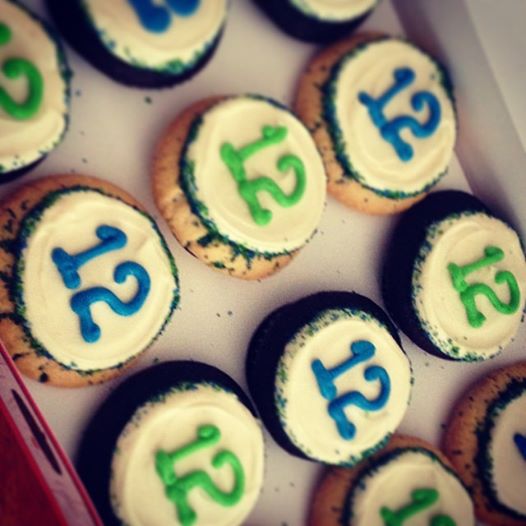
12th Man Cupcakes from Cupcake Royale. Yum.

12th Man Cupcakes from Cupcake Royale. Yum.

Now that I’m not in the classroom teaching college students (aka the world’s germiest people), I almost never get colds. When we got back from Vancouver, Z succumbed to one, which is always a sad thing because a) Z should always feel great and b) I am the world’s worst caregiver. I’ve got no real domestic skills, and so I spend way more time lecturing him on the merits of Kleenex vs. hankies instead of fixing him steaming bowls of chicken soup and fluffing his pillows. I once brought him borscht from the Russian pierogi shop up the street when he had a stomach flu, which I discovered is not a good idea. My most recent care-giving faux pas was just last night. He was suffering with a sinus headache, and so I gave him a head massage with Aveda Blue Oil (love this stuff!) and got some of its minty goodness in his eye. He spent the rest of the night blinking furiously. I kept insisting that it wasn’t the Blue Oil and my ministrations that had caused the trail of tears on his cheeks, but instead attributed it to the strong emotion he was feeling about a particularly dramatic song one of the Olympic ice princesses was skating to.

All week, Z blew his nose and walked around the house wearing sunglasses for his headache and a furry blanket wrapped around his neck and torso, looking kind of like an eccentric drug kingpin. Meanwhile, all week I was crowing about my amazing immune system and how rarely I succumb to things like the common cold now that I’m not grading 400+ coughed-upon papers a semester. And then Saturday evening as Z was starting to feel like himself—the night before the big game and the little party we were having at which I planned to cheer on the Seahawks and hold (and hog) the new baby belonging to our friends—my nose started running.

Boooo. BOOOOOO. If you’ve been wondering why there wasn’t a gloating post-Bowl post, it’s because I was either blowing my nose or napping for the last week.

I am not really a sports fan, and most years when we watch the Super Bowl, I’m in it for the commercials. But this year I was surprised to discover that I’d caught a case of Seahawks fever. I still have no idea what “off sides” means and when the announcer says someone has “taken a knee” I expect to see the extra players praying on the sidelines, so I’m not claiming to be a #1 fan here. But when you live in a city with a team and see some of the players on the cheesy local commercials for things like plumbing and when you can hear the touchdown cannon go off whilst sitting on your very own sofa, it’s hard not to feel . . . involved.

Plus, I’ve discovered via the magic of the interwebs that the Seahawks are one of the most disliked teams in the country, and for some reason this makes me feel kind of protective of them. They’re clearly loved here—there has been a gross misappropriation of office Post-Its to make 12th Man flags in blue and green in the windows all over town—but mention the Seahawks to someone outside of Puget Sound and you’ll see actual lips curl.

Obviously, the Seahawks were not depending on me so my cold didn’t really affect the outcome of the game, but I did miss out on serious baby-holding time. The baby in question—who I will call Pippi (as in Longstocking) here because she has a hint of red hair, Scandinavian heritage, and what I believe will be a fierce heart and vivid imagination—still came over, but I had to just sort of peer at her in her little Seahawks onesie from a distance and promise not to sneeze in her general direction. As it turned out she only spent the first half of the game with us as her parents decided that Baby’s First Super Bowl was slightly less important than Baby’s First—and probably only—Trip to Costco When No One Else is There.  Because they left us with half a dozen 12th Man cupcakes from Cupcake Royale, I forgave them the early departure.

The city went a little nuts, which was kind of fun mainly because the crowd stayed well behaved. (Often when groups of people get together in Seattle, someone decides they’re an anarchist and starts breaking windows.) I was grateful for the cold because it gave me an excuse to stay indoors and just peer through the blinds at the whooping and hollering that went on well into the night and on into the next day. And the next. And the next. Wednesday evening I heard a guy under our windows randomly yell, “Seahawks!”

Since we only live a few blocks from the victory parade route, Z and I decided to pop down to see a little of it on Wednesday before he had to head to work for a meeting. I still had a cold and it was freezing out, but it was sunny so I put on extra layers of clothes, including two hats, and off we went. We stood half a block from the parade route and waited. We watched people. We waited. I checked my email. We waited. Then we got word that the parade was going to start almost an hour late. Z had a meeting to go to and my nose was starting to run more furiously, so we posted a photo of ourselves “at the parade” on Facebook and trudged back up the hill, feeling a little dejected to miss out but also a little relieved to be heading back into the warm. Z went to work and I curled up in my chair under a blanket and watched the parade on TV.

A parade without floats and drill teams just does not engage me. I want scenes made of roses or giant balloons, but this parade involved only the Seahawks and their entourage riding around on the amphibious “Ride the Ducks” tour busses, throwing Skittles and beads to the crowd. The game was over, and as I watched people on TV scream and climb trees, I couldn’t remember exactly what all the fuss was about. My brain started asking big questions, like, Would there be a parade this frenetic if this were a women’s football team? Or, Would there be a parade if someone from Seattle won the Pulitzer?

After half an hour, I was bored and had my nose stuck in a book.

I’m not sure what my prognosis is. The Fever has subsided for now, but there’s a possibility it will return in the fall. We’ll have to wait and see.

Crowd waiting for the Seahawks victory parade.

Crowd waiting for the Seahawks victory parade.