Category Archives: Writing

Flashback Friday: Skintuition

Standard

Sunday, January 28, 2007

One advantage to having a boyfriend, it turns out, is that they can see things you cannot. For instance, your back.

One night while I was in Seattle, Z was rubbing my back and discovered this bump that he thought I should have checked by a dermatologist. He didn’t technically discover it as I had already made an appointment to have it removed, and maybe I sounded a little defensive when I told him this because the next deformity he discovered on my back he kept to himself for several days. One night he couldn’t stand it any longer, abruptly stopped the back rub, and said, “What IS that?” He peeled up my shirt and discovered a price tag for $19.99 plastered between my shoulder blades. For days, he’d thought I’d had some deformity about which I might be self-conscious. My face was red, but despite being mortified that the evidence pointed to bad hygiene on my part, I laughed with him about it and felt a little warm that he cared enough not to verbally note my every flaw.

My dermatologist, on the other hand, has no problem pointing out the flaws. She’s a bit flakey on a good day; she’s my age or older but wears her hair in these high partial pony-tails cinched back with little girl barrettes. When I had the non-price tag flaw removed she was in rare form. I hadn’t seen her for two years at which time I’d had a little thing sliced off of the side of my nose, so it struck me as odd that she shuffled in flipping her half pony-tails, looked at my face and said, ‘Oh, it looks good!’ Only what she was examining was not the two-year-old healed place but instead a chickenpox scar I’ve had since 1974. She complimented her own handiwork and then suggested that I let their new cosmotologist micro-dermabrase my face to smooth out the remnants of what she thought was her scar. She went on to tell me how this amazing cosmotologist would fix all manner of problems and could even wax eyebrows.

When she saw I wasn’t signing up for a makeover, she went on to announce that she was trying to drum up business for the woman because nobody in my town seems interested in spending money to look better. I suspect it’s just that people here are accustomed to having their eyebrows done at a salon and not at a doctor’s office. Isn’t it a bit like going to the dentist and having her try to sell you lipstick? I suppose I’d appreciate it if my hair stylist noticed something on my head (a price tag perhaps) and suggested I go to the doctor to have it removed, but somehow when a doctor does it, it smacks of a snake oil selling. Do I NEED microdermabrasion for some medical reason? Are my eyebrows going to cause me long-term health problems if not cosmotologically altered? I think we all know the answers to these questions.

And now, on to a skin of a different color.

I’m a fairly intuitive person, so why does it surprise me that when I do some dumb thing that an inner voice has told me not to do, it doesn’t turn out well? More importantly, why don’t I just listen to myself? I’ve come to the conclusion that either I am slightly mentally handicapped or I have a dual personality: one of a benevolent, intuitive parent and the other of a petulant, rebellious child.

I’ll spare you the details, but bottom line, despite a niggling voice telling me I was about to make a mistake, I violated my pricey iSkin—a Shrek-green condom that protects my iPod from all manner of bumps and spills—in the interest of its fitting into a stereo dock more efficiently. It didn’t work, and furthermore, within 60 seconds of making the last snip, I discovered another way to attach the iPod to the stereo that won’t affect the skin at all.

Because I do not like to cry over spilled beverages, I opted to fix the situation by gluing the silicon sheath back together with nail glue. On any other day, nail glue could be used to reattach previously conjoined twins. I have frequently glued my fingers together when using it, so when the little niggling voice told me this experiment would also fail, I told it to hush because I know all about nail glue.

Maybe they taught this kind of helpful stuff in high school science classes on a day I was absent, but it turns out that quick-drying nail glue does not dry so quickly when applied to silicon. Instead, it makes a sticky mess and never dries. Despite both my intuition’s best attempt to save me from myself and despite my own resolution to be more frugal in 2007, there is now another Shrek-green iSkin on my Visa. I considered not buying a replacement, but the niggling voice said, “Your iPod needs to be protected from people like you.” This time I listened.

With Z and my intuition watching out for me, all I have to fear is, um, myself.

Betty MacDonald Had a Farm, E-I-E-I-O

Standard

RGSSketchBook

Mom is visiting us for three weeks, and to celebrate her birthday, Z and I decided to treat her to an overnight on the farm of one of her favorite authors. Betty MacDonald wrote The Egg & I, her memoir of time spent on the Olympic Peninsula raising chickens, in 1945. A movie was made from the book and starred Fred MacMurray and Claudette Colbert and was followed by a string of “Ma and Pa Kettle” movies that were based on back woods characters Betty described in her book. (She was later sued by people who believed she had based the unflattering but beloved Ma and Pa on them). Though I’ve never actually read this particular book, I grew up feeling like I knew the author. Mom was often reading passages from one of the books and telling me anecdotes from Betty’s life as if they were old friends. (The author died in 1958.) I did, however, read her series of Mrs. Piggle-Wiggle books, which I was convinced were the American answer to Mary Poppins, so I had my own “Betty love” going on.


When Z and I stay somewhere, we study the descriptions and photos on VRBO and airbnb as if we are buying the property instead of just staying there for a night or two. I’m pickier than he is and because I’m what they call a “Highly Sensitive Person” I’m affected negatively by ugly things or dirty things or even spaces that seem too much to belong to someone else. My ideal spot to stay is one that looks like one of those little IKEA display rooms, where you can imagine living your life without having to think about how anyone else has maybe trimmed his toenails on the sofa.


So when we’re looking for a weekend getaway, Z will often find a spot he thinks looks perfect, but I’ll see a throw pillow with a color scheme that makes my skin crawl or a poster of an eagle on a back wall, and I’ll insist we keep looking. I can’t express this enough: I am not a princess. Really, I’m not. But I have a lot of feelings and other people’s things affect how I feel and when I’m on a little vacation, I don’t want to have to deal with turmoil inside of me just because a chair is scratchy or there is bad lighting. I had to quit going into antique stores a few years ago when I realized I always left depressed and a little obsessed about how wasteful and tacky we are as a people. So online photos of potential digs have to give me a good vibe before I’ll send the payment information.

rgsbettymacdonaldfarm

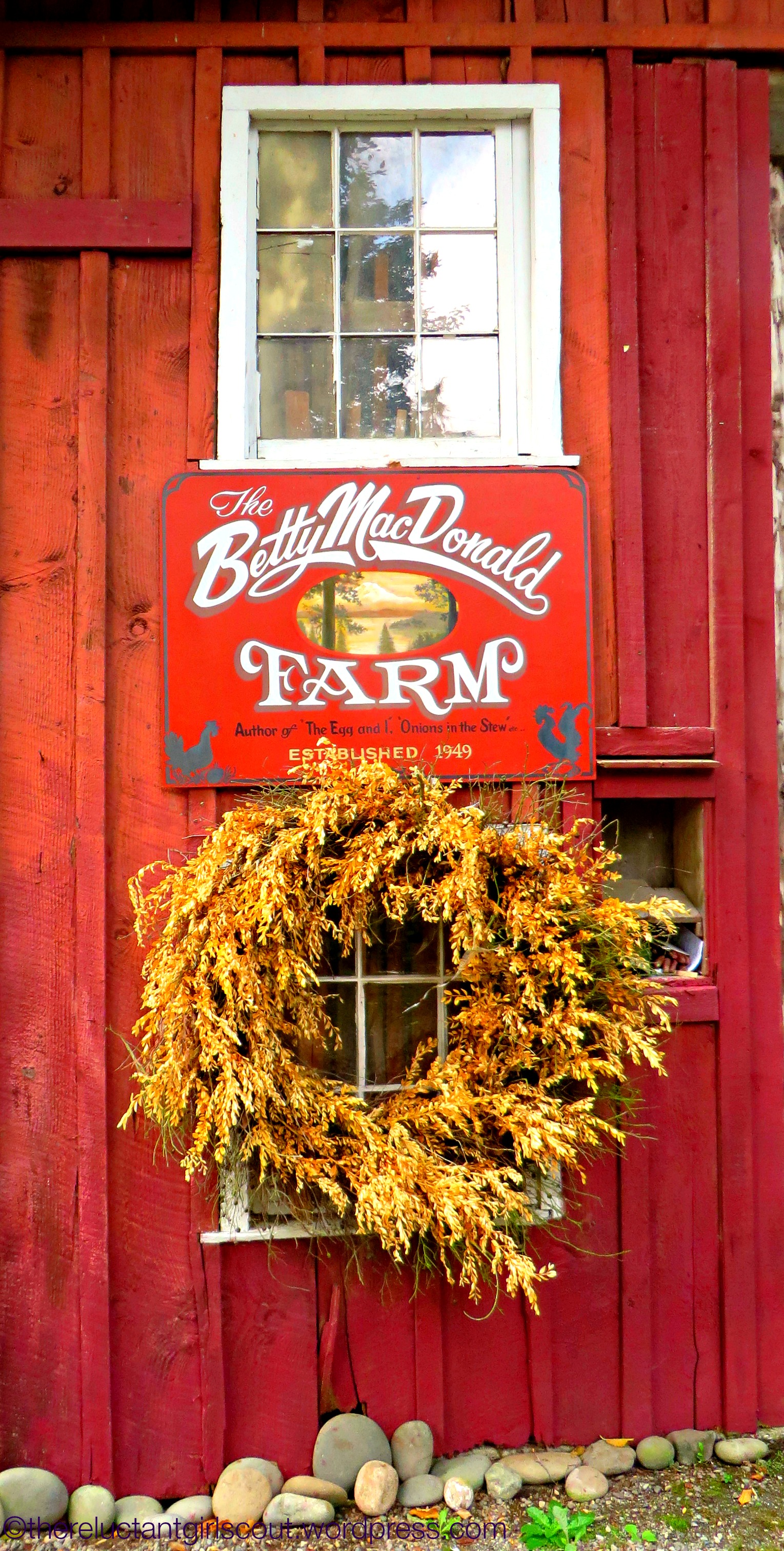
The Betty MacDonald Farm Bed and Breakfast website has a few beautiful photos, but it’s a little short on specifics. So when Mom and I arrived after a twenty-minute ferry ride from West Seattle, we didn’t know what to expect. Finding it felt like an adventure in itself because we weren’t exactly sure where we were going and other than a very generic “LODGING” sign on the main road with an arrow, Vashon is not a neon-light or billboard sort of place that will direct you anywhere. You “discover” things on the island, which is part of its charm. Other things you will discover: quiet and an easy slowness that would be honked out of existence in Seattle.


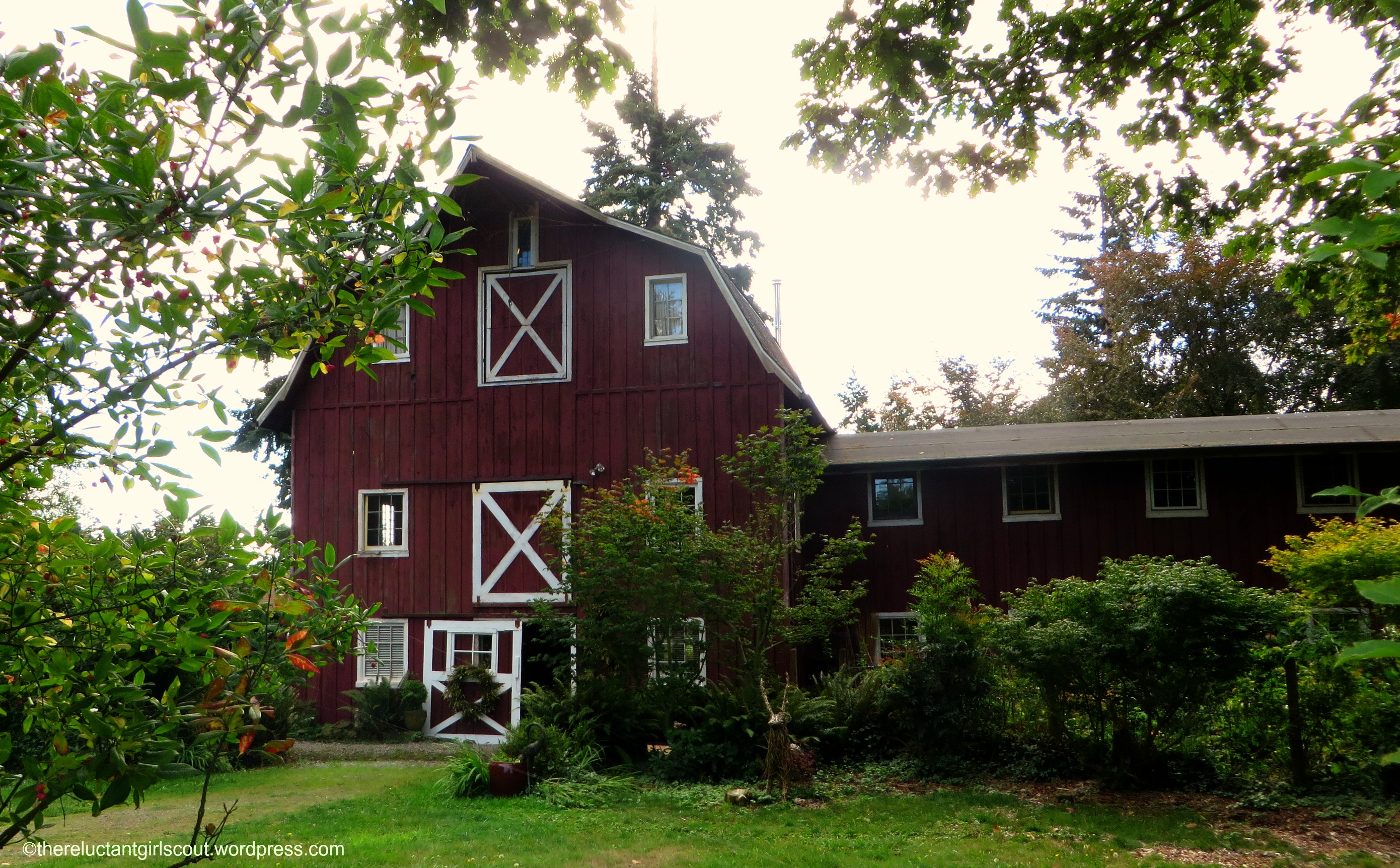
We were greeted by the owner, Judith, who gave us brief directions up to the third story of the barn and a warning to shut all the doors to keep the animals out, particularly a mother raccoon and her babies who had been trying to find some indoor accommodations. Mom and I hauled our bags up the multiple stairs, and as I was dragging my stuff up, I was thinking, “Oh, geeze. We’re staying in a barn.” Now, it was clear from the website that we’d be staying in a barn, I had specifically made a reservation and paid to stay in a barn, but somehow in Seattle I was imagining something less barn-y. No spiders, no feeling of the hundreds of chickens that used to live there, something in the shape of a barn but with dry-wall and track lighting to illuminate my way. (Before you judge me, please re-familiarize yourself with my camping adventures through the ages here and here.)


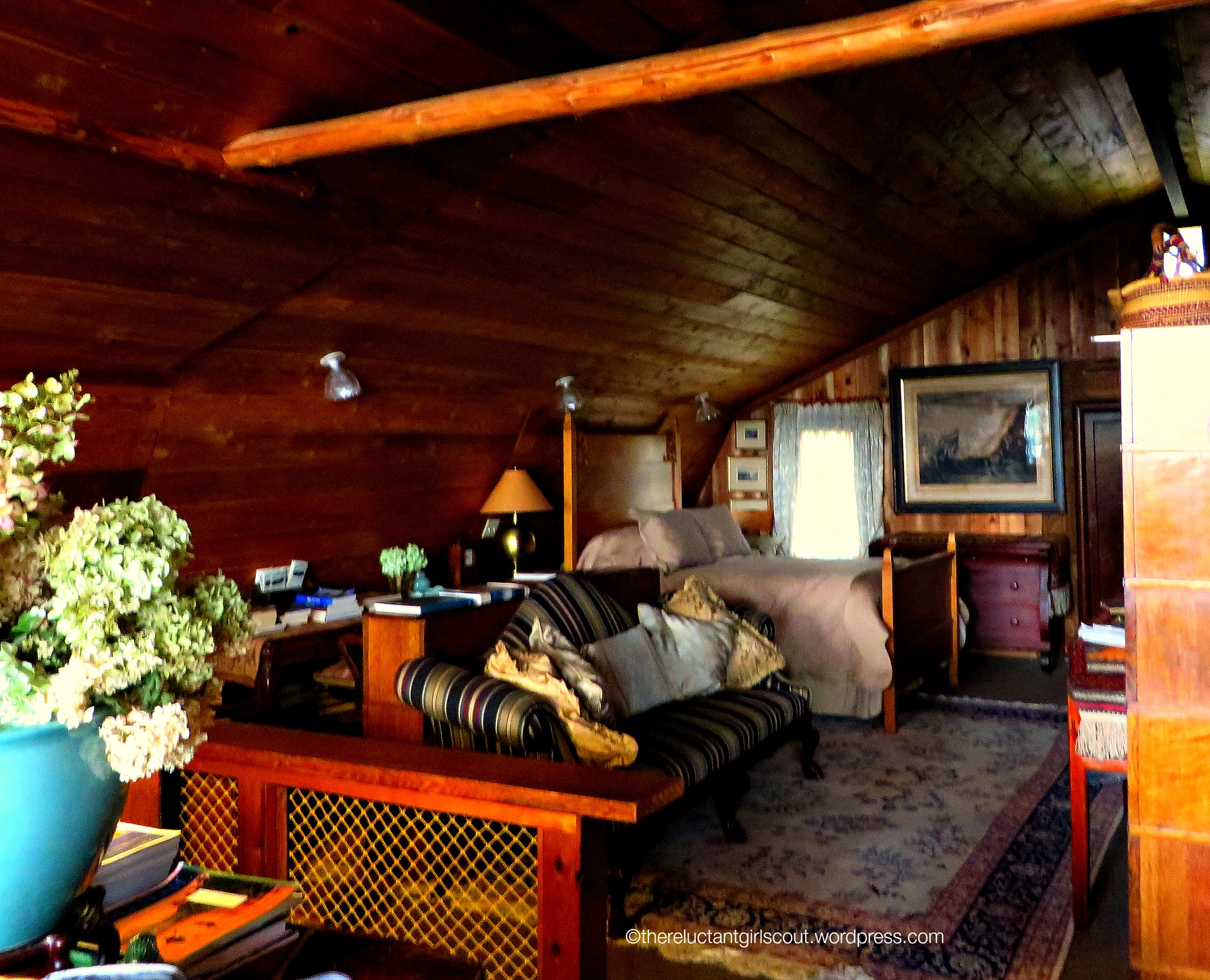
And then we popped up into the loft and we instantly moved from “barn” to “antique store.” The loft was vast as it was literally the barn loft that went from one end of the three-story barn to the other in a big open space. It held a full kitchen, an antique bed, various gorgeous bits of tables and chests and bookcases, this giant dual-couch construction made out of wood and covered with woolen carpets that looked like it belonged in a bunk house on the range, a wood stove, and a table laid out with Spode for our meals. There was not a horizontal surface that wasn’t covered with books, and the bookcases were all full as well. Good books. Books you wanted to lose yourself in, or at the very least flip through and then order a copy for yourself. The couches faced the wall of windows, which overlooked the six-acre farm, Puget Sound, and the idea of Mt. Rainier that was out there under the cloud cover.


rgsmacdonaldloft


Initially, I sat on the sofa staring at the view with my lips pursed, uncertain if I should be pleased or disappointed. The bunk house couch was surprisingly comfortable. The view couldn’t have been better and I loved being in this “writerly” space, but there was absolutely no way for my highly sensitive brain to pretend that this place was the blank canvas of a slicker vacation rental cottage. There was absolutely no way to imagine that it was my personal living space because it was so filled with the owner’s belongings. So I kept sitting there, thinking.


Mom was excited, soaking up the view from the balcony, as well as a good bit of weather since it was misting a little bit. When she finally had to come in because it got too wet and cold to reasonably sit outside, she started foraging for books, creating a huge stack in front of herself, and then curled up on her section of the bunkhouse sofa and started reading.


Imagine Mt. Rainier in the distance. We did.

Imagine Mt. Rainier in the distance. We did.

The books were too hard to resist. My lips un-pursed a little. I got my own stack, and we spent the night reading and talking, and never did get around to watching The Egg & I video that the owner had at the ready should we want to steep ourselves in Betty MacDonald’s life a little more.


I’m not sure when exactly the scales in my brain tipped towards “pleased.” The quiet and view certainly worked some magic on me. And the sheets in the little bedroom helped because I’ve never felt anything so soft and crisp (except for the impossibly fluffy towels that were waiting for us in the bathroom, along with robes and African baskets filled with everything we could need to pamper ourselves). Possibly the fact that Mom, who was on the other side of the door sleeping in the main loft got momentarily freaked out because something was on the roof, and then we fell into hysterics like we were at a slumber party when we realized the sound she heard was not the mother raccoon trying to break in but was really just me turning the pages of a Country Living article about Corbin Bernsen’s house.


No, I think it happened well before that, when I was looking at all the stacks of books, and all the little nooks and crannies where you could cozy up with a book or a writing pad. It is hard not to hanker for a good reading and writing space, and this one was the best. The place is too unique to turn your nose up at it. Plus, it was clean and our every need was anticipated. By the time I fell asleep I felt like I was spending the night at my grandmother’s house, cozy and well-cared for. And when I woke up the next morning after a perfect night’s sleep on a very comfortable bed, I felt sad that we’d only booked the single night.


Mom and I sat on the porch the next morning so entranced with the view and the books we wanted to skim before leaving that we failed to shower and make ourselves breakfast. Showering and eating could happen after check-out time when we’d made our way back to the grit of the city. (Z would be none the wiser about our slovenly choices because he’d still be at work.) We begrudgingly packed up our things, tidied up after ourselves, and trudged down the stairs to the car.


The Betty MacDonald Farm B & B

The Betty MacDonald Farm B & B

I made my way over to say hello to the adorable Irish terrier who lives on the property and ran into Judith. I asked her a few questions about the farm and the island, and she started what turned into a fascinating history and horticulture lesson. Mom joined us, and an hour later we knew how to get a start of hydrangea, more about Betty MacDonald’s life, more about the history of the island, the personality of Irish terriers, and the property itself. We even got a peek of the cottage on the ground floor so we could see if we’d like to stay there in the future. (It was cozy too and called to us, including a beautiful old claw-foot tub, perfect for reading that was situated in the bathroom surrounded by windows so you could read, sip some wine, and stare at the Sound and Mt. Rainier. If we ever tried to book a weekend there and couldn’t get the loft, we’d be perfectly happy in the house.) It was the perfect ending to a delightful 24 hours.


By the time we climbed into the car and made our way back to the ferry, I was solidly in love with the place and wondering when we could come back. I’ve no doubt that there are people who arrive on the farm and don’t adjust to its quirky self and wish they’d stayed in one of those IKEA-furnished cottages where everything is new and personality-neutral. But for me, I was glad I was able to hit the pause button on my own peculiarities and enjoy the gorgeous peculiarities of the Betty MacDonald Farm B & B. I sincerely doubt that I’ll ever find another place like it, and isn’t that what we should be out here doing? Acquiring unique experiences instead of the cookie-cutter ones?

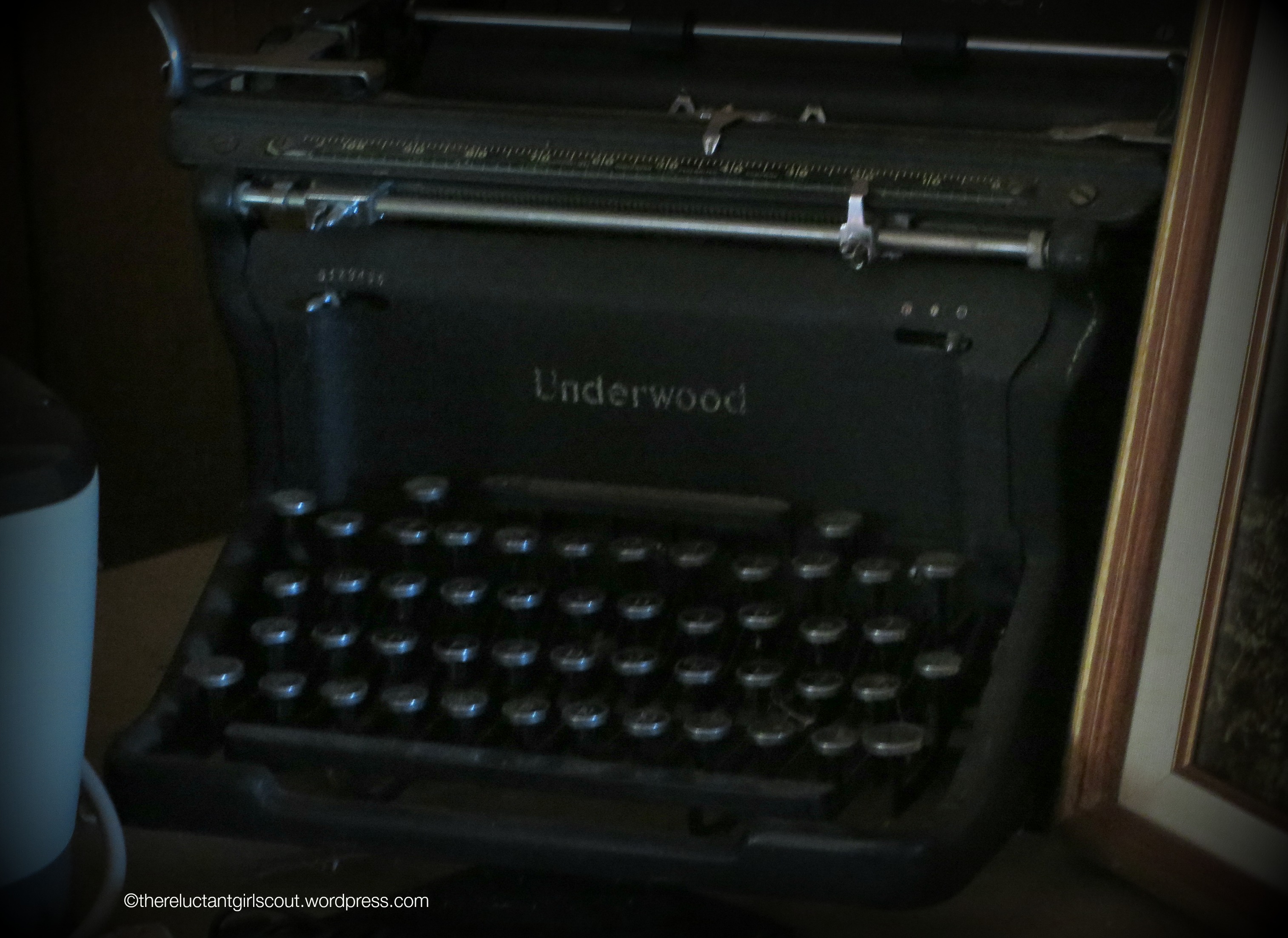
Betty MacDonald's Underwood

Betty MacDonald’s Underwood

Flashback Friday: Secret World

Standard

Wednesday, October 25, 2006

[FYI, this entry covers my inaugural trip to Seattle to help my friend Z celebrate his birthday. Keep in mind, at this point, I’d resigned myself to the notion that he wasn’t interested in me as anything other than “good buddy.” I’d been in love with him for four years and the boy just would not budge.]

There’s a reason why Meredith Grey’s hair is so flat and lifeless on Grey’s Anatomy. It turns out, everyone’s hair, especially mine, is flat and lifeless here. I assume it is the weather (rainy with a chance of rain), yet it seems like that would lend itself more to frizz.

I’m here visiting my Zimbabwean. I like saying that. It makes me feel like Meryl Streep in Out of Africa when she refers to the people she makes work on her farm as my Kikuyu. He’s teaching here, and I am in his bed. Before you get notions of me, spent from a night of international passion, you should know that while I was in his bed, he was on the an egg-crate mattress on the floor of his living room.

I ruin all the best romantic scenarios I create for you by telling the truth.

My college friend Jane emailed that her eleven-year-old son came home from school yesterday and said, “I’m just starting to realize that girls have their own secret world, and it’s FREAKY!” The Zimbabwean and I laughed and laughed over that last night when I read it aloud, but I could tell he has no idea. No idea despite advanced academic degrees that we women have secret communication-interpretation skills no Navajo code-breaker could ever crack. So when you open his refrigerator and see he has two Cokes and a package of Dubliner cheese, just for you, you swoon a little even though you’ve sworn off swooning over this particular man. When you lament how awful and Meredith Grey-y your hair looks and he says, “I don’t think so” it is, after several mental contortions, the equivalent of his saying, “Your hair is as the sun shining on the Zambezi, and I wish to spend my days basking in both the glow and beauty of it.” When he refers to his apartment as “our apartment” it is as if he has said, “I want to share my living space for the rest of my days with no one but you.” When he says, “I took off the roll of scratchy toilet paper and bought you the kind that those bears use” it’s as if he said, “I love you so profoundly that I want only the very best—softness, absorbency, and four-ply bathroom experiences—for you.” In this sick, sad world, even his choosing to sleep on egg crates instead of in his own bed with you seems like a declaration of love.

Poor eleven-year-old boy. How can he ever learn to cope in a world where half the population is this indirect, this given to fancy. . . this freaky?

So, Seattle. We walked over half the city last night and so I’m reserving judgment until we rent a car tomorrow and investigate it when my feet don’t hurt. It’s nice. Lots of coffee. The people are friendly. Somehow I had in my head that it would look and feel like Vancouver, but it turns out it’s a whole different place. Yesterday, my Zimbabwean took me to Pike Place Market. While I don’t like fish and do not like to smell them, eat them, watch them, or see them manhandled by the stall vendors, it was a unique experience. Also, there is a lot there that is not fish. Like huge bundles of fresh flowers for $4, and hippies selling art, and little dogs in plaid raincoats, and jam sampling, and fudge sampling, and street musicians singing protest songs (just protesting in general, with an undertone of “This war is unconscionable” and “George Bush sucks” thrown in for good measure), and all sorts of useless crap you don’t need like Oscar Wilde action figures, “Aunt Flo’s Tampon Case,” and cardboard cutouts of William Shatner. From there, we went to Ye Olde Curiosity Shoppe, where you can buy other useless things and see oddities like mummified human remains and a stuffed two-headed calf. We took a bus to the Space Needle but opted not to go up because it cost $14 and was cloudy. My cousin G suggested I go up not because the views are spectacular or because it is a piece of post-Populuxe history, but because she didn’t go up when she visited in the spring and apparently the only thing people ask youwhen they hear you visited Seattle is, Did you go up in the Space Needle? I will wait for a sunny day. Or at least a day when there is a chance of sun.

Last night we walked up a San Francisco style hill to see his university. He wanted decorating suggestions for his office as some big wigs are coming to campus today, but it is a hopeless cause. I suggested he buy a plant and an Edgar Allen Poe action figure from Pike Market, but other than adding some doo-dads like that, it is a hopeless sea of glass and giant industrial office furniture in the space of a broom closet. While there, I met the man who hired Z, and he tried to entice me to their wine and cheese reception this afternoon. I will, instead, be buying a birthday card and maybe a cake or some gift-ish thing for Z’s birthday. Extroverts never seem to get that the invitation to spend three hours with total strangers whom you will never see again is like a prison sentence.

After that, we walked up Broadway in search of food and so I could see, as Z put it, “the freak show.” It’s a street that apparently delights in the counter-culture, so in the space of a single block you can see goths, hipsters, drag queens, the heavily made-up, heavily tattooed, significantly pierced and spiked, as well as people randomly dressed like super heroes.

Sadly, the freaks were not out, either because it was too early in the evening or two middle-of-the-week. I will have to save those human oddities for another day, though clearly I’ve got my own little freakshow happening right inside my head and don’t have to walk up any hills to get a front row seat.


Flashback Friday: The Rules of Engagement

Standard

Monday, October 16, 2006

[It’s worth noting that when this entry was written my life was about to change in a big, surprising Zimbabwean way in less than ten days. Tune in next Friday for more in the saga of Z and Beth’s Love: The Early Years.]

I’ve been thinking about the rules of attracting a mate lately. You know the ones. Some are probably holdovers from the days of courtly love. I’m talking about the ones no one really teaches us, but we can quote them more quickly and accurately than we can the First Amendment or the Ten Commandments. (Pick your politics.) They are:

1) Love comes when you least expect it.
2) Absence makes the heart grow fonder.
3) You must love yourself before love will find you.
4) Why buy the cow when you can get the milk for free?

There are variations of the above but all fit comfortably in one of the four above groups. For instance, if you’ve read enough self-help books or watched movies like Runaway Bride, you’ll recognize a combination of one and three. That is, you might love someone, but until you quit being devoted to your idea of love of them and learn to make hideous lampshade art on your own like Julia Roberts almost always does in whatever movie she is in, you will not find true love. A variation of four that I prefer because I am mildly lactose intolerant is that you must withhold your love if you expect the object of your affection to return your warm feelings.

I’ve followed most of these rules, off and on, with some regularity, and I can’t say that any of them work. For me. That’s fine. Single is okay, so don’t think this is a blog of self-pity. It is not. For instance, I had a flash last night of all the horrible décor I’d be forced to live with if some of my former loves had come to a point of cohabitation: dogs playing poker, posters of Johnny Cash, farm implements as art, eagle blankets as window treatments….

It annoys me when people explain their newly found love by relying on these platitudes, usually because they are not true. You cannot believe anyone who says they weren’t looking for or expecting love. They were. Okay. They were. We all are. If you are between the ages of 12 and dead and you spend more than 15 minutes a day watching television or listening to non-talk radio, then you are expecting at some time to be “surprised” by love. If you weren’t expecting to be surprised by love, you wouldn’t have the good underwear and you would never shave your legs. Don’t kid yourself and don’t try to kid me. You might not have been expecting it today between 12:00 and 12:15, but you were expecting it eventually.

What annoys me even more than this, though, is when someone willingly breaks one of these rules and finds true love in spite of the rule breakage. For instance, I know a woman who loved a man who did not love her back, even though they had a steamy sex life. By all accounting with Price Waterhouse, this relationship was doomed, she was being used, he would never respect her, and thus she would never win his love, no matter what acrobatics were involved. It’s the cautionary tale every young girl hears from her mother or Sunday school teacher. Yet after a year of this FREE and FLAGRANT milk giving, the guy realized he loved her and couldn’t live without her. They are now married and have matching tattoos celebrating their love.

When you have been a rule follower your whole life, this is one of the jaggedest little pills to have to swallow: rule breakers win; rule breakers do not necessarily go straight to hell. (Though this is a young marriage, and so the verdict is still out on that one. Hell has many manifestations.)
What is the MOST annoying, however, is when someone willfully breaks the rules but presents her story of love as if she were adhering to the above. Recently, my mother befriended the wife of the first boy I loved, grades K thru 3. He was cute, smart, skilled at kickball, and was regularly awarded the title of “Good Citizen.” His wife (an excellent and good person by all accounts) tells the story of how she was not interested in dating anyone and told the friends who set her up with him that she wasn’t. She told him she wasn’t interested in him repeatedly on that first non-date, and three days later she moved in with him and they’ve been blissfully happy ever since. She followed those rules of courtly love and rejected him multiple times, but still, she went on the non-date. Still, she answered the phone after the non-date when he was calling to tell her he wanted to see her again. And when, later that same night, he drove through the country looking for her house so he could kiss her soundly and show her that there was something between them, she told him where to find her driveway.

So, at cocktail parties, she can tell people that she wasn’t looking for love and in fact discouraged love, but even so, she gave it directions.

My luck with absence making the heart grow fonder has been no better. It can make the heart grow fonder, but only in people who weren’t into you enough in the first place to realize they should stay put. Them joining the military and then realizing they really miss you is not really a testament to how lovable you are so much as it is a testament to how miserable it is in a desert. Or Duluth. People have had good, long marriages based on this absent, fond heart mythology, so perhaps I should not judge it so harshly. But I do, primarily because I am the kind of person who feels that the separation by just a two- mile stretch of road is too great. I do not need to go to Duluth to realize I am in love.

Also, statistically speaking, what absence does is make people unfaithful. They’re lonely, Van Morrison gets played on the jukebox, and they bump up against another lonely some body.

Am I too cynical? Bitter? Frustrated? A case could be built for any of these. But I don’t think so. I’m just wondering, that’s all. How is it that other people know when to follow the rules, when to break them, when to break them but pretend they didn’t? How is that whatever I do seems like exactly the wrong thing to do, but then if I switch to the exact opposite tactic, it immediately seems like the inferior one?

These are rhetorical questions, you understand. I’m beginning to suspect the truth is that no one knows anything, and the platitudes we rely on and untruths we tell are simply needed because it is an unbearable thought that our lives and loves are a crapshoot, that it is, at it’s very basest level, just an issue of timing: who was available at 12:15 on a Monday afternoon.

No, this version is even less satisfying than the lies. I find myself once again in the precarious position of needing to quote Fleetwood Mac: Tell me lies, tell me sweet little lies.


Grab the Badges and Run

Standard

rgsgirlscoutstamp

I didn’t enjoy much about Girl Scouts. I liked the idea of the organization, the wholesome history of it, the biography of founder Juliette Gordon Lowe, the goodness implicit with being a Girl Scout, the uniform, the abstract idea of community. But in truth, I was too independent to function happily in a group. I found the other scouts and scout leaders to be “not my kind of people,” I looked bad in that shade of green and always felt as if parts of me were going to come bursting out of the buttons. I might have still been a girl when I was in Girl Scouts, but my body was a few years ahead of itself, so I looked like someone dressing up for Halloween more than a legitimate ten year old.


I never felt legitimate.


Frankly, I hated the outdoors, which might make one question why I had chosen this extracurricular activity for myself. Let me tell you: I was a badge whore. I loved the badge guidebook. I loved ticking items off the badge to-do list and earning yet another badge for my sash. My troop leader, an odd bird with old-timey glasses (now trendy again), told us once about a girl who had earned all of the badges. My troop leader felt it was ridiculous because it didn’t really demonstrate dedication to a single particular area and she felt the time it would take to earn those badges could be better spent living a life, but I thought the notion of earning all the badges was the equivalent of becoming Miss Teen USA. I wanted them all myself even though there were ones I never could have earned because they involved sports or extended camping or being gregarious.


Even then I was desperate to be a well-rounded person, though in my mind, well-rounded meant “knowledge about X” and not “experience doing X”, a problem I’ve continued to have into adulthood.


Oh, how I coveted those green, quarter-sized badges with activities embroidered on them that symbolized some possible accomplishment. In my thirties, I found my sash and badge book and was bitter that I couldn’t keep adding to the list as an adult. (I could easily earn a photography badge now for instance—I own multiple cameras and have an Instagram account.) Just by looking at the badges I had acquired in the late 1970s, I could see that I was preparing myself for a certain kind of life that hasn’t yet panned out. For instance, I have two different cooking-type badges even though I spend every night waiting for Z to serve me my supper like I’m some sort of princess. (The one time I tried to make him pancakes, they rolled right off of our new griddle and onto the floor. He’s the cook in the house.) Despite having a sewing badge, it was my mother who always sewed the badges onto my sash. She just did it so much better than I could, and I wanted it to look good.


We would occasionally get patches for something like the Spring Fling that we were supposed to put on the back of our sashes, but I wasn’t interested in patches. Anyone could get handed one of those who spent a Saturday attending some stupid gathering of Girl Scouts. To my mind, they just took up space where earned badges should go.


Aside from the badges, I also loved the system and symbolism in scouting. I loved that there was an actual guide about how to live your life well. And I remember in detail watching a Brownie ceremony when they got twirled around and had to look into a mirror before they “flew up” to junior scouts. I hadn’t been a Brownie, and I was bitter that I was now too old for the full experience. After being a junior scout, I wanted to be a cadet and then a senior scout, but even in my deluded, badge-lust state, I knew I wouldn’t last that long. Five days at Camp Wapi Kamigi nearly killed me. Beyond my dislike of camping, though, was my dislike of socializing with strangers, and even with people who I knew marginally. I loathed it.


One of my great early joys was an overnight (with mothers), and the next morning Mom nor I could face the idea of an entire day spent putting on stupid skits or talking about ways to increase troop revenue. I feigned a stomachache as soon as we woke up, and the two of us zipped down the tree-lined canopy of the camp like bandits, giddy with our own escape. On the way home, we stopped at McDonald’s and got Egg McMuffins and a cinnamon Danish, and if you asked, I could describe, bite for delicious bite. It all tasted like freedom.


And as a side note, this is one of the things I love most about the childhood I got to have: I had a cool mother who knew who I was and what was and wasn’t important. Spending a tedious afternoon with those earnest Girl Scouts and their earnest mothers was not going to make me a better person. It was not going to build character. It was just going to make me (us) really miserable.


I wish I’d known then about personality types. About introverts and extraverts and INFPs and the Enneagram and how kids from single parent homes maybe saw things differently than “normal” kids. I wish I could have realized that this day of declared independence with Mom was the right path for me and the other days—of which there were so many more—when I tried to contort myself into a box someone else had created for me were the anomalies.


I wish I’d known it was okay to hate schilling Girl Scout cookies. That as an adult I’d make a pledge that my children (imaginary) would never sell anything for any organization until they were adults and could make decisions on their own about how they felt about capitalism. (My imaginary children are very gifted in the arts, but they do not have the skill set to understand things like political theories or when they and their band uniforms are being used to make money for larger corporations.) My face still turns red when I remember asking my paternal grandparents to buy a Girl Scout calendar from me. I knew they didn’t want one. They traveled the country in a tiny Airstream trailer that lacked excess wall space, plus even if there were calendar room, why would two retirees want to spend an entire year looking at photos of girls they were not related to doing activities that the Girl Scout they were related to hated doing? Still, I asked. I had to sell some calendars. So I asked them, as well as my maternal grandparents who I had fewer qualms about asking because I knew they would just fork over the $5 and wouldn’t expect me to really demonstrate any marketing prowess. God bless them for that.


I suspect children inherently know what is right and what isn’t right for them, but grown-ups are forever trying to get them to do the thing that is counter to their own sense of rightness: eat the vegetables, talk to certain safe strangers, play the sport, the instrument, the party piece… Some kids try to be good and acquiesce. Some stick to their stubborn guns. I always felt caught in the middle. It was constantly a war inside me, wanting to give the adults what they wanted all the while telling them I had drawn a line in the sand that I wouldn’t cross: no broccoli, no camp-outs, no making friends with a girl who was acting a fool.


I’m still not sure which side won the war. I’m note even sure if the war is over. Maybe to be human is to house these warring factions inside yourself. Or maybe that is just what it is to be Beth.


I need to look at those badges I earned and see if they add up to me. Was I true to myself and the things I was interested in in 1977 or was I grasping at straws, at badges, at showing others I was a Renaissance girl? What I’m curious about now, as I remake my life is this: do I know who I am—as well as I think I knew myself then—and can I shape this second half into what I want? Should I try harder to put that cooking badge to use and give Z a night off?


Is there a badge for this kind of mid-life inquiry? There should be.


Flashback Friday: Little Brownstone on the Prairie

Standard

rgsroom

[Oh, the irony of this post from eight years ago, particularly when bumped against the one from earlier this week.]

 15 July 2006

Last night I was feeling “troubled” about my silly life as I went to sleep, which is a fairly frequent occurrence. Usually the troubledness has to do with my age, my living situation, my marriage/partner/dating and motherhood status. Other things get factored in based on the latest magazine article I’ve read or Dateline exclusive I’ve watched. Last night, after messing with a picture shelf my mother and I were hanging above my desk and trying to figure out which of my 20 works of art I was going to hang on the little hunk of wall that is left in my room, I was feeling particularly freaky. I have friends who are bitter because their houses aren’t brand new and don’t have granite countertops or swimming pools or room for a home office, but all of them have managed to get more than four walls to hang things on.


This isn’t about some people being luckier or having more than me. I know if I wanted to make it a priority I could maybe get myself eight walls, so I’m not talking about jealousy here. If I wanted to give up the frequent flying and the handmade furniture and the Sundance catalog jewelry, I could buy a little house and hopefully have enough money left over to pay a boy (preferably a shirtless one) to come and do things for me like hang picture shelves. I could.

Anyhow, I woke up this morning, looked at all my stuffed-full bookshelves and realized, I’m living in a brownstone circa 1945. I always imagined living a writer’s life in a big city where I couldn’t afford anything but a bedsit so all of my worldly possessions would be in the one room, and for reasons that are unclear, I always imagined doing this in the post war era. And now I realize that’s what I’ve got. Only without the city, without radiators (thank you, Jesus), without loud neighbors, and without a book contract. I AM Helene Hanff. I am whatever the bookish sister’s name was in My Sister Eileen. I just can’t go walk my dog in Central Park (partly because I don’t have my own dog), and I still have not developed a taste for coffee and cigarettes, both of which figure prominently into my 1945 brownstone fantasy.

Also, in this fantasy, I have a throaty laugh and I know how to dance.

I really am amazed by people who figure out how to settle into a place. At almost 40, I’m still trying on locations for size. For instance, I now know I do not want to live in Aspen, even if I do become a billionaire. In fact, you can scratch ‘anywhere in Colorado’ and ‘the Rockies’ right off the list of possibilities. It’s gorgeous there. The quality of life is good. I understand the fervor of John Denver’s Rocky Mountain High, but it is not my place in this world. There is too much sun and too many people happy to be outdoors, risking their lives on guardrail-less roads, in treacherous rapids, and while battling wildfires.

While I was at Aspen Summer Words, my friend Heather drove me up Independence Pass so I could see the Continental Divide. On the way up I told her how beautiful the landscape was and she said, “I know. When I see these mountains my heart just opens right up.” My heart wasn’t opening–not for those mountains–but I liked the emotion with which she spoke. It’s how I feel about the West of Ireland, Chicago, East Tennessee, London. There are places you belong and places you don’t belong and I live in fear that I’ll accidentally end up in a place where I don’t belong, where my heart not only won’t open up but instead will seize because of the ugliness or inhospitably of the people or landscape. For instance, the two hours I was waiting for my return flight from Phoenix, I kept thinking, “This is a dead place. People aren’t supposed to live here.” Yet people do. And some people love it. My grandparents loved it. But they sure didn’t pass those genes down to me. (Nor the genes that would make camping seem like a good idea, for that matter. Nor the ones that would make me good with money or able to cook.)

When I figure out how to get myself to 1940s Manhattan, I’ll let you know.

Curmudgeons in the City

Standard
Not Treme. The French Quarter.

Not Treme. The French Quarter.

It got a little warm in Seattle this past week. There was virtually no humidity and were it in the 80s in Indiana with no humidity, it would be considered a nice summer’s day, but here, it is too hot. I believe you are familiar with my policy on summer and heat.


Few people here have air conditioning because it’s needed so rarely, and those who do don’t use it right, which leaves a girl clammy and gasping for breath. How we know it is hot in our place is if we have to open the bedroom window, which remains shut about eleven months out of the year because evenings here are generally cool. It’s been a week with the window open.


Our bedroom window is next to the intercom for the building. When Z moved in, the old intercom was loud and made horrible honking noises, so we were excited when they replaced it, but the new one is worse. For no good reason, it makes an electronic beep—like an alarm trying to wake you—as a guest scrolls through each name trying to find the person she knows. Beep, beep, beep, beep, beep. And then, finally, blessedly, the sound of a phone ringing and the longer beep that lets the person in. Most of the visitors seem to be friends with people whose last name begins with V and the names are sadly listed in alphabetical order, which means a whole lot of beeping. It’s a very inefficient system both for the buzzee and for the people trying to sleep next to the buzzer. In the winter, it’s just kind of a distant mosquito wing of a sound, but when the window is open, the intercom might as well be attached to a bullhorn.


The surprise of this summer when I opened the window for the first time to prop the fan in it was that our screen was missing. I have this idea that someone who wanted a screen performed some acrobatics to jerk it out of our crooked windowsill. Z has this idea— and probably the correct one because his world view is less dark and twisty than mine—that the screen became loose, fell out, and the maintenance woman removed it from where it fell. We have one of those accordion-style fans that sits in the window, so it’s sort of like having a screen, but I swear, it makes everything outside even louder because we’re down one layer of mesh between us and the noise of the city.


Z and I have been binging on Treme episodes this past week. We are late coming to the show, so there won’t be any spoilers here, wrecking anyone’s goodtime. While watching it, I’ve been feeling envious of the folks in the show, which is no mean feat because post-Katrina New Orleans where the series is set was no kind of place to be. But there is something about the uniqueness of New Orleans and all that place-specific culture that makes me extra envious. They have a parade, I feel envious. They eat a bowl of gumbo, I feel envious. They have a jazzy funeral procession, I feel envious. I didn’t eat gumbo when I was in New Orleans three years ago, I don’t particularly like jazz, and a funeral, no matter how festive, is still sad, so I’m not sure exactly what I’m envious of other than this very specific sense of belonging and culture that seems to come from the location. You’ve heard me whine about Indiana and how much I miss it, but a lot of the things I miss from there would be the same in Ohio or Northern Kentucky or Illinois. I can’t even get ten Hoosiers to agree with me that John Mellencamp is a better musician and lyricist than Bruce Springsteen. Z is used to having students who hear him and say, “I wish I had an accent” or who say, “I wish I had a culture” and he always laughs and points out to them that they do have accents, they do have a culture. At the risk of sounding like one of his students, when I watch Treme, I feel the same way. I wish I had a specific, discernible, place-specific culture.


For those of you who don’t know, much of Treme is set in a neighborhood of the same name that is musically and culturally rich. It’s a cacophonous place where you shouldn’t plan to find peace and quiet. There is music. There is hooting and hollering. There is life being lived, loudly. In one scene in the first episode, Steve Zahn’s character, Davis McAlary, a New Orleanian musician-cum-dj, turns his speakers outward to blast his neighbors, a couple who have recently moved in to gentrify the neighborhood and whom, he believes, have called the cops on him. He gets in an argument with the couple about the justification of the noise, explaining everything he believes they don’t know about the neighborhood they’ve moved into. He says to them, “You’re living in the Treme. Gotta deal with that shit.” Because we like the character and we are suspicious of all the ways our own neighborhood has “gentrifically” changed in the eight years since Z moved in, we both felt a sort of righteous kinship with Davis and his speech. That’s right. The city is about tolerance of other people. Amen, Davis.


And then later that night, the people sitting on the stoop right outside our bedroom window showed no sign of moving their party indoors. It’s a favorite place for our young neighbors to hang out with friends, smoking the cigarettes they don’t want stinking up their apartments and talking animatedly as they sip on beer, stroking their own neck tattoos thoughtfully while they solve the world’s problems. It’s mildly annoying at 10 p.m., but at 3:30 a.m. on a Sunday night, it feels criminal. So Z pulls on his relaxi pants and stuffs his feet into his Crocs and shuffles out to the front door to tell them, very dad-like, that it’s time for their party to move indoors or quiet down. They apologize and start whispering, which was, frankly, not the scenario I was imagining after hearing Davis blast his neighbors for being uptight fuddy-duddies.I thought, perhaps, there would be vocal retaliation.


The next day, Z and I walked down to the waterfront. It was a gorgeous day, as most days in the summer are. Blue, clear skies. The Olympic Mountains showing themselves in ways they rarely do in winter. Everyone happy not to be under an umbrella, avoiding puddles. But it was hot. And there were so many tourists, gawping in the middle of the street, so we had to navigate around them as if it were an obstacle course. People were hacking and spitting and riding skateboards right in front of us. Everyone seemed dirty and sweaty and loud. I complain too much about Seattle, particularly to Z whose general dispensation is about ten clicks more content than mine, so I was determined not to whine about how much I hate the city in summer, how much I hate not having a car so we can escape it when we want, how much I think if I hear one more siren or horn honk or late-night howl from a drunk that I will lose my mind. So I sweated and huffed and puffed as we started our assent up the hill to home. A man we passed hawked a loogie on the pavement in front of us.


Z looked at me and said, “I’m not loving the city today. It occurs to me, that we would not be happy living in Treme.”


I’ll probably always get a thrill when I hear John Boutté’s Treme Song playing. I’ll always have this idea that if I lived in the Crescent City I’d embrace it and feel fully alive there (and those four years studying French would finally kind of pay off). But the truth is, I’m thinking we need to start buying more lottery tickets so we can have a small fuel-efficient car and an island house where we can spend quiet, peaceful weekends. Some place with screens and neighbors on our distant margins.


A Cure for the Simple Life

Standard

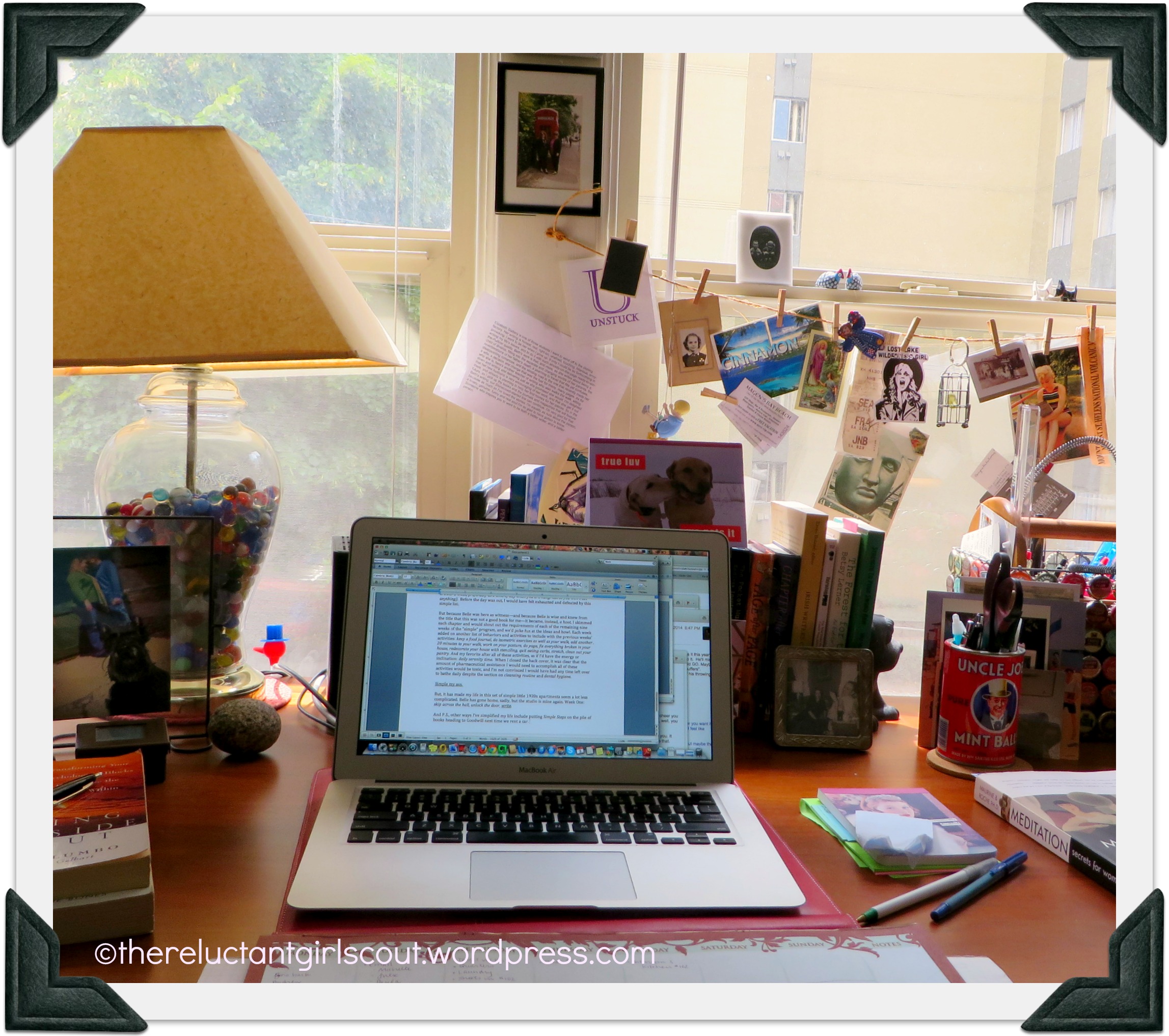
rgsdesk


When we got engaged, we looked at two-bedroom rentals within walking distance of campus because we needed more space than Z’s little 1920s one-bedroom apartment offered. With his three pieces of Craig’s List furniture and five batik wall hangings from Zimbabwe, the place looked spacious, but I come with a certain amount of baggage. I wasn’t prepared to begin a new life in a new city without my precious things: Amish-built furniture, objet d’art, childhood sock monkey, a herd of bulky Irish sweaters (too hot to wear in Seattle, fyi, but I like having them available should the weather take a turn), and the cloud of paper that follows me wherever I go, like Pig Pen’s dust. If we had stuffed all of my things into his apartment, we would have instantly been candidates for Hoarders: Newlywed Edition.


I loved Z’s apartment. Loved the woodwork and the big bank of windows overlooking a shady tree, how it felt to live smack in the middle of things, but most importantly, I loved its oldness, its crookedness, its sense of history. I imagined a bevy of nurses living here in the 1930s, walking to work at one of the many hospitals here on First Hill. I imagined what it might have been like for them to look out our windows and down to Elliott Bay, a sight we can’t see now because of a high rise full of partying youth that sits between us and the ferry-laden waters. It seemed like a simpler time, and I liked being in Z’s apartment pretending we would be living a simpler life together.


Neither of us are that strong at math, but when the apartment across the hall from his became available, it didn’t take a genius to figure out that it was cheaper to rent an entire bonus apartment in an old building whose only modern conveniences are electricity and running water than it was to rent one of those new, two-bedroom places with leather furniture and cappuccino machines in the lobby, triple-paned glass, walk-in closets, dishwashers, and personal washer-dryers that aren’t shared by the building’s inhabitants in a basement that some days smells like Satan’s backside. We decided immediately that the apartment across the hall would be a writing studio for me, a place to keep our newly acquired Kitchen-Aid mixer for our “baking center” (a use that had “failure” written on it before I ever tried my first batch of cookies—I’m not that strong a measurer, and it turns out a ring on a finger does not instantly make a woman domestically inclined), and guest quarters should family or friends decide to trek across the globe to see us. My only concern was that should Immigration Services ever get wind of our two-apartment lifestyle, they might make assumptions about our marriage that are untrue. (Though if they stopped by for tea and saw how often the bonus apartment is used as a storage facility, then they would believe! It is often nearly uninhabitable because of picnic gear, off-season clothing, stacks of finished books waiting to find homes, half-finished craft projects, and the other detritus of our life together. Plus Hudge parks her bike there when she rides over for a visit.)


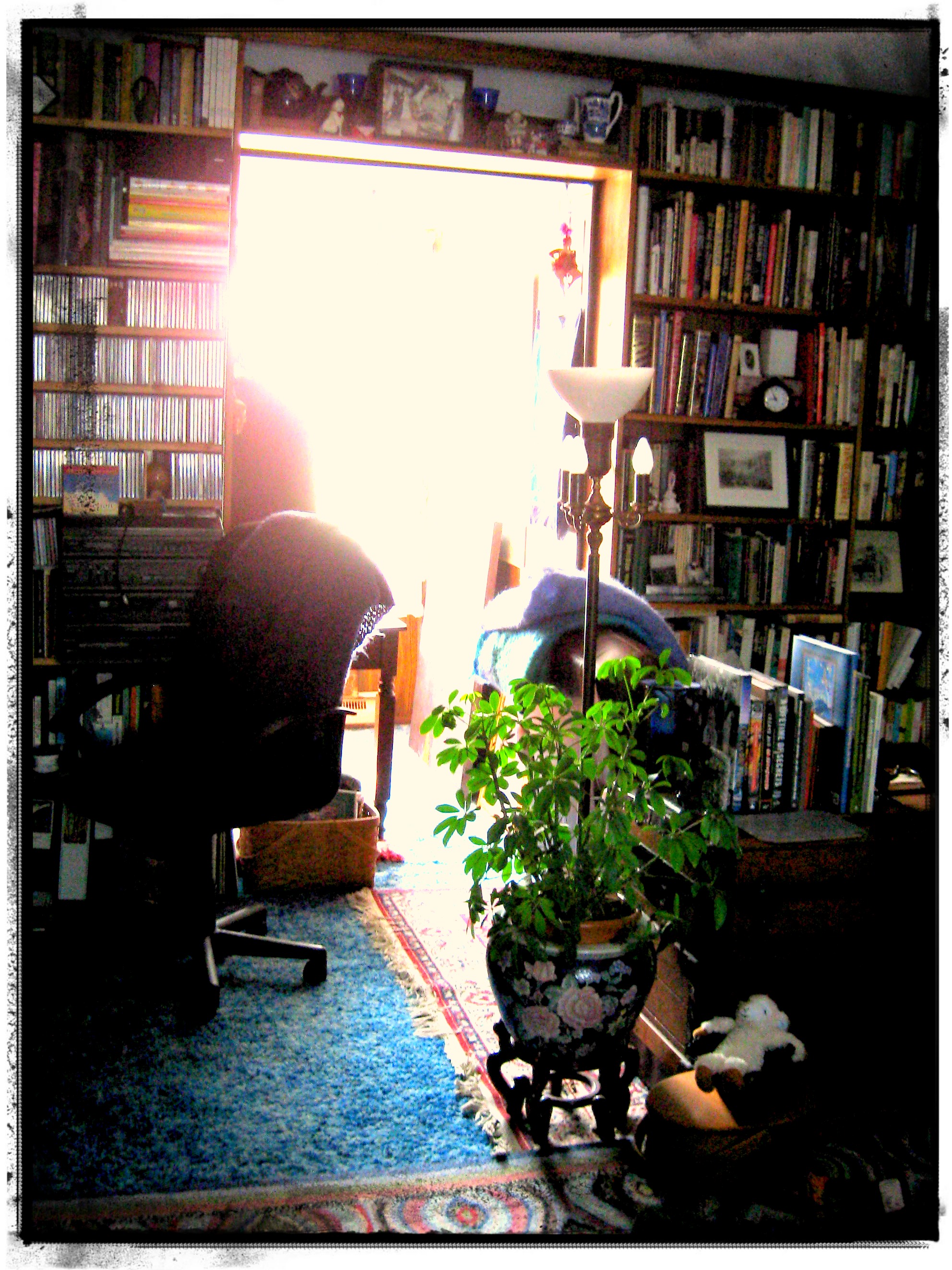
The problem with having two living spaces separated by two locked doors is that often I simply forget to go to the other space. The apartment where we live our lives is like a Nest of Inertia, and I often find it nearly impossible to lift myself off the sofa and walk across the hall to write at my desk, as if there are 100 lb. weights holding me down. I have this idea in mind that if those locks did not exist, I would wake up every morning and skip across the hall, plop down at my desk, and write for a giddy eight hours before skipping back “home” to greet Z when he returns at the end of the day. Instead, I think about going to the studio. I think about the light I love and how much I want to be there at the desk, and still, I sit under the weight of the identical apartment that feels more like home. It seems lonelier in the studio that has less of Z in it, which makes no sense. Both apartments are empty—Z is at work. What’s more, I LOVE my writing space. I feel like myself—my pre-married self, my childhood self, the self I was before I was born—when I am at this desk, yet too many days I deny myself the joy of being here and instead curl up in a ball on my corner in the Nest of Inertia and write. Or worse, I don’t write and instead just think about writing and hate myself a little. Or even worse still, I don’t write, don’t think about writing, and instead, invent things to do that have nothing to do with writing at all, like reorganizing the cutlery drawer.


There is no time I like my writing studio more than when we have a house guest who takes up residence in it and so being in it to write is no longer a viable option for me. My brain becomes electric with ideas. My fingers physically ache to be on a keyboard that is sitting on my desk. The books that surround the desk suddenly feel like all the books I should be reading right this minute. I’m very nearly jealous of our guests because they “get” to live in a space that I have access to  every other day of my life but too often ignore. Their presence, perhaps, frees it from being a lonely place where I am meant to face myself on the page every day and suddenly becomes a vacation getaway, where my ideas suddenly seem 100% more creative. The guests sit on the sofa, and I sit in my desk chair, spinning around while we talk, noticing things on which my eyes would not even land if this were one of my solitary writing days.


Last week Belle was here, and we spent time in my studio talking about her latest poetry manuscript and the pile of papers I’m trying to turn into a memoir if only the fog would clear in my brain. While we talked, I spun and scanned like a cheeky six year old sitting in Daddy’s Office Chair, feet off the floor, twirling. The chair would slow and I’d zero in on a particular book I felt a need to steal away from Belle’s domain and drag back to my lair across the hall. One such book was one I bought exactly 24 hours after declaring to Z that I would never, with God as my witness, buy another self-help book again. It is called Simple Steps, and promises on the cover that in ten simple weeks you can gain complete control over your life. It joins a host of other books that promise peace of mind to the Highly Sensitive INFP #4 Child of Divorce who is also an Anxiety-Ridden, Meditative, Mystic Disorganized Writer with big plans to start and maintain an illustrated journal. But this one—only TEN weeks to a healthy, more organized, thinner, stronger, de-cluttered, spiritual lifestyle?–who wouldn’t want that?


I remember when I bought the book three years ago, Z just shook his head in amusement. Not only was I already back-peddling on my no-more-self-help-books proclamation, but we’d just gotten married and while Z knows I’m not perfect, he really does not understand why I’m constantly trying to change these inherent parts of my personality. I’ll never be particularly tidy. I’m never going to be the housekeeper my mother is. I’m always going to nod off when I try to meditate. Why can’t I just accept myself the way he does?


Who knows. Each self-help book is like a little bundle of hope about the person I could become.


Had I been alone in the studio when I re-found this as yet un-read book, what would have happened is I would have started another journal with the plan of changing my life. I would have spent the first week following the authors’ simple steps (Week #1: drink 64 ounces of water a day, walk 20 minutes a day, save $2 a day, and clean out a drawer a week, preferably at a time of day when you are hungriest so you won’t eat anything). Before the day was out, I would have felt exhausted and defeated by this simple list, probably while I was drinking a Coke, and sitting amidst the contents of a half-decluttered drawer.


But because Belle was here as witness—and because Belle is wise and knew from the title that this was not a good book for me—it became, instead, a hoot. I skimmed each chapter and would shout out the requirements of each of the remaining nine weeks of the “simple” program, and we’d poke fun at the ideas and howl. Each week added on another list of behaviors and activities to include with the previous weeks’ activities: keep a food journal, do isometric exercises as well as your walk, add another 20 minutes to your walk, work on your posture, do yoga, fix everything broken in your house, redecorate your house with stenciling, quit eating carbs, stretch, clean out your pantry. And my favorite after all of these activities, as if I’d have the energy or inclination: daily serenity time. When I closed the back cover, it was clear that the amount of pharmaceutical assistance I would need to accomplish all of these activities would be toxic, and I’m not convinced I would have had any time left over to bathe daily despite the section on cleansing routine and dental hygiene.


Simple my ass.


But, it has made my life in this set of little 1920s apartments seem a lot less complicated. Belle has gone home, sadly, but the studio is mine again. Week One: skip across the hall, unlock the door, write.


And P.S., other ways I’ve simplified my life include putting Simple Steps on the pile of books heading to Goodwill next time we rent a car.



On Cousins and Only Children

Standard
Not me and G, Puget Sound, 2014

Not me and G, Puget Sound, 2014


The cure for what has been ailing me (homesickness, friendship distress, caffeine withdrawal, and general malaise) came this past week in the form of a seven- day visit from my cousin G. If you don’t have a cousin like her, then I give you permission to go berate your aunts and uncles right this minute for not producing one for you. Such a person really should be an unalienable right mentioned in the U.S. Declaration of Independence.


What did we do all week? I don’t remember. We walked by the water a lot, including a lovely long wade (or “paddle” as Z calls it) in Puget Sound. We went to bookstores and yarn stores and ate things we shouldn’t. We spent an afternoon on Hudge’s houseboat. Saturday night we went to the Seattle International Film Festival’s showing of the South African film Leading Lady, and had the added bonus of “Billy” from Ally McBeal sitting in the same row as us. (Other than taking some blurry photos, we acted nonchalant with this brush with B-list fame.)


But mostly, we just talked. Yesterday I woke up and realized she wasn’t still in residence, and I felt decidedly ho-hum about life in her absence. It was good to have a paisano in the house.


Though I acquired two half-brothers as a young adult (and am now reaping the benefits of aunthood), I was an only child for the whole of my childhood. I was not one of those lonely, pitiful characters in literature like Jane Eyre who has no family, but instead grew up a few miles from my cousins on my mother’s side, which meant weekends and summers in the country with them, avoiding cow pats as we played in the fields, demanding one of the endless Eskimo Pies my grandmother kept in the freezer, rubbing my allergy-inclined face onto the fur of barn kittens, and riding a garden tractor/go-cart/Radio Flyer train around the barnyard while dressed in our best parade finery (which mostly involved fancy hats and Nerf balls stuck under our shirts, Dolly Parton style). From these cousins, I learned a little of the positive side of what it might be like to have siblings (the camaraderie! the similar family experience! the Eskimo Pies!) with only a hint of the dark side (the arguments! parentally-forced sharing! the hair pulling!) Often now that I’m in Seattle and feeling a longing for home, it isn’t lost on me that I’m not missing home so much as I’m missing 1974 in a tire swing at my grandparents’ house, waiting on the cousins to arrive and the fun to begin.


G was not one of these cousins. Since my parents divorced when I was young and since all of my cousins on Dad’s side lived in different parts of Indiana, I often felt less connected. I went through a period of time when I wasn’t even sure if I belonged anymore, like somehow those cousins with their intact families were more legitimate than I was.


Once a year or so, we’d all get together and it would take awhile for me to feel satisfactorily reacquainted with them. Because I was the baby girl, I was often in awe of my older cousins, studying how they dressed, what they did, what they read and listened to, and then attempted to incorporate it all into my life. From these paternal cousins, I developed an affection for horror movies (for a time), miniature golf, Shakespeare and John Irving novels, and, randomly, the Carpenters and the Beach Boys even though we were really too young for this to be “our” music. I loved these cousins, but they were more like exotic, affectionate strangers than the closer, more sibling-like connection I had with my cousins back home in Wayne County.


I can’t pinpoint when the magic happened on my dad’s side of the family. It was after we were all out of college but before the family funerals started adding up. For me, it was as if a switch was flipped and suddenly I realized how much I genuinely liked these cousins. We didn’t grow up together. Our lives had evolved differently. And yet, we were somehow connected. I’m convinced that if I’d never met them and then bumped into them at a cocktail party, I would have gravitated to all of them intuitively. They’re smart, well read, wickedly funny and somehow. . . familiar.


G’s familiarity is still a source of wonder to me. Six years separate us and our life experiences have been very different, yet we get each other. One of us might say, “I think I’m weird because I …” and before the sentence can be finished, the other is nodding her head and admitting to doing or thinking the same thing. Maybe it’s because we’re both Capricorns or share a bunch of similar letters on the Myers-Briggs Temperament Indicator. Maybe it’s just genetics. I don’t know. All I do know, is the day of my father’s funeral when I was sitting on the front “immediate family only” pew feeling very alone, I looked behind at G with what must have been a face of misery, and she nodded, knowing intuitively what I needed, and without saying a word, skooched herself out of the crowded row she was in, and came to sit beside me, leaning in and making the whole rotten experience bearable. Who doesn’t feel lucky to have that in her life? Could a sister have offered me more than that?


Right after I met Z, she is the one I took to scope him out and see if I was delusional or if he seemed like he had potential. He was working a bean-bag toss at the university Homecoming carnival and had no idea he was under surveillance. She gave him an enthusiastic thumbs up and kept giving it, years later after everyone else’s enthusiasm for Z was waning, and even mine was beginning to ebb because he was operating on what I would later learn was “African time.” Five years after the bean-bag toss when I was starting to feel mostly done with him, she dragged me out to buy new Z-catching eye shadow and gave me a pep talk about destiny, and a few weeks later, he told me his heart had shifted. (It was awesome drugstore eye shadow—if you have unrequited love, I recommend it.)


So a few years later when Z and I got married, it was only natural that I’d want G, who had been there on the worst day, to be my “best woman” on the best day. She even patiently gave in to my desire that she be gussied up like a Disney princess, along with me, never mind our middle-agedness and how we should have been wearing something more subdued and matronly, like grey pantsuits, instead of sparkle and shine.


When someone tells me they plan to have only one child, I never feel badly for that kid. The only downfall I can remember to my “only” status was the assumption by people that an only child was naturally bratty and spoiled. (It’s worth noting that these people making these claims always had multiple ill-behaved children.) Instead, I loved being just me. Loved the pockets of solitude and being treated like a little adult instead of one of the wildings in Lord of the Flies.


But maybe I can say I loved being an only child simply because I was rich with cousins. A cousin-less life sounds much less enticing to me.


Now if I can just get the other eleven to visit.

In Praise of a Rainy Memorial Day Weekend

Standard
Lake Washington, Seattle

Lake Washington, Seattle


I once had a student who claimed to be psychic tell me that I had a problem with jealousy. “You’re a jealous person,” she said. “You should work on that.” I stood in front of her gawping, trying to imagine a scenario where I might have given a college prof unsolicited psychic advice. But then again, I’m not clairvoyant.


I wanted to give the student an automatic D for cheekiness but quickly banished the thought before she could intuit my intentions. She was, after all, a good student. Even if she had it wrong.


I’m not jealous so much as I am given to small fits of envy, which is, I think, an entirely different animal. Jealousy makes you scheme and plot and try to steal things away from other people that you want and believe to be rightfully yours. Envy just makes you miserable because you have this notion that you are lacking something other people have managed to provide for themselves.


For the last several years, basking here in Z’s love and all of our glorious freedom and good times, a lot of the things I used to be envious of don’t even phase me now. Someone gets a new house? Good for them! Someone has a new baby? How exciting and life affirming! Someone goes on vacation? What was it like? Someone gets a new dog? When can I see it, please?


But then a summer holiday like last week’s Memorial Day rolls around, and my green eyes get greener. On any given day when Z and I are sitting beside Lake Washington in our relaxi chairs, reading, I’m happy. Any time we score an hour or two on Hudge’s houseboat on Portage Bay, I’m pretty content. But if it is a summer holiday, I can only assume that everyone we see is with family or a big group of old, close friends, cooking out, playing croquet, sailing. Living some version of the American Dream that I’ve failed to provide for myself.


It didn’t help this year that I came home from Indiana feeling six degrees more homesick than usual. And I was already crabby because of the weekend-long, self-congratulatory posts on Facebook that imply the poster knows how to patriotically observe Memorial Day (which they believe is three days long), while I must surely be an ingrate who needs reminding and barely deserves my American citizenship. It also didn’t help that I’ve had a stomach thing going on that’s had me on the world’s blandest food for two weeks.


It really, really didn’t help on Saturday when Z and I tried to go to Golden Gardens, one of our favorite city parks with gorgeous views of Puget Sound, only to discover the parking lots were full and the place was crawling with people who had a similar idea. (We were reminded of the time two years ago when we took my mother there for a quiet picnic in a stand of trees by ourselves, only to soon be surrounded by fools balancing on slacklines and blocking our views, hula hoopers gyrating in front of us, and, I kid you not, someone with fire batons that they tossed in the air dangerously close to us. It was as if we’d accidentally set up our picnic blanket in the middle of a circus.) Last Saturday, as we drove around hoping to score a parking spot, Z and I looked at each other and one of us said, “I forgot how much I hate summer in Seattle,” and the other one concurred. It’s a refrain we’ll be repeating until September, especially when the cruise ships roll into town, crowding things up even more than they already are.


And so I thought about how if only we were in Indiana (though not by the Speedway where the Indy 500 would be running) we wouldn’t have to jockey for a park bench and we could rest our eyes on a landscape not littered with humans. My homesickness was compounded.


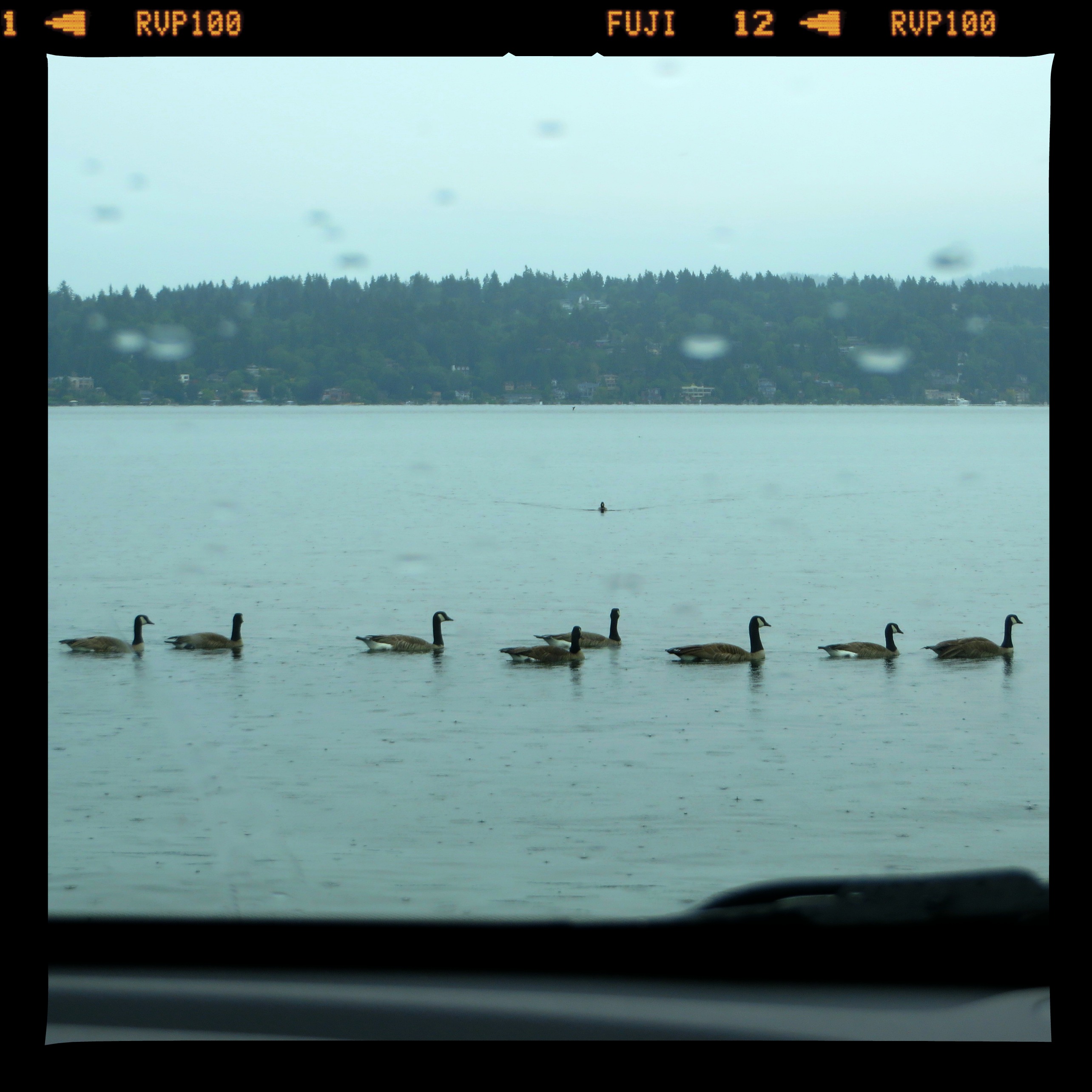
On Sunday, when I woke up to one of those hard rains that had set in for the whole day, the corners of my mouth twitched into a small smile. When Z and I decided to drive to Lake Washington and we did not have to dodge any cyclists or fight for a parking space, the smile got larger. We parked at a boat dock, where no boats were bothering to venture out so miserable was the day, and we sat listening to the rain on the roof of our rental car. We watched a gaggle of geese, wave patterns, a soggy Labrador being walked by his soggier owner. I napped.


There was a tiny, naughty part of me that delighted in the notion of other people’s fabulous plans being ruined, but I instantly felt a smidgen of guilt and did quick penance of saying to no one in particular, “Sorry about your plans.”


No. It wasn’t a good day because other people’s plans were ruined; it was a good day because there were no expectations by anyone, including myself, that the day should be more fabulous than it was. There was no reason for envy.


And the rain on that roof was so soothing.