Curmudgeons in the City

Standard
Not Treme. The French Quarter.

Not Treme. The French Quarter.

It got a little warm in Seattle this past week. There was virtually no humidity and were it in the 80s in Indiana with no humidity, it would be considered a nice summer’s day, but here, it is too hot. I believe you are familiar with my policy on summer and heat.


Few people here have air conditioning because it’s needed so rarely, and those who do don’t use it right, which leaves a girl clammy and gasping for breath. How we know it is hot in our place is if we have to open the bedroom window, which remains shut about eleven months out of the year because evenings here are generally cool. It’s been a week with the window open.


Our bedroom window is next to the intercom for the building. When Z moved in, the old intercom was loud and made horrible honking noises, so we were excited when they replaced it, but the new one is worse. For no good reason, it makes an electronic beep—like an alarm trying to wake you—as a guest scrolls through each name trying to find the person she knows. Beep, beep, beep, beep, beep. And then, finally, blessedly, the sound of a phone ringing and the longer beep that lets the person in. Most of the visitors seem to be friends with people whose last name begins with V and the names are sadly listed in alphabetical order, which means a whole lot of beeping. It’s a very inefficient system both for the buzzee and for the people trying to sleep next to the buzzer. In the winter, it’s just kind of a distant mosquito wing of a sound, but when the window is open, the intercom might as well be attached to a bullhorn.


The surprise of this summer when I opened the window for the first time to prop the fan in it was that our screen was missing. I have this idea that someone who wanted a screen performed some acrobatics to jerk it out of our crooked windowsill. Z has this idea— and probably the correct one because his world view is less dark and twisty than mine—that the screen became loose, fell out, and the maintenance woman removed it from where it fell. We have one of those accordion-style fans that sits in the window, so it’s sort of like having a screen, but I swear, it makes everything outside even louder because we’re down one layer of mesh between us and the noise of the city.


Z and I have been binging on Treme episodes this past week. We are late coming to the show, so there won’t be any spoilers here, wrecking anyone’s goodtime. While watching it, I’ve been feeling envious of the folks in the show, which is no mean feat because post-Katrina New Orleans where the series is set was no kind of place to be. But there is something about the uniqueness of New Orleans and all that place-specific culture that makes me extra envious. They have a parade, I feel envious. They eat a bowl of gumbo, I feel envious. They have a jazzy funeral procession, I feel envious. I didn’t eat gumbo when I was in New Orleans three years ago, I don’t particularly like jazz, and a funeral, no matter how festive, is still sad, so I’m not sure exactly what I’m envious of other than this very specific sense of belonging and culture that seems to come from the location. You’ve heard me whine about Indiana and how much I miss it, but a lot of the things I miss from there would be the same in Ohio or Northern Kentucky or Illinois. I can’t even get ten Hoosiers to agree with me that John Mellencamp is a better musician and lyricist than Bruce Springsteen. Z is used to having students who hear him and say, “I wish I had an accent” or who say, “I wish I had a culture” and he always laughs and points out to them that they do have accents, they do have a culture. At the risk of sounding like one of his students, when I watch Treme, I feel the same way. I wish I had a specific, discernible, place-specific culture.


For those of you who don’t know, much of Treme is set in a neighborhood of the same name that is musically and culturally rich. It’s a cacophonous place where you shouldn’t plan to find peace and quiet. There is music. There is hooting and hollering. There is life being lived, loudly. In one scene in the first episode, Steve Zahn’s character, Davis McAlary, a New Orleanian musician-cum-dj, turns his speakers outward to blast his neighbors, a couple who have recently moved in to gentrify the neighborhood and whom, he believes, have called the cops on him. He gets in an argument with the couple about the justification of the noise, explaining everything he believes they don’t know about the neighborhood they’ve moved into. He says to them, “You’re living in the Treme. Gotta deal with that shit.” Because we like the character and we are suspicious of all the ways our own neighborhood has “gentrifically” changed in the eight years since Z moved in, we both felt a sort of righteous kinship with Davis and his speech. That’s right. The city is about tolerance of other people. Amen, Davis.


And then later that night, the people sitting on the stoop right outside our bedroom window showed no sign of moving their party indoors. It’s a favorite place for our young neighbors to hang out with friends, smoking the cigarettes they don’t want stinking up their apartments and talking animatedly as they sip on beer, stroking their own neck tattoos thoughtfully while they solve the world’s problems. It’s mildly annoying at 10 p.m., but at 3:30 a.m. on a Sunday night, it feels criminal. So Z pulls on his relaxi pants and stuffs his feet into his Crocs and shuffles out to the front door to tell them, very dad-like, that it’s time for their party to move indoors or quiet down. They apologize and start whispering, which was, frankly, not the scenario I was imagining after hearing Davis blast his neighbors for being uptight fuddy-duddies.I thought, perhaps, there would be vocal retaliation.


The next day, Z and I walked down to the waterfront. It was a gorgeous day, as most days in the summer are. Blue, clear skies. The Olympic Mountains showing themselves in ways they rarely do in winter. Everyone happy not to be under an umbrella, avoiding puddles. But it was hot. And there were so many tourists, gawping in the middle of the street, so we had to navigate around them as if it were an obstacle course. People were hacking and spitting and riding skateboards right in front of us. Everyone seemed dirty and sweaty and loud. I complain too much about Seattle, particularly to Z whose general dispensation is about ten clicks more content than mine, so I was determined not to whine about how much I hate the city in summer, how much I hate not having a car so we can escape it when we want, how much I think if I hear one more siren or horn honk or late-night howl from a drunk that I will lose my mind. So I sweated and huffed and puffed as we started our assent up the hill to home. A man we passed hawked a loogie on the pavement in front of us.


Z looked at me and said, “I’m not loving the city today. It occurs to me, that we would not be happy living in Treme.”


I’ll probably always get a thrill when I hear John Boutté’s Treme Song playing. I’ll always have this idea that if I lived in the Crescent City I’d embrace it and feel fully alive there (and those four years studying French would finally kind of pay off). But the truth is, I’m thinking we need to start buying more lottery tickets so we can have a small fuel-efficient car and an island house where we can spend quiet, peaceful weekends. Some place with screens and neighbors on our distant margins.


A Cure for the Simple Life

Standard

rgsdesk


When we got engaged, we looked at two-bedroom rentals within walking distance of campus because we needed more space than Z’s little 1920s one-bedroom apartment offered. With his three pieces of Craig’s List furniture and five batik wall hangings from Zimbabwe, the place looked spacious, but I come with a certain amount of baggage. I wasn’t prepared to begin a new life in a new city without my precious things: Amish-built furniture, objet d’art, childhood sock monkey, a herd of bulky Irish sweaters (too hot to wear in Seattle, fyi, but I like having them available should the weather take a turn), and the cloud of paper that follows me wherever I go, like Pig Pen’s dust. If we had stuffed all of my things into his apartment, we would have instantly been candidates for Hoarders: Newlywed Edition.


I loved Z’s apartment. Loved the woodwork and the big bank of windows overlooking a shady tree, how it felt to live smack in the middle of things, but most importantly, I loved its oldness, its crookedness, its sense of history. I imagined a bevy of nurses living here in the 1930s, walking to work at one of the many hospitals here on First Hill. I imagined what it might have been like for them to look out our windows and down to Elliott Bay, a sight we can’t see now because of a high rise full of partying youth that sits between us and the ferry-laden waters. It seemed like a simpler time, and I liked being in Z’s apartment pretending we would be living a simpler life together.


Neither of us are that strong at math, but when the apartment across the hall from his became available, it didn’t take a genius to figure out that it was cheaper to rent an entire bonus apartment in an old building whose only modern conveniences are electricity and running water than it was to rent one of those new, two-bedroom places with leather furniture and cappuccino machines in the lobby, triple-paned glass, walk-in closets, dishwashers, and personal washer-dryers that aren’t shared by the building’s inhabitants in a basement that some days smells like Satan’s backside. We decided immediately that the apartment across the hall would be a writing studio for me, a place to keep our newly acquired Kitchen-Aid mixer for our “baking center” (a use that had “failure” written on it before I ever tried my first batch of cookies—I’m not that strong a measurer, and it turns out a ring on a finger does not instantly make a woman domestically inclined), and guest quarters should family or friends decide to trek across the globe to see us. My only concern was that should Immigration Services ever get wind of our two-apartment lifestyle, they might make assumptions about our marriage that are untrue. (Though if they stopped by for tea and saw how often the bonus apartment is used as a storage facility, then they would believe! It is often nearly uninhabitable because of picnic gear, off-season clothing, stacks of finished books waiting to find homes, half-finished craft projects, and the other detritus of our life together. Plus Hudge parks her bike there when she rides over for a visit.)


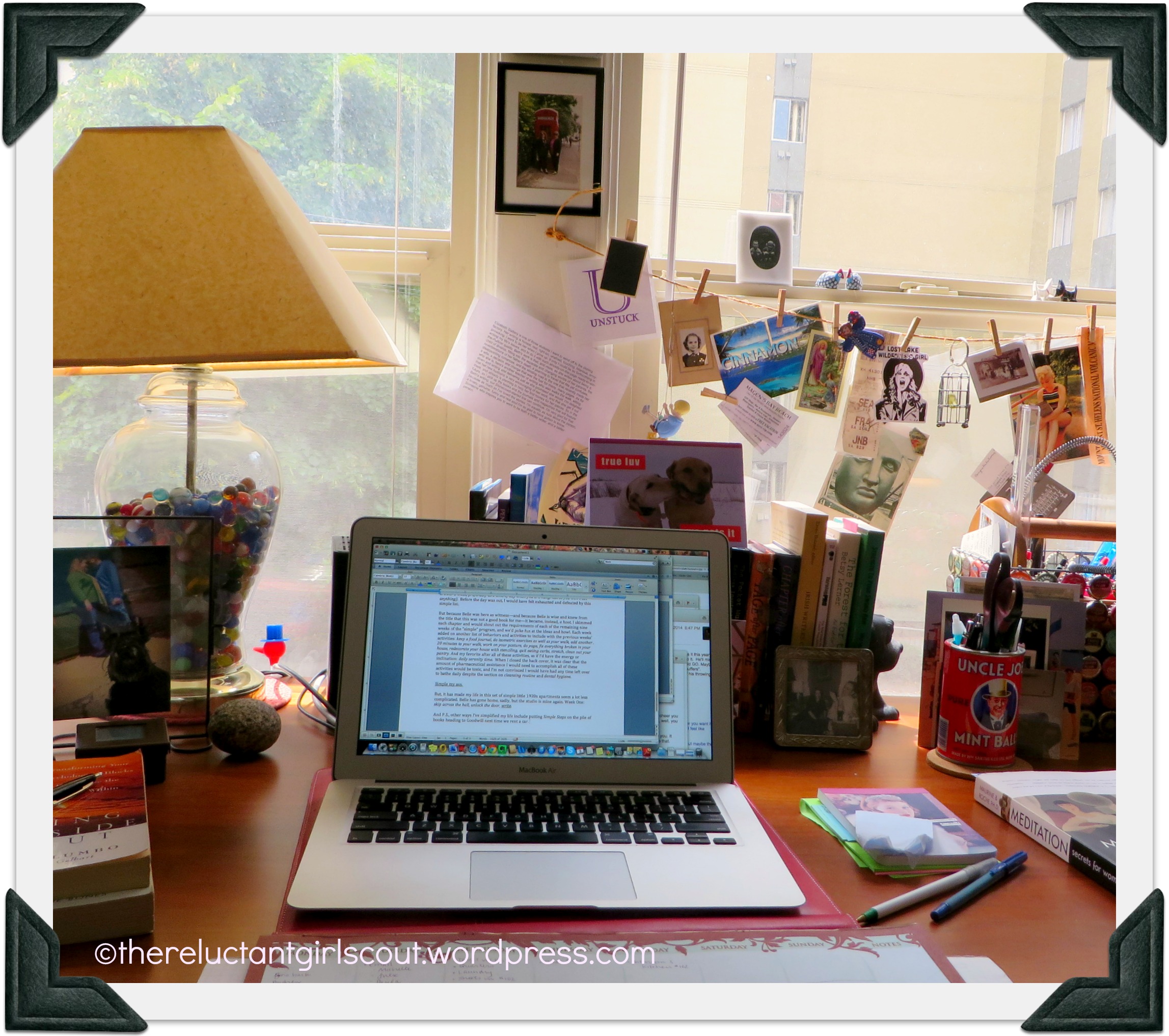
The problem with having two living spaces separated by two locked doors is that often I simply forget to go to the other space. The apartment where we live our lives is like a Nest of Inertia, and I often find it nearly impossible to lift myself off the sofa and walk across the hall to write at my desk, as if there are 100 lb. weights holding me down. I have this idea in mind that if those locks did not exist, I would wake up every morning and skip across the hall, plop down at my desk, and write for a giddy eight hours before skipping back “home” to greet Z when he returns at the end of the day. Instead, I think about going to the studio. I think about the light I love and how much I want to be there at the desk, and still, I sit under the weight of the identical apartment that feels more like home. It seems lonelier in the studio that has less of Z in it, which makes no sense. Both apartments are empty—Z is at work. What’s more, I LOVE my writing space. I feel like myself—my pre-married self, my childhood self, the self I was before I was born—when I am at this desk, yet too many days I deny myself the joy of being here and instead curl up in a ball on my corner in the Nest of Inertia and write. Or worse, I don’t write and instead just think about writing and hate myself a little. Or even worse still, I don’t write, don’t think about writing, and instead, invent things to do that have nothing to do with writing at all, like reorganizing the cutlery drawer.


There is no time I like my writing studio more than when we have a house guest who takes up residence in it and so being in it to write is no longer a viable option for me. My brain becomes electric with ideas. My fingers physically ache to be on a keyboard that is sitting on my desk. The books that surround the desk suddenly feel like all the books I should be reading right this minute. I’m very nearly jealous of our guests because they “get” to live in a space that I have access to  every other day of my life but too often ignore. Their presence, perhaps, frees it from being a lonely place where I am meant to face myself on the page every day and suddenly becomes a vacation getaway, where my ideas suddenly seem 100% more creative. The guests sit on the sofa, and I sit in my desk chair, spinning around while we talk, noticing things on which my eyes would not even land if this were one of my solitary writing days.


Last week Belle was here, and we spent time in my studio talking about her latest poetry manuscript and the pile of papers I’m trying to turn into a memoir if only the fog would clear in my brain. While we talked, I spun and scanned like a cheeky six year old sitting in Daddy’s Office Chair, feet off the floor, twirling. The chair would slow and I’d zero in on a particular book I felt a need to steal away from Belle’s domain and drag back to my lair across the hall. One such book was one I bought exactly 24 hours after declaring to Z that I would never, with God as my witness, buy another self-help book again. It is called Simple Steps, and promises on the cover that in ten simple weeks you can gain complete control over your life. It joins a host of other books that promise peace of mind to the Highly Sensitive INFP #4 Child of Divorce who is also an Anxiety-Ridden, Meditative, Mystic Disorganized Writer with big plans to start and maintain an illustrated journal. But this one—only TEN weeks to a healthy, more organized, thinner, stronger, de-cluttered, spiritual lifestyle?–who wouldn’t want that?


I remember when I bought the book three years ago, Z just shook his head in amusement. Not only was I already back-peddling on my no-more-self-help-books proclamation, but we’d just gotten married and while Z knows I’m not perfect, he really does not understand why I’m constantly trying to change these inherent parts of my personality. I’ll never be particularly tidy. I’m never going to be the housekeeper my mother is. I’m always going to nod off when I try to meditate. Why can’t I just accept myself the way he does?


Who knows. Each self-help book is like a little bundle of hope about the person I could become.


Had I been alone in the studio when I re-found this as yet un-read book, what would have happened is I would have started another journal with the plan of changing my life. I would have spent the first week following the authors’ simple steps (Week #1: drink 64 ounces of water a day, walk 20 minutes a day, save $2 a day, and clean out a drawer a week, preferably at a time of day when you are hungriest so you won’t eat anything). Before the day was out, I would have felt exhausted and defeated by this simple list, probably while I was drinking a Coke, and sitting amidst the contents of a half-decluttered drawer.


But because Belle was here as witness—and because Belle is wise and knew from the title that this was not a good book for me—it became, instead, a hoot. I skimmed each chapter and would shout out the requirements of each of the remaining nine weeks of the “simple” program, and we’d poke fun at the ideas and howl. Each week added on another list of behaviors and activities to include with the previous weeks’ activities: keep a food journal, do isometric exercises as well as your walk, add another 20 minutes to your walk, work on your posture, do yoga, fix everything broken in your house, redecorate your house with stenciling, quit eating carbs, stretch, clean out your pantry. And my favorite after all of these activities, as if I’d have the energy or inclination: daily serenity time. When I closed the back cover, it was clear that the amount of pharmaceutical assistance I would need to accomplish all of these activities would be toxic, and I’m not convinced I would have had any time left over to bathe daily despite the section on cleansing routine and dental hygiene.


Simple my ass.


But, it has made my life in this set of little 1920s apartments seem a lot less complicated. Belle has gone home, sadly, but the studio is mine again. Week One: skip across the hall, unlock the door, write.


And P.S., other ways I’ve simplified my life include putting Simple Steps on the pile of books heading to Goodwill next time we rent a car.


Flashback Friday Night: Snakes I Have Loathed

Standard
Horrible, Scottie-eating snake.

Scottie-eating snake. A cobra, perhaps? A python? Something horrible.

(Earlier today, I was forced to stare at a metaphorical snake and my blood ran cold. Fortunately, it wasn’t feeling any animosity toward me and so slithered away to sun itself on a rock somewhere. Even so, this seemed a timely post from eight years ago when I was staying at Mac the Scottie Wonder Dog’s house.)


15 June 2006

I hate snakes. Call it irrational, girly, predictable, whatever you want, but I  think all snakes should die, or, when I’m in a more goodwill-toward-all sort of mood, then I would be satisfied if they were all quarantined on an island somewhere so I could easily avoid it. I don’t feel this way about spiders or mice–in fact, I regularly spring the mouse traps set at the Dog House because it seems like bad, bad karma to eighty-six something so cute who is just out there trying to make a living like the rest of us.

But snakes are a different story and I’m not even from a part of the world where they are poisonous.

Several years ago I had a grandmotherly student who was not a native speaker of English. I was fond of her despite how difficult her papers were to decipher. Aside from the ESL issues, her thoughts often seemed jumbled and it was difficult to figure out how the ideas were connected. She once wrote a paper in which she talked frequently about “sneaks.”  For an evening, I tried to piece together what she really wanted her paper to be about. I pictured people who were out to get her, sneaking around her neighborhood, maybe painting racial epithets on her garage door or rifling through her garbage in the early-morning hours, co-workers sneaking behind her back and trying to make her life difficult. I wondered briefly if perhaps her husband had been sneaking around on her but she was afraid to write boldy about such a personal betrayal and so made her essay vague in order to protect herself.

After the third read-thru, it dawned on me that “sneaks” were really SNAKES. It was, perhaps, the strongest paper she ever wrote for the class, her hatred of snakes seemed to help her unify her thoughts.

Today, I let Mac out and two seconds later heard this awful caterwauling on the kitchen deck. I looked out in time to see a giant snake coiled up and ready to lunge at my sweet Scottie. Mac has a ferocious bark and tenacious spirit, and while both of these things should have scared the snake off, neither did. I called the dog in but the snake then glared at us through the patio door, still coiled and ready to strike. He opened his mouth, wide, to show us what he was made of. Mac whimpered, desperate to tear into this invader. I poked at the glass and made noises meant to scare it off, but the snake just stared at me, sitting on its snake-haunches, on the verge of attack. It didn’t leave until Mac and I walked away from the window and let it “win.” I haven’t let the dog out since.

(And yes, I did have to go through that paragraph and make it gender neutral because I always think of snakes as “he.”)

There are a lot of fantastical things in the Bible–people turning to pillars of salt, burning bushes, walking on water–but I’ve never had a problem with believing any of it. Today, though, I’m thinking the whole Garden of Eden story is a real crock. What self-respecting woman would talk to a snake? I just don’t think it would happen. They are all side-windy and slithery and awful. I can see how Eve might have been hoodwinked by a honey-tongued snake-like fruit salesman, whispering in her ear and telling her that his apples were better than anyone else’s while he twirled his moustahce, but an actual, honest-to-goodness snake? I don’t think so. I like to think the mother-of-us-all would have been cleverer and looked for a way to avoid a serpent confrontation.

At school, I regularly have students–almost always female, usually those with tattoos of pentagrams who smell of patchouli–who insist that snakes are wonderful, loving pets, but I never believe them. You can’t curl up with a snake and watch old Frasier reruns, like the Scottie Dog and I did last night. What you can do with a pet snake is take it out of its aquarium in an attempt to make guests uncomfortable. That’s about it. I’ve always thought how awful it was that cats were regularly murdered in medieval times (and beyond) because they were associated with witchcraft. How ignorant and heartless, I’d think. But snakes? If there were an anti-snake mob out there with the torches and  zeal? I’d probably join in, shouting and shaking a cudgel, ready to make the neighborhood safer.

Except for the part where I might actually have to face one of the sneaks. Ugh.


On Cousins and Only Children

Standard
Not me and G, Puget Sound, 2014

Not me and G, Puget Sound, 2014


The cure for what has been ailing me (homesickness, friendship distress, caffeine withdrawal, and general malaise) came this past week in the form of a seven- day visit from my cousin G. If you don’t have a cousin like her, then I give you permission to go berate your aunts and uncles right this minute for not producing one for you. Such a person really should be an unalienable right mentioned in the U.S. Declaration of Independence.


What did we do all week? I don’t remember. We walked by the water a lot, including a lovely long wade (or “paddle” as Z calls it) in Puget Sound. We went to bookstores and yarn stores and ate things we shouldn’t. We spent an afternoon on Hudge’s houseboat. Saturday night we went to the Seattle International Film Festival’s showing of the South African film Leading Lady, and had the added bonus of “Billy” from Ally McBeal sitting in the same row as us. (Other than taking some blurry photos, we acted nonchalant with this brush with B-list fame.)


But mostly, we just talked. Yesterday I woke up and realized she wasn’t still in residence, and I felt decidedly ho-hum about life in her absence. It was good to have a paisano in the house.


Though I acquired two half-brothers as a young adult (and am now reaping the benefits of aunthood), I was an only child for the whole of my childhood. I was not one of those lonely, pitiful characters in literature like Jane Eyre who has no family, but instead grew up a few miles from my cousins on my mother’s side, which meant weekends and summers in the country with them, avoiding cow pats as we played in the fields, demanding one of the endless Eskimo Pies my grandmother kept in the freezer, rubbing my allergy-inclined face onto the fur of barn kittens, and riding a garden tractor/go-cart/Radio Flyer train around the barnyard while dressed in our best parade finery (which mostly involved fancy hats and Nerf balls stuck under our shirts, Dolly Parton style). From these cousins, I learned a little of the positive side of what it might be like to have siblings (the camaraderie! the similar family experience! the Eskimo Pies!) with only a hint of the dark side (the arguments! parentally-forced sharing! the hair pulling!) Often now that I’m in Seattle and feeling a longing for home, it isn’t lost on me that I’m not missing home so much as I’m missing 1974 in a tire swing at my grandparents’ house, waiting on the cousins to arrive and the fun to begin.


G was not one of these cousins. Since my parents divorced when I was young and since all of my cousins on Dad’s side lived in different parts of Indiana, I often felt less connected. I went through a period of time when I wasn’t even sure if I belonged anymore, like somehow those cousins with their intact families were more legitimate than I was.


Once a year or so, we’d all get together and it would take awhile for me to feel satisfactorily reacquainted with them. Because I was the baby girl, I was often in awe of my older cousins, studying how they dressed, what they did, what they read and listened to, and then attempted to incorporate it all into my life. From these paternal cousins, I developed an affection for horror movies (for a time), miniature golf, Shakespeare and John Irving novels, and, randomly, the Carpenters and the Beach Boys even though we were really too young for this to be “our” music. I loved these cousins, but they were more like exotic, affectionate strangers than the closer, more sibling-like connection I had with my cousins back home in Wayne County.


I can’t pinpoint when the magic happened on my dad’s side of the family. It was after we were all out of college but before the family funerals started adding up. For me, it was as if a switch was flipped and suddenly I realized how much I genuinely liked these cousins. We didn’t grow up together. Our lives had evolved differently. And yet, we were somehow connected. I’m convinced that if I’d never met them and then bumped into them at a cocktail party, I would have gravitated to all of them intuitively. They’re smart, well read, wickedly funny and somehow. . . familiar.


G’s familiarity is still a source of wonder to me. Six years separate us and our life experiences have been very different, yet we get each other. One of us might say, “I think I’m weird because I …” and before the sentence can be finished, the other is nodding her head and admitting to doing or thinking the same thing. Maybe it’s because we’re both Capricorns or share a bunch of similar letters on the Myers-Briggs Temperament Indicator. Maybe it’s just genetics. I don’t know. All I do know, is the day of my father’s funeral when I was sitting on the front “immediate family only” pew feeling very alone, I looked behind at G with what must have been a face of misery, and she nodded, knowing intuitively what I needed, and without saying a word, skooched herself out of the crowded row she was in, and came to sit beside me, leaning in and making the whole rotten experience bearable. Who doesn’t feel lucky to have that in her life? Could a sister have offered me more than that?


Right after I met Z, she is the one I took to scope him out and see if I was delusional or if he seemed like he had potential. He was working a bean-bag toss at the university Homecoming carnival and had no idea he was under surveillance. She gave him an enthusiastic thumbs up and kept giving it, years later after everyone else’s enthusiasm for Z was waning, and even mine was beginning to ebb because he was operating on what I would later learn was “African time.” Five years after the bean-bag toss when I was starting to feel mostly done with him, she dragged me out to buy new Z-catching eye shadow and gave me a pep talk about destiny, and a few weeks later, he told me his heart had shifted. (It was awesome drugstore eye shadow—if you have unrequited love, I recommend it.)


So a few years later when Z and I got married, it was only natural that I’d want G, who had been there on the worst day, to be my “best woman” on the best day. She even patiently gave in to my desire that she be gussied up like a Disney princess, along with me, never mind our middle-agedness and how we should have been wearing something more subdued and matronly, like grey pantsuits, instead of sparkle and shine.


When someone tells me they plan to have only one child, I never feel badly for that kid. The only downfall I can remember to my “only” status was the assumption by people that an only child was naturally bratty and spoiled. (It’s worth noting that these people making these claims always had multiple ill-behaved children.) Instead, I loved being just me. Loved the pockets of solitude and being treated like a little adult instead of one of the wildings in Lord of the Flies.


But maybe I can say I loved being an only child simply because I was rich with cousins. A cousin-less life sounds much less enticing to me.


Now if I can just get the other eleven to visit.

In Praise of a Rainy Memorial Day Weekend

Standard
Lake Washington, Seattle

Lake Washington, Seattle


I once had a student who claimed to be psychic tell me that I had a problem with jealousy. “You’re a jealous person,” she said. “You should work on that.” I stood in front of her gawping, trying to imagine a scenario where I might have given a college prof unsolicited psychic advice. But then again, I’m not clairvoyant.


I wanted to give the student an automatic D for cheekiness but quickly banished the thought before she could intuit my intentions. She was, after all, a good student. Even if she had it wrong.


I’m not jealous so much as I am given to small fits of envy, which is, I think, an entirely different animal. Jealousy makes you scheme and plot and try to steal things away from other people that you want and believe to be rightfully yours. Envy just makes you miserable because you have this notion that you are lacking something other people have managed to provide for themselves.


For the last several years, basking here in Z’s love and all of our glorious freedom and good times, a lot of the things I used to be envious of don’t even phase me now. Someone gets a new house? Good for them! Someone has a new baby? How exciting and life affirming! Someone goes on vacation? What was it like? Someone gets a new dog? When can I see it, please?


But then a summer holiday like last week’s Memorial Day rolls around, and my green eyes get greener. On any given day when Z and I are sitting beside Lake Washington in our relaxi chairs, reading, I’m happy. Any time we score an hour or two on Hudge’s houseboat on Portage Bay, I’m pretty content. But if it is a summer holiday, I can only assume that everyone we see is with family or a big group of old, close friends, cooking out, playing croquet, sailing. Living some version of the American Dream that I’ve failed to provide for myself.


It didn’t help this year that I came home from Indiana feeling six degrees more homesick than usual. And I was already crabby because of the weekend-long, self-congratulatory posts on Facebook that imply the poster knows how to patriotically observe Memorial Day (which they believe is three days long), while I must surely be an ingrate who needs reminding and barely deserves my American citizenship. It also didn’t help that I’ve had a stomach thing going on that’s had me on the world’s blandest food for two weeks.


It really, really didn’t help on Saturday when Z and I tried to go to Golden Gardens, one of our favorite city parks with gorgeous views of Puget Sound, only to discover the parking lots were full and the place was crawling with people who had a similar idea. (We were reminded of the time two years ago when we took my mother there for a quiet picnic in a stand of trees by ourselves, only to soon be surrounded by fools balancing on slacklines and blocking our views, hula hoopers gyrating in front of us, and, I kid you not, someone with fire batons that they tossed in the air dangerously close to us. It was as if we’d accidentally set up our picnic blanket in the middle of a circus.) Last Saturday, as we drove around hoping to score a parking spot, Z and I looked at each other and one of us said, “I forgot how much I hate summer in Seattle,” and the other one concurred. It’s a refrain we’ll be repeating until September, especially when the cruise ships roll into town, crowding things up even more than they already are.


And so I thought about how if only we were in Indiana (though not by the Speedway where the Indy 500 would be running) we wouldn’t have to jockey for a park bench and we could rest our eyes on a landscape not littered with humans. My homesickness was compounded.


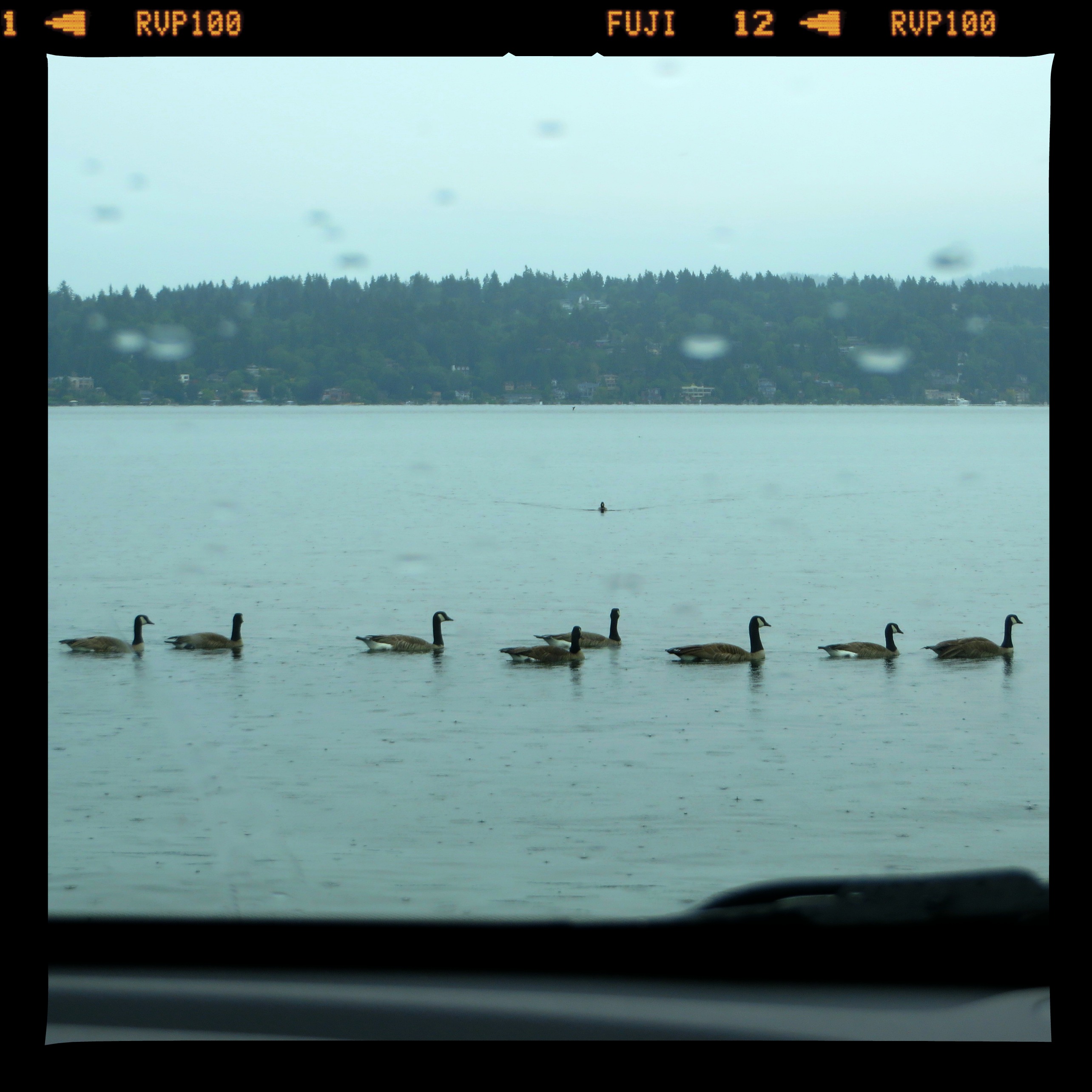
On Sunday, when I woke up to one of those hard rains that had set in for the whole day, the corners of my mouth twitched into a small smile. When Z and I decided to drive to Lake Washington and we did not have to dodge any cyclists or fight for a parking space, the smile got larger. We parked at a boat dock, where no boats were bothering to venture out so miserable was the day, and we sat listening to the rain on the roof of our rental car. We watched a gaggle of geese, wave patterns, a soggy Labrador being walked by his soggier owner. I napped.


There was a tiny, naughty part of me that delighted in the notion of other people’s fabulous plans being ruined, but I instantly felt a smidgen of guilt and did quick penance of saying to no one in particular, “Sorry about your plans.”


No. It wasn’t a good day because other people’s plans were ruined; it was a good day because there were no expectations by anyone, including myself, that the day should be more fabulous than it was. There was no reason for envy.


And the rain on that roof was so soothing.


Flashback Friday: Bridget Jones Has a Baby (and I Feel Fine)

Standard

rgsbabybeth

[Since this was written eight years ago, some attitudes have changed. Also, Helen Fielding has given us an installment wherein Bridget Jones becomes a mother, and from all reports, it isn’t pretty. I’ve refused to read it because I prefer the Bridget Jones of my late youth.]

Monday, May 29, 2006

It’s Memorial Day and I’m tired of thinking about the war dead, the high cost of crappy plastic cemetery flowers, and why it is everyone else I know has cookouts but I mostly have bowls of Fruit Loops.
So let’s talk about babies. It seems timely. The media can finally quit telling us that Baby Jolie-Pitt is about to be born, has been born, has been given the name of a Golden Retriever, has been made an honorary Namibian princess, etc. (The downside, of course, is that we’ll be back on Britney-watch.)

Also, in other celebrity baby news, it seems Helen Fielding, the author of _Bridget Jones’s Diary_, has just had her second child at 48. I like this story because it gives me almost a decade to  keep motherhood on the table. I keep a list of “older” mothers just in case–at some later date–I need a role model.

That said, today I visited a friend who recently had her first baby. A little over a year ago the two of us got together for the ballet and dinner, where she confessed that she was thinking of having a baby but she really wasn’t sure she wanted to, had never wanted kids, had never seen herself as a mother, etc. (I encouraged her, for the record. It seems like a thing you are supposed to do if you can.) Then about three weeks later she wrote that she was pregnant and so she guessed the decision had been made. Before Baby, we met in bars and talked about men and what we wanted to do with our lives. Today we met at Bob Evans. On the surface, she looked as fresh and well-organized as she always has, but something was off. She seemed scattered and a little unsure of herself. She kept apologizing. She confessed that she knows nothing about babies and so still has no idea if he is exceptional or below average in what he does, though what he does mostly is chew things and smile. She said that while she used to think about climbing the corporate ladder, she now suddenly wants a job where she can work less than 40 hours a week and wear comfortable shoes. I felt both sorry for her and a wickedly envious. There’s this cocoon around a mother and a new baby that third parties  can’t quite penetrate.

She’s younger than I am and I (being so very old and so very jaded) have lived through several of these get-togethers in the first six months of Baby’s life and it is wrist-slittingly tedious while the two of you try to re-navigate your friendship since you are no longer in the same boat…or floating on the same body of water. I’m sympathetic to how hard this transition must be for the parents. In fact, on a couple of occasions with close friends, I’ve enjoyed watching the transformation and hearing about the feeding schedule and quality of diaper contents and the features on the Bebecar Stroller (which costs more than my first vehicle) and how really, you just can’t be a GOOD parent without a Diaper Genie. I take mental notes so I can have rational discussions about things I know nothing about with whomever has the next baby. And maybe I take notes in case my ovaries are as hearty as Helen Fielding’s. Maybe.

I’ve always wanted to be one of those cool single people who “understands” the trials and tribulations of marriage and a childless one who totally “gets” what it is to be a mother, so admitting any of this is like blowing my own cover, but here it is: when friends have babies it totally sucks. At least it does in the early days because suddenly the glow of the spotlight shining on the baby is just wide enough to shine a bit on you and expose something you’ve never known before about your own life, which is this: it is silly and insignificant. I want to be clear: this has nothing to do with the mothers’ attitude. For instance, my friend today generously praised my writing and asked several questions about my life, but then when I went to tell her, the baby would coo or shake his stuffed cow and we would both stop mid-sentence and grin at him like a couple of idiots. She asked what I’d been up to, and nothing I’ve been up to seemed noteworthy. Perhaps if I was making scientific discoveries or brokering peace in the Middle East I wouldn’t feel this way, but mainly what I’ve been doing is eating Fruit Loops on Memorial Day and that hardly qualifies as news. I’ve been to Ireland. I’ve taught some classes. I’ve flirted with some men. But how can we discuss that when she so recently brought new life into the world and here it is sitting before us, filling its diaper?

We gave up after awhile. We made faces and weird sounds at the baby and assured each other regularly that he really is the most beautiful, smartest, and most cheerful baby ever. When I pulled away, he was screaming at the top of his lungs, his mother looked pained at the thought of the hour long drive she had in front of her.

I cranked up the Pearl Jam in my own car where there were no little eardrums to worry about, which is another kind of satisfying.

Getting in on the Ground Floor

Standard


"Love & Loss," Olympic Sculpture Park, Seattle

“Love & Loss,” Olympic Sculpture Park, Seattle

On the flight to Indiana, the woman sitting next to me asked me to watch a video about a company she works for because she felt like it could change my life. She was young, friendly, dressed to the nines, and I liked her watch, so I agreed. The product itself was intriguing—it was some sort of natural compound that has been scientifically proven (and even talked about on a network investigative news show) to improve health and longevity—but the point of the video was not to sell me the product so much as to sell me the company. Just as my brain was thinking, This is a pyramid scheme, the video said yes, this could be called a pyramid scheme, but then insisted that all business is a pyramid scheme with a CEO at the top raking in the big money and the peons at the ground floor doing the grunt work, and it was said so enthusiastically that I was momentarily forced to believe it was true and that I should get in on the ground floor. Everything is a pyramid scheme. Pyramids are awesome! Fortunately, my better sense prevailed (around the time Donny Osmond appeared on screen, though he was looking remarkably well-preserved) and I was able to muster up the courage to tell her I wasn’t interested. Pyramid schemes only work if you get in on the ground floor, and it was pretty clear to me that this pyramid was already 3/4 built.

She turned her attention to the guy sitting next to her. I spent the remainder of the flight bouncing between pity for a woman gullible enough to believe she’s going to become independently wealthy shilling snake oil, and pity for myself because I never can wholeheartedly buy in to a cause or a product or a belief system. I might attend services, but I never drink the Kool-Aid, and while some might say this is smart, what it really means is that I’m riddled with doubt on a lot of levels.


On the return flight to Seattle, I was relieved not to be sitting next to someone trying to sell me something. My seatmate looked like a high school senior and was expressing annoyance that the fleece she’d ordered hadn’t arrived in time for her trip. She told me she would be spending the next two weekends with friends, hiking around the Pacific Northwest, and during the week she’d be at a conference. She looked like maybe she was a dolphin trainer or something, so I was surprised when she told me she had an MBA from Carnegie-Mellon, lived in D.C., and did something that sounded vaguely important and international. I’d love to tell you what her job was, but I didn’t understand what she was talking about. She was speaking clearly and wasn’t using polysyllabic jargon, but the words that she strung together made no sense to me, and what’s more, I couldn’t get my brain to shut off while she was talking. Instead, inside my head was a roar, This is just a girl and she knows more about the world than you do. This girl is going places. This girl has a plan for her life.


She told me about this artist community in Mexico where she’d done an internship and where a lot of Americans emigrate, and my brain roared, This girl knows about a place you should know about but don’t. I asked where she’d done her undergraduate work, and it was a college that I’d considered for about 15 minutes when I was 15 before I knew about things like “out of state tuition”. I asked how she liked it, why she chose it, and she explained that she’d picked it solely because of its excellent intern program in D.C. because she knew she was interested in international business and the nation’s capitol would be a good place to do that. My brain roared, When you were thinking about that college, it was only because you liked the way the campus looked in the brochure photos. What’s wrong with you?


She wasn’t intimidating. She didn’t seem particularly wise. She asked me if I thought it was crazy that she’d come to Seattle without a raincoat or an umbrella. (Answer: duh, yes.) She was just a person, young enough to be my daughter probably, but full of information about the world that I don’t have. I was relieved when she plugged in her earphones  and started watching the in-flight movie, which was Spiderman, if for no other reason than so my brain would quit roaring at me.


It was a weird way to bookend my trip home. I went in feeling smarter than the posh, pyramid sales person, and I left feeling old and dumb (and pessimistic about a stranger’s choice of outerwear for nine days in the Pacific Northwest). As I walk around Seattle, where the average age is something like 30, I’m feeling past my prime and not nearly clever enough. I’m going to have to spend this first week back in the city Googling things like “Gen X” and “generational beliefs” and “multiple intelligences” and figuring out all the ways I’ve still got it going on.


Hopefully, after the research is in, I won’t come to the conclusion that I made an error in not signing up for a new career with Donnie Osmond and the anti-aging pyramid sales woman.

Now is the Springtime of Our Discontent: A Dog Story

Standard

RGSMac


Seattle Beth always has big, big plans for Indiana Beth. When she’s in Seattle, she makes lists of all the people she will see and the boxes she will rifle through in her parents’ attic and the epiphanies she will have while she is in her natural habitat. But Indiana Beth always has other ideas. Indiana Beth mostly wants to sit around staring out the window, chatting with her family, reading books that got left behind in the Great Move. Inexplicably, on this trip, Indiana Beth has been obsessively doing jigsaw puzzles on her iPad. Like an old person.


Seattle Beth is disappointed in Indiana Beth.


Frankly, I’m disappointed in both of them: the one for not realizing the limitations and proclivities and the other for being so incredibly lazy.


I was supposed to fly back to Z on Tuesday, but had an unwelcome 24-hour bug that made air travel seem like a bad idea. I was disappointed not to see Z on schedule and disappointed not to get to claim the first class seat to which I’d been upgraded. But I’m never sad to spend more time at home. Luckily, Mom has taken over my pet sitting gigs with Mac the Wonder Scottie, and so the bonus days in Richmond were spent with him at his gorgeous house. What’s a little stomach discomfort when you get to sit on a screened porch staring at a pond and woods with a little Scottish Terrier under your chair?


As soon as I realized that I needed to skip the flight and rebooked for three days later, Seattle Beth started making plans again. Maybe I could still clean out a closet, write a book proposal, post a blog a day, go on hour long walks of a vigorous nature, meditate, do yoga, find inner peace, come up with an idea for world peace.


It’s a lot to accomplish in three days, especially when there is a lovely view and a porch.


Mac is always initially excited to see me. He does his happy dance and his special growl-talk and we’re both overjoyed to be together again, and so we love on each other and then fight over his scruffy hedgehog. I’ve been watching him since he was a puppy and now he has a beard that makes him look like a wizard, so it is safe to say we know each other well. I know that if I say “Get the monkeys” when I open the door to let him out, he will go tearing into the yard set on chasing away the imaginary beasts even though he should know by now that there are no monkeys. (Mac hates monkeys even though he’s yet to come face to face with one.) He should also know that I am not what you’d call an energetic person.


Like Seattle Beth, he becomes discontent, and I can only assume that the source of this discontentment is me. I read too much. I sit and stare too much. Mom and I talk too long about things like the influx of buzzards. Finally, he sighs and turns his back on the pair of us and has a nap. I’d kind of like to teach him to play Words with Friends to take some of the pressure off of me. I’m not a good entertainment director. Once you have the walk and the hedgehog tug-of-war and the meal and the snacks, what else is there really? I’ve long been convinced that if I could show him how to read, he’d be so much more content.


Other sources of discontentment on this my last day in Indiana: a Ku Klux Klan rally in neighboring Centerville. I’m horrified and disgusted. And frankly, Mac is too. He seems to have a strong desire to sneak into the rally and tug white sheets off of participants, exposing them for the cowards and fools that they are. Maybe this explains the buzzard problem.

On Grail Quests and My Hometown

Standard
Mittrione's Italian Market

Mittrione’s Italian Market


What I’m noticing on this trip back to Indiana is the astonishing number of buzzards. They scope out their dinner options, catch currents and circle over cornfields, often in clusters of three. It’s eerie. When I was a kid, I might occasionally see a lone vulture feasting on some road kill, but now the sheer number of these things is otherworldly, as if they are trying to tell us something. Abandon all hope ye who enter here.


As I drive through this town of my youth, I think about the recent spate of shootings and burglaries and drug busts, the derelict properties, the businesses that have closed. My outlook on this trip is grim, though I have no real reason for it other than summer is coming and heat always makes me think the world is about to end. May has not always been the kindest month to me, but I haven’t been obsessing about the diagnoses, the deaths, the goodbyes, or last summer’s broken toe, so that’s no answer either.


The buzzards circle and I see one more thing that doesn’t look the way it did in 1978, and my eye twitches.


These particular creatures are reminding me a little too much of the second half of Excalibur when King Arthur is wasting away, his kingdom crumbling around him, because he’s just found out that Lancelot and Guinevere have betrayed him, and the external landscape matches his mood: grapes wither on the vine, pastures turn brown, and the corpses of knights who have failed at the grail quest line the roads of mythic England. This is my least favorite part of the movie (and that is saying a lot considering the rape, incest, sorcery, grisly battle scenes, and truly horrible Irish accents with the exception of Liam Neeson’s). More than once, I have hit the fast forward button to skip these depressing scenes in order to get to the part where Perceval discovers that the grail is not a thing after all, but is, instead, an idea: the king and the land are one. He rides through the countryside, a sort of Medieval Paul Revere, shouting his discovery, Arthur gets the message, perks up, and, and voilà, the crops start growing and everything greens up. (If you like your stories to end on a happy note, I recommend that you quit watching as soon as the land begins to blossom.)


I don’t like looking at my hometown with this lens.


I’ve been living in Seattle for four years come August, and because I’m gone for four or five months at a time, when I come back, I notice subtle differences and I have strong, internal reactions to these changes. It can be anything from a closed business, bulldozed 19th century mansion, or a stoplight that is now set permanently on blink. I have this irrational sense that Richmond should have written and asked my permission before proceeding with the alterations.


I also bristle at changes that my people make themselves. I will never get used to Leibovitz’s kitchen remodel. It’s lovely, but I miss the now-dated, fruity wallpaper border that I watched her hang one night before her daughters were born—daughters who refuse to remain in footy pajamas and are, instead, teenagers now, one of whom will insist on driving.


Two days ago Mom and I were at the post office mailing a package and she addressed a box with the city on a single line and the state on another, and I found myself spluttering, an action that heretofore I’d only seen in comic strips and had no idea I was capable of. This is the woman who taught me how to address things properly, and now, suddenly, she’s putting Indiana on it’s own line, like she’s unilaterally decided it is its a country. I demanded that she tell me why she’d done this, and she gave me a brief history of the different ways packages have been officially addressed in the course of her lifetime, but no real explanation as to why she’s made this change. She said something like, “This is how I’ve always done it,” and I was shaking my head because I know it is not how she’s “always” done it. I pursed my lips in disapproval. I didn’t mean to, but I could feel them pursing and once they start pursing, I can’t stop them. Mom has always been a rule follower and now suddenly she’s going against USPS addressing guidelines to put her own flourish on packages? All the way out to the car I had to give myself a talking to about how I need to be more malleable, that I can’t expect things to stay exactly as they were when I left in 2010. Businesses close. Traffic patterns change. Mom is a free agent and can address a package as creatively as she wants and as long as that zip code is on there, chances are the package will get delivered.


Clearly the problem is not with Richmond or my people, but instead, a problem with my perspective. Sure, the crime and the economy, but there are good things happening here too. If nothing else (and there is plenty “else”), Richmond should win major awards for the awesome historical murals that dot the downtown and illustrate its glorious past and contributions to American culture. It’s much more colorful than it was in my youth. The roads are uncongested. People spend a lot more time and energy on lawn care here than they do in the Pacific Northwest, so there is plenty of lovely. People are friendly. Nobody questions my food choices here and insists I must eat quinoa instead of mashed potatoes. Nobody forces me to hear all the reasons I should do a little hiking on the side of a live volcano in Indiana. (In fact, “lack of live volcanoes” should be put on the tourist brochures as a selling point for this place.) Richmond has changed, yes, but it is just like other towns–and people–around the country trying to find its place in world.


If Arthur had adapted more graciously instead of moping when the loyalty of those closest to him shifted, Camelot would have stayed paradise. If I’d adapt to the notion that nothing is static, I wouldn’t have to write frantic blog posts about how my own sense of history is disappearing before my eyes or how my people have gone right on living their lives in my absence.


When Jane’s husband graduated from our alma mater our junior year, he said mournfully, “I want them to laminate this place after I’m gone.” At the time, I thought he was joking, but now, I think maybe that’s all any of us want, including King Arthur: lamination of all the places and people we love, exactly when we loved them most.


For me, I’d choose the period of time before the buzzards were circling Wayne County so frequently.

Flashback Friday: The Cheerleader and the Bookworm

Standard

Sunday, May 21, 2006


Once a month when the bill is due, I go to the gym. I can’t say it does much for muscle tone or weight loss, but I am dedicated even though I don’t see results. Once a month. Like clock work. I go to the gym at 10:00. This is the perfect time to go because the only people who are there are usually older people who have either had strokes and are rehabilitating or older people who are healthy and trying to ward off the strokes. Nobody is there who looks like they’ll be on the next series of Real World in other words. There is no spandex or neon. The older people don’t really work the machines right. They do things in a lopsided fashion. I say this not to make fun of them but to point out that in order for me to feel good about the hour I sometimes spend in a gym requires me to be surrounded by people bent over with osteoporosis and propping themselves up with canes. I am not what you would call a natural.

When I was in high school, I was one of those girls who always had her nose stuck in a book and who was always the last one in from the mile run around the track in gym class. Because there were no books involved with gym, I considered it a waste of my time. I didn’t particularly like my body (though I would certainly like to have access to that version of myself again) and so tended towards maximum coverage in oversized Amy Grant sweatshirts and army jackets. Gay men loved me. Boys who read The Lord of the Rings found me a worthy enough companion.

On the other end of the mind/body spectrum was a girl, let’s call her Trixie, who wore her parachute pants so tight that little was left to the imagination. She was spoiled and cute with a horrible reputation though I was never clear if it was warranted or created by jealous girls and hopeful boys. She was just someone in general math and English classes whose wardrobe and body were enviable, who had gone out with a lot of different guys, and who had a contagious laugh. Also, she was a cheerleader.

Yesterday when I got the gym, there on the steppy-uppy machine I haven’t the stamina to use, was not one of the geriatric regulars, but Trixie, chewing gum, reading a celebrity gossip magazine, and talking to a trainer. She saw me and greeted me warmly, as she always does though we were never friends, and we talked about school and old acquaintances and life. She was sheepish because the last time I saw her was at a restaurant where her eleven-year-old son announced across the aisle separating us that she’d been married and divorced twice and that he and his brother had different fathers. This announcement caused her to clam up and me to eat the rest of my deep friend dinner in uncomfortable silence.

At the gym, we were able to laugh this off. Obviously, this is her domain. She effortlessly talked to me as she climbed an invisible K-2 while I huffed and puffed on the 0% incline of the treadmill. She told me how good her boys are—how they are so much better than she was. She said she wished I had a kid that would spill MY secrets to her in restaurants, and it struck me how sad it is that we humans go through our lives worrying about what other people think of us. Trixie thinks I sit in judgment of her because she’s been married twice, didn’t go to college, and knew how to have a good time. Meanwhile, I think Trixie is judging the size of my treadmilling backside, judging me for my lack of mate or children, and poverty of fashionable workout clothes.

Why do we torture ourselves this way? I allowed myself about 120 seconds of masochism (Why don’t I go to the gym more so I too can speak without huffing and puffing? Why don’t I wear something more attractive than my relaxi pants and “Guinness is Good for You” T-shirt?) and then forced myself to focus on her and what she is: a thing of beauty. Not just because she is firm or tan or has long blond hair or looks ten years younger than I do, but because she still cracks her gum and giggles and tells you she likes your shoes instead of mentioning how you look fatter or older or more single than you did in 1985.

As we were getting ready to leave, the trainer she had been talking to earlier was rubbing a kink out of her back. In six years of semi-irregular gym attendance, no trainer has bothered to smile at me let alone rub a kink out of any of my muscles, but here was Trixie, getting a post-workout backrub and telling the trainer that she thought perhaps she was so tense because she hadn’t had sex for so long.

Gum crack. Gigggle.