A Little Lenten Temptation

Standard

Thin Mints

Tuesday night Z came home from the store with a bag full of ice cream, chocolate, and potato chips to celebrate Fat Tuesday. We weren’t exactly throwing Mardi Gras beads at each other so it wasn’t really a celebration, but Z is a Lent observer, and the idea of giving up his beloved ice cream for the next six weeks made the junk food buffet a necessity.


Z is good this way: making a promise and keeping it. He’ll only eat ice cream for the next six weeks if he forgets about his vow, and then he won’t let himself off the hook with a shrug. Instead, he’ll extend his frozen dairy fast by one day. Mostly though, he won’t forget.


I, on the other hand, don’t participate. Last night when Z and I were at iHop, the table of people next to us were sporting big black ash crosses on their foreheads as they devoured pancakes and talked about what they’d given up for Lent, and I admit, there is part of me that is envious of that devotion and that adherence to tradition. But I kind of stink at those sorts of things, and it seems better not to set myself up for failure.


When I was growing up,  Mom and I would give our favorite treats up for Lent, but it inevitably felt more like a diet than a religious observance, and mostly I was crabby about it. My last Lenten observance was when I was nine or ten. I’d given up all manner of sweet treats and walked around for a couple of days with a penitent, mournful look on my face that had nothing to do with God and everything to do with how much I wanted a Pop-tart.


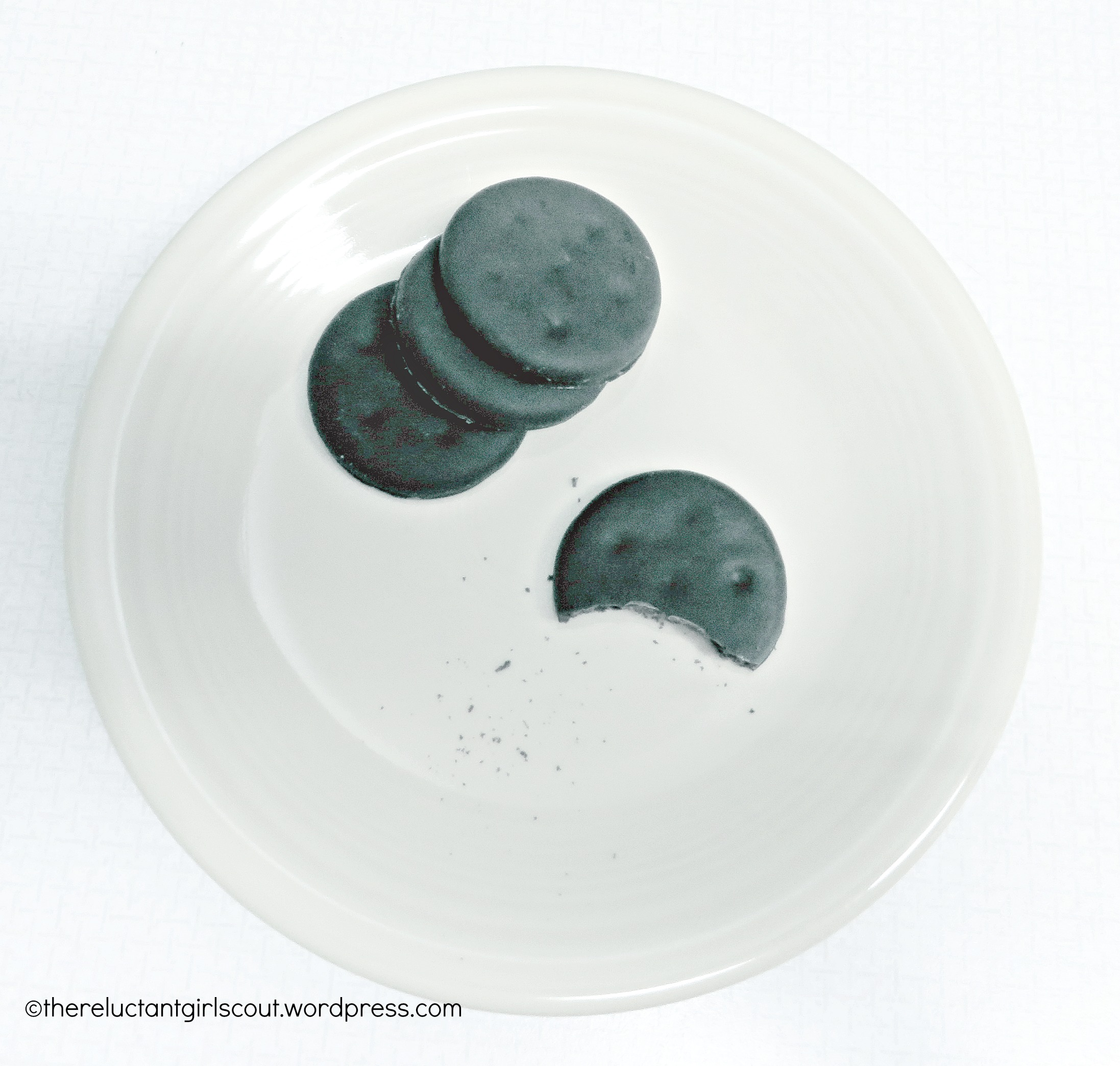
That year, my former second-grade teacher had decided that she and Mom were friends and also that we would drive to a neighboring city to meet her twin sister. I remember virtually nothing about the day except I was bored and ready to go home almost as soon as we got there. The twin’s apartment was beige and under-stimulating, as was the adult conversation, and the novelty of seeing my former teacher’s look-alike quickly wore off. But then the twin brought out a plate with Girl Scout cookies on it. In my memory, the room was like a blank canvas with no art, no knickknacks on the coffee table, nothing on which to focus my attention other than the chocolaty, biscuity goodness that sat before me on a white plate.


It is no accident that Girl Scout cookies are delivered roughly around the time that Lent begins. Satan is clearly a consultant for the Girl Scouts of America and has a hand in the cookie delivery schedule.


I lasted about five minutes. Once I caved to temptation, my next battle was eating like a lady and not inhaling all the cookies on the white plate. It was one thing to disappoint Jesus, but I really didn’t want my former second grade teacher to think I was a graceless pig.  Jesus would forgive, but Miss B might gossip about me in the teacher’s lounge and I had this good girl image to uphold. It and good penmanship were the main things I had going for me.


I felt bad about this failure. Not because I’d let God down. I was pretty sure God had other things to worry about, what with the Energy Crisis and the killer bees and various other world events that haunted the edges of my childhood and that I hoped He was working on. No, I felt bad because I realized as I bit into that first Thin Mint, that I would probably always be a person who couldn’t keep promises to herself, particularly where sugary goodness was involved. It seemed better not to set myself up for failure in the future, so I resolved not to observe Lent ever again.


Maybe I’m being too hard on myself, because that vow I’ve actually stuck with.


Trying to Step in the Same Stream Twice

Standard
Santa Barbara

Santa Barbara

We hadn’t been in Santa Barbara for nine years when we arrived there last Wednesday. When we did the math and counted out how long it had been, we were both surprised. It has lived big in both of our memories all this time, and when we exited the highway and found ourselves cruising up Cabrillo Boulevard towards Hotel Oceana where we’d be staying, it felt to me like no time had passed at all. Maybe a few months.


In 2005 when we were still just friends, Z, who’d been in Zimbabwe for a year, returned to the U.S. to teach as a visiting professor at a college near Santa Barbara. Other than a deep affection for my Malibu Barbie collection in the 1970s, I’ve never been California-inclined. I had this notion of it as a place that was too thin, tan, sunny, and plastic to ever make me happy. So when Z invited me to spend my spring break with him all those years ago, let us be clear: I was going to see him, not to soak up the sun on some shell-strewn beach. I would arrive in Santa Barbara ready to assess the situation and see if he’d budged an inch since the year before when I’d told him I was in love with him. I even bought myself a new orange bra because I felt with such a thing beneath my clothes, I would subconsciously become more alluring and magnetic than I really am. It was huge and day-glo and I had to be careful what shirts I wore with it because it was not a bra to be trifled with. Even so, Z remained impervious to the super powers of my undergarments, despite the fact that at one point when we were on a trolley in San Francisco, my blouse came unbuttoned of its own volition and I accidentally treated about 30 strangers to my bright orange satin-encased breasts.


Z stared out the window, oblivious.


The trip nine years ago involved a mixture of emotions that started and ended with longing and confusion on my part. We were both happy, I think, to be back in each other’s company, exploring a new location, investigating the old mission, driving up Highway 1, sifting through bargain bins at what may have been the world’s most affluent Goodwill ever, and walking the beaches. Oh, the beaches! But then somewhere in my head I’d hear Kate Bush singing, “The thrill and the hurting/ This will never be mine,” and the aching would start. I’d wonder how much longer I could sustain our friendship in the face of it. Then he’d say something funny and we’d start laughing and I’d forget the hairline fracture in my heart.


I don’t understand time travel, but the first day of this 2014 trip, I felt as if time wasn’t linear after all. It seemed reasonable to me that we might bump into our younger selves, that maybe I’d see us on East Beach and I’d be able to take 2005 Beth aside and say something encouraging like, “Just hang in there—he’s worth the wait and right now he’s just moving on African time.” Or better yet, I had this notion that somehow I might be able to turn back time and reclaim those days that were lost to us. That there would be a puff of smoke and we’d get sucked backwards, and get our party started sooner rather than later. (It should be noted that in my memory, we are way younger than we were nine years ago, and I was much thinner and looked more like Malibu Barbie than I do in now or then. Also, we’re wearing really attractive swimwear and we’re much better coiffed than we are in real life.)  It’s just so lovely and magical there on the beach in Santa Barbara that it seemed entirely possible that either of these things might happen.


Poor Z! That first day, I think he was wondering if he’d made a mistake, bringing me back to Santa Barbara because I was acting like we’d returned to the scene of some crime. I was given to sudden storm clouds of regret that would form behind my eyes, and worse, torturing him with jabs about what he’d been missing out on back then (for instance, I no longer have that orange bra and he never got to see it). He was good natured about my ribbing. At some point on Wednesday night, I realized I was ruining now with my incessant reflection on then and what could have been. I mean, honestly, can you imagine having to listen to Elizabeth Bennett complain about how Mr. Darcy didn’t love her quickly enough, as she sits on the veranda at Pemberley? Please. Even I was getting tired of me. Frankly, I’m getting tired of me recounting the story here.


View from our Hotel Oceana room

View from our Hotel Oceana room

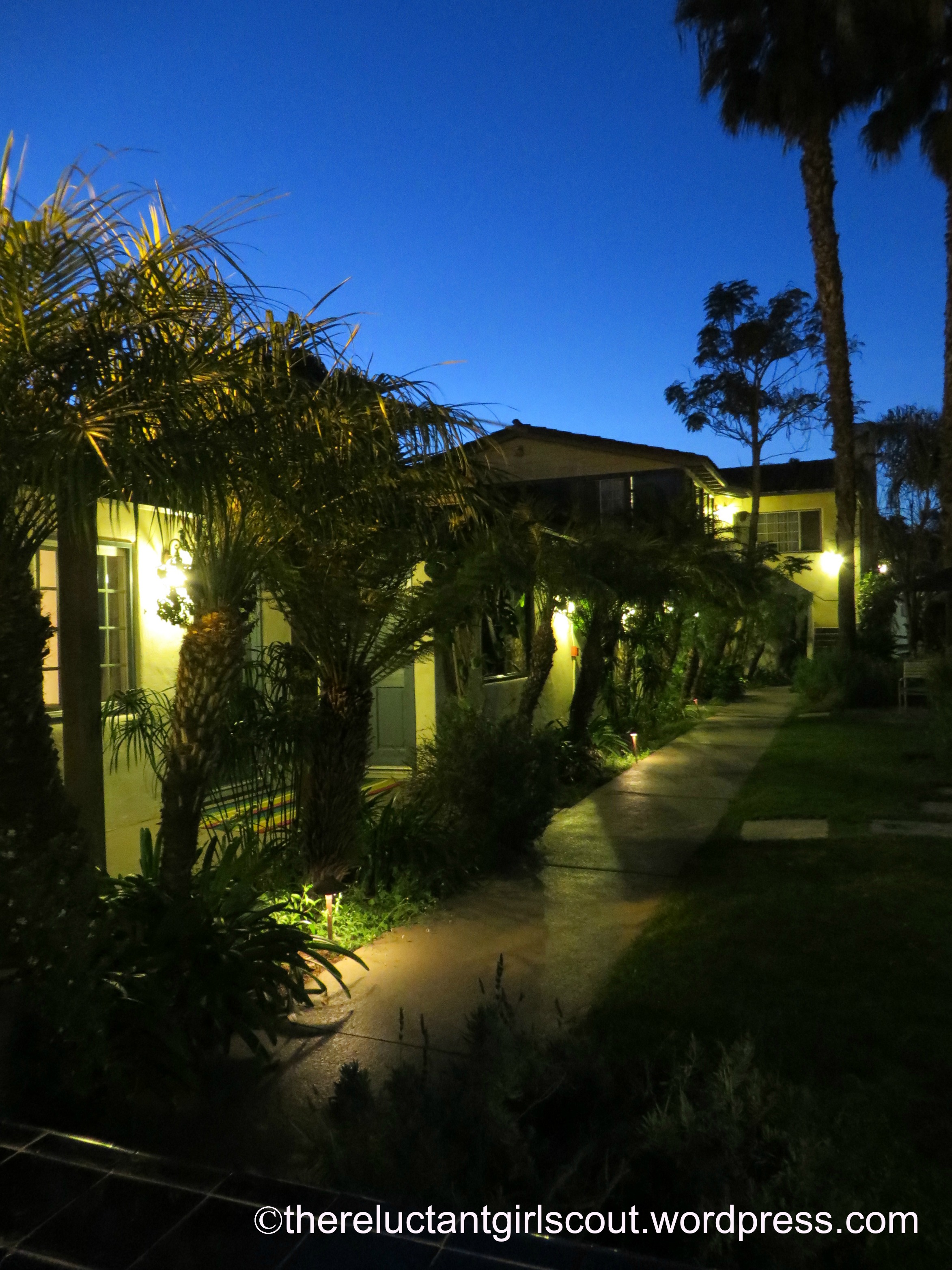
Eventually, I shut my mouth and directed my line of sight on the present. Hotel Oceana was delightful. It was right across from the beach and we splurged on a room with a view. Aside from the view, I was smitten with the Spanish style courtyard that the rooms opened up on. A fountain tinkled. Humming birds flitted around the stralizia. Even the opossum that was creeping up a tree right at eye level and scared me half to death seemed quaint.  When it isn’t a 100 degree humid summer day in Indiana, I’m always struck by the magic of how you can live your indoor life outdoors in climates like this one.

Hotel Oceana courtyard, Santa Barbara

Hotel Oceana courtyard, Santa Barbara

We speculated on the lives of the people in the neighboring room who left their door open, and when we peered in all we could see was a sea of plastic bags—we still can’t decide if they were some sort of bag people/hoarders or if they just did a lot of shopping and weren’t very tidy or safety conscious. We walked on the beach, laughed at the Californians who were bundled up like it was winter as we shuffled around in shorts and flip flops,  and said hello to a host of dogs. We drove out to Z’s old campus and poked around to see how things have changed since he was in residence. Then we investigated his old neighborhood to see what houses survived the fires a few years ago. Finally, we went to his old Von’s grocery store and lamented the fact that Jonathan Winters is dead now so there was no chance of running into him the way Z used to. We had apps with his former boss in an Irish pub and caught up on nearly a decade’s worth of events. Our last night there, we walked on the beach under a full moon, the way you do when there is a beach and a full moon available to you.


Maybe all the time travel I need in this life is the realization that when we are together, we have fun, just like we always do, always have done. Even before we were us.


Moonlight, Santa Barbara

Moonlight, Santa Barbara

(P.S. Should they make a movie of my life posthumously, would one of you please try to secure the rights to that Kate Bush song? I think it would work really well in the “longing for Z” sections of the film.)


Flashback Friday: The Sea is Wide and I Cannot Swim Over

Standard
[In this final installment from Ireland, I pack my bags for home and try to make sense of the personal and the political.]

Monday, March 27, 2006

There’s something about leaving Ireland that makes it imperative that you listen to all of your favorite Van Morrison songs immediately. Lucky for me, I had several on my iPod and so could begin the lament on the long train journey from Waterford to Limerick before I ever got on the plane. I started with ‘Carrickfergus’ where the line about Kilkenny had new meaning to me, and ended with “Won’t You Stay.”

The last day in Ireland was a drizzly one, so it took awhile to get moving. I have about a sixty minute tolerance for museums of any sort, so even though I’d been warned to have three hours for the Waterford Treasures museum, I had to walk around the town centre, poking my head into stores, getting dew kissed from the drizzle, and generally feeling a part of life there before trekking to the museum. The Irish coat I bought when I was there in November must make me look more like a native, because again I was asked for directions. This time, sadly, I had no answers.The museum is nicely done and has a remarkable amount of interactive “treasures” as well as the more traditional kind. The first thing I did was go into a little theatre where an aluminum version of a Viking ship made up the seating area. I was the only person in there and almost got hysterical when the movie started and the ship started rocking back and forth beneath me. The movie itself was silly–about a bunch of Vikings making the journey from York back to Waterford, calling out to a horned old disembodied head who must have been Odin. But the creaking of the aluminum bleacher-seat ship was worth 12 minutes of movie boredom. I was only sorry that I was alone on it and so my laughter must have seemed a bit deranged.

Probably the most impressive piece in the whole museum is the city charter, which is, essentially, a bunch of documents about mayors and city ordinances written and illustrated on vellum and then sewn together into one big historical quilt. I liked seeing man’s history presented in such a girly fashion. Which brings me to my main beef with museums and history in general. I can rarely find myself there. Sure, there might be some bowls women served food in, a beaded necklace of some ancient peoples, but mostly what you see are the stories of men. Likely, they affected the women in fringe ways, but I would prefer learning about women’s lives & that forgotten history. What shaped domestic life instead of how a political action shaped a nation’s history, or, to borrow words from the Feminist movement of the 1960s and 1970s, I am most interested in how the political shaped the personal. While I don’t care which king presented the Mayor of Waterford with the Cap of Maintenance (which, by the way, looks over much like the Hogwart’s Sorting Hat), I am curious about the woman who helped piece it together or the Lady Mayor who had a laugh with her husband after the presentation about how stupid he looked in it. (“Ohhhh. Don’t you look divine in your cap o’ maintenance, Darling.”) But those aren’t the stories we get in museums or history books because they aren’t considered important. They aren’t national or global. They aren’t worthy of being recorded. In museums, it seems, the female story is predominately relegated to who wore what and which of our dishes were used to feed the men who were fighting the wars and signing the charters. This is an old, unoriginal argument I’m presenting, and it is changing in terms of recorded _modern_ history, but it does have an impact on my level of interest in dusty relics that I pay seven euro to see.

I cruised through the rest of the museum, paying homage to anything that seemed homage worthy, but generally reassuring myself that I am not a bad person or a bad student of life if I don’t love museums, where life and stories are kept in airtight cases.

Back at the Artist’s house that evening, he showed me his artwork from the period right after his wife had died. These were all chalk pastels with mythological figures and death symbols throughout. He explained each one, which I appreciated, because it helped me understand his thought process. Talking about these pieces must have been exhausting for him, both because physically it is hard for him to get breath behind his words and also because of the subject matter. I was overwhelmed by the pain that was in them and found myself having to turn away periodically. After he had shown them to me, I asked about the sketches he did while his wife was dying and he nodded toward the cabinet where they are kept and said that his children can’t even look at them because they are too painful. At that point, the phone rang–two of his friends were taking Belle and me out for a drink–and I felt relieved to have the spell broken and to have been spared witnessing that pain. Even so, as Belle and I were driven away while he stood at the door, holding onto his wheeled-walker, waving goodbye to us, I wanted very much to hop out of the car and insist we spend the evening at home with him instead of drinking with his friends. I wanted to soften the sadness of what I’d just seen. Of course he has lived with these paintings and his grief for several years, so it is likely that I was the only one who needed the softening.

The man who picked us up was the Artist’s neighbor, a retired banker who now travels and studies languages. He drove us to the house of the other man, a sort of care-taker for a Big House that was formerly owned by the Waterford Crystal people. Gates had to be opened before we could drive in. We had drinks there and then later at a 17th century pub which sits under an ancient-looking “flyover” (overpass). We talked about politics (Irish, U.S., Zimbabwean, E.U.) and drank, then went back to the Big House for tea before heading home to our unpacked suitcases. When we got back, the Artist was already in bed, so Belle and I stayed up until 1:30 talking about life, even though we knew we had to get up at 4:30 the next morning to catch the cab that would take us to our train. Though we’ve worked together in one form or another for over ten years, we didn’t know all the bits of the other’s life, and it felt good to share

Morning came early, but we made our connections and had only an hour to kill at Shannon Airport. There were a few U.S. service men (I saw no women) walking around in their desert cammies. I felt self-conscious about my black shamrock, anti-U.S.-troops-at-Shannon-Airport button and was glad it was out of view. As much as I don’t believe in this war and don’t believe we should be involving Ireland in our nation-building, I feel none of those things about the soldiers themselves. They are my neighbors, my students, my cousins, and, if I’d been more productive on prom night, they could be my sons.

As we were in the departure hall, we could see a large line of soldiers on the other side of the glass just arriving from their trans-Atlantic flight, ready to be shipped to Iraq. As they walked by us, a few waved tentatively through the glass, and Belle and I and some others felt compelled to wave back. My God did they look young. I know this is what people always say about soldiers, but seriously, these boys looked about 14. And maybe I was reading in, but they looked a little scared too. More people waved. A few clapped. I got teary, thinking of the hardwork they were about to undertake. How some of them wouldn’t be coming home the same as they left. How some of them wouldn’t be coming home at all. I had to turn away, as I had the night before looking at the Artist’s study of grief, because the idea of it all was overwhelming. But then the cheers and chants of “U.S.A.” started and the spell was broken. Suddenly it became not a poignant, human moment, but a sporting event. Our team is best. Our team will win. Our team will trounce your team. Gooooooo team. No doubt there is need to build up the gladiators  before they go into the arena, but it rang false.

My thoughts turned to a local business owner whose marine son recently walked through that same arrivals hall on his way to be a tank gunner. She said this is what he wanted to do with his life, that this is his destiny. She told me the story of how he and a woman he’d met online tried to connect at Shannon so they could meet face-to-face before he went to Iraq. She talked about how upset the woman was when they missed each other, how touched she was that someone cared so much for her son that she would drive all the way from Dublin, just for a glimpse of him. She explained how she sent an angel statue to the woman as thanks. So anyhow, I ignored the cheers and false bravado and thought instead of these two women and this young soldier, and how though I haven’t met him, I hope he comes back in one piece, because this personal story is the one I care about. Not the oil. Not the WMDs. Not even how political boundaries are drawn or how the history books later present the events.

Maybe its juvenile of me to have this attitude, but I don’t think so. Several years ago a friend told me that he believed poetry would save the world. I couldn’t quite wrap my mind around the concept at the time, though appreciated the validation he gave to my chosen line of work. Now, I think I understand better. It’s the little moments of personal pain or joy that are recorded into the story, the song lyric, the dance, that will do the work all of our peace talks and war making cannot. It is art that will breathe life into dusty relics in those air-tight museum cases, even if it is by way of an aluminum Viking ship and bad video. It is Van Morrison telling us how he longs for the ability to swim or fly or pay a boatman to carry him back to his own ones across a wide sea.

Snow Memory

Standard


Seattle Snow on Spring

Seattle Snow on Spring

I realize some of you won’t appreciate this post, because you are stuck there in the dark heart of the Polar Vortex. But think of us here—a girl who misses her Midwestern snow and believes every winter should look like the holiday issue of the L.L. Bean catalog and a boy raised in a country deprived of snow completely—now stuck in a city that has on offer only rain. Wet, cold, wintry rain.  Look deep in your heart. Don’t you want more for them?


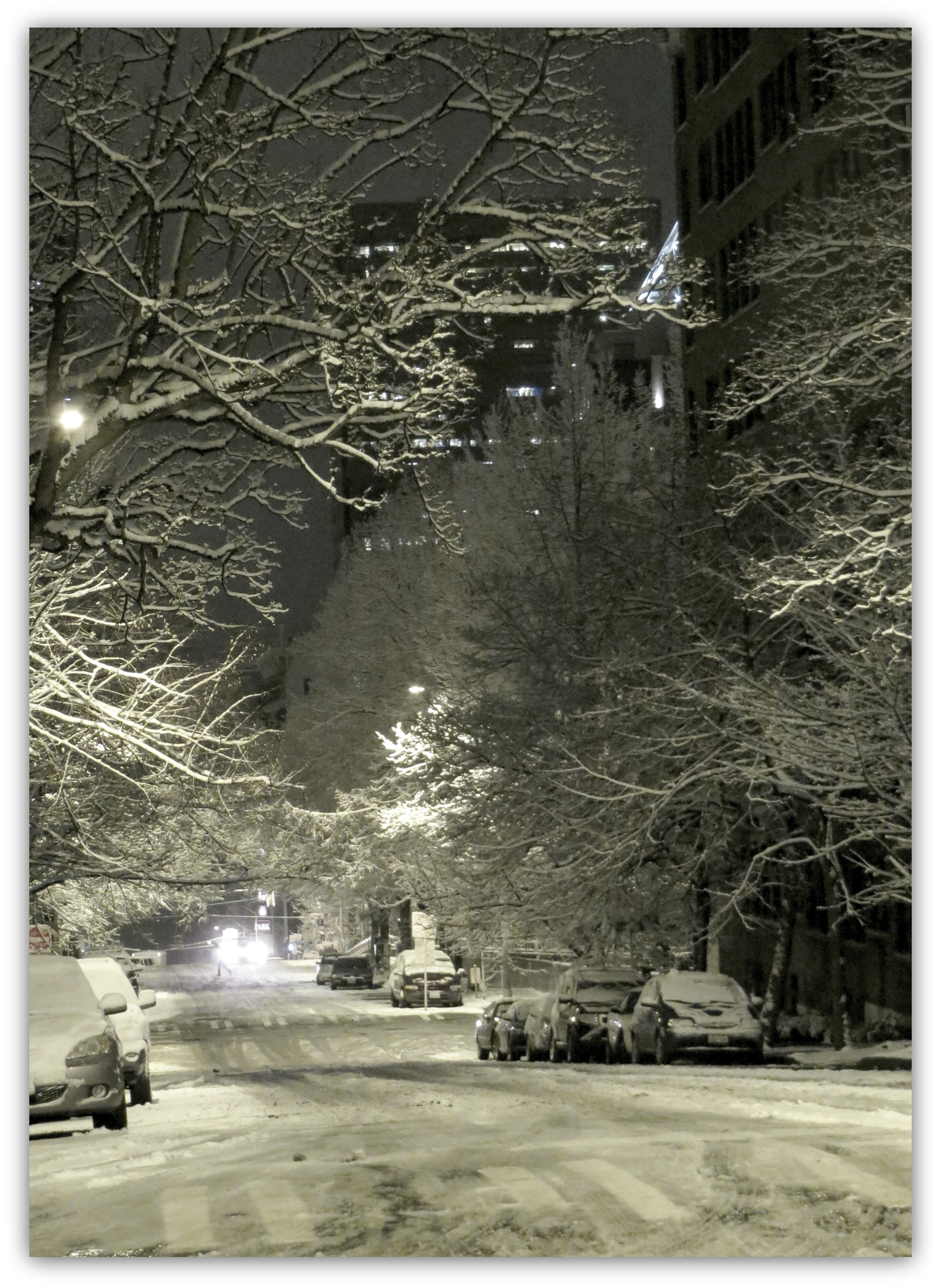
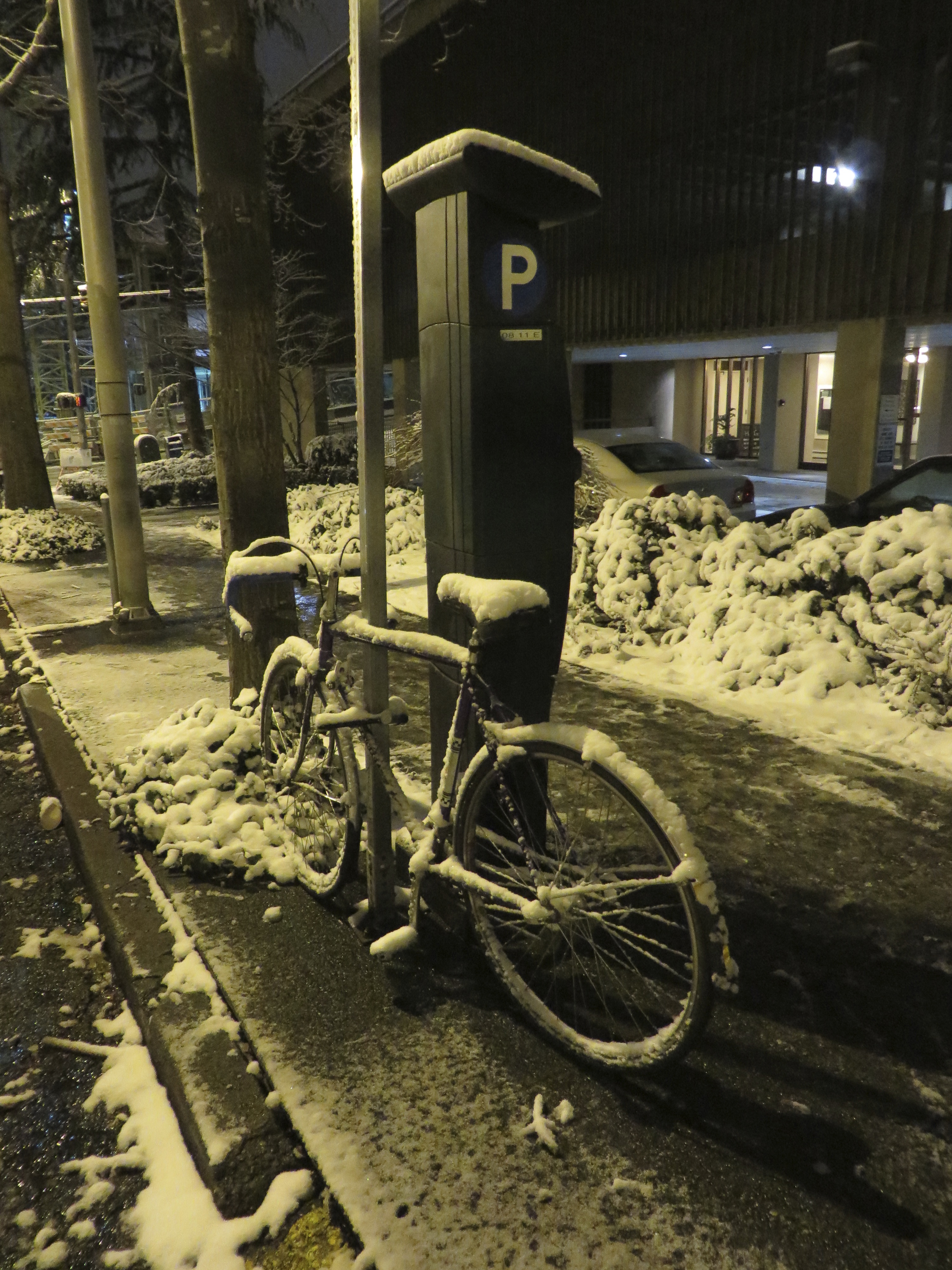
Saturday night the cars driving by sounded extra slushy, so we peeled back the curtains and what did we see but one of those wet, lovely, tree-clinging snows.  Even though I knew it was fleeting, for a whole night, I was able to pretend it was really and truly winter. We pushed open the curtains, turned off the lights, and watched the snow come down. To make it truly spectacular, I should have turned on our DVD fireplace.

rgssnowsteps

Z likes to argue that I don’t really love winter and that I am only happy if the temperature is somewhere between 58 and 64 outside and 68 inside. I complain about heat, rain, sun, wind, and anything else that gets hurled at me. Maybe he is right and I’m the Goldilocks of weather, but some of my best, clearest memories are of snow in a city at night. They aren’t “event” memories—nothing happens in these memories—instead, they are more memories of ambience: walking with my two mittened hands in the hand of a parent when I’m too young to even have memories; walking amidst the Victorian houses and tree-lined streets of Richmond’s north end from the apartment Mom and I were living in to the cozy apartment of our good friend; sitting on a hay bale singing Christmas carols with my cousins at my grandparents’ farm; my little college campus transformed into a 1980s snow globe as we moved from dorms to classes to cafeteria, cocooned in snow; more than one knee-deep, frigid snow in Chicago, where I first discovered how even a big city can seem small and quiet (and clean) late at night with snow falling; a birthday in Freeport, Maine, where I actually got to see that perfect L.L. Bean catalog cover in real life but also sadly dropped my camera in a snow drift trying to capture it; last March, a midnight walk from Chickpea’s apartment in Brookline to the hotel where Z and I were staying and where I was the only person on the street and the whole city felt like mine.


My favorite, though, was the surprise Seattle snow the first few months Z and I were together and the block walk from the Quarter Lounge to his apartment, and we were both electric with love for each other and the snow felt like some kind of magical fairy dust that had appeared just for us.


So those are the reasons why at 1:30 a.m. on Saturday, I decided I needed to take my congested nose out into the cold to walk around and snap some photos. Z spent several years in Minnesota, so romanticizes snow a lot less than I do, but even so, he eventually came outside to humor me.


The city was quiet and we passed very few people and one perturbed looking dog. By the next morning, the snow was gone, almost as if it had never happened.


Tomorrow, we leave for California where Z will be presenting at a conference, so all memory of winter will disappear as quickly as a Seattle snowfall.


IMG_0813

Cure for the Common Cold

Standard
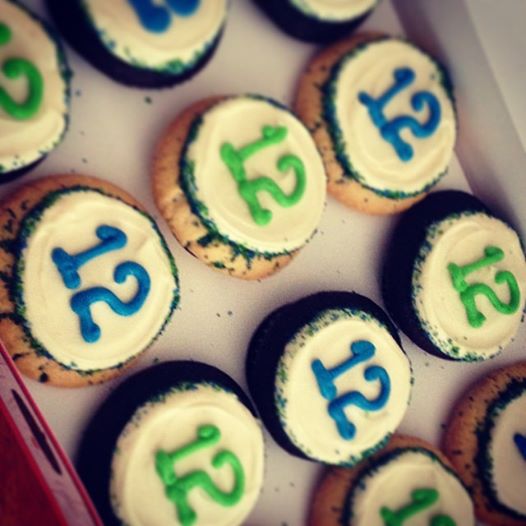
12th Man Cupcakes from Cupcake Royale. Yum.

12th Man Cupcakes from Cupcake Royale. Yum.

Now that I’m not in the classroom teaching college students (aka the world’s germiest people), I almost never get colds. When we got back from Vancouver, Z succumbed to one, which is always a sad thing because a) Z should always feel great and b) I am the world’s worst caregiver. I’ve got no real domestic skills, and so I spend way more time lecturing him on the merits of Kleenex vs. hankies instead of fixing him steaming bowls of chicken soup and fluffing his pillows. I once brought him borscht from the Russian pierogi shop up the street when he had a stomach flu, which I discovered is not a good idea. My most recent care-giving faux pas was just last night. He was suffering with a sinus headache, and so I gave him a head massage with Aveda Blue Oil (love this stuff!) and got some of its minty goodness in his eye. He spent the rest of the night blinking furiously. I kept insisting that it wasn’t the Blue Oil and my ministrations that had caused the trail of tears on his cheeks, but instead attributed it to the strong emotion he was feeling about a particularly dramatic song one of the Olympic ice princesses was skating to.

All week, Z blew his nose and walked around the house wearing sunglasses for his headache and a furry blanket wrapped around his neck and torso, looking kind of like an eccentric drug kingpin. Meanwhile, all week I was crowing about my amazing immune system and how rarely I succumb to things like the common cold now that I’m not grading 400+ coughed-upon papers a semester. And then Saturday evening as Z was starting to feel like himself—the night before the big game and the little party we were having at which I planned to cheer on the Seahawks and hold (and hog) the new baby belonging to our friends—my nose started running.

Boooo. BOOOOOO. If you’ve been wondering why there wasn’t a gloating post-Bowl post, it’s because I was either blowing my nose or napping for the last week.

I am not really a sports fan, and most years when we watch the Super Bowl, I’m in it for the commercials. But this year I was surprised to discover that I’d caught a case of Seahawks fever. I still have no idea what “off sides” means and when the announcer says someone has “taken a knee” I expect to see the extra players praying on the sidelines, so I’m not claiming to be a #1 fan here. But when you live in a city with a team and see some of the players on the cheesy local commercials for things like plumbing and when you can hear the touchdown cannon go off whilst sitting on your very own sofa, it’s hard not to feel . . . involved.

Plus, I’ve discovered via the magic of the interwebs that the Seahawks are one of the most disliked teams in the country, and for some reason this makes me feel kind of protective of them. They’re clearly loved here—there has been a gross misappropriation of office Post-Its to make 12th Man flags in blue and green in the windows all over town—but mention the Seahawks to someone outside of Puget Sound and you’ll see actual lips curl.

Obviously, the Seahawks were not depending on me so my cold didn’t really affect the outcome of the game, but I did miss out on serious baby-holding time. The baby in question—who I will call Pippi (as in Longstocking) here because she has a hint of red hair, Scandinavian heritage, and what I believe will be a fierce heart and vivid imagination—still came over, but I had to just sort of peer at her in her little Seahawks onesie from a distance and promise not to sneeze in her general direction. As it turned out she only spent the first half of the game with us as her parents decided that Baby’s First Super Bowl was slightly less important than Baby’s First—and probably only—Trip to Costco When No One Else is There.  Because they left us with half a dozen 12th Man cupcakes from Cupcake Royale, I forgave them the early departure.

The city went a little nuts, which was kind of fun mainly because the crowd stayed well behaved. (Often when groups of people get together in Seattle, someone decides they’re an anarchist and starts breaking windows.) I was grateful for the cold because it gave me an excuse to stay indoors and just peer through the blinds at the whooping and hollering that went on well into the night and on into the next day. And the next. And the next. Wednesday evening I heard a guy under our windows randomly yell, “Seahawks!”

Since we only live a few blocks from the victory parade route, Z and I decided to pop down to see a little of it on Wednesday before he had to head to work for a meeting. I still had a cold and it was freezing out, but it was sunny so I put on extra layers of clothes, including two hats, and off we went. We stood half a block from the parade route and waited. We watched people. We waited. I checked my email. We waited. Then we got word that the parade was going to start almost an hour late. Z had a meeting to go to and my nose was starting to run more furiously, so we posted a photo of ourselves “at the parade” on Facebook and trudged back up the hill, feeling a little dejected to miss out but also a little relieved to be heading back into the warm. Z went to work and I curled up in my chair under a blanket and watched the parade on TV.

A parade without floats and drill teams just does not engage me. I want scenes made of roses or giant balloons, but this parade involved only the Seahawks and their entourage riding around on the amphibious “Ride the Ducks” tour busses, throwing Skittles and beads to the crowd. The game was over, and as I watched people on TV scream and climb trees, I couldn’t remember exactly what all the fuss was about. My brain started asking big questions, like, Would there be a parade this frenetic if this were a women’s football team? Or, Would there be a parade if someone from Seattle won the Pulitzer?

After half an hour, I was bored and had my nose stuck in a book.

I’m not sure what my prognosis is. The Fever has subsided for now, but there’s a possibility it will return in the fall. We’ll have to wait and see.

Crowd waiting for the Seahawks victory parade.

Crowd waiting for the Seahawks victory parade.

Elegy to a Mentor

Standard
Gibb (with Beth and her 80s hair).

Gibb (with Beth and her 80s hair).

Today would have been the 80th birthday of my college mentor. All afternoon I’ve been having “Gibb flashes” and was surprised to look on my perpetual birthday calendar and see his name in parentheses (parentheses being the only indication I am ever willing to give that someone on my calendar is now dead). Somewhere on one of my often-confused brain cells, there must have been some Gibb info stored and an impulse got released to remind me to send him a greeting today.

Only sadly, I have to send it to the general populace since he died in 2006.

When I went to college, I was an art major. My whole life until then I’d either had a pen in my hand for writing or a pen in my hand for drawing, so it’s easy to see now why I was confused about what I should do with my life back then. For the first six weeks of college, I dutifully carried my art supplies to the Fine Arts building and tried not to be intimidated by the girl who wore a beret or the guy who carried a paisley purse, both of whom looked like artists while I was wearing polo shirts and sweaters with shoulder pads. I also tried to ignore how loathe I was to use the mandatory charcoal because the feel of it dragging across the paper set my nerves on edge and I preferred the delicate, fine strokes of a pen. Eventually it became apparent that the joy I felt going into the classroom beneath the art studio for my Valuing Through Literature course when compared to the glumness I felt about Drawing 101, probably meant something significant. Possibly, I would have come to this realization without Gibb at the helm of that class I’d accidentally been placed in by a disinterested advisor, but I like to think it was destiny that put me in his class and that led me to the registrar’s office before the term was up to change my major to English.

Gibb was in his 50s, balding, and had this air of an Englishman even though he was 100% American. (When I say “air” I don’t mean that he put on airs. He was just so caught up in British literature and history, that he gave off an English vibe, so much so that his perfectly American English would start to sound like English English in your ear.) More than once, the actor Anthony Hopkins has reminded me of Gibb, though not so much when he played Hannibal Lecter.

Gibb had this habit of lecturing into his yellow legal pad, as if he were talking to himself in an empty room, only occasionally looking up at one of us with a slight smile or a squinted eye if he’d said something particularly poignant about a poem or essay. He moved his coffee cup around as he talked, as if he couldn’t find the exact right spot for it, and his lectures, while full of the expected details about literature, were also chock-full of anecdotes that you’d miss if you weren’t listening, such as his  memory of the first ball point pen and how the advertisements  had said, “It can write on butter!” as if writing on butter was something everyone would want to do, or his disappointment that inaugurations never looked as good as they did after the Kennedy presidency, which he blamed on the lack of top hats. One of my favorites was about the Wedgwood China he’d won in a puzzle contest that he enjoyed because with it came a trip to England. When he told us about it, he shook his head at the memory of his daughter, who was concerned about how much each piece of it had cost. He said, “How does the price of a gravy boat make the gravy taste any better?” In his mind, it was somehow tied to what we were learning to value through literature, but to some of my classmates, he just seemed like an old guy who rambled. It was these anecdotes of his—dutifully copied in my notes right next to dates and themes of Bride of Lammermoor—that led me to the understanding that literature was life, and vice versa.

He loved pigs and had had a pet one named Jipper when he was a boy, and it would meet him after school each day. Various pig trinkets dotted the shelves which were filled with books about and by Romantic and Victorian British authors, including a tea towel with pigs on it dancing around some building blocks that spelled out ENGLISH. (My friend Bunz, once said, “Until I met Gibb, I had no idea that pigs and English had anything to do with each other.”  I’m still curious about where one would find such a tea towel.)

My fellow English majors liked him fine, but he was not one of the campus personalities around whom students flocked, those intellectual celebrity-profs who spent as much class time talking about themselves and their vast stores of knowledge and accomplishments as they did the subject at hand. Nor was he like the psychology prof in the tight Levis who was popular despite a rather crabby disposition. Gibb amused students, if anything, both because of his odd lecturing manner and the quiet jokes he’d crack in the classroom. Did my classmates respect him? I don’t really know but I have to believe they did because I can’t really stand the thought that they might not have.

Friends who were English majors were aware of my devotion to him and how I hung on his every word, and they sometimes teased me about being in love with him. It was in good fun, but it got under my skin…like being accused of having the hots for Mr. Chips or Yoda or, well, Buddha or Jesus. You just don’t do that. It wasn’t about that. Mostly, I just wanted to scoop out what was in his brain and put it into mine.

One of the regular requirements for his classes were journals, an activity that I loathed for other professors, but I knew Gibb was reading mine because he regularly praised me for the quality, and so I began writing them with more vigor because it was clear I had an audience. It was the perfect communication style for two introverts. His written commentary gave me insight into the work I was writing about, his praise gave me a little more faith in my abilities, and on one occasion when he chastised me, his words burned deep and I spent weeks mentally twisting while I tried to figure out if I had been misunderstood or if I needed to alter my perspective to align more with his.

I remember the satisfaction I felt, when I brought Helene Hanff’s books, 84, Charing Cross Road and The Duchess of Bloomsbury Street to his attention. He’d never heard of her, devoured the books, and one day when I was working in the English Department at my job as a student secretary, I overheard him suggesting the books to someone else. I felt like I’d accomplished something, to carry these two small books to this man who had introduced me to so much fine literature, the way a cat leaves a mouse on a doorstep for its master.

My junior year, he and his wife, took a group of students to England for a week. It was my first trip outside of the U.S., and the idea of seeing the England that Gibb had lectured about with him (and with my friends), really was a dream come true. Our first full day there he led us to the Tower of London, and I can still remember the sort of naïve shock I felt when I realized that the places I’d spent my life reading about were real, the historical figures were real, and even the fictional characters and places were real­-ish.

For some reason, one of my fondest memories from that trip was at Windsor Castle where I overheard his wife pointing out that St. George’s chapel was closed, and Gibb said to her, with the most irritation (and disappointment) I had ever heard from him, “Of course it is closed. Whenever we are here it is closed. Why would it be open today?” Years later when I managed to be there on a day when it was open, I was sure to remember the details of what struck me there—the photo and light burning by the tomb of the current queen’s father, what it felt like to stand directly over Henry VIII’s bones, the checkered floor, the banners—so I could give him the details in case he never did get to see it for himself.

After my graduation, we kept in touch with letters and regular Christmas cards, in which we’d always promise to get together in the near future, though we never did. I wanted to be able to report to him that I had become the next Erma Bombeck or Mike Royko (his two suggested futures for me, as if these were job openings I was likely to see an ad for), and so I kept putting off seeing him maybe, and instead reported less grand things in my letters: a new degree, a trip to Ireland, a new job teaching. In my  memory, I thanked him for what he’d taught me when I started teaching my own students, but I’m not sure I did. I hope I did. Certainly, some percentage of what I said and did in the classroom was because of Gibb.

One year his wife signed the Christmas card and there was no letter. Instead of feeling glad to hear that they were both well, I felt annoyed. Within the year, he had died.  A few weeks later, I found the previous year’s Christmas card and realized it wasn’t his wife who had signed it. It was Gibb. His handwriting looked less like itself, less sure, and the message was short, “Please come and see us!” And I wept because of those things we desperately want “do-overs” on but can’t have.

His voice cracked once when he talked about aging love in Robert Burns’s poem “John Anderson, my Jo” and it has stuck with me all of these years, how much the words on the page were alive for Gibb and should have been alive for all of us, young things that we were, so sure we’d never age.

Travel Styles

Standard

IMG_0773

My modus operandi when traveling for all of my adult life has been to pack as much as possible into a day. I study guidebooks and websites and make lists of the “must sees” and map out a course of action. I’m not rigid, or anything, but I’m always imagining what is just around the bend that I can observe. The most famous of these pack-as-much-as-you-can-into-a-single-day excursions was on the occasion of my mother’s 60th birthday when we went to New York City a few years ago, and we wanted to get as much of the city explored during our few days there.

On our last afternoon in New York, it was pouring with rain but we had just enough time to go into the MoMA before it closed. We both desperately needed to go back to the hotel and put our feet up because we’d started early and covered a lot of ground. But the MoMA? How could we not go? So we did, and we saw a lot of gorgeous and thought-provoking art, and I remember being there probably better than I remember any other art museum I’ve ever been in because I was in agony. If I’d been allowed, I would have curled up in a fetal position in the room with all the Joseph Cornell boxes and stared at them until closing time. By the time we left the city, Mom’s feet were bruised and raw and she hobbled through the airport like she was 90. She had to call in sick for two days because she couldn’t move. She was happy and had 8 million photos to document everything we saw and did, but I felt like a very bad daughter for putting my greedy need to see sites ahead of Mom’s well-being (and my own body’s protestations).

While Z and I were in Vancouver last Saturday, a large family was behind us, kind of pushing us along the sidewalk as we walked from our Sky Train station down to the spot where we could pick up the ferry for Granville Island. A couple of the people in the group broke free and moved quickly ahead of us, darting in and out of pedestrians, and one of the younger members of the family behind us said, “Why does Mom have us on a forced march?” A sibling, perhaps, said, “We’re running out of time in the city and she has things to do.”

It struck me how in just a few short years—and whether it is being married to Z or the icy hands of middle age, I cannot say—my traveling style has altered. Before, if there were 14 sites to see, I would, by golly, see them all in a single day even if I were miserable by the end of it. Z is not that kind of traveller. If I had to choose a single word to describe him, in this regard, I would say Z is content. He doesn’t want to get up early, he has no delusions about how his life will be better if he gets to see x, y, and z, and mostly he just wants to have fun. When the sight-seeing ceases to be fun, he’s ready to head back to the hotel, and he never has regrets about what he might have missed.

Oh, to be Z.

My body may be begging me for a rest and I may be snappish because of excessive tourism, but mentally, it goes against my grain not to do as much of everything as I possibly can. When I was younger and read “I Shall Not Pass This Way Again” by Stephen Grellet, I failed to pick up on how the poem was about being kind and helpful to those whose path crosses yours and instead I thought it was some sort of travel manifesto. I may never be here again, so I better do it all. But Z is laid back. He’s not ticking anything off a list. He’s having a good time, hoping for a nice snack, and just generally more content.  He has the Zen quality of Pooh Bear traveling, while I, instead, have a combined personality of Rabbit, Owl, and Eeyore. When I start making a huge “to see” list, he reels me in and reminds me that he likes to do one or two things only. So I push him to do more and he pushes me to do less, and we end up somewhere in the middle. I don’t put up much of an argument when he declares he’s ready to head back to the hotel anymore because I’m beginning to understand the merits of leisurely.
IMG_0744

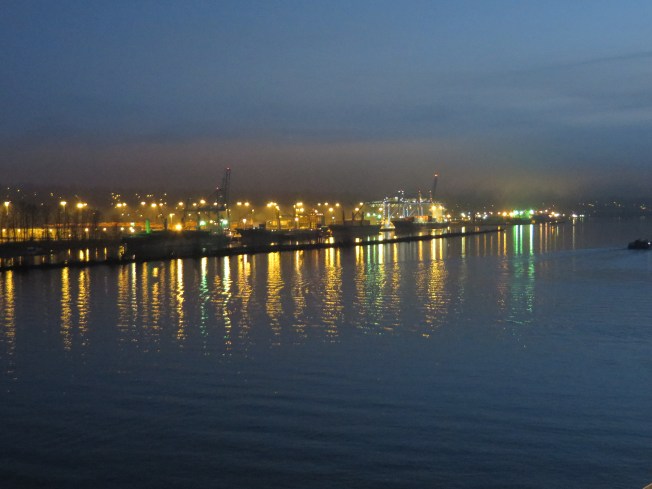
So our two nights in British Columbia were not jam-packed. We stayed in New Westminter at Inn at the Quay, and had a room overlooking the Fraser. It’s a working river, so it wasn’t idyllic, but it was peaceful and we enjoyed the view until later in the evenings when the fog swallowed it whole.

Other things the fog swallowed: the mountains. What I remember from my only other trip to Vancouver several years ago was the shock of such beautiful mountains being so close to a city. The views were gorgeous. On this visit, we could have been in Kansas City if there was a lot of waterfront there. Still, lovely though.

In some ways, I’d remembered B.C. and Canada in general as more perfect than it actually is. For instance, I’d told Z how amazed he would be by how much cleaner it was than Seattle, which ended up being completely untrue. I’ve never nearly stepped in so much dog crap in my life. (The upside: loads of dogs for me to oogle, one of my favorite past times.) There was litter. Some areas were sketchier than I remembered. None of it was bad, certainly none of it was worse than what we see every day in Seattle, but it wasn’t the utopia I’d remembered, which was a good realization for someone like me to have; I always think somewhere else is better than wherever I am.

In New Westminster, we explored their revitalized waterfront, sampled some of the wares at the Rivermarket, which was right next to our hotel. At the market, on the first or “hungry” floor, you could devour a variety of local foods, and on the second or “curious” floor you could take classes, including learning a few tricks at the drop-in circus school. (We ate food but did not learn the trapeze, fyi).

We were right across the street from the Sky Train—fully automated and mostly elevated—into Vancouver. It reminded me more of the Chicago El and less of Seattle’s light rail. It was clean and quick and I enjoyed peering into the apartments and condos of people as we whizzed by to see how they decorated.

rgspublicmarketblue

On my last trip, I’d never made it to Granville Island, though several people had suggested it, so we decided this should be our destination.  I’d read about it, so knew what to expect, but poor Z was picturing a leisurely ferry ride to a wooded island like Bainbridge, instead of the half a minute Aquabus ride to what felt like the other side of False Creek. He was happy when we disembarked, however, and made our way to the public market. It was reminiscent of Pike Market (particularly in the way I got crabby after about ten minutes because there were entirely too many people there), but had more food stalls. Z was particularly pleased with the Cornish Pasty he had, and I, because I eat like a picky four year old, had spaghetti and meatballs. Delicious, but not very adventurous. (This will never turn into a Foodie blog—sorry to disappoint you.) We walked around the island for a while, investigating the artisans’ wares in Railspur Alley, and tried to investigate the little bookstore and stationery store, both of which looked delightful but were way too crowded for it to be enjoyable. Then we hopped on the Aquabus and made our way back downtown.  On the walk, we visited the museum store (and loo) at the art museum, where it was nearly closing time. The building looks lovely, even if we didn’t make it in to see the collection. We continued our walk, peering into the Fairmount Hotel, where I hoped to see the resident yellow Lab, whom I met last time I was in town, and then on to the waterfront to try to find a view through the fog.

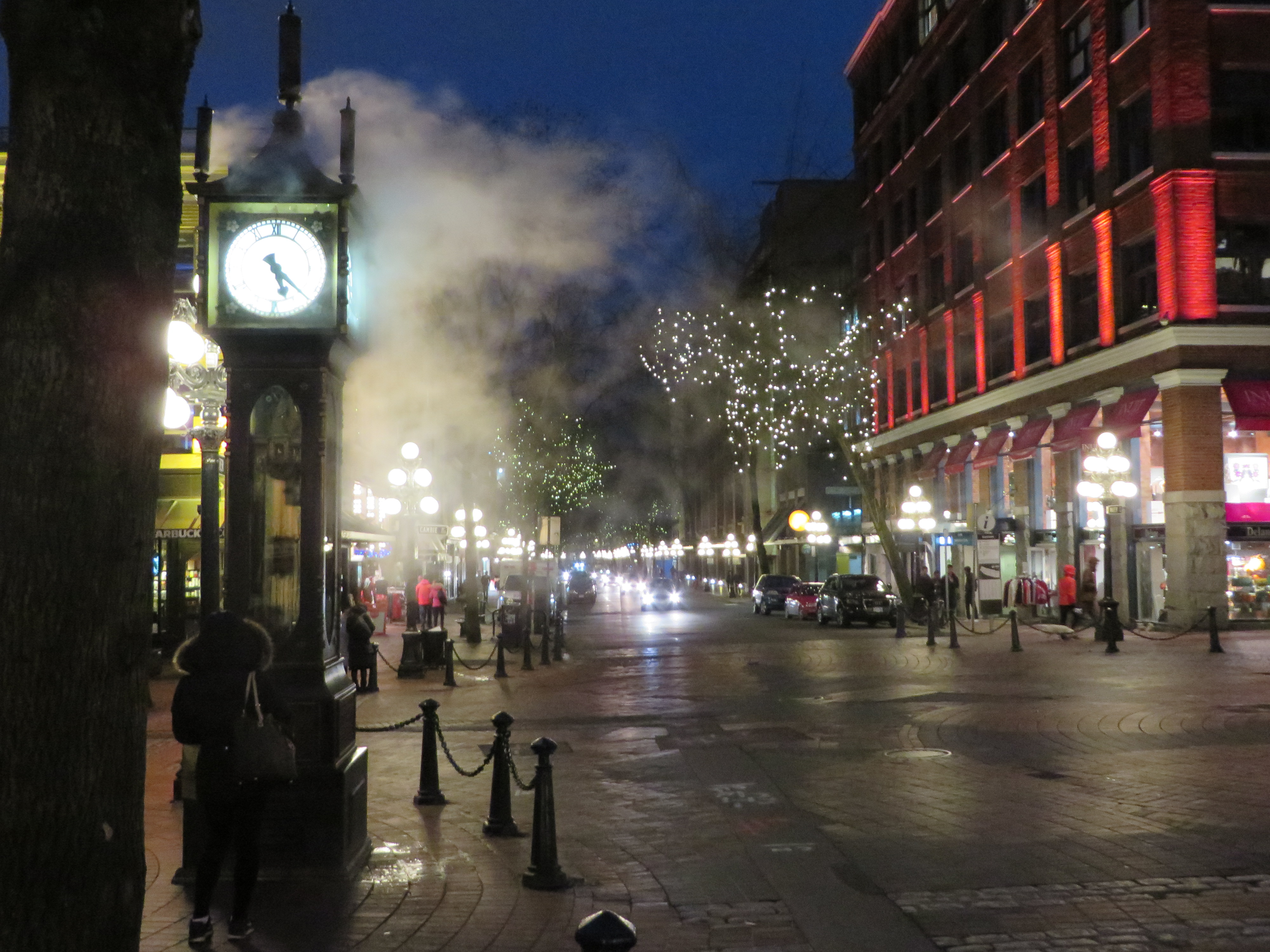
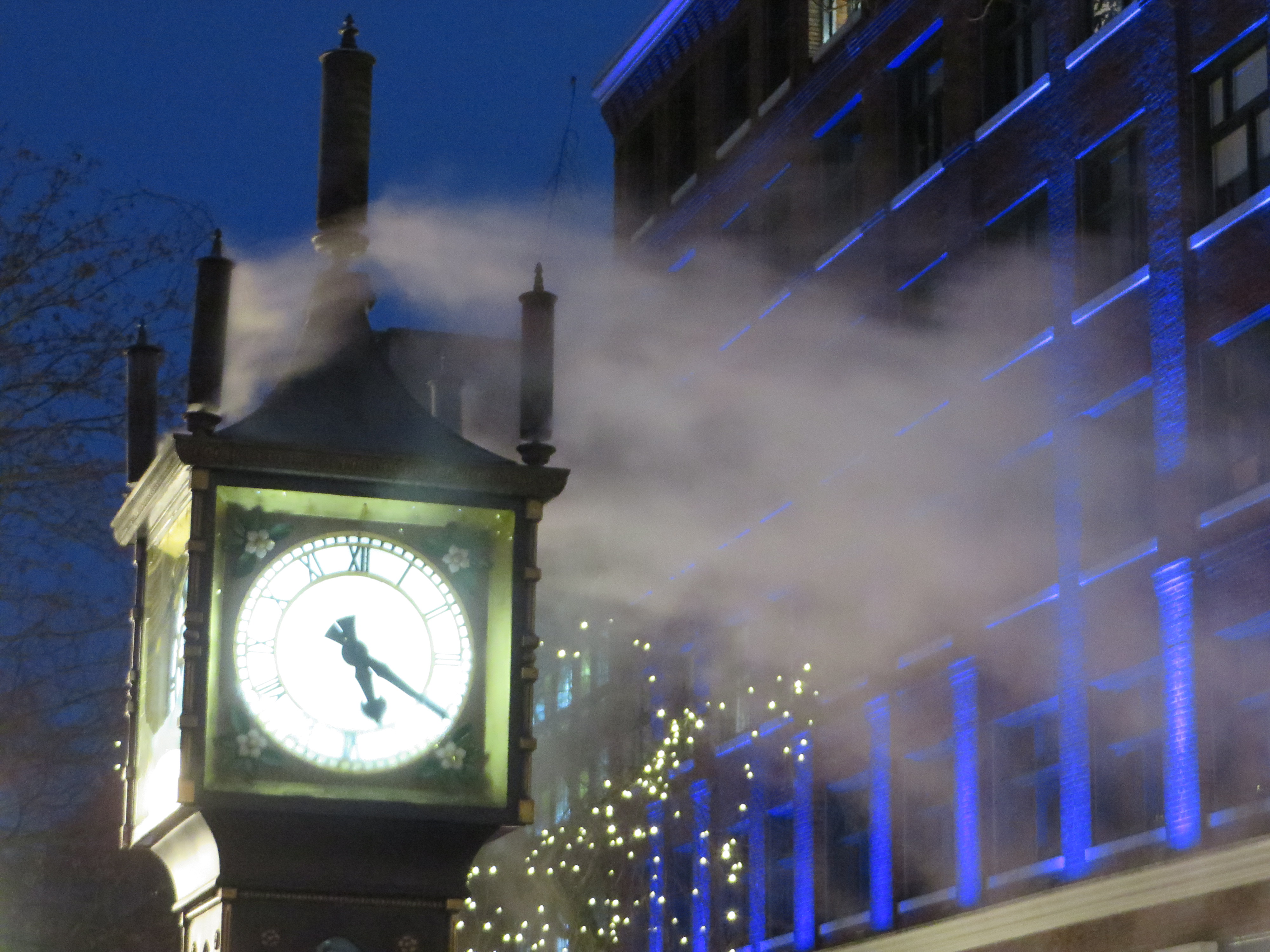
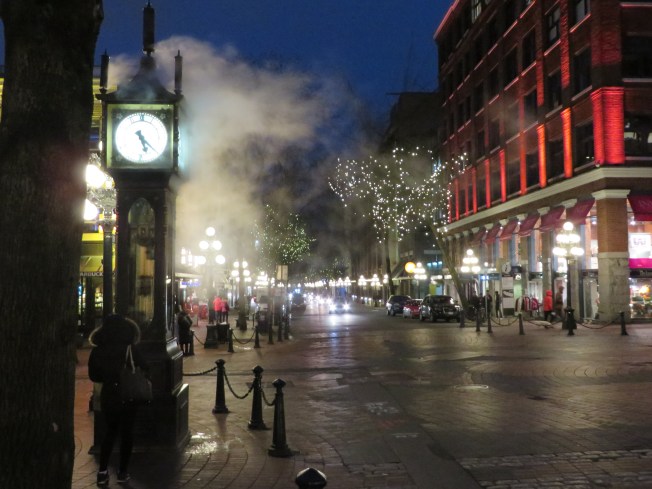
Eventually we arrived in Gastown. It was a particular favorite of mine, before I moved to Seattle and was introduced to Pioneer Square. The two places remind me a lot of each other: both have roots to the oldest part of the towns’ histories, both fell on hard times and became “skid row”, both were on the verge of being demolished when some forward thinking person realized the value, both for history’s and tourism’s sake, and the areas were saved and revitalized. Our biggest Gastown disappointment is that we’d stuffed ourselves so full on Granville Island we weren’t ready to eat dinner yet. It niggled at me a little that we were headed back to the hotel when everyone else was just headed out for the evening, but if I’m completely honest, I was looking forward to the quiet, un-crowded hotel and foggy view.

On Sunday, before heading home, we had lunch at the Dubliner Pub, which is housed in what used to be part of the penitentiary. It was cozier than you might imagine and the brunch there was delicious. We may have stopped at the Hard Rock casino for a flutter before directing the car towards the border, and we may have cleared $33 of the bizarrely plastic-y and see-through-y Canadian dollars, which we have tucked away for our next trip north.

Are there other things on our list to see in Vancouver like the observatory or Dr. Sun Yat Sen Garden (or the neighboring free park) or the scenery  we’ve been promised on the drive to Whistler? Um, yeah. But for our inaugural trip, we were content. And it didn’t hurt that we made it home just in time to see the Seahawks make it into the Super Bowl.

IMG_0769

Flashback Friday: Ghost Ship

Standard
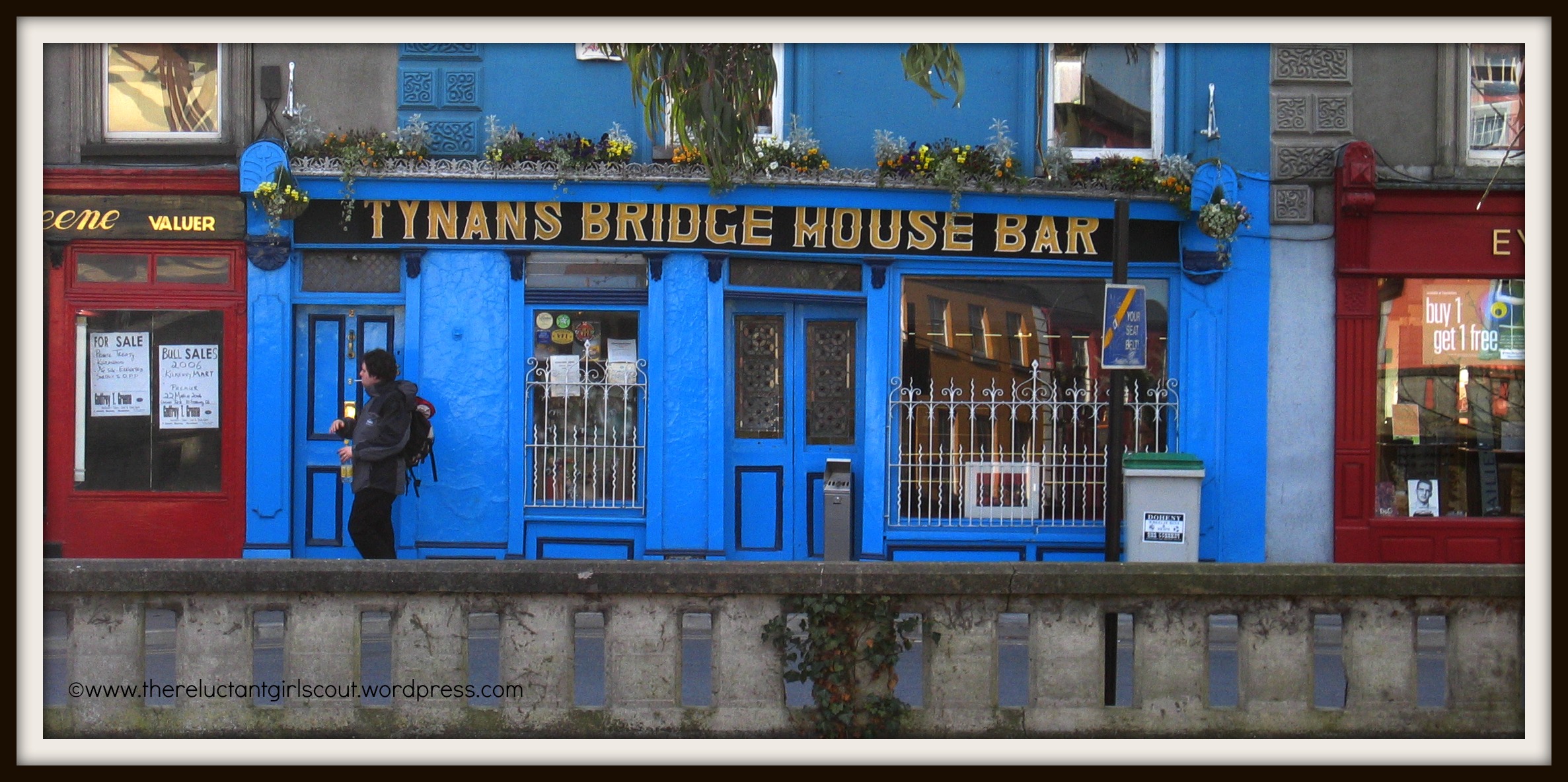
The House Bar, Kilkenny, Ireland

The House Bar, Kilkenny, Ireland

[Another Friday, another flashback. Here is another chapter from the Irish adventure with my friend Belle. As with most of my Irish posts, you should imagine Van Morrison (or the Saw Doctors) playing in the background.]


23 March 2006

Crystal is expensive & its absence of color bothers me, but when you are at the Waterford Crystal Factory and you’ve watched the film about how it is the MOST perfect crystal in the world—how, in fact, imperfection is not tolerated—suddenly it seems like you need to own a piece and like maybe your cousin who is getting married next month needs a piece. And maybe your mother. Maybe an aunt. Maybe a neighbor. If you find yourself in this situation here is my advice to you: don’t do the euros-to-dollars conversion in your head. Pretend that the sticker that says ’85’ means eighty-five dollars and be done with it. Later, when your Visa bill comes, you can worry about the math and bad exchange rates. At which point, the prisms dancing around your living room and your cousin’s note of thanks about how her marriage would not have been so happy without your gift will soften the blow.

It really is just the most awful kind of extravagance there at the Waterford Crystal Visitors’ Center. For instance, I mailed ten postcards by dropping them into a giant crystal mailbox.

When you walk in, you are at the highest level of the show room, looking down on the chandeliers. This level has replicas of the various trophies that have been created (one in the shape of a football, most in the shapes of loving cups), place settings of goblets and doo-dads that Queen Elizabeth (or Oprah) couldn’t afford. It’s gorgeous, but excessive.

The next level down is where the goods are sold. I walked around this area for an hour, trying to do the math that would make it possible for me to spend money in a cost-effective way, get a wedding present, a shower present, some other small gifts, and spend the 200 euros needed so I could ship everything home for free. (For the record, other people are going in with me on the wedding gift. I’m not THAT extravagant. I do just teach at a small Midwestern university.)

I couldn’t decide, so I went to the next level down where the Wedgewood is sold. I’m not buying English china in Ireland. I’m not. So I scooched on into the room where other bits and bobs were sold. The space started feeling a lot less posh and a lot more like a basement. I was more comfortable. Here was the tourist tat that is sold everywhere in Ireland, of which I own too much because in those last minutes before a plane boards, suddenly it seems imperative that I have a Claddaugh apron or sixteen bumper stickers that say ‘Póg mo Thóin’ and key chains and coasters with my family’s supposed crest on it. It disturbed me that Waterford Crystal, an entity that couldn’t be more Irish, has the same class stratification that the Titanic (another Irish creation) did. So there I was in the basement in my scuffed up clogs with my hair in a ponytail and my black ‘just say no to troops in Shannon airport’ Shamrock button, KNOWING that I belong—and always will—in steerage. But for the sake of my cousin and her impending wedding, I clawed my way out of the ship’s hold before I was tempted to buy her a shamrock covered teapot with ‘Eire’ written above a facsimile of Brian Boru’s harp.

I made my choices, did the euro-only calculations, and then at the last minute asked the woman how long the free shipping would take on these items. Six weeks, she says. The wedding is in three weeks. Guess what’s going to be in my carry-on, wedged under the seat in my own little hunk of American Airline’s version of 3rd class travel?

An interlude: yesterday in Kilkenny, I saw a pub with a blue sign that said, “The Mouse Bar.” It made me laugh and imagine tiny rodents sidling up to the counter, asking for a pint, so I took a picture. This evening I mentioned it to Belle and Himself and showed them the picture. Isn’t this funny, I said. The artist looked at me like I’d lost my mind. “It’s the HOUSE bar,” he said. “Not the MOUSE bar. I told you about it before you left, said it would be a good place to eat.” Belle got so tickled she couldn’t quit laughing. Her face was red and Himself said, “Get control of yourself, woman.” For the rest of the night, all either of us would have to do was softly mention “mouse bar” and the other would start cackling.

Back to our regular scheduled programming:

This afternoon, Belle decided that I should see the famine ship in Dunbrody. She’d tried to see it last spring but it was in dry dock, and then later in the year she’d made the trip and found it worthwhile. She’d even checked the web last week to make sure it would be open this time of year. It is a replica of one of the ships that brought over emmigrants who were trying to leave an inhospitable Ireland in the mid 19th century. The night before she’d pointed me to a few sights to find information on a great-great grandfather no one in my father’s family knows anything about, and she said that at the ship I could search manifests to see who traveled from where and when. Though I’m not big on re-enactments of such things (can we really know how horrible the insides of those coffin ships were in 1847?), the genealogical aspect seemed excellent, so today we drove the 20 minutes or so down the road to New Ross, and as we were crossing the bridge, she said, “I don’t see the boat.” It was misty out and I figured she’d just forgotten where it was. The closer we got to the dock, the more sure it seemed that it wasn’t there.

The visitors’ center, however, was opened. People were there having sandwiches in the little shop and the ladies running it were dusting off the souvenir erasers and sterling silver Celtic crosses in hopes of making a sale. It was as if they were unaware that the boat wasn’t there. As if, perhaps, it were a ghost ship that only they could see. There were two computers there and I momentarily got my hopes up that I could do my search anyhow, but then quickly saw the ‘out of order’ signs hanging on both. Belle asked about the ship. It’s in dry dock again for some big sailing thing later in the spring. Belle pointed out that she’d just checked the website. The lady said, “But it only went into dry dock last week!” Belle said that yes, perhaps that was the case, but last week was when she checked the website to see if it was worth making the trip (FROM AMERICA) and the woman said, “But it will only be in dry dock for a week!” as if that explained it away. She then offered to show us a ten-minute video about the boat we wouldn’t be able to see. I said, ”No. I’ve gone off it,” and we left. And then we laughed most of the way back to Waterford. It was annoying, but I can’t really be too annoyed in Ireland about anything. Everything just seems sort of funny. Going to the wrong church. Having a pint at a mouse bar. Visiting a ghost ship.

To save the day, Belle then drove me to East Dunmore, a resort town that Maeve Binchy writes about and where movies of her books are filmed. Lots of cottages with English thatch. It was a windy, misty, cold day, and the sea was crashing against the rocks and roaring. We saw a monument to the sea-dead from the area that one of the Artist’s co-workers designed, and drove around the high road looking at the view. It was breathtaking, and there, without benefit of ten-minute films or faux famine ship passengers, I could think about what that voyage must have been like, how desperate a person would have to be to leave family and home to brave a sea that could be so violent. How optimistic. And while I’m not ego-centric enough to think they imagined their future generations drinking Coca Cola out of crystal goblets, I wonder if maybe they weren’t wanting something a little more close to perfect than what they’d been born into.

Isn’t that why we’re always scratching and whinging and charging things on our credit cards? Don’t we have some idea that things could be better if only we….

East Dunmore Memorial

East Dunmore Memorial

Borderline

Standard
Peace Arch

Peace Arch

This weekend, Z and I went to British Columbia to celebrate, belatedly, our 4th anniversary, which we had to spend apart last month.

Z has a freshly minted Canadian visa burning a hole in his pocket, and he’s never been north of the 49th parallel in North America, so it seemed like the best place to celebrate. (Also, I like to think we were celebrating the occasion of my 50th blog  post with a little international travel.) It wasn’t my first trip there; a conference in Vancouver almost a decade ago was my first introduction to this part of the world, even before I met Seattle, so I was anxious to see it again now that we’re neighbors.


Because I grew up smack in the middle of the country in a town situated on the National Road and I-70, it often felt as if there was nothing but wide-open space and an open road that led to other more exciting kinds of lives. Since moving to Seattle, I’ve sometimes felt the pinch of this geography. It’s not exactly that I want to run anywhere, but the close(ish) proximity of the Pacific to the west and the Canadian border to the north, has, at times, made me feel hemmed in. I have elaborate apocalyptic fantasies that I blame on being raised during the End Times crazed 1970s, so while we were sitting in line at the Peace Arch waiting to cross into Canada, my brain got a little overactive, thinking about how our twenty minute wait would be hours and hours if we ever had to run away from home because of some sort of Red Dawn style invasion or Zombie attack or what have you. And that “Brethren Dwelling Together in Unity” etched across the top didn’t soothe me so much as make me imagine ways in which this would become a mockery in some dark future, not unlike that scene of the decimated and mostly submerged Statue of Liberty in Planet of the Apes.


Is there a word for being simultaneously creeped out and fascinated by something? Someone should invent one if there isn’t. (And if there is one, someone should tell me. I can’t figure out how to google such a query.) Aside from end-of-the-world concerns, I’m also weirdly drawn to and repulsed by those places in our lives that are neither here nor there: airplanes in mid flight, waiting rooms when someone is in surgery, the place where the sea and land meet, the gloaming. It’s magical and kind of terrifying. What is that no man’s land, that is neither one thing nor another?


While we sat in line waiting to cross into Canada, where were we exactly? We were, I think, still technically on US soil, yet the houses we were looking at beyond an inconsequential fence seemed to be in Canada. The yards looked Canadian, if that’s possible. And if we got out of our car and walked in the roadside park, where exactly were we? Would anyone want to tackle us to the ground for stepping over some line we shouldn’t?


Also, I felt really geeky that at this friendliest of borders, the adrenaline rush I was feeling was tantamount to moving between East and West Berlin before the wall came down. When we finally made it to the border patrol agent and he asked us a few questions about how we knew each other and what our plans were, in my mind the whole trip had grown into some caper we were trying to get away with. All we really wanted to do was get to our hotel in New Westminster, eat some food, see some sights in Vancouver, relax, and after two days, return to Seattle in time to see the Seahawks playoff game from the comfort of our own sofa. Yet as the questions got fired at me, I felt more and more like we were smuggling  someone across the border in our trunk. Also, because Z doesn’t yet have a green card, I often worry that someone with a badge will decide we aren’t legitimately married and make us live apart. (Why I thought a Canadian border agent was the person to do this, I don’t know.)


The guy looked at Z’s documents and asked a few more questions about why he’s here and not in Zimbabwe, and Z, being Z, answered with authority and reminded me of Obi Wan Kenobi when he does that Jedi mind trick on the storm troopers and says, “These aren’t the droids you’re looking for” and the storm troopers sort of shrug their shoulders and give up the hunt for R2-D2 and C-3PO. Z is amazing. Meanwhile, even if I seemed calm, inside I felt as if I had baggies of heroin stashed in unmentionable places, and I hoped he wouldn’t notice the sweat on my brow.


Something snapped inside me though when the agent asked why we had a rental car instead of our own. I can’t say why it annoyed me so much except our lack of car here sometimes gets under my skin. I miss Hilda, my beloved CR-V that is parked in my parents’ drive-way currently covered in snow, waiting for my return, and I love the ease with which you can drive places back in Indiana. So it was kind of a sore spot, frankly. I was pleasant, as is my Midwestern training, but for some reason, I wanted to say, “Screw you. We’re going back to Bellingham where we’re wanted and no one questions our life choices.”


In retrospect, I wish I’d acted morally superior about carbon emissions and how we don’t own a car because we love the planet more than most people.  (Though just between us, the reason we don’t own a car is because parking in our neighborhood is $4 an hour, traffic is tedious, and Z walks to work.) Anyhow, he seemed to believe me and waved us on.  Never mind my body cavities filled with imaginary drugs or the imaginary Peruvian in our trunk, trying to get into the country illegally.

Stacked

Standard
My desk (fantasy version)

My desk (fantasy version)

I used to have students who would say to me, “I’m a writer, but I hate to read.” Whenever I’d hear that—and I heard it too much—I’d always want to do one of those obnoxious cough talks, where you hold your hand over your mouth, bark a cough, and simultaneously say something rude. But I was a good teacher, so instead I’d suggest a book I was sure would capture their interest.

You can’t write and not read. I mean, I suppose you can, but I don’t really want to have to read what you write. And frankly, it seems a little rude to me to write something you think other people should read when you refuse to read yourself. I suppose you could be a chef who doesn’t like to eat anyone else’s food, but where would you get your inspiration and style?

I have no idea if I would have thought of myself as a writer if my mother hadn’t made being a reader non-negotiable. Maybe I would have been like those old students of mine, enamored with the idea of having my name on a book or a story or a poem published with my byline without having bothered to study craft or let someone else’s words inspire my own. It’s one of those unanswerable nature vs. nurture debates. I grew up in an apartment that was filled, floor to ceiling, with books crammed into a brick-and-board shelving system. I saw my mother reading and I was read to nightly. I had my own library card the moment I was allowed to have one, and I knew how to use it. (Brief aside: one of the saddest losses to me in this barcode age is the absence of the satisfying “Ka-chunk” sound when you checked out a book.) My childhood was spent at garage sales, used bookstores, and in the book sale section of the musty Salvation Army store, where Mom’s early collection got its start. Though I might have gotten bored during these lengthy browsing sprees at times, I was resigned. Books were holy and when you were in the presence of some that were for sale, you kept quiet and waited for selections to be made and the ting of the cash register that signaled the benediction.

I had my own bookcases before I had my own room. They were full of Little Golden Books, Dr. Seuss, the Little House on the Prairie Series, Trixie Belden mysteries, and all manner young adult books. The shelves grew. First three small ones, and then a desk set with adjoining shelves that were later cut in two, turned sideways, and had boards put across the short ends, giving my own library room to grow. When my  mother and step-father got married and bought a house, it wasn’t long before we’d enlisted him into building floor-to-ceiling shelves in my bedroom. When I was constructing my library, my belief was that it was something I’d carry with me for life, like scars and family photos. You might weed out the baddies, but even if you outgrew a book, you didn’t casually release it into the wilds. You hung on to it because it was part of the literary canon of your life.

* * * * *

When you think of me, I’d like for you to have the above photo in mind: my tidy desk with a row of writing books in front of me at the ready, should I need to find an answer about style or read a line for inspiration. These are all books that I’ve read in total or in part and know to be useful. When I look at my desk, these books bring me joy because this is the sort of person I always imagined I’d be: organized, controlled, and like a good Girl Scout, prepared.

But I’ve got a book problem. They multiply like rabbits. Despite the fact that I culled the herd when I moved here, and left half of my collection back in Indiana at my folks’ house, I’m operating at near maximum capacity here. When I was cleaning out my office this past spring after I resigned from my teaching position, I weeded extensively. There were a lot of books there that I had bought when I was just starting my collection, thinking that my life wouldn’t be complete if I hadn’t read the complete works of  ________________________________, but two decades later I no longer felt compelled. I’m beginning to recognize that I don’t have an infinite amount of reading days ahead of me, and so I’m trying to be choosey. (Which begs the question, why was I up until four a.m. last night finishing the latest Dan Brown novel.) But even with the weeding, every time I’m back home, a few more books leap into my suitcase, desperate to be reunited with their siblings.

rgsofficeshelves

So this is what my writing studio looks like, plus another set of shelves on the opposite wall where the books are double-stacked. Plus, a small set of cubes to go on top of these just as soon as Z and I figure out how to secure the shelves to the wall without wrecking our chances of getting our deposit back.

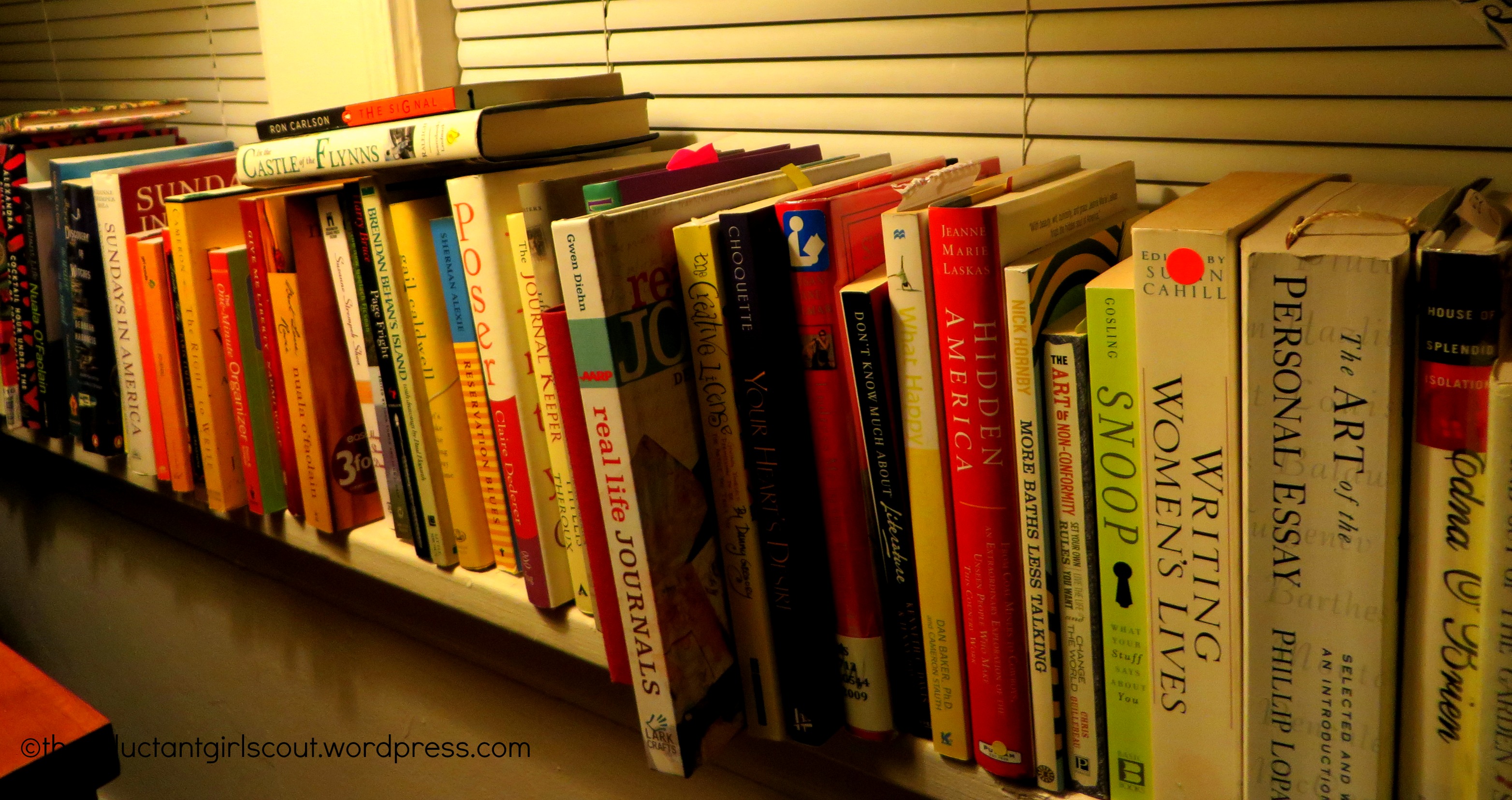
There wasn’t room for bookshelves in our living room, so for the first year or so that we were married, it was largely book free, give or take a coffee table book. Then I started getting books that I was planning to read “next.” So I put them on the windowsill behind the sofa. At first, it was just a few books and I definitely would be getting to them shortly, but then I went to a bookstore, used up an Elliott Bay Books gift card, went to a reading and felt compelled to buy the author’s latest title, had a birthday, and the next thing I knew, my “next” collection ran the length of the double windowsill. While the books in my studio are arranged in a very specific but intuitive fashion so I can easily find what I need, on the windowsill it is a free-for-all. I put books there as they come to me, so race car driver Janet Guthrie’s biography is right next to National Geographic’s Scenic Highways and Seven Secrets of the Prolific.

Book chaos

Book chaos

Books crept into the weird bar space behind our TV. Some appeared under my little wooden stool. We won’t speak of my nightstand, where the stack is currently so high, it threatens to block out my light. Nor will we speak of Z’s poor books, which I always relegate to hidden corners and alcoves. Any of these books could go live in the studio, where they might be more at home and so I would have more surfaces in my living room on which to set Zimbabwean objet d’art (read: stone hippos and wart hogs made of scrap metal), but I know as soon as I take them there, they’ll be lost to me. I’ll forget about them, find them in ten years and wonder what made me ever think I wanted to read a memoir about a Seattle mom who loves yoga or an American family who lived in Berlin before World War II.

And don’t even get me started on why it is I think I need to own every book about writing that was ever written. I’ve got so many books on how to be a productive writer, that I refuse to buy another unless the first line is: In order to be a more  productive writer, quit reading books about how to be more productive. It’s a sickness I have.

What I'm reading NEXT.

What I’m reading NEXT.

This is my most recent stack of books, compliments of Z and my folks. They came for both Christmas and my birthday. The desk behind them will open. Right now. But as soon as I cash in those holiday gift cards? Forget about it.

I know the world of e-reading makes for tidier living spaces, but I’ve got five books on my iPad and I can’t remember to read them. An iPad, to me, is not a book; it is a place to check my mail, watch Downton Abbey, and play “Ticket to Ride.” My brain doesn’t hear the start-up ping of an electronic device and think, “Oh boy! Time to read!”

So here’s my 2014 challenge to myself. I am going to show up to those books on the windowsill (and my new books, of course!) read as many of them as I am able, and report back to you.

If it were a real challenge, I’d make some outlandish promise about how they’d all be read and removed by December 31st, but I’m not crazy. Some books will probably always need to live there so I have easy access: The Art of the Personal Essay, The One-Minute Organizer, and You Can Heal Your Life (because sometimes I need to know what negative thought pattern I have that might be causing my big toe to hurt). That’s 68 books, plus the top two on my nightstand that I’ve got  to finish, which rounds it off to a solid 70.  And maybe, for good measure, I’ll read all the magazines I’ve been stockpiling since I got married. Joan Didion has been staring at me from the cover of Poets & Writers for two years now.

What are you reading? Oh, don’t tell me. The windowsill is already full.

rgsstool