Category Archives: Anxiety

Politics and Religion

Standard
photo 5

Whitewater United Methodist Church (Photo courtesy of Val Jennings)


Midwesterners often live by the adage that you should never talk about politics or religion. If we don’t live by it, we’ve heard it enough and have probably kicked ourselves at least once for bringing either topic up in “mixed company” only to have the conversation fall flat or get heated in un-enjoyable ways. Were I a better arguer, then maybe I’d love the challenge of heated debate or see such discourse as entertaining, educational or satisfying.


But I’m not.


I don’t enjoy strife. Z once got in an argument with a peace protestor by Westlake Center, and I skedaddled half a block away from him so I could avoid hearing whatever words he shared with the tired-looking woman with the “Give peace a chance” sign scribbled on cardboard. I’m not sure what I was afraid of: Z is not rude OR hawkish, but he does like clarity and finds idealistic platitudes useless and so wanted to know what giving peace a chance looked like to her in regard to the quagmire the Middle East had become. Still, I didn’t want to hear their words even if it was a pleasant exchange.


Were it not unseemly for an adult person to put her fingers in her ears and sing “la la la la” whenever there is a disagreement, I would do it.


At home in Indiana, I basically know the rules. I can have a religious or political discussion with a good friend who I already know basically believes what I believe. I know that with my extended family or friends who have differing beliefs, we can ignore uncomfortable topics (the best choice, really) or, if we are feeling brave, each say one conflicting thing politely to the other before we start talking about something innocuous like pie. The objective of these exchanges is that everyone knows there is no ill-will even if someone’s belief system is faulty. The closest I ever got to a political argument was when my uncle, the farmer, sputtered about how difficult the EPA was making his life re: what weed killer he could use on his crops, as if somehow my first-ever vote in the presidential election of 1992 a few months before had caused his headache. Of course even this wasn’t an argument. My uncle said his piece and I said, “Hmmm. I hadn’t considered that,” and then the subject got changed, though neither of our minds did.


But this political cycle is like the beast from the Book of Revelation, thrashing around, wreaking havoc where previously there were harmonious relationships. Usually, during the primary season, people who are not on the podium are relatively civil to each other as they try to figure out who would best lead their party of preference. They say things like, I don’t know, I kind of like the look of _______. Have you listened to him? and they save the ugliness for the second half of the year when they want to tear the opposition from limb to limb. But with the help of social media and everyone’s lack of tolerance and increased righteous indignation, this has been the some of the most stress-inducing six months of 2016 (and I’m  including the parts of the year where beloved pop icons died of drug overdoses, terrorists killed people trying to have a good time/do a hard day’s work, and my mother had a stem-cell transplant). One political party has almost completely imploded and the other has turned against itself like one of the more grizzly battle scenes from Game of Thrones.


Most of these battles are being fought in the media or on social media. Certainly, my own shouting fits and blood pressure spikes have only come from Facebook feeds and comments sections and not from any “real” interactions with humans. I don’t want to suggest that before Facebook was a regular part of our lives that we were a polite and genteel culture, but surely we’ve gotten ruder, haven’t we? And more full of ourselves? More certain that we are right and if we say something over and over enough times, everyone else will eventually be forced to agree with us because our logic and our words are so superior? Also, I’m not sure what convinced us all that our opinions actually matter and must be heard, like we’ll shrivel up and die Wicked Witch of the West style if we don’t speak our minds.


There’s got to be some diagnosis in the DSM-V that explains this lunacy.


A couple of weeks ago while I was talking to Mom on the phone, her call waiting went off and she came back, a bit breathless, and said that the church was on fire and she and my stepdad had to go. I sat around the rest of the afternoon feeling like I was waiting on a health report from someone who’d been rushed to the ER. The church is in the middle of the countryside and I knew the prognosis probably wasn’t good; it takes time for firefighters to do their job when they’re called in from the small neighboring towns and villages miles away. Later that night when she reported that the church was still standing but charred on the inside nearly beyond recognition and likely a lost cause, and later still when the photos rolled in, I cried. It felt like a family member had died.


I haven’t been in that little white church for probably two decades, and I haven’t attended services there since I was 19, but I always imagined it would be available to me. It is the oldest Methodist church in Indiana, nestled on the outskirts of a teeny village in the country, started at the time of circuit riders. It’s the church my mother and I started attending right after my maternal grandfather died unexpectedly and we were trying to find our way in the world without our patriarch. The church we started attending just before she and my stepdad started dating. It’s the church my great-grandmother went to and the church my great-great-grandparents attended. One particularly hot Sunday morning when I was bored during a sermon, I looked out the opened stained-glass window at the field behind the church and I could imagine the generations before me sitting there, so much hotter in their long dresses and suits, staring out the same window, their horses tied up outside, shuffling feet and nickering.


For me, the church was a source of great love and great conflict. Any church for me is that way, really, but this is the church where I came of age and where I first felt those tugs in opposing directions. I longed to belong, but never fully did. I was a divorced kid in a congregation that mostly wasn’t. I was an introvert in a congregation that, it seemed to me, preferred people not too timid to stand up and perform some service. I was living in the city and everyone else was from the country. I played the piano briefly when we lost our much more accomplished accompanist, but I wasn’t really a musician, so even that didn’t feel like the right fit. Plus, I’d spent more Sundays in mass with my father’s family than in a Protestant church until that time, so while I liked the deviations from the script that the Methodist minister took for dramatic effect or because he felt spiritually led to do so, I missed the comfort of the ceremony, beauty, and sameness offered at the Catholic Church.


There was an awful lot of politics in the church. People who thought they ran things. Other people who did a lot of the daily maintenance that kept the church running but got none (and asked for none) of the credit and had none of the say. People who had strong opinions about what the youth of the church should or shouldn’t be doing. People who had opinions if you skipped church to go to a Cincinnati Reds game. People who assumed that because you went there you must believe exactly how they believed and vote exactly how they voted. I’d feel crabby some Sundays, but then as the service came to a close we’d all stand to sing the doxology, say our goodbyes, and before getting into our cars and heading home, a sort of peace would descend that felt an awful lot like belonging. Like maybe despite the differences, we were all on the same team. And we were. If someone was in crisis, there were the prayers, the casseroles, the quiet concern.


In retrospect, I suspect I was just an emerging feminist trying to figure out what exactly my place was in an institution—or, at least, certainly a little country church—that liked it best when a person fit into a role. Though no one expressly told me my role was to be a good girl until I was a wife and mother or that I shouldn’t be overly interested in the leaders of the Women’s Movement or worldly concerns, it seemed to me that that was the track I was supposed to be on: one that didn’t ask too many questions, shake too many boats, or rattle any cages. So what to do with the secret knowledge that I spent as many Sundays in the sanctuary thinking lewd thoughts as I did concentrating on God? What to do when I felt cantankerous when someone made a request of me about performing some activity (lighting candles, speaking on behalf of the youth group in front of all those people, babysitting in the nursery) that I didn’t want to do? As a female, shouldn’t I be compliant and happily subservient? What to do with the realization that while I wanted to be one kind of person (a good, church-going, rule-following woman who read mostly Christian books and listened mostly to Christian music and shied away from anything too earthly), I also wanted to be myself (someone who devoured all texts, dipped toes into a variety of musical genres, and maybe rubbed up next to a boy I might not marry).


I never did make peace with that quandary, but eventually, my desire not to feel controlled outweighed my desire to conform.


I’m not sure what my little country church has to do with the 2016 election except on Facebook I read today that I can’t be a Christian if I vote for a Clinton and I also hear regularly in Seattle and online that if I were really a humanitarian—and surely that’s what Jesus was—then I would have chosen Sanders and not a “criminal” as my candidate. My “favorite” criticism this year has been the implication that by voting for a woman, I’m clearly making my choice based solely on our shared gender and have not relied on logic. As if I’m too feather-brained to realize I shouldn’t vote for someone for whom I hadn’t done some research and weighed the options.


All of that external judgment shares the same quadrant of my brain as my earlier internal conflicts in church. To be good? To be unapologetically myself? It isn’t lost on me that I’m still just as conflicted about being “good” and getting approval now as I was then, but also just as determined to be true to my own beliefs. The best example of this conflict hashing itself out is my choice this election season to wear a tiny, dime-sized button with a vivid pop-art picture of Clinton’s face that I pin on my purse and can cover up with my hand if I know the person viewing it will get too riled up. I’m not proud of this compromise, but it’s a good Midwestern coping mechanism as deeply ingrained as my need to be viewed as good and my desire to be an independent entity.


When I was home this winter, my stepdad would return from Sunday services, and I’d want to hear the news. The church, which was ten times larger when I went there, had dwindled down to a congregation smaller than ten and there’d been talk of closing. When I imagined it in February, I didn’t picture a tiny congregation of which my seventy-year-old stepdad was the youngest member. When I imagine it today, I don’t picture its now-charred remains. Instead, I imagine it when I was 16: people in every pew, friends of mine lighting the candles up front and our plans for the evening’s youth group activity being written about on the week’s program, my step-grandfather leading the singing as my step-grandmother plays the organ or piano, a message I’m half listening to while staring out the window or trying to catch the eye of a guy I have a crush on, maybe communion, an offering, another prayer, the smell of thousands of earlier church services, the doxology that ended it all so well (and that maybe we should be singing to each other now until after November to remember we’re all on the same human team): God be with you ‘til we meet again/by His counsels guide uphold you/With His sheep securely fold you/God be with you ‘til we meet again.


photo 5 copy

(Photo courtesy of Val Jennings)


Hoosier Ecclesiastes

Standard

rgsbottle

For the last ten weeks, I’ve been in Indiana, sleeping in the bedroom of my girlhood home while my mother recuperated from a stem cell transplant. It’s a pretty scary and significant medical ordeal if you are unfamiliar with it, but she was in good hands at IU Health in Indianapolis. The day my stepfather and I brought her home with her brand new immune system I felt like I got a teensy inkling of how nerve-wracking it must be to bring a baby home from the hospital for the first time. Everything seemed like a danger. I got on Facebook and threatened to taze anyone who stopped  to see her or even thought about breathing their germy breaths on her. I fielded all calls because she didn’t have the energy to answer. (A bath would require a two-hour nap afterward, so there was no bonus energy for entertaining even her favorite people.) I stayed away from everyone myself—even perfectly healthy friends—because I was afraid I’d catch some bug  and give it to Mom.


I did my best to assure her that she’d feel like herself again eventually—as the doctors had promised—even though I had absolutely no idea what I was talking about and Mom clearly knew it. Also, the Domestic Arts are not really in my skill set. I rubbed all knobs and switches with antibacterial wipes as if I were sprinkling the house with holy water. I had to try to figure out what food would taste good to her, and then felt like a failure (but also slightly relieved because it required no cooking) that the main thing that she could tolerate was Cherry Garcia. There was the ER trip after she broke out in hives for no good reason and the ensuing fear that she was rejecting a platelet transfusion. There was the frustration of her not acting quite like herself—no interest in TV, in conversation, in reading—and worrying that my “real” mother would never come back. There was the night my step-dad ended up in the ER and then the hospital for a few days and I felt torn between which parental unit I should be with—there’s the true curse of the Only Child…there’s only the one of you to go around.


Then there was the date of my return ticket to Seattle at the end of three weeks and my sense of impending failure: what sort of daughter leaves her mother to answer her own phone, fend off visitors, and go to a germy grocery to buy her own Cherry Garcia? I’ve never completely come to terms with the normal guilt I feel from moving to the other side of the country, but now? Ugh. At night when when I was alone in the bedroom of my teens, I’d feel cranky with myself that when Z and I got engaged eight years ago I didn’t at any point think that I could say, “Yes, of course, I’ll marry you, but I’m not leaving Indiana. We’ll buy a house with more square footage than any apartment we could ever afford in Seattle and we’ll learn about things like caulking and lawn mowers together and I’ll teach you to hate Daylight Savings Time, appreciate Mellencamp lyrically,  and to be more tolerant of the 14-haired mustaches so popular here on  Hoosier youth.” But I didn’t say any of those things then, hence the post-transplant-impending-flight-back-to-Seattle frustration.


Fortunately, Z is always clever, thoughtful, and clairvoyant about my feelings. He called one night to say he thought I should stay in Indiana awhile longer and since his sabbatical would be starting soon, he’d join me for a few weeks in Indiana. (Right now we will not discuss the state of my feminism—weak, apparently—and how I needed him to make this decision instead of me making it for myself. I’ll save that for some later blog post when I’m feeling more self-fulfilled and we can all just laugh at silly, silly Beth and her inability to name the thing she wants. Ha ha ha. But let me tell you, there were tears.)


Z arrived and went with me on my regular trips to restock ice cream and we all watched reruns of “King of Queens” every night. Mom started to laugh more and to want to eat things not made by Ben and Jerry’s. After she got the okay from her oncologist, we’d go out for dinner and I quit looking at her as if she were a toddler about to put a bobby pin in a light socket. Z and I took a road trip to Minnesota to see a friend get married. I texted Mom photos of every state line we crossed, interesting roadside attractions, a church where Laura Ingalls Wilder attended, landscape photos so she and I could try to scientifically determine if the flatness of Iowa was equal-to-or-greater-than the flatness of northern Indiana. She seemed interested in the world. When we got back a week later, there was a massive stack of books next to the sofa; she’d read every one of them while Z and I were away. Suddenly, when we’d enter the room, she’d be peering into a book through the $1 bright green reading glasses we stuck, as a lark, in her Easter basket.


I don’t know how you parents do it—not crowing about every achievement your child has made—because I was telling complete strangers, “Mom is reading again!” while they looked at me with confusion. Seeing her stack of recently read books is one of the sweetest sights ever. She was back. I won’t say it made it easy to leave her a week later, but it definitely made it easier.


It was a weird trip home. One of those strange moments in time where great joys (a mother on the road to recovery, the announcement of a cousin’s new baby, good health news from Zimbabwe about Z-ma who had been living under a potentially very dark medical cloud, another family friend whose post-cancer surgery scan was all clear, young people counting down the days until their driver’s licenses/ graduations/weddings) bump up against terrible sadness. There was a lot of drama and loss in the local community while I was home, and it was not lost on me that while I got to leave on the happy note of a mother who was nearly herself again , some of my cousins were called in to be with their own mother who is critically ill.
 

It was two-and-a-half months full of all the things that make being human glorious and terrible.


So now I’m three days back in Seattle, and I’m suffering my usual culture shock. Monday morning I was lying in my old Indiana bed, looking out the window at the long shadows of the trees in the backyard that were stretching west towards a cornfield, listening to birdsong, and feeling amused by a cheeky cardinal who desperately wants in my parents’ house and hangs on the screen, peering in, flapping his wings. This morning in Seattle, I woke to the bus out front that idles there during rush hour, waiting to dump off a host of workers at the neighboring hospitals. Outside my screen, there’s been one domestic altercation, one woman weeping because something unfortunate happened to her backpack, and at least five sirens. And let me not forget the early morning leaf blowers because at some point cleaning the street and sidewalk with a near noiseless broom became passé and you apparently aren’t really cleaning anything if you don’t have a leafblower strapped to your back causing a racket before the more artistic types among the citizenry are ready to get out of bed (ahem). Since I’ve moved here, there’s never not the sound of traffic, dogs, humans. There’s never not something unfortunate in the street to step over: trash, dog crap, or someone passed out in a doorway. If a bird were tweeting here or pecking at the window, I’d never hear it.


This is not to say I hate the city. In a week or two, I might like it again. No doubt the next time I leave it, I’ll feel a little blue about being parted from its company.


But today is not that day, and the news that Prince just died—thus sealing the door on the vault of my youth forever—isn’t helping. Other people who knew the intricacies of His Purple Majesty’s guitar licks and the nuances of his lyrics will be writing about him for the next weeks with passion, but I was never more than a middling-level fan who knew his major hits, his full name, can quote a line or two from Purple Rain, believed his Super Bowl halftime show to be the best in memory, and who still feels happy if one of his songs comes on the radio. But I don’t deserve to say much about him because I haven’t put the time in. I never went to a concert. Never read an unofficial biography. Never really “got” his movies. Didn’t follow his Princetograms. I’m glad that his music was playing as part of the soundtrack of my life, and I’m glad that when I hear one of his less-played, more raunchy songs, I still get the devilish thrill I did when I was a teenager as I sing along, that I’m still waiting for my mother to say, “Beth Lynn!”


And I’m glad that I never go to a wedding without mentally finishing the officiant’s “Dearly beloved…” with Prince’s “we are gathered here today to get through this thing called life.”

An electric word, life.

photo


The Ill-Planned Grand Tour, Part VII: Galway, a Girl in a Cape, and a Dream

Standard

RGSHookerwHouses2015

When I was newly out of college and driving into town to work at the public library—a job I thought I’d love but didn’t—I’d often find myself giving tours to imaginary people riding in my Dodge Omni. I don’t know who the people were or why I thought they’d care about the historic train depot or the various beautiful but poorly attended Victorian churches in my little Midwestern town, but I’d sometimes arrive at work completely uncertain of how I got there because the intensity of my gig as an imaginary tour-guide had made time disappear.


It never occurred to me that this was odd behavior for a 23-year-old woman to indulge in. Certainly, it makes one wonder why I was in hot pursuit of a fiction degree if my imagination couldn’t cook up better fantasies than driving figments around my hometown and pointing out the Tiffany windows at Reid Presbyterian Church. When my college friends (real humans, not imaginary) would visit from out of town, I’d often figure out routes to drive them from one of our two historic neighborhoods to the other, explaining about Richmond’s Quaker heritage, telling them about how at some magical point in its history there were supposedly more millionaires per capita in Richmond than anywhere else in the U.S. I’d point to the old mansions that more recently had been turned into mortuaries and B&Bs as evidence. My friends always indulged me even if they were bored out of their minds.


This wasn’t Richmond-exclusive behavior. I did the same when showing people around my college and grad school campuses, around Chicago after I’d spent years there with some regularity, and eventually around Ireland. Not only did I offer tours to family and friends, but on two occasions I invited people I’d met in other parts of Ireland to come with me to Galway so I could show it off. As an introvert, this behavior was out of character for me: inviting people who were very nearly strangers to come with me on a sacrosanct trip to Galway? But it felt like a venial sin if not a mortal one not to introduce them to this city I love and then point them into Connemara.

RGSGalwayBoatHouse2015

I’ve dreamed of giving Z the Grand Tour of Galway since before we were even a couple, so the minute we get off the train I’m hurrying him towards the luggage storage at the station so we can maximize the few hours we have before checking into our B&B. He is heavy laden with suitcases, but even so, I am an oversized border collie nipping at his heels to hurry him along. It is frustrating that we need lunch before my formal tour can begin because there is so much to show him and so little time: in three days we’ll be heading into Connemara and the next leg of our adventure. Already, I’m regretting that I didn’t schedule an entire week here in the City of Tribes.

RGSGalwayHookerdrink2015

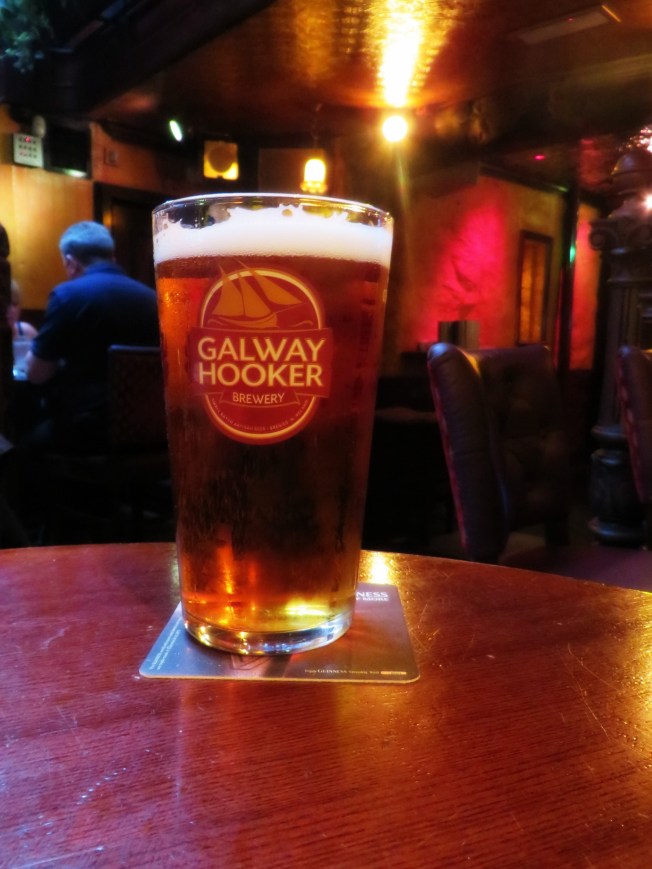
Free of our luggage, we go across from the station to a pub that looks like it’s been there for two centuries even though I know a decade ago it was a nightclub with sleek, modern decor. It’s deserted, except for the barman who is friendly and fills us in on the upcoming sporting events that have Dublin, Galway, and neighboring Mayo full of excitement for rugby, Gaelic football, and hurling.


Galway is not, perhaps, the most Irish of Irish towns. Historically speaking, it was more English than Irish with a helping of Spanish influence. The course of Irish history was never changed significantly because of anything that happened here, and other than Claddagh rings (those rings with the heart and hands and crown that Irish Americans love), not much is exported out of Galway to make it noteworthy. Yet the twisty old Shop Street, the rapidly flowing River Corrib, the churches, the area by the bay called the Claddagh? It all calls to me. If I don’t get there every few years, I start to twitch.

RGSCladdaghsign2015.jpg

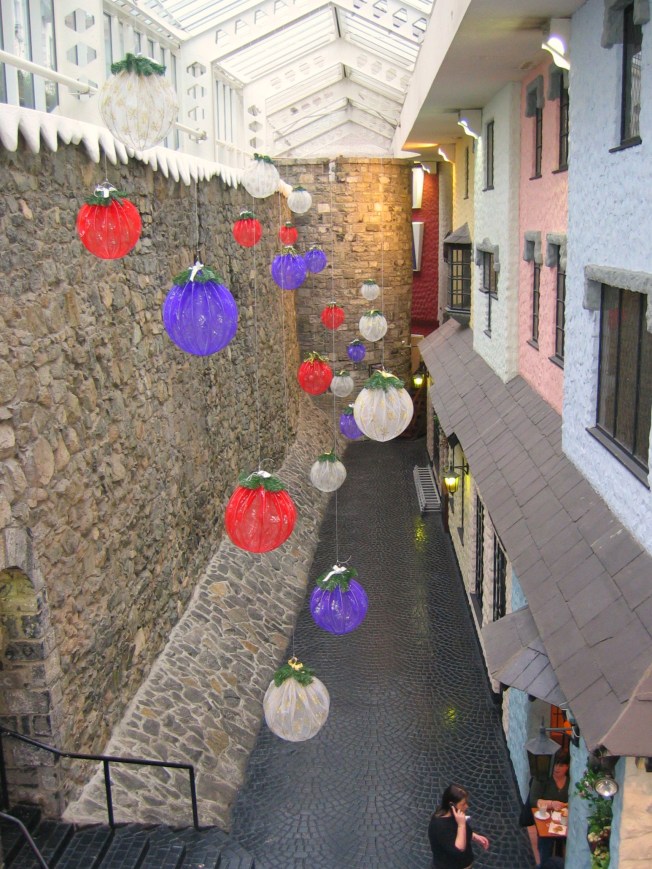
My plans are thrown into a tailspin when we leave the bar and find ourselves standing in Eyre Square in the midst of a heavy downpour. Because I had all those years of imaginary tour-guiding in the 1990s, I know that the hallmark of a good guide is one who can adapt to circumstances. I hurry Z into the shopping center across from the open park square. He hates shopping centers and is no doubt disappointed with my choice, but I nudge him towards the back where the medieval wall that used to surround the city still stands, incorporated into the heart of the mall. On the one hand, it’s an historian’s nightmare to have something so noteworthy jutting out of a Pennys. On the other, were this wall in America, it would have been ripped down with little thought of preservation. We admire the quirk of it and then head towards the Vodaphone store to see if it’s possible to make our English cell phone magically Irish. It isn’t. The woman who delivers the sad news is so charming that we don’t really even mind forking out the money for another phone. She tells us that the store across the way might be able to help by cracking into our English phone (they can’t) and refers to them as “the likes of them over there” with a dismissive head nod. Though it’s not a phrase unique to Ireland, with her lilt, it sticks with me for the rest of the trip and I try to figure out ways to work it into my own conversation. Phone in hand, we venture back out where the rain has disappeared as quickly as it arrived.


RGSMallWall2005

Medieval wall-in-the-mall as decorated for Christmas, 2005.

Petra House is my favorite B&B ever, and that includes some posher places I’ve stayed in Ireland and America over the years. It really does feel like a home away from home.  Over a decade ago I randomly picked it out of a Rick Steves’ tour book when my mother and I were in Ireland, and now it is the gold standard to me of what an excellent B&B should be like: tasteful accommodations, a spotless room, a delicious breakfast, and friendly hosts who make you feel you’re being looked after. Mom and I both had crushes on the owners, Frank and Joan, a couple who embody the “thousand welcomes” that Ireland is famous for. At one point, Joan and my mother were talking so animatedly that they could have been mistaken for girlhood friends, and Frank endeared himself to me on my second visit two years later, when he saw me at the breakfast table and said, “Ah, last time you were here, you were with your mother and were leaving us for Inishbofin. You know, the new dock they were building burned down right after you were there.” This visit is no different, and when Z and I leave in three days time, Frank will walk us out to the car, hand us road maps, tell us to be careful on the narrower, rougher roads of Connemara, and generally make us feel like we’re forlornly saying goodbye to a family member. Other than all meals with my cousins at the end of our trip, we won’t have another meal as delicious as Joan’s either.


RGSHooker2015

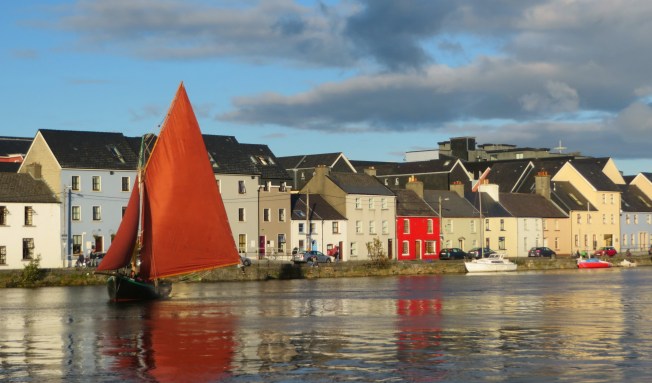
Galway Hooker venturing towards Galway Bay

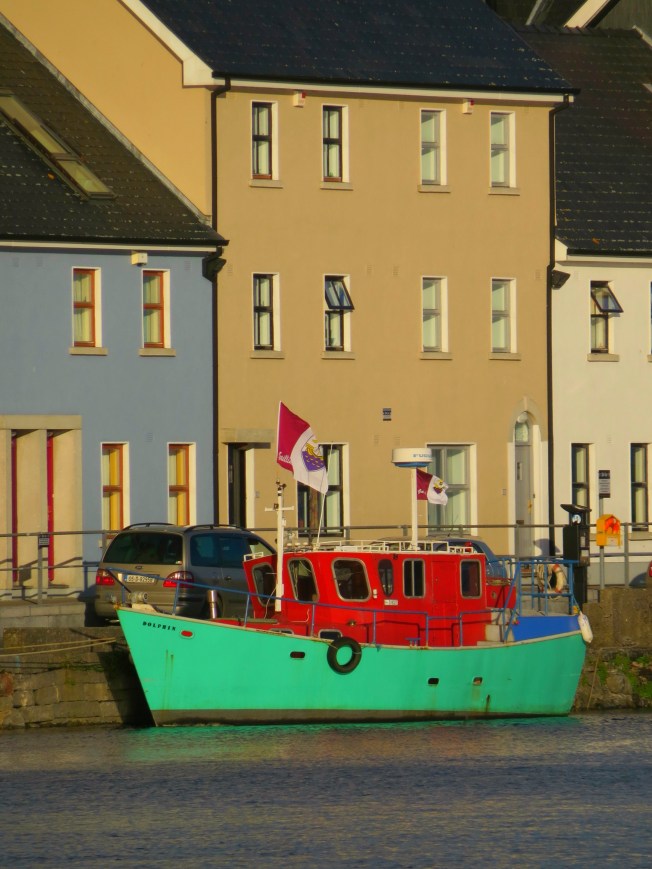
The three days we are in Galway, I walk the legs off of Z. I want him to see it all immediately. Admittedly, I tell some fibs so he readily agrees to walks that are three times as long as he is led to believe. I walk him along the River Corrib, the canal, to the cathedral, the Claddagh where we see postcard-perfect Galway Hookers (red-sailed boats that were used to haul turf to the Aran Islands but now seem to be used to sail tourists around in circles). There is an extra long walk along the Salthill Prom overlooking Galway Bay and the rocky moonscape of the Burren across the water in County Clare. I force Z to sing a chorus of Steve Earle’s “Galway Girl.” When we reach the end of the promenade, I insist that he “kick the wall” like a true Galwegian. Here, I am disappointed that where there was once just a wall and where you could imagine decades of citizens kicking it instinctively, now there is a donation box sloppily cemented into the wall for some charity wherein I’m meant to deposit euros for the privilege of the kick. In protest, I do not deposit coins ( also because I think we might need to take the bus back to the town center because we’re knackered from the walk) but I do spend the rest of the day feeling guilty and uncharitable.


RGSCorribview2015

View from our damp dock picnic perch

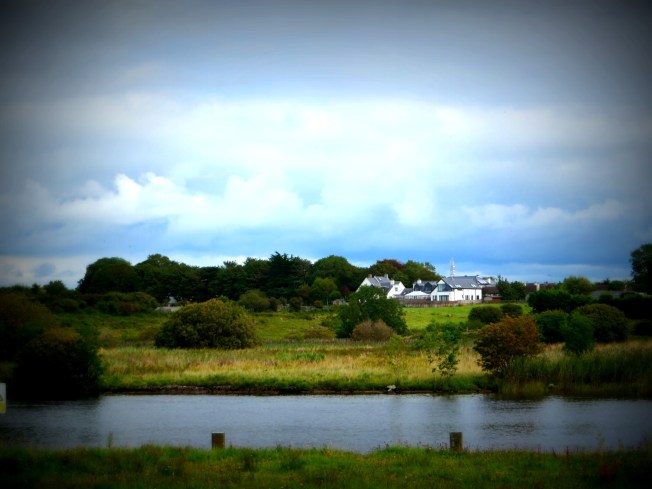
Perhaps my worst sin against Z is the day I lead him on a long walk past the university to the area where I lived for a summer so we can have a picnic by the river. The walk takes longer than planned, Z is hungry, and when we arrive, the picnic table that had been there over a decade ago has been removed in an attempt to make the youth of Galway behave themselves. The view across the river is still lovely—with the city behind us, we look out across fields, at some oldish stone ruin and larger house. A boat tour glides past us and we wave, happy to be less touristy than the people on the boat. I feel momentarily victorious that I’ve brought us to such a lovely spot, but then, as we lower our middle-aged bones to the dock so we can eat our sandwiches along the river, it starts pouring with rain. Z has a look of annoyed resignation on his face. He’s a trooper though and never says a word about the inconvenience of our lunch, or even the annoying walk to and from our destination during which I have lamented at every turn all the changes that have befallen the UCG campus since I was there last. The biggest sin, as far as I am concerned, is that the pub where the writer Dermot Healy once bought me a pint is no more (much like Dermot Healy himself). But I also lament the trees in the wooded area through which I’d walked to class every day like a modern, thirtysomething Red Riding Hood; they’ve been chopped down and an athletic center built there. It all feels like a travesty of justice. The place should have been laminated after I left. Buoyed from his lunch and a lessening of rain, Z happily sits with me in the inner courtyard of NUI Galway that is modeled on Christ Church at Oxford and lets me reminisce about the summer before I met him when I was here.


RGSUCGCourtyard2015

In the UCG courtyard, recounting past glories


Z has some research to do on this leg of the trip as well, and the half hour he turns me loose to interview someone, I make a beeline to a shop I like. Within two minutes, the clerk has dropped this rich green cape thing (don’t even think about calling it a poncho) over my head and clearly it is meant for me. Another clerk comes up and says it matches my eyes and when I tell the likes of them that we’ll soon be spending a night in a castle, they both nod their heads and say, “Sure, you’ll be wanting this to wear while you sit by the fire with a glass of wine.” This trip has not been about the buying of mementos, but even so, I’m an easy mark. I hand over my money and the clerk hands me the bag. I’m only half way out the store before I’ve tugged it on—all of this within five minutes of having said goodbye to Z. To my credit, it’s lovely and I do not look as ridiculous in it as I did on the first trip when I bought a thick Aran sweater and insisted on wearing it daily even though it was summer and the sweater was heavy enough to be a winter coat. (Mom wears it as a coat now actually.) I have no doubt any Irish person passing me on the street must have thought then, “Americans are ridiculous.” On this day though, I can only imagine they are all admiring my new purchase and assuming I’m a native Galwegian. When we are reunited, Z grins at me and shakes his head when he sees me sashaying up shop street in it. Because he likes to name things, he dubs it “Capey” and it becomes a sort of family pet for the rest of the journey. Did you pack Capey? Don’t spill Ribena on Capey! Don’t leave Capey behind?


RGSGreencape2015

Z with spendthrift wife, elderly passerby, and the beloved Capey


We do the things I always do when I am in Galway too. We poke our noses into the restaurants in the Latin Quarter trying to select the best one. We go into my favorite sweater shops and fondle sweaters we aren’t going to buy. We look in the windows of jewelry stores at Claddagh rings we’ve no use for since I seem to already own three and Z refuses to wear one. We go into St. Nicholas Collegiate Church, a 14th century church said to have been visited by Cromwell. We look at the Spanish Arch and I tell Z about how Columbus popped by Galway when he was off on his exploring adventures. I point out Lynch’s castle, now a bank, where the mayor of Galway hung his own son, who had killed another young man, and the mayor became a recluse afterward. Sometimes serving justice is a heart breaker.

RGSGalwayLatinQuater2015

Galway’s Latin Quarter, geared up for the big match

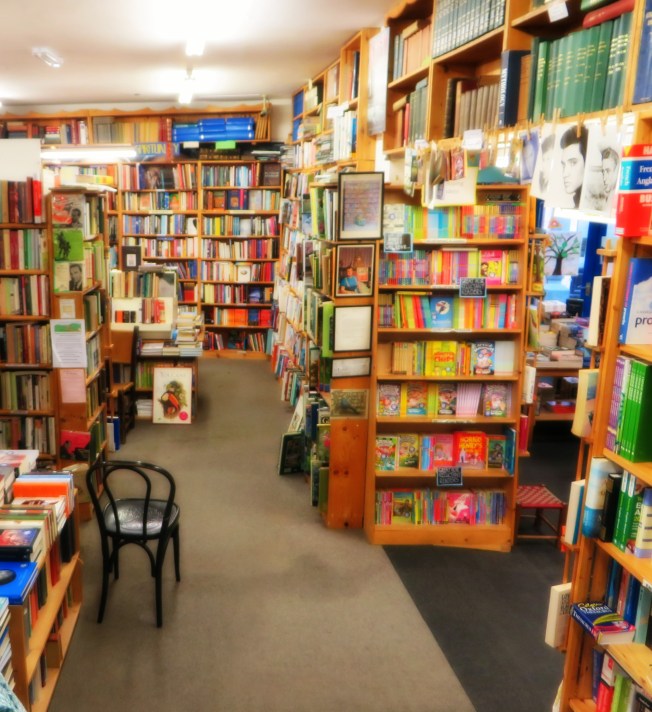
We go to Charlie Byrne’s Bookshop and buy books we’d have to work hard to find in America, including the latest Jack Taylor mystery by Ken Bruen that is set in Galway. Z and I are both big fans of this brutal series, and I know now that he’s seen the city, the books will be even more (horrifying) fun—I’ve spent these three days reminding him of plot points and where I think Jack Taylor lives, where various crimes unfolded, etc. As we’re checking out with our purchases, I spy a Charlie Byrne’s tote and Z gallantly tells the clerk I’d like one; the clerk even more gallantly says, “No charge.” In no time, I’ve filled it with books and postcards and pieces of detritus and added it to the increasing pile of luggage hogging our room at Petra House.


RGSCharlieByrnesInterior

Oh, Charlie Byrne’s–you never disappoint!

On our second night in the city, Z is presented to my cousin Mary and her husband John, who have driven into town to meet us at the hotel where their son Eoin is working for the summer. I see Eoin first, and am shocked that he has grown approximately 12 feet since last I saw him. On my first meeting, he was in “junior infants” (kindergarten) and finagling sweets out of his mother when we stopped to get petrol. It is a real joy to reconnect with all of them since I haven’t seen them for six years, and a greater joy that at the conclusion of the evening when Z and I are snuggled in at Petra House, he tells me how much he enjoyed Mary and John, and I shortly receive a text from Mary telling me that they approve heartily of Z and are happy to see me so happy and healthy. The next night, we have dinner with Mary’s niece Catherine—my “little” second-cousin-once-removed–who introduced me to nearly every cow on her grandfather’s farm when she was about six and now she is a grown-up college student who loves to read and has a wicked sense of humor. Another delightful evening with family, and I feel so happy that all those years ago I was uncharacteristically nervy enough to demand that my grandfather give me the address of his cousins in Ireland so I could claim kin and be the first member of our little American branch of the tree to meet them. What a lucky day for me.


This day is also a lucky one for Z and me because John and Mary take half of our ridiculous amount of luggage back to their house since we’ll be seeing them again, thus relieving us of the Samsonite albatrosses that have been weighing us down. There’s a ferry ride to an island in our near future and I don’t want to be seen as the ridiculous Americans with the steamer trunks for a two-night stay in the Inishbofin House Hotel.


RGSGalwayCathedralWindow

Galway Cathedral window

On our last morning in Galway, Z and I walk down the hill to pick up a rental car—a little red one that we dub the Galway Hooker—and head back to Petra House to settle our bill and collect our luggage. Because I have trouble with The Leaving, I want to insist to Frank and Joan that they tell their next guests they have to find other accommodations because we’re staying another eight nights and just forego the next leg of our adventure. They’ve made us feel so well taken care of, that I even feel a little nervous leaving. Who will be looking after us once we pull out of their driveway? Surely, we need looking after.


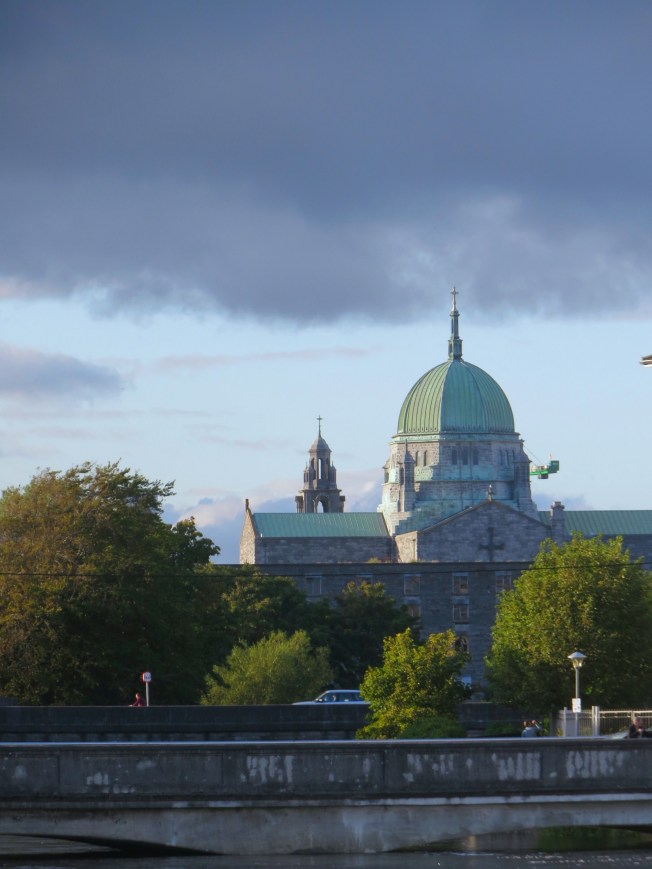
RGSGalwayCathedral2015

Galway Cathedral


Though I’m looking forward to the next leg of our trip—some of it familiar to me, some of it brand new territory—I am loathe to leave Galway. We’ve hit the highlights, but you can’t really settle into a place in three days. I’m lucky to have had those days, but I am greedy and want more. No matter how much time I get here, I always want more. A week. A month. A year. I’m not sure how long it would take me to tire of Galway, but I’d really like to push those outer limits.


After Frank has kicked the tires of the Galway Hooker and waved us off, we head west into Connemara. We’re out of Galway in a matter of minutes, and I distract myself from the sadness with self-congratulations that I was clever enough to have married a man who is used to driving on the “wrong” side of the road as I now have a built-in chauffeur. We wind around the bends and I feel giddy to be doing this with Z, pointing out favorite places of mine from past trips and oohing and aahing over sights I’ve never seen or have forgotten. Though I haven’t hung up my tour guide cap entirely, from this point on, there will be a lot less of me giving Z mini history lessons and a lot more of us discovering places together. Abbeyglen Castle, here we come.


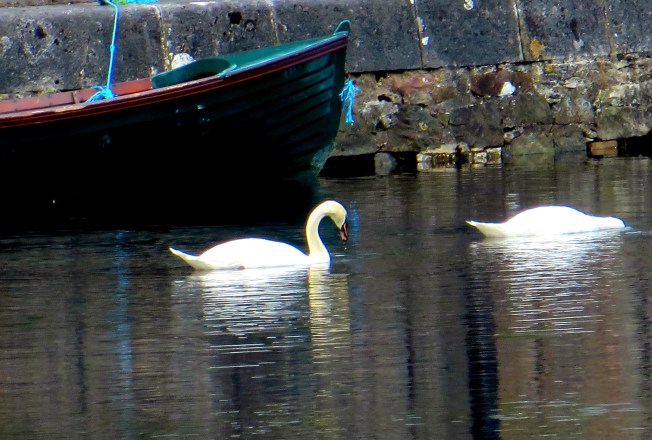
RGSGalwaySwans2015

Galway’s iconic swans


The Ill-Planned Grand Tour, Part VI: A Little Irish Anxiety

Standard

IMG_4677

Before Z, there were other loves. Z and I do not speak their names because he is a jealous husband in the best kind of way, and though I am perhaps more curious, he knows at heart that I am wickedly jealous myself. He is a Scorpio (“jealous” being one of the main descriptors in your better astrology books) and I have a Scorpio Rising and a Scorpio Moon (“double jealous,” I guess), so it is an arrangement—burying our heads ostrich-style to the pre- Beth & Z past—that works well for us. It probably works best for me because Z does not write personal essays or keep a blog where he occasionally feels an urge to mention some former object of his affection. He is also not confessional by nature, whereas I, well…you’ve read me. I might not tell you all my details over lunch, but somewhere, they are being typed into an essay or post.
 

There is one photo of him going to a formal dance in high school with, he tells me, “a family friend”, and I’ll admit it, I hate that girl whenever I see that photo. She’s probably a lovely person and could now, easily be my daughter, but I can’t help myself. (Frankly, when he tells the story about the six-year-old twins who used to fight over who got to carry his school bag when he was in first grade, I don’t much like them either.) So I’m not really sure how Z handles it when I accidentally mention an apartment in Chicago I used to frequent in my twenties where my art-student boyfriend lived or how Z felt the night we watched a documentary about the famous-ish brother of my high school boyfriend, and there, in the middle of the show, said boyfriend appears looking uncomfortable in front of the camera, staring through dark sunglasses right into our living room.


Irish Ferries Club Class which looks the way I imagined the Love Boat's Lido Deck.

Irish Ferries Club Class which looks the way I imagined the Love Boat’s Lido Deck.

But this is all old news. Z and I are all about being in the present moment, and the present moment has Ireland on the horizon. As Z and I board the ferry in Holyhead and the horn sounds as our three-and-a-half-hour journey across the Irish Sea commences, I have butterflies in my stomach. My palms are sweaty. I get ratty with Z while we try to find the Club Class area that we paid extra for so we’d have free wi-fi and complimentary snacks. Z looks at me bewildered. We’ve had a lovely trip so far in England and Wales with none of the tiffs or dramas other couples might expect, and we’re about to start the last two-week leg of it—the part certain to be the best from my Irish-American perspective—and I’ve turned into a shrew. I bark at him as he (ineptly, I think) reads the ship map to try to locate this Brigadoon of spaces on the ferry, a place no elevator nor staircase seems to want to take us. I stomp around. Roll my eyes. Huff. We can’t get to Ireland fast enough and somehow it seems he is impeding our progress, even though he is not piloting the ferry. In the end, his “inept” reading is correct and he ushers me into the quiet, sparsely populated club room, and we settle into a comfy booth at the front where a vast bank of windows gives the impression that we are at the world’s best drive-in movie. I take a few deep breaths. It doesn’t take long into our three-and-a-half hour journey before a grey silhouette of Ireland comes into view. My eyes fill.


I met Ireland for the first time when I was 32. My college friend, Anaïs, and I booked a week there without knowing much about it other than we both had some vague family ties there, both listened to U2 and Sinéad O’Connor, and had read Ulysses together in a college Modernism class, taught by a bore of professor who refused to let us read any female writers because he didn’t believe any women had written anything worthy of being studied. We also both liked the idea of Guinness. At the time, I’d recently begun writing letters to my paternal grandfather’s first cousins in County Galway who farmed the land where my great grandmother grew up, and the only real itinerary Anaïs and I had, other than a vague plan to go to Dublin and Belfast–the only names on the map we really knew–was to get ourselves to Galway to meet my kin.


I don’t know when I fell in love with the place exactly—whether it was love at first sight or if it took a couple of days, the whole week. Nor do I remember the catalyst: did the light hit it just right when we were riding on a bumpy bus through Connemara or was it the smell of my first peat fire or the sound of the voices? Regardless, I fell deeply, madly in love with the place. I’d spent the whole of my adult life thinking what was missing was the perfect boyfriend or an acclaimed writing career, but what had actually been missing was an entire country where for whatever reason, I felt most myself. On that first visit, I stood in the ivy-covered quadrangle at the national university in Galway and vowed that I’d take classes there, and two years later, I did: studying Irish poetry, scribbling  some halting poems of my own, but mostly, loving Ireland up. Two years after that, I brought my half-brother over to celebrate his 21st birthday, then my mother, then I attended a writing workshop at a haunted castle, a spring break with my friend Belle, and so on.


I was hooked, body and soul. I studied the history, read the literature, taught classes on it, carried Edna O’Brien’s suitcase through the Denver airport after an Irish-themed writing festival in Aspen and thought—all the while trying to make clever conversation with her—“this suitcase is going to Ireland”(only it wasn’t: Edna O’Brien lives in London). The only way I could talk about Ireland was with the over-exuberant language of the infatuated, which shamed me because it made me seem like just another American with an idea of Ireland in her mind (leprechauns and rainbows and Aran knit sweaters) who could just as easily be talking about any vacation destination. Like a teenager whose parents believe she just has a crush, I wanted to stamp my foot and shout, but you don’t understand—this is real! Even so, if I heard a commercial for the Irish tourism board come on, I stopped what I was doing and stared at the television, haunted that it was playing “our” song by the Cranberries. I listened to heart-wrenching Celtic music and wept for no real reason. I refused to wear any perfume but the sweet Irish lavender I special ordered, and every day when I dabbed it on, I’d be transported to what felt like the life I should have been living.

Irish Ferries ferry

Irish Ferries ferry

As Z and I watch Ireland get closer—stuffing our faces full of free fruit, muffins, and Jacobson’s crackers—I am conflicted. On the one hand, I cannot wait to be reunited with my beloved. On the other, Z is my beloved now, and I am afraid he will not share my affection, will not like the idea of Ireland as a sort of sister-wife in our marriage, afraid he will point out all the ways it is sub-par (the showers are almost always more complicated than they need to be for starters), afraid he’ll see me differently after meeting the place: who is this woman with the irrational obsession with a somewhat grey and rainy landscape?


And also, my last tryst with Ireland was not my best. Six months before Z and I got married, I spent a summer residency for my MFA program in Dingle. I was without my normal klatch of friends and with, instead, a group of people I didn’t know. I’d just said goodbye to Z for the entire summer, and I was so homesick for him that every morning in the half-light before workshops started, I’d walk half a mile to a phone box to call him in Zimbabwe for a few minutes just to help me get through the day. Furthermore, though I kept it to myself, I was having issues with shortness of breath and vague chest pains that I now know from a slightly disgruntled nurse were not “mini heart attacks” but panic attacks about the impending nuptials and move across country. In other words, I was not fully present for Ireland, and Ireland knew it. After the residency, I met my cousin and her daughter at the Shannon Airport to introduce them to the country I loved, but something was off. None of us were as bouncy and excited as I imagined we’d be, swilling Guinness at trad sessions, traipsing through monastery ruins, standing over the bones of our great great grandpeople. We were glad to be together, but we all had our own internal wars being waged though on the surface, all was well.


I was relieved to get back to America after that last trip, and I don’t even remember saying a proper goodbye to Ireland or any promises to return soon. The best I can compare it to is a romance that you know is faltering and you aren’t sure if it is worth fighting for or if it should just become a shoebox full of memories. Maybe my time with Ireland was over. Maybe my head had been turned too much by Z, by the mystery of Zimbabwe that was now on my radar.

Dublin from the Irish Sea

Dublin from the Irish Sea

As Dublin gets closer, Z squints and says, “But where are all the buildings?” A week ago, we were in London with a skyline so bizarre and full of both tall buildings and cranes making more tall buildings, that Dublin’s low-to-the-ground profile must be a surprise to him, and I feel instantly defensive of it, but also disappointed that it is disappointing him before we’ve even landed. The only thing we can really see are the twin smokestacks of the Poolbeg power station, but already my brain is seeing the Liffey as it moves through the docklands and goes under O’Connell Street, the country as it stretches west towards the place that is always my destination: Connemara. My gut clenches. If Z is disappointed before we’ve gotten off the ferry, how is he going to feel about the rural bits I love where there is nothing much but sheep, rocks, a pub, and the random “Up Galway” banner? I send a sort of prayer across the remaining expanse of water directly to Ireland: Please be good to Z, I implore. I need for him to love you a little. For me, that is what is on the line here: if we have a bad time, if Z does not take a fancy to Ireland, this could conceivably be my last trip to a place that has felt like my heart’s home for nearly twenty years.


When the ferry docks, it takes forever for us to be let us off the ship, and the anticipation and anxiety builds. Finally, we work our way through customs, as usual, a process that is quicker for me with my U.S. passport than it is for Z with his Zimbabwean one but even so, within fifteen minutes we’ve gotten our passports stamped, our luggage collected, and a taxi hailed. I sit forward and peer out the window, like some kind of over-eager Labrador retriever. As the cab moves through the docklands, I look for the spot where ten years ago Mom and I walked in the dark of the night with a Swedish woman we’d just met to U2’s recording studio; this unlikely trio of groupies stood outside until nearly midnight, hoping to get a look at the band. We heard them recording songs for the next album, saw Bono’s wife drop someone off (not Bono), and caught a glimpse of the top of Edge’s knit cap when he stuck his hat out the door, but that was the extent of that night’s adventure. Now, the docklands look quite different. They seem more vertical than the last time I was here, less tatty. As we move into the city center, I have to ask the cabbie the name of the two new bridges that are crossing the Liffey: one, the Samuel Beckett Bridge, which is lovely in that it looks like a harp but strikes me as something a little too Irish for Beckett himself to approve of, and the Rosie Hackett Bridge, which is named for the founder of the Irish Women Workers Union and which pleases me more even though the bridge itself is no work of art. Z peers out the window; it’s all new to him.


I ask the cabbie, “What else has changed in Dublin in the last six years?” (How can six years have passed since I was here?). He sighs at the traffic jam we’re tangled in because the semi-final for the Gaelic football game just ended in a draw—fans pour into the street, most wearing Dublin’s light blue, but a few in the red and green jerseys of Mayo, both sides celebrating, sure their team will win the re-match in a week—and he chuckles, “Nothing much.” The Angelus bells start to play on the radio, which he turns up and we sit quietly there in traffic, penitently waiting as each bell strikes, despite the cacophony outside the cab as the revelers revel. After the last bell chimes, he turns the radio back down and explains that he’s going a roundabout way to our hotel to try to get through the crowd, and it pleases me that I am familiar enough with this little hunk of the city to know he’s not padding the fair and is getting us there as best he can.

The Liffey

The Liffey

Our hotel sits on Bachelor’s Row, just across from the River Liffey, and the city tugs at me before we’ve ever checked into our hotel. In the mere day and a half we have in Dublin, I’ll drag Z to my favorite spots—touristy, all, but I will be an unapologetic guide. I march him up to the General Post Office (GPO) and force him to admire the bullet holes still in the façade from the 1916 Easter Uprising that—in an overly simplified blog-sized history lesson—was the beginning of the Irish Republic. (Think July 4, 1776 in Philadelphia, only with gunfire and men shortly to become martyrs for the cause of independence.) I never come to Dublin without buying stamps here, even though there’s now a machine outside built into the building façade where you can make your purchases. I like being inside, imagine the noise and the barricades and the smoke and people willing to die for a little freedom.

The G.P.O. always makes me start humming rebel songs.

The G.P.O. always makes me start humming rebel songs.

From there, we head to Trinity College, another of my regular pilgrimages. The campus is beautiful—a walled respite in the heart of the city—but the real reason I’m there is to see the 800 A.D. illustrated gospels depicted in the Book of Kells on display there. Every day, a page is turned, so though I’ve seen the scrolled letters and intricate knotwork that decorate it six or so times, I’m always seeing something different. What is always the same, however, is the disorganized crowd of people around it, all jockeying for a prime spot right in front of it. It’s a frustrating labor of love when it’s just me, but because Z is here, I want to push people out of the way so he can have a few precious minutes admiring the craftsmanship. Finally we, push our way into position and refuse to give up ground until we’re satisfied that we’ve properly admired it.


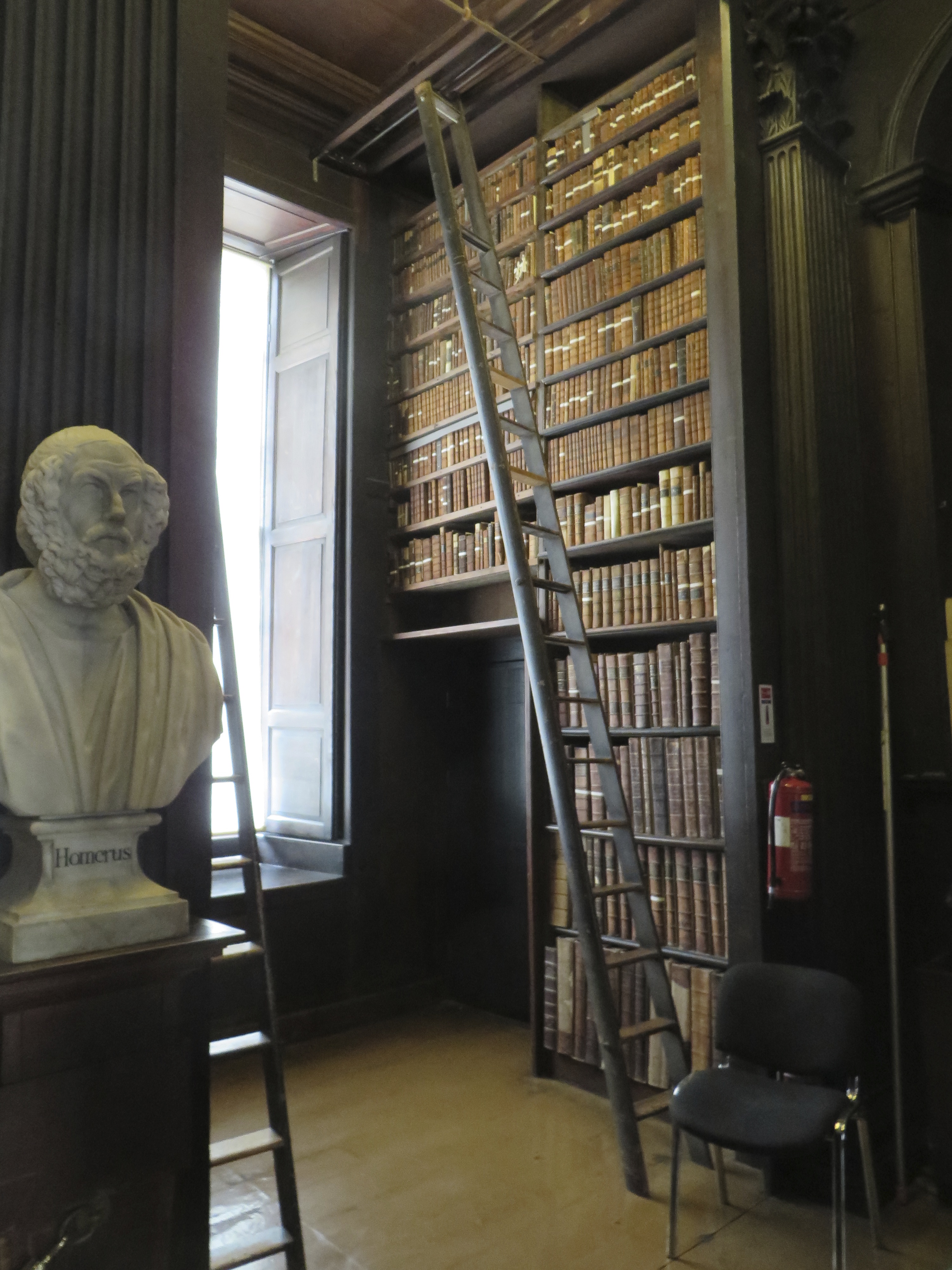
My annoyance with tourists around me (always “they” are tourists, whereas I see myself as having some divine right to be there) disappears as we climb the stairs that spill us out into the Long Room of the Old Library. It smells of books and knowledge and mysteries unsolved. Though it takes my breath away, I normally walk through it quickly after a few cursory photos that simply cannot capture the vastness or atmosphere of the place because I am gift-shop bound. But on this trip, Z and I are not in the market for trinkets, so we linger over each case, read the placards hanging up for the display about myth and folk tale through the ages. We sit on a bench and soak it all in, and it is, no contest, my best ever visit to this library because I am just there and not anticipating our next move or the Book of Kells tea towels and key rings calling out to be purchased downstairs.

The Long Hall

The Long Hall

We do the other things you do when in Dublin: we wander down Grafton Street, which is a shopping area where buskers are often attracting attention with their songs or puppet shows; we try to pick our favorite of the distinctive Georgian doors on the townhouses that surround St. Stephen’s Green; we meander through both St. Stephen’s Green and Iveagh Gardens in the rain, exclaiming about the beauty, the dampness, the half-breed Scottish terrier that defies description in that it is equal parts cute and hideous.  In Iveagh Gardens, we traipse around a hedge maze, though the hedges have not yet grown much higher than our knees, and we are perplexed when we get to the center and find a sundial, which seems a useless thing to have in a shady park in a climate that tends toward cloud. We search for an ATM that isn’t opposed to Z’s bank card to no avail, and then briefly wonder what the rest of our trip might look like without cash in hand. I convince him—as I have convinced others—that’s there’s really no need to go to the Guinness Storehouse because it’s gotten too chic and sophisticated since my first visit, when it still felt kitschy. We eat Mexican, Italian, and a full Irish breakfast. We saunter around the Liffey, stand at the peak of Ha’penny Bridge and watch the night lights dance on the water.

The Liffey

The Liffey

Both nights there, I drag Z through Temple Bar looking for the Ireland v. Zimbabwe rugby poster I had seen in a pub there in 2003 that felt cosmically placed specifically so I’d remain focused on him despite the fact that my confession of love had fallen on his somewhat clogged ears just a month before. I had visions of taking a photo of 2015 Z standing next to the poster as a sort of triumphant conclusion to my earlier, more forlorn and very single trip, but alas, the poster is nowhere to be found lo these twelve years later, and though the most likely reasons are the pub in question has redecorated or I had taken too much drink the night I saw it because it was my half brother’s 21st birthday and only ever imagined it, I’m convinced it was one of those weird synchronicities that only Ireland delivers where you see the thing or meet the person or hear the bit of information that you most need at that very moment. And certainly that poster and a few other of these mystical occurrences on that 2003 trip kept me hot on Z’s trail even though he’d tried to gently put the kibosh on my love.

Temple Bar, where IS that poster?

Temple Bar, where IS that poster?

I regret that we have budgeted only two nights in Dublin. Though Z has professed to like Ireland, I hear an unsaid “so far” in his voice that worries me. As me make our way to Heuston Station with our mountain of luggage so we can head to the western edge of this country I love, I begin to worry again. What if after Dublin, the rest of Ireland will pale in comparison? What if he doesn’t fall in love with Galway’s twisted streets and Spanish Arch and raging Corrib River? What if he sees Connemara as a rocky sort of wasteland? What if he doesn’t like my cousins? What if, what if, what if…?


Like the ferry ride two days before, as the train lumbers through the Midlands towards Galway, my anticipation of arriving in my favorite bit of Ireland begins to override my fear that Z will not fall in love. My throat constricts as soon as we are out of the city and the countryside and villages speed past the window. As the fences surrounding the rolling pastures begin to change from wire to stone, as the sheep become more plentiful, as the train stops are names more familiar to me: Ballinasloe, Attymon, Athenry, it seems likely that I will come unhinged with excitement. I will never understand why Ireland affects me this way, and still does after all of these years, but I am glad for it. I want Z to love this place as much as I do, but as we pull alongside the estuary that spills into Galway Bay, I begin to believe that even if he hates it—and why would he anyhow?—my ardor hasn’t dampened. It is still mine and I can love it enough for the pair of us.

Iveagh Gardens

Iveagh Gardens


The Ill-Planned Grand Tour: Part IV (A Shrewsbury Short)

Standard
Shrewsbury, England

Shrewsbury, England

After some trial and error, Z and I have a policy that when we travel we spend at least two nights in any given place, though we believe three nights is better.  With one night, the place you stop is really just a waiting room for the next leg of the journey. With two nights, you are either coming or going. With three, you can settle in a little, maybe unpack part of your suitcase, return to a favorite pub, feel familiar enough with a few places that if someone asks for directions you aren’t lying if you point them up a particular street. Shrewsbury was my first experience with a one-night stand that worked perfectly, despite rain that wouldn’t stop.

Sometimes it’s good when you break your own rules.

Train stations in England seem to be universally designed for discomfort so you’ll spend as little time there as possible. Euston is no exception. We like to arrive extra early when we are departing, so the lack of seats, general chaos, and giant digital board everyone stands gawping at, wasn’t exactly welcoming. Fortunately, we had splashed out an extra $18 for first class tickets which meant we had access to Virgin’s upstairs lounge.

As it turns out, one reason you should pack light when traveling in Europe (or possibly anywhere but North America) is the size and quality of the elevators. Our hotel’s elevator in London felt cramped if another couple got in with us, but the one shuttling us and our five bags of varying sizes up to the first class lounge where we are promised snacks and free wifi is basically the size of a phone box built for two. It is glass, so we watch an elderly couple ascend to the floor above us and then descend because they can’t figure out how to escape the pod. We laugh knowingly with the people in line behind us. Clearly this couple is a pair of boobs, unschooled in basic elevator mechanics. Eventually, the box returns empty and Z and I stuff ourselves in, press the button, and chug slowly upwards. I lean against the wall while we wait for the journey to end—clearly hamsters on a wheel somewhere are powering this thing. Suddenly, the lift stops. We can peer down at the people below us, and we have an idea of our destination above us, but there is no movement. There also isn’t room to dig for the Xanax I’ll need if we are going to be indefinitely stuck in this glass coffin. Then I see a sign about keeping clear of the walls, which aren’t moving with the lift, so I shift myself away from the wall and the elevator starts moving again. When we see the couple that had gotten stuck before us, I look at them and mentally retract my “boob” description. (After spending an hour in the lounge eating our lunch, we opt to descend via the staircase, with Z makes multiple trips to collect our bags and I make a mental list of all the ways we can and will pack lighter next time.)

The trip to Birmingham is delightful with views of bucolic fields and little hamlets, though I find it impossible to stay awake. As someone who often has insomnia, I would be the first in line to buy a bed that is created to simulate both the sound and movement of a train or ferry. I can’t keep my eyes open. At Birmingham, the peace of the first leg of the journey is shattered. The station is crowded and under construction. The platforms are labeled in an orderly fashion except our platform, which is as mysterious as Harry Potter’s platform 9 ¾. When we finally spot a set of escalators that looks like it might lead us to where we need to be, we discover the train is about to leave without us and have to run, rolling our luggage as fast as we can. In movies, running for a train always looks romantic and exciting. In reality, it’s awful. I’m huffing and puffing and my new four-wheeled suitcase doesn’t want to go the direction I’m going. The only car we can reach before the train pulls out is the last one where all the other late arrivers have poured themselves. We are sandwiched with all of our luggage in the little entryway amongst a group of similarly out-of-breath people, including a friendly young woman with a baby in a pram. Every time the baby threatens to whimper, she shoves a Cadbury Finger in his mouth and I worry that he’ll choke but am appreciative of his chocolaty agreeableness. Eventually, a seat opens up that the chivalrous Z directs me to though he has to stand  for another half hour.

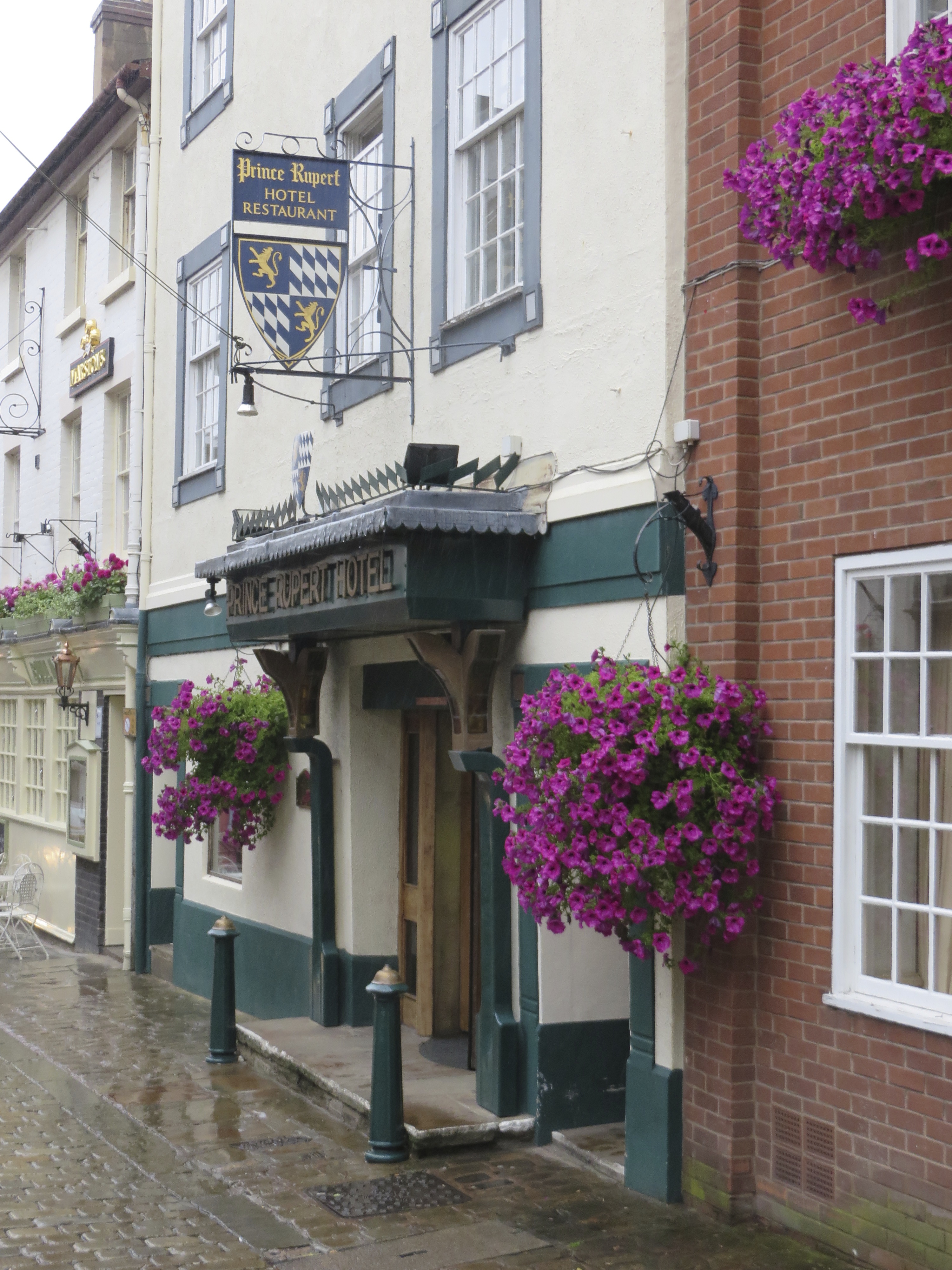
Prince Rupert Hotel, Shrewsbury

Prince Rupert Hotel, Shrewsbury

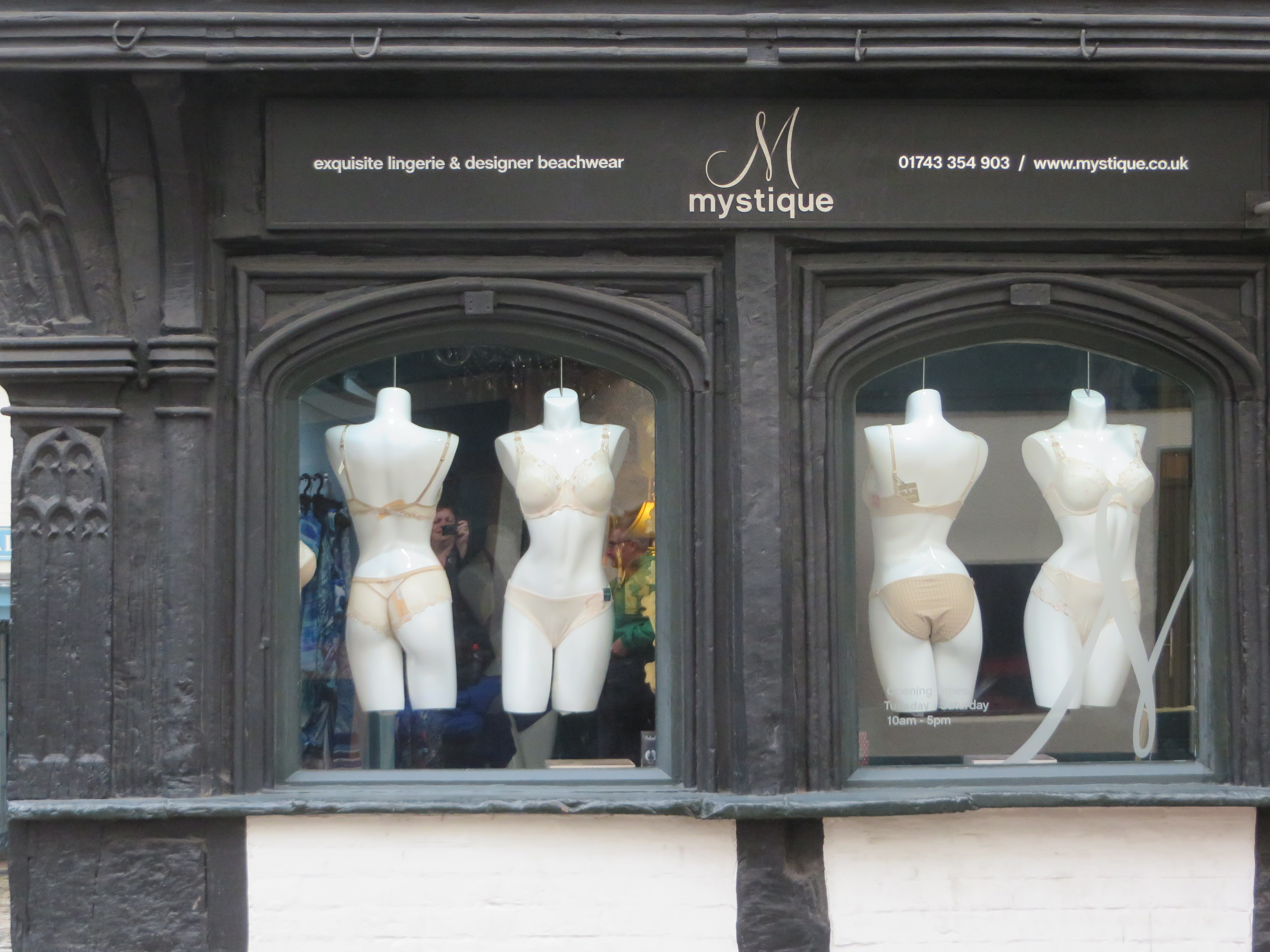
Fortunately, the minute we step out of the station and into Shrewsbury, all of our traveling angst disappears. It is exactly the town I’ve wanted to spend a day in even though two days ago I wasn’t sure I’d ever even heard of Shrewsbury. It is medieval with all the little twisty lanes and crooked buildings you could want, and there are flowers everywhere. Our hotel, The Prince Rupert, is on Butcher Row, right across from a a lingerie shop, where spinning mannequins display intimate apparel in the Tudor-era building. A small, picturesque church stands on the corner. Prince Rupert was the grandson of James I and our hotel was his home. It is slightly less luxurious than the website photos indicate, but it is quirky and charming and we aren’t unhappy with it, threadbare as it is.


Spin ladies, spin!

Spin ladies, spin!


Full disclosure: we booked the hotel when we read that it had an elevator. The excessive nature of our luggage situation makes an elevator a real boon. Then we see the elevator. My mother’s nearly useless, too-small coat closet is bigger than this lift. It doesn’t take a genius to surmise we aren’t both going to fit into it at once, so we take separate trips up and I refuse to ride it for the rest of our stay. (When we leave the next day, I help Z cram the luggage into the tiny thing, then cram Z into the tiny thing, kiss him goodbye just in case, and then race downstairs for the reunion.)


The Dingle

The Dingle

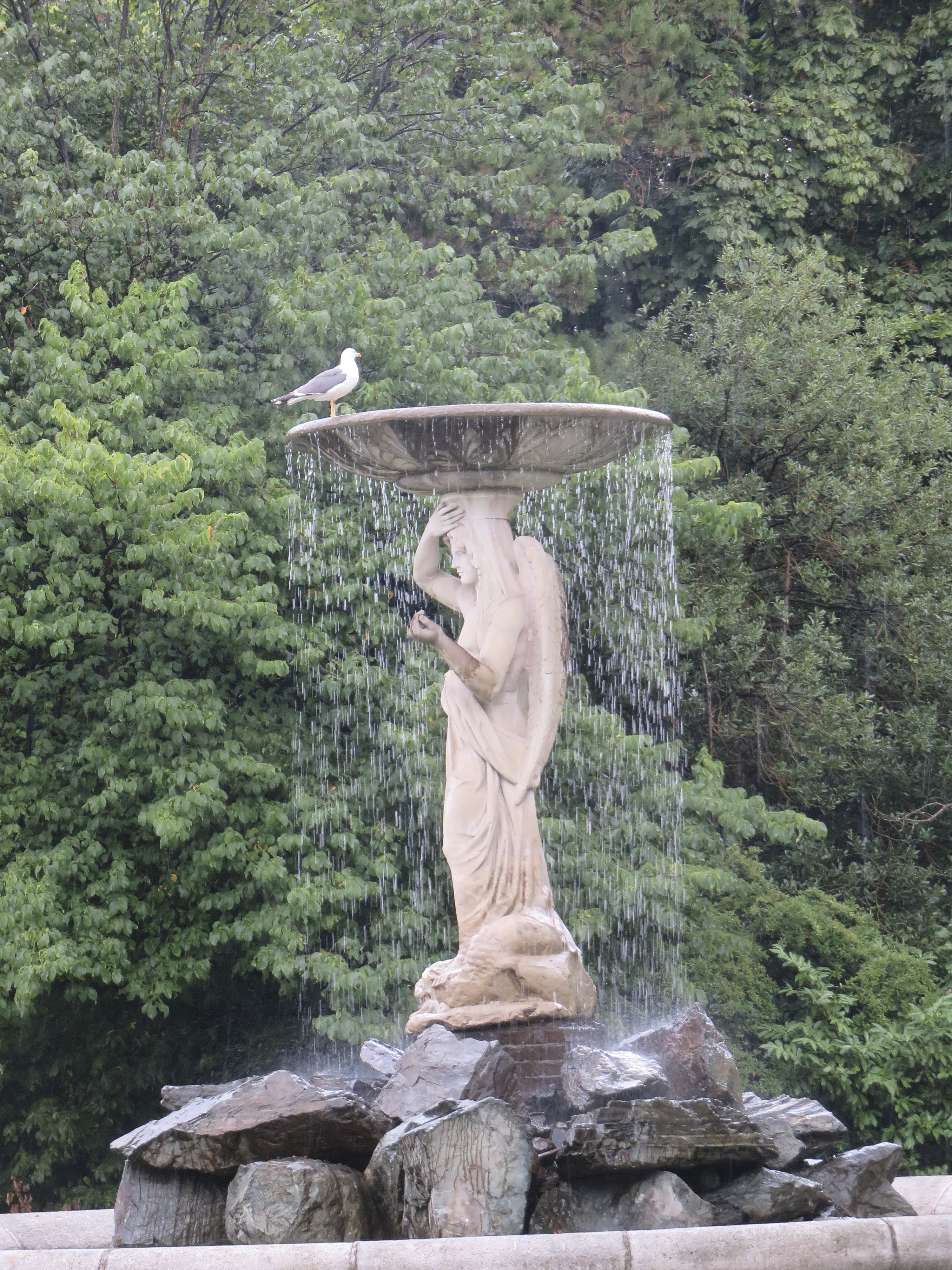
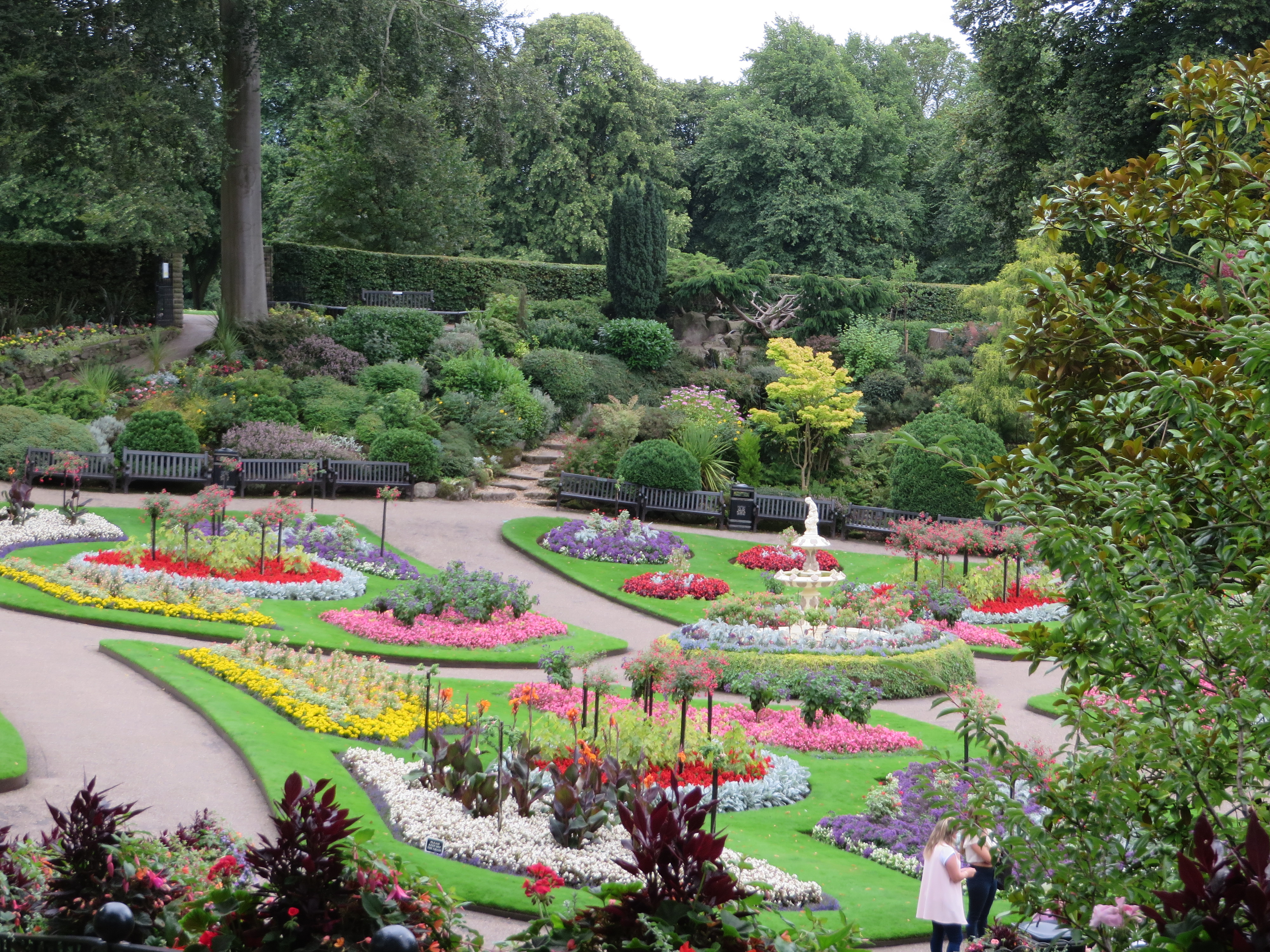
We spend very little time in the room because we have very little time in Shrewsbury. After a quick tea at Camellia’s next to the hotel (where I re-discover my love of crumpets), we head into the winding, medieval streets, snapping photos at every turn because the whole place looks like the set of some historical movie. Ultimately, our destination is the Quarry. Unlike it’s name and the quarry where Fred Flintstone earns his living there in Bedrock, this Quarry is a large, gorgeous park that butts up against the River Severn. Inside the Quarry is a gated off section called The Dingle, wherein there are some of the most gorgeous flowers I have ever seen. The brochure we read earlier boasted three million blooms. I don’t know who does the counting, but they may have underestimated.

The Dingle

The Dingle

There’s a formal garden, a beautiful pond with fountain, artfully arranged trees and shrubbery, and various memorials to England’s war dead. The school children must have recently done a unit on the animals who were in service and gave their lives (though perhaps didn’t volunteer to do this!) during the First World War, so in one section of the garden there staked to the ground are children’s drawings of various enlisted animals.


Few people speak of the elephants who valiantly gave their lives during the Great War!

Few people speak of the elephants who valiantly gave their lives during the Great War!

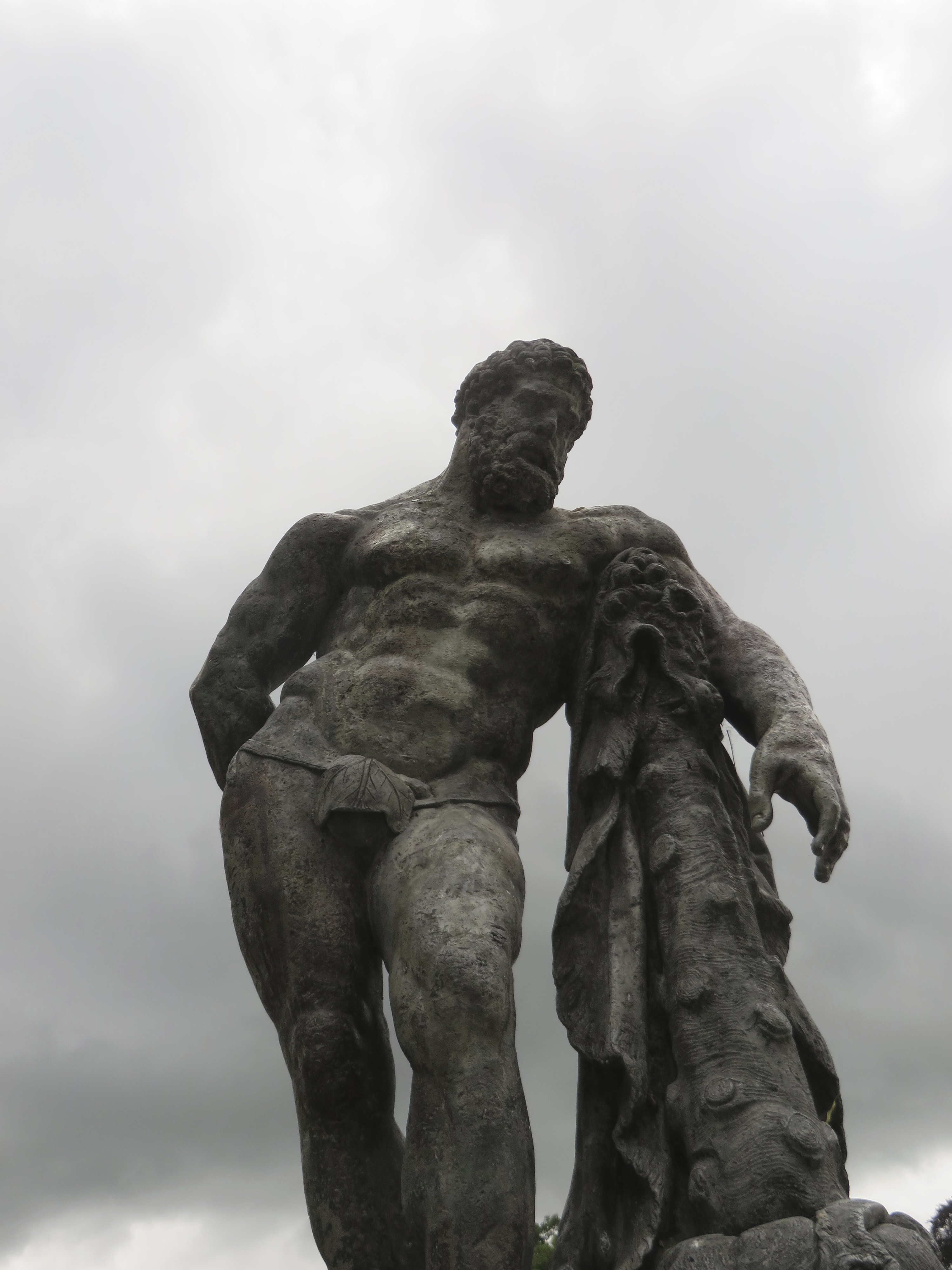
Once we leave the Dingle, we see a statue of Hercules that is quite stunning. He used to live in town but in order not to offend the ladies, he was situated so his nethers faced away from the center of town so the “fairer sex” need only see his bare bum. Now, he is living in the Quarry, happily displaying his fig leaf to all. We walk around the Severn, speculating about whether the building we see on the hill is where native son Charles Darwin and Michael Palin went to school (it wasn’t) and greeting passersby as we circle the town.


Hercules and his fig leaf

Hercules and his fig leaf

It is the perfect leisurely antidote to the hubbub of London. After dinner at an Italian restaurant with Darwin-themed wallpaper, we stop at Waitrose (a grocery chain) to get a few supplies like bottled water because we don’t know if they’ve replaced the pipes in the hotel since Prince Rupert’s era, and then we call it a night. I have a little trouble sleeping after I read in the hotel brochure that there have been some hauntings.

The next morning we get a late start, check out of the hotel but ask them to look after our luggage, and have a very un-picturesque brunch at Burger King. Surely this alone is proof that I am not a fabulist. A fabulist would have invented something much better, but we want cheap and we want quick because Shrewsbury Castle awaits.

Shrewsbury Castle

Shrewsbury Castle

A smallish and not-that-ornate red sandstone building, Shrewsbury Castle’s original parts date back to the 11th century, though there have been several additions to the present incarnation. My love of castles is largely based on fairy tales and the Fisher-Price castle I had as child that had turrets and a moat and a fire-breathing dragon kept in a dungeon behind a portcullis. This castle is a little less romantic in that it now houses the Shropshire Regimental Museum. It is an impressive collection of uniforms and other military artifacts from the 18th century to the present day (if you can be impressed by such things). Z looks over the displays contentedly, while I try to find more personal elements to distract me from the ceremony of regimental life: a description of life for the wives of the soldiers, letters penned at the front (whichever front it is), photos of individual soldiers. In a huge case full of swords and uniforms, I zero in on a wooden spoon, hoping for some domestic connection, only to discover it was the “prize” for worst bugler.

The wages of bad bugling.

The wages of bad bugling.

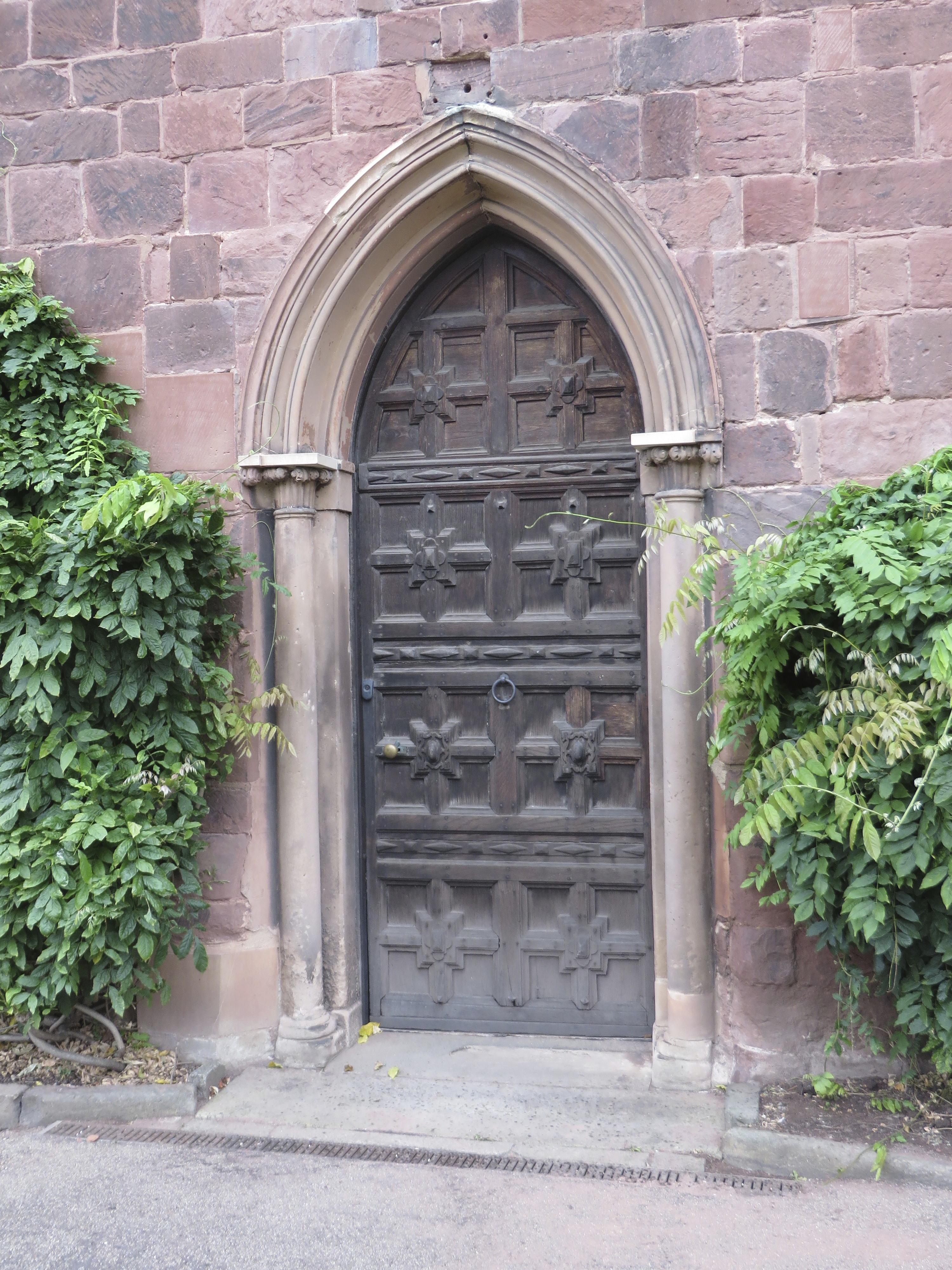
We make our way to a room where weddings are held where a photo album of past brides and grooms is displayed. It seems a dubious place to begin married life, surrounded by the accoutrement of war. The photos in the archway by the heavy, ancient-looking door are stunning though.

Doorway to wedded bliss?

Doorway to wedded bliss?

Very little of the castle’s history seems to be covered here other than in a small, stuffy room where there are panels with the castle’s early days recorded there. I’m fascinated to discover that the battles covered in Shakespeare’s Henry IV Part I are directly related to the battlefields near the castle.

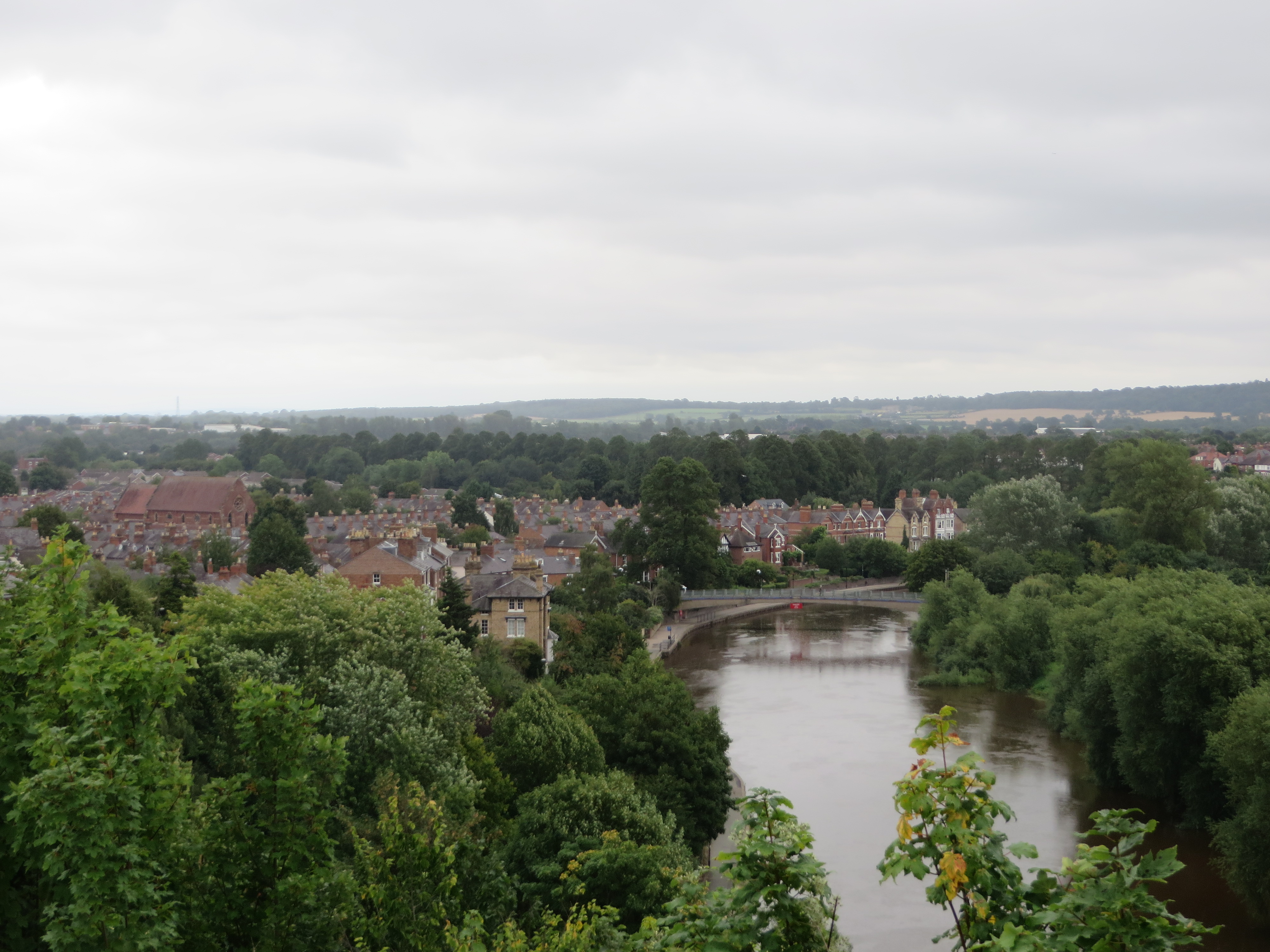
View from Laura's Tower

View from Laura’s Tower

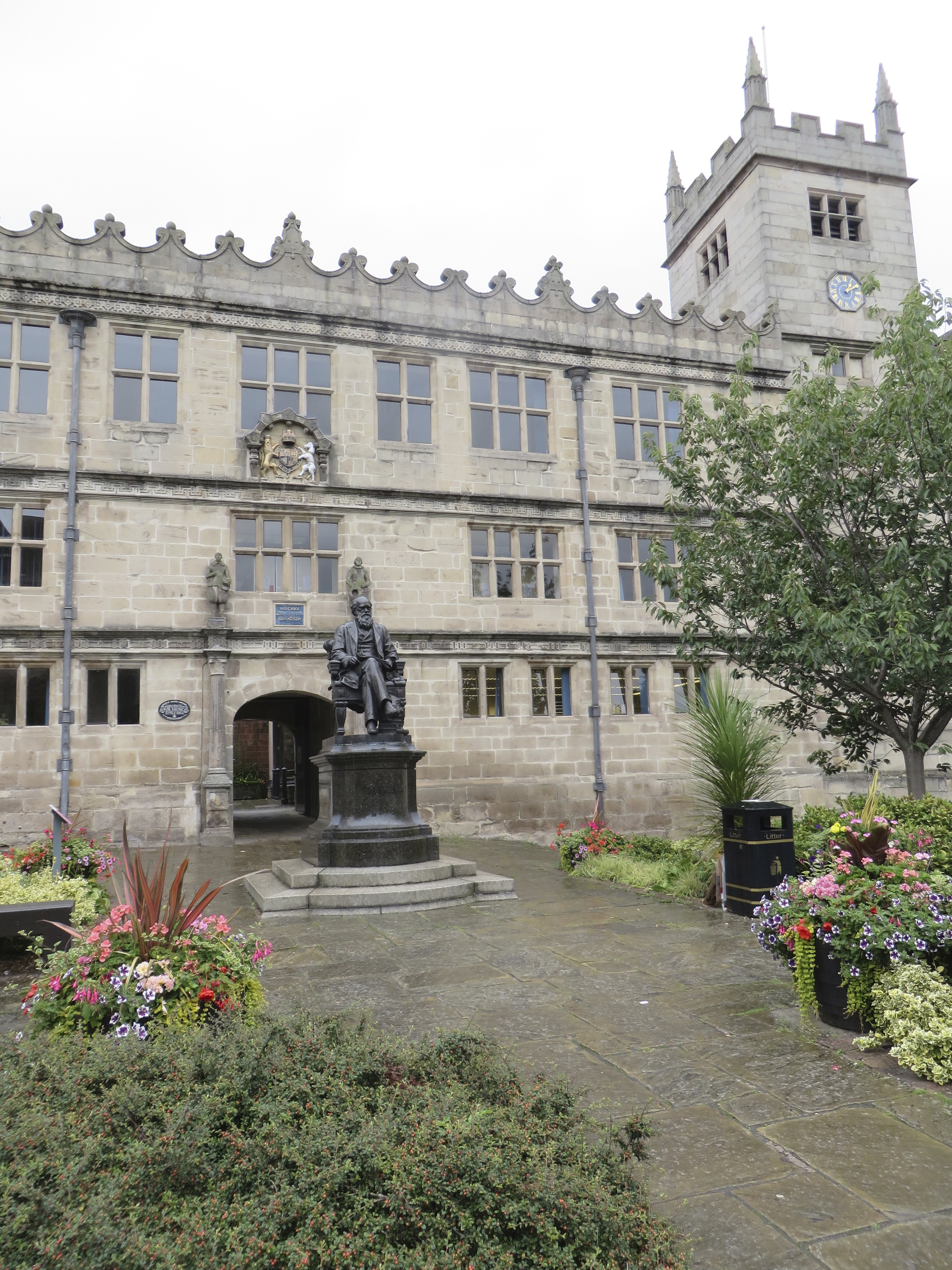
Z and I walk the castle grounds, hike up to Laura’s Tower, where there are great views of Shrewsbury, and then find ourselves in a rainstorm, huddled under our cheap London umbrellas. Since we’ve checked out of the hotel, we’re homeless until our train leaves for Wales in the evening. We see the library across from the castle, housed in a beautiful old building—the former school of Charles Darwin—and so go there to write postcards and wait out the rain.

Chuck sitting around his alma mater

Chuck sitting around his alma mater

While it seems a silly place to spend our precious Shrewsbury time, I love being inside this space with people who aren’t tourists. It has been repurposed cleverly. Ancient-looking beams and other architectural elements have been kept intact. I’d happily spend the whole afternoon here, perusing books, but we have items on our list that we want to tick off: a visit to the chemist’s to get some antihistamine cream for some mosquito bites I’ve acquired, a stop at two stationery stores, a bookstore, and Neil’s Yard, a store I discovered in London in 1992 that sells a variety of potions in cobalt blue bottles. Also, there is the matter of me wanting to stop back by a shop where a gorgeous William Morris coverlet is on sale, though Z declares it “ugly” and I spend the rest of the day, in vain, explaining the merits of Morris designs.

Clearly Z needs new glasses

Clearly Z needs new glasses

Ultimately, we end up in a sleepy pub where we kill time happily for a couple of hours, eating lunch, having a drink, writing more postcards, watching local people interact with each other. It’s a perfect pub in that I think we are the only tourists in residence. It’s dark but cheerful, and one of the customers has his little dog with him. The rain buckets down but we don’t care—we are warm, cozy, and dry.

Cozy pub of the day

Cozy pub of the day

Because the rain won’t let up, we leave the pub and scurry back to yesterday’s tea room so I can have another round of crumpets, then we make our way to the hotel where we camp out in the lobby for 45 minutes while waiting for our taxi to take us to the train bound for Wales. No doubt there are more experiences to be had in Shrewsbury (certainly there were more stores and cafes to visit, and with another day or two, I might have won Z over on the issue of William Morris bedding), but I’ve enjoyed this lazy, rainy day, killing time in what is one of the most picturesque towns I’ve ever been in. I’m glad we broke our own rules.

Shrewsbury, we hardly knew ye!

Shrewsbury, we hardly knew ye!


The Ill-planned Grand Tour: Part I

Standard

IMG_3083

My first trip to London was in 1988 with a small group of my fellow liberal arts majors and my beloved mentor, Gibb. I’d just read 84 Charing Cross Road, I was 3/4 of the way done with a lit degree that focused heavily on British Lit, I was studying British history as an elective, and I had an unhealthy attachment to the Royal Family. (Specifically, I was sure I was meant to be one of them and was holding out hope for Edward.) It was my first trip abroad and as soon as I discovered that the ability to read a train schedule, a guidebook, and a metro map opened up a person’s world exponentially, I was hooked. And so a love affair that began in books was finally consummated.

Four years later, a family friend agreed to act as tour guide for Mom and me, and we spent two glorious weeks living in a house owned by Stephanie, an Austrian octogenarian who was friends with the doctor who delivered Prince Charles and knew from first hand experience that Winston Churchill’s wife’s  Siamese cats had ugly dispositions. Her three-story brick house was on Muswell Hill and on the first day there we looked out the back windows to discover not just rose-covered walls but also a community bowling green where men dressed in whites looked like something straight out of a Merchant Ivory film. In America at the time, we were obsessed with all things British, all things Victorian and Edwardian. It wasn’t just Mom and me; entire stores were dedicated to bringing a little 19th Century British class to our ranch houses and condos. Though the city was modern, it was as if the plane that carried us across the Atlantic had also been a time machine. Because of the lady of the house’s age and social class and the length she had owned her beautifully appointed home, we could, at the very least, pretend we were in pre-Blitz London. At night, I’d eat biscuits and work on a needlepoint project I’d purchased at Liberty while Stephanie and I would watch TV. In my twisted memory, instead of viewing episodes of East Enders though we were listening to the wireless and hearing news about impending troubles in Europe. We were delighted one day when Stephanie was in a tizzy because she couldn’t find her hat for Royal Ascot, and the next day, we were lucky enough to see the entire Royal Family leave Windsor Castle for the big race. They were waving and all be-hatted, while we stood along the road, cheering and clapping and taking blurry photographs. (Sadly, Edward did not notice me, and one of us noticed how miserable poor Diana looked despite the fact we were all about to be surprised by her tell-all biography and impending separation.)

Because Barb, our tour-guide friend, had traveled extensively, I studied her actions carefully. She carried a small backpack so she was always ready with a rain coat, London A to Z, and space to shove bread and cheese from Sainsbury’s for lunch on a train to Dover. She understood the Tube and planned well a day’s itinerary so no time was wasted. I could do this, I thought, unadventurous as I was. I was in my early twenties and determined not to spend the rest of my life in Richmond, Indiana, waiting on the Barb’s of this world to take me to the places I wanted to see.

When Mom and I left, we had an extra suitcase full of all the bits of England we’d purchased in gift shops in an attempt to take the experience home with us. In our carry-on luggage alone, we had three teapots. All these years laters, it remains one of the Big Moments on the timeline of our respective lives.

Seven years later, I fell in love with Ireland and never once looked back  across the Irish Sea to England’s green and pleasant land. I became obsessed with Irish literature and Irish history, and the best I can do to explain this is to compare it to the difference between a first love and a soul mate. There would always be a tiny corner of my heart that belonged to England, but I was in love with Ireland body and soul, and because England had been, over 700 years, badly behaved towards Ireland, it was like realizing that first love of yours was actually a bully who’d been taking your (eventual) soulmate out into the school parking lot and beating him senseless while you were eating a cheese sandwich in the cafeteria. In 1998, I started seeing Ireland exclusively and I never regretted my decision. The landscape, the literature, the people—it all felt like mine. The first week I was there, it occurred to me that  I’d spent my twenties looking for the right man when really what I should have been doing was looking for the right place in the world. Ireland was that place. If I could have easily moved there, I would have. Because I couldn’t,  after every return back to America, I’d start planning my next trip, enlisting other people to go with me, traveling solo if the situation dictated it.

So now Z and I are spending a month traveling through England, Wales, and Ireland, while he does research and I write and stare at views and buildings that quicken the heart. It is the most ill-conceived, ill-prepared for trip ever because we’ve had to postpone it twice and didn’t know until two weeks ago that it was even going to happen because of visa issues. (If you have a US passport, might I recommend you take it out of its hidey-hole and kiss and bless it for the ease of travel it provides–not all passports are created equal). Also, the day I decided to extend my trip to Indiana by a week, we got the news that this trip was a go. I don’t regret being home to visit Mom and her ailing back and to help my stepfather celebrate his 70th birthday, but what this means is I was back in Seattle for just two and a half days before we had to be on our Heathrow-bound flight. And finally, in the eleventh hour, I thought I was coming down with shingles again, which would have thrown a further kink into all of our plans. While in my suitcase there are the clothes and equipment for every conceivable weather condition and natural disaster, the rest of the trip has only the vaguest of outlines. Barb nor my Girl Scout leader would be proud with my planning and preparedness levels at this moment. Case in point, we seem to be in London on the brink of both a train and Tube strike, which could make things interesting.

But even with delays and missed connections and the realization there’s no way to do “it all” in just a few weeks, I’m looking forward to reconciling my past love with my current one and sharing both (plus Wales!) with Z, who is better than any Windsor prince, any day, any time.

Stay tuned.

Post-Apocalyptic Lifestyles of the Timid and Bookish

Standard
Columbia River

Columbia River

There’s been a heat wave burning through the Pacific Northwest, so naturally my pale Irish American thoughts have turned to the dystopian future that is probably awaiting all of us. I’ve barely left the house for five days—let’s be honest: I’ve barely had clothes on for five days—I’ve been reading the world-is-mostly-over-because-of-flu novel Station Eleven, Z and I finished binge watching The Walking Dead, and we went with Hudge to see Mad Max, a movie so aesthetically assaulting that I kept my eyes closed for the bulk of it. So it’s hard to see the weeks’ long streak of 90 degree heat as anything other than a harbinger of bad things to come.

In other words, this is my annual post about how much I hate summer.

Robert Frost may enjoy debating whether the world will end with fire or ice in his famous poem, but I have no doubt that ice will not be the method. It’s going to be one really big, hot sun and not enough fossil fuels to run the last remaining air conditioner on the planet. This might explain why I buy three bags of ice every three days from the drugstore on the corner and then crunch it obsessively all day long, much to Z’s chagrin.

Aside from the heat, one of my fears for my future post-apocalyptic lifestyle is that I was always one of the first people knocked out in elementary school when we played Dodge Ball. I wasn’t particularly quick or athletic, which was a contributing factor, but often I’d stand there making myself an easy target in order to get it over with. I hated waiting for the worst. In high school when my friends and I would play Ditch ‘em in one of the farmyards, I was always perfectly happy to get caught early and spend the rest of the game sitting on a hay bale at home base waiting for everyone else to get corralled. It was preferable to the heart-pounding rush of hiding under a pine tree and hoping no one could hear my anxiety driven loud breathing. Despite having a competitive spirit in the board game arena, I have very little in the physical world. In terms of fight or flight, I’m almost 100% flight unless someone mistreats or underappreciates Z, and then I want to cut them.

So when I watch something like The Walking Dead, I want to be Michonne, the sword-wielding badass who doesn’t need a gun to take out a herd of zombies. You never see anything akin to terror or dread on her face. She’s fueled by rage and some innate desire to survive, and she is always calm and rarely breaks a sweat. However, I know should I find myself jettisoned into a zombie-apocalypse situation– even with years of training–I almost certainly would not be Michonne or her male counterpart, Daryl the bow-hunting-survivalist-tracker of few words. Instead, I would be the sniveling character who a) must be protected b) inevitably ends up a zombie feast when the source of my protection has “gone out for supplies.”

Last week Z and I drove down to our favorite beach hideaway on the Oregon Coast. It’s a little cottage that hangs on a hill overlooking an outcropping of rocks and endless surf. We always pack our swimsuits and then discover that only small children, people in wet suits, and the mildly insane can brave the temperatures. This year the Pacific was particularly cold and I couldn’t even stand to wade for very long. While folks back in Seattle were trying to find the one restaurant in town that has air conditioning, Z and I were huddled under our beach towels trying to stay warm. We were committed to the beach experience, even if it meant sweatshirts with hoods up. I was particularly pleased with my heartiness the day I did brave the water for a quick “paddle” as Z calls it, and then he looked down and noted that my fingernails had turned blue. (I’ve never been so cold I had blue fingernails before—what an accomplishment.) We didn’t really care though. The colder it is there, the more the beach belongs to us and it’s just the escape from the city that I wanted and Z earned after his long hard slog towards his much deserved tenure.

When we first discovered this outpost back when we were dating and I was living in a cornfield, I longed for civilization and every night we’d drive into the nearest town for dinner or a trip to a big box store to buy unnecessary plastic objects so I’d feel connected to humanity. On this trip, however, I had no desire to leave our little cottage and drive somewhere with traffic lights—a sure sign I’ve been too long living in our part of downtown-adjacent and way-too-populous Seattle.

On the trip to our beach haven, we stopped in Astoria, Oregon, the place where Lewis & Clark spent the winter when they were busy “discovering” this part of the world. Now, it’s a town of almost 10,000 residents where the Columbia River meets the Pacific Ocean. Then, it was, well, nothing but a vision for westward expansion and commerce. Their trip fascinates me for many reasons. I’m in awe that anyone would look at a wall of wilderness, harsh weather conditions and potentially dangerous situations, and think, hey, let’s see what’s out there. Lewis and Clark probably never had a Dodge Ball strategy that involved letting themselves get thwacked with a ball in the first 30 seconds so the horror would be over more quickly.

I am not a camper or an adventurer. I enjoy the trappings of civilization, even as I am critical of it and all the ways it has really messed up the world. As much as I would love not living in an urban apartment building outside of which a fellow tenant sometimes shouts about the pyramids and unfair rent increases at 2 a.m., I also can’t get excited about a back-to-nature lifestyle that doesn’t involve stacks of books and time to read them and electronic devices and places in which to plug them. I’ve heard when you are conquering new frontiers, there aren’t libraries or a lot of down time, and so other than a little travel, I should be content where I am, five blocks from one of the country’s best independent bookstores, two blocks from a modern marvel of a public library, and surrounded by Starbucks full of people reading real and virtual books. Not to mention the heavy duty extension cord that I cleverly put under our sofa so Z and I have easy access to free plus to charge our devices.

This is a war that constantly wages inside of me: this desire for tranquility, space and a view of the gorgeous sunsets like those outside my parents’ country home versus my love of culture and convenience.

Ultimately, these are my fears about a post-apocalyptic life: I don’t want to have to spend time figuring out how to stay fed and sheltered and cool when I could have my nose buried in a book or a screen showing some excellent television programming. I don’t want to have to work out “reading shifts” wherein someone keeps me safe from zombies or marauders while I read the latest Marian Keyes novel or daydream in front of a vista. It sounds like no kind of life.

Fortunately, I’m well-practiced in how to get out of a game of Dodge Ball.

Oregon Coast

Oregon Coast

Girls Growing Up

Standard
Dear diary.

Dear diary.

If it weren’t a sin to make additions to the Bible, I’d probably implore the folks at Zondervan to include a verse that reads something like: Woe unto the adult woman who happens upon her junior high diaries and reads them, for she will be sorely mortified.


I found the red calico receptacle of my seventh-through-twelfth-grade thoughts on the bookshelves while I was back home in Indiana babysitting Mac the Wonder Scottie. I tucked it into my suitcase before I returned to Seattle, anxious to see what messages I had had for Future Beth. Because I had no such biblical warning and because I was a bookish girl who was overly concerned with grades and my future, I assumed that I would discover raw genius on the pages. I also suspected that early 1980s Beth had a clearer perspective on who her essential self was before she was shaped and twisted by the outside world. I settled in to read these nuggets of teen wisdom with anticipation.


Sadly, what I discovered was that aside from having truly atrocious handwriting, the only thing in my head was apparently boys. Pages and pages about my feelings for and the merits of this boy or that boy. Boys whose names no longer can bring an image to my mind. Boys I barely knew. Boys who likely didn’t know me at all. Sentence after sentence of heartfelt evaluation of the various boys in my school, in my youth group, boys I had known for all of 15 minutes when we were visiting family friends out of town. I had a vivid and completely imaginary romance with a mortician’s son from one of those trips. In one entry, I marveled that I had not gotten depressed when Mom and I went to the wedding of “S”—“S” was the son of a friend of my mothers who was about six years my senior and with whom I had never once had a single conversation. It is a mystery as to why it seemed likely his nuptials would have made me blue.


It was hard not to be retroactively disappointed in myself. Z suggested I should be kinder to the younger Beth because she was just behaving age appropriately, but it took me a good two days to get over the shock of realizing that I hadn’t been some writerly savant. I was no Anne Frank. No junior Virginia Woolf. No teenage girl Pepys. I sure wasn’t writing pages about my career dreams or my hopes (outside of boys) for the future, which disturbs me greatly because I know in 7th and 8th grade I was obsessed with getting a 4.0 GPA, I learned to play string bass because the orchestra had no bass player, I took piano lessons, played a flute, loved art, read, thought regularly about college, and wanted to know everything about the world and the people in it. But none of that is recorded. No one would ever know from the evidence before them in the red calico journal that I had a brain in my head or aspirations beyond convincing the boy I liked to like me back instead of hitting me on the arm so hard I’d have bruises.


(What was that about? Who was I then that I’d let a guy sock me in the arm and not flatten him. I blame his dreamy blue eyes but am thankful that after about three weeks of the daily arm slug, I determined that he “wasn’t really the guy for me.” Ya think?)


The whole time I was reading my journal, I kept texting my oldest friend, Leibovitz, to tell her what 1980something me was concerned about, what she’d been up to, who was annoying us in 7th grade.


“You just danced with J.T!” I’d text, to which she would reply, “Oh, don’t remind me.”


Possibly, my texts were annoying. Her oldest daughter was about to graduate from high school but I was so immersed into the early 1980s–wondering if I’d be more appealing to the boy of the week if I asked for a pair of Bass Weejuns for Christmas—that I couldn’t even fathom a Little Leibovitz existed at all, let alone talk coherently about her high school graduation. It was as if the last thirty odd years never happened (and it may explain why this weekend I bought a pair of Tom Mcan tasseled mocs for $12.99 on a K-mart clearance rack even though, my mother pointed out, I made fun of her for wearing the same in 1998). I did not need a DeLorean to go back to the future; I was wedged in it.


Plus, I admit, I did not like the way Little Leibovitz had recently made me feel ancient. While I’d been home, I took her out to dinner—something I did more regularly when she and her sister were little and I was still living in Indiana. She’s beautiful and seems supremely confident in ways I could not have mustered at her age (or now). Maybe she doesn’t feel like she has the world on a string, but it seems like she does. We chatted about school and her summer and college plans. After we were finished eating, I offered to take her out for dessert or to the mall or something. She shook her head and said no thanks, and then it hit me: Little Leibovitz had been humoring me. She didn’t need me to drive her around town: she has her own car, a rich collection of friends, a busy social life. My offering of taco chips and boring old-people questions about her future plans was not the draw it might have been a decade ago.


The thought of her in a cap and gown made me feel old and I wanted to keep on feeling like I’d just seen Urban Cowboy for the first time. (One advantage to not having children of your own is that you can more easily live with the delusion that you are ageless.)


A few days after reading my journals, I started reframing what I’d read there. Yes, I did talk obsessively about boys, but on a second thought, it was not random, mindless chatter. I was analyzing and evaluating them like I was a detective or a zoologist: what were the subject’s good qualities? Bad qualities? Did those qualities mesh with mine? What was the likelihood of our future contentment? I was picky and dis-inclined to flirt. As my detecting progressed, I moved more quickly reached the “not the guy for me” evaluation and moved on. I seemed to know exactly the sort of person I wanted in my life and I was willing to wait for him. Which is a good thing since it took Z a few plane rides and three decades to arrive on the scene.


If I had the superpower of time travel, I’d put a Post-It in that diary for 12-year-old Beth to read that said something like, “Honey, calm down. It’s going to be a few years before you find the right one. Why not jot down some current events while you wait?”


I'm certain my dog-eared copy of _The Preppy Handbook_ did not allow for shoes from K-mart.

I’m certain my dog-eared copy of _The Preppy Handbook_ did not allow for shoes from K-mart.


Saigon Keeps Falling

Standard

Forty years ago today, I remember playing with my Barbies on the braided rug of our living room with our little black and white TV blaring in the background. I was oblivious to whatever was on the screen, so the reports that Saigon had fallen and the Vietnam War was over must not have come during afternoon cartoons. Mom left the living room, stood at the kitchen sink, and sobbed. The newscaster’s announcement was less real to me than whatever drama was unfolding in front of me with the dolls, but the sound of Mom crying was different and distressing enough to halt my play.


I followed her into the kitchen and asked what was wrong, and because we are not the sort of women who can beautifully and coherently talk while crying, the only words I remember her eeking out were that the war was over. Though I think of myself even now as a child who had always secretly been an adult, the richness of her sobs momentarily had me convinced that the Vietcong would soon be coming to Indiana because we’d lost the war. I was terrified. I can’t remember how she comforted me: if I was a nuisance interrupting her grief or a welcome distraction. I only remember the sobs and the confusion I felt; surely the war being over was a good thing, so why the tears?


My father wasn’t in the military. None any of my uncles went to Vietnam. Though there may have been Vietnamese refugees who ended up in my hometown, none were at my school. I can’t say the war affected my life, but it was the background noise of the first eight years of it. My mother lost high school friends and one of her best friends lost her fiancé. I can still remember standing near his grave, kicking clods of dirt with my canvas shoes, not entirely understanding the level of adult sadness on such a beautiful day with flags snapping in the breeze. It was no more real to me than my GI Joe doll with the missing foot, who had, in my mind, been to Vietnam; he perpetually wore fatigues because he was too muscle-y to fit into Ken’s leisure suits–a good guy but so world-weary only the lesser Barbies with missing limbs or brown hair would date him.


So no, it didn’t influence me directly, and I’m not entirely sure why I spent a portion of this morning weeping over forty-year-old news footage of people clamoring onto helicopters, remembering something I didn’t understand when it was unfolding live. But it did give a melancholy flavor to my Gen X childhood, perhaps a weird obsession with China Beach when it aired twenty-five years later, a distrust of military actions, a strange mix of both respect for and wariness of the men my mother’s age who wore bandanas and fatigue jackets and looked down and out.


The catalyst for today’s tears was an on-the-scene interview with a man who had tried but failed to help his college friend and family—a friend he’d  met at Washington State University—escape Saigon in those last hours. He was reduced to tears. The reporter tried to suggest that maybe his friend would be okay, but the man stood there, choking back sobs and shaking his head saying, “I don’t know. I don’t know.” I tried this afternoon to figure out some magic way to use Google that would answer the question of whether that man’s friend survived or not; I failed.


It’s the same melancholy I felt talking to my old  students returning from the Gulf or from Afghanistan, trying to make sense of the lives they were now supposed to assimilate back into. How I feel when I talk to Hudge about her military career and the affects, both positive and negative, it had on her life. How I feel when I think about the non-military personnel in faraway places just living their lives, trying to get by, while men with money and power–and some with questionable ideals–make decisions that will affect whether those people’s homes will become a battle zone.


I wish now–my Barbies packed away lo these many decades–that my over-read, over-reflective brain could make sense of such events. See some pattern, some unanticipated benefit, some reason for pain and suffering so I could say something wise about the disruption of lives that might have been otherwise lived, so I could feel more positive when my cousins’ sons consider joining up, feel more hopeful when they ship out.


But I don’t know. I don’t know.


Hey There, Little Red Riding Hood

Standard

RGSRedRidingHoodMaterialIMG_2441


“Alas for those girls who’ve refused the truth: the sweetest tongue has the sharpest tooth.

—Jack Zipes Little Red Riding Hood and Other Classic French Fairy Tales


I’ve been lost in the writing woods for a few months, hence the lack of blog posts or tangible proof that I’m a writer. For the last hour, I’ve been jotting down lines for this little ditty and then immediately deleting them. I stare at the screen. Make a list of things I think I want to say. Crunch through a cup of ice (which feels really productive even if it is bad for my teeth). Stare at the screen. Read a chapter of a book. Write a line. Delete it. I keep reminding myself that this is a single blog entry and not the opening lines to a novel I hope will win a Pulitzer Prize, but still, the words won’t come. Z will be home in three hours and I have zero faith that this post—let alone an essay I’m trying to finish and ship off—will be done before his key is in the door.


Even eating the last remaining strip of Easter Marshmallow Peeps has failed to get the juices flowing.


Last fall while Mom was visiting Seattle, we were at a fabric store because the elastic on a skirt I wanted to wear had gone rogue. While I was supposed to be finding the necessary repair tools, what I found instead in the kid section was the most delightful Red Riding Hood material. A more sophisticated woman might see it and think it would look nice in someone’s nursery, but I saw it and felt certain that my life would not be complete until I had it whipped up into some curtains to hang in my writing studio.


When I showed the material to Mom and asked her if she thought it would be hard for me to make into curtains, we both knew that what I really meant was, “Could you do this for me, pretty please?”


Poor Mom. I can’t tell you how many of my hair-brained projects she has gotten roped into because I have great faith in both her skills and her love for me. Could you just paint my bedroom that perfect shade of blue? Could you just make me a mirror out of flattened out soda cans? Could you just design, carve a linoleum block, and hand print all of my wedding invitations, even if it gives you temporary carpal tunnel? The fact that she never says no to me is testament to what an excellent (long-suffering) mother she is. Were our roles reversed, I’d probably say something like, “Honey, why don’t you find a YouTube video that will show you how to do it yourself?”


Thus, my favorite Christmas present of the year from Mom was a bank of café curtains that have transformed my little writing studio.

rgsredridinghoodcurtainsIMG_2437

I grew up on fairy tales, both the sanitized Disney and the grimmer versions where badly behaved step-sisters were inclined to get their eyes plucked out. Though I liked the ones that ended with princes and castles, Little Red Riding Hood was always my favorite. As an introverted only child who tried hard to follow the rules, I loved Red’s solitary walk through the forest, her purposeful journey to get to her destination with a basket of treats for her ailing grandmother, her stylish outerwear. Though admittedly, I could never imagine my over-protective mother sending me out into the woods on my own when she knew there were sinister forces lurking behind trees.


A lot of the time when I’m writing, I feel like Red, trudging through the forest, hoping to stay on the path, attempting to avoid wolfish distractions. Often, I fail. It seems only fitting that she should be there with me in my writing studio, while I try to stick to a plan.


When I would teach a fairy tale unit in my composition class, we’d often end up talking about Red Riding Hood and the various endings that befall her depending on the teller of the story. With most other folk tales, I’m always keen to know the oldest, most original version because I see that as the “true” one. But with Red Riding Hood, I don’t care how it ends. It doesn’t matter to me whether she is eaten whole by the wolf and either digested or rescued by a woodsman and his sharp ax just as she begins simmering in gastic juices. I don’t even really care if she saves herself. (Okay, okay. I hope she saves herself.) For me the real crux of the story is that moment when she must choose between following the rules given to her by her mother (“never talk to strangers” and “stick to the known path”) or whether she will follow what I always believed was a Midwestern cultural imperative to be polite. On the surface, the wolf demonstrates no savage tendencies, and in most versions he isn’t even trying to get her to leave the path. Instead, he offers to accompany her once he knows where she’s heading, and it is very difficult for a girl to say, “No thanks” without feeling rude. Even so, when I read the story, I want to shout at her, “Ignore him! Tell him nothing!”


It occurs to me now, that pre-Z, this might explain why my dating life was so abysmal. On multiple occasions the most benign of men might say hello to me or ask me a question as a sort of opening line, and instead of being flirtatious in return, I could see only wolfishness in the eyes, a salacious sheen on the teeth, and I would run—sometimes literally—the other way. I have no doubt, the “danger” was all in my head. Often I give Z a hard time that he made me pursue him for so long before he was willing to admit we belonged together, but the truth is if he had seemed even the least big eager, I’d have zipped away at lightening speed. Well played, Z. Well played.


Monday I went down to the International District to sit in the waiting room of a doctor’s office while Z was inside getting some results from a routine doctor’s visit. It’s not our neighborhood and not a doctor we are familiar with. Though the receptionist and nurse were friendly to me while I sat there, I felt out of my element. It was just me sitting across from a fish tank that appeared not to have as single fish in it, reading the signs plastered on the walls in English and then trying to find meaning in the Chinese characters beneath the English letters, as if I were finding a pattern to crack the Enigma Code.


A tall, older guy came in, moaning and dragging his leg behind him. Oh no, I thought. Drama. I hate public drama and there is too much of it in the city. He dragged himself up to the window and said something to the receptionist and they both started laughing. Tension broken. He wasn’t really in pain—he was waiting for test results too—and he’d just been trying to add a little levity to the day. He sat down across from me and waited. I poked around on my cell phone.


He sort of relaxed against the wall and started singing low and sultry like Barry White: Girl, come on back to my place. You know we’ll have a good time. Girl, come on back to my place….


Sexy as I was there in my green fleece hoody, un-brushed hair and big middle aged Midwestern body, I felt fairly confident that he wasn’t singing to me. And even if the amazing Z hadn’t been on the other side of that door, I wouldn’t have been inclined to follow this guy out into the concrete forest that is Seattle if he had been making up this song just for my ears. There was a certain confidence he emanated that seemed related to his belief that his dulcet tones would stir something up in the women of the International District, and that confidence annoyed me.


I stared at my phone like I was cramming for an exam, like I was deaf and couldn’t hear this serenade that filled the small room. (Never has an article about global warming been so mesmerizing.) I could not allow myself to look up. I could not do what I normally do in a doctor’s office and smile at the person sitting across from me before quickly looking elsewhere lest I see overly interested in what might be ailing them. It felt dangerous. The guy sang several more choruses—all with similar lyrics—before letting out a big yawn and then asking the receptionist to be let into the back to use the restroom. My sense when I heard the yawn was that he found my response uptight and boring, though in all likelihood this entire storyline was unfolding in my head only. Even so, when Z came out, I nearly leapt into his arms.


This is why I need to brave the forest in my mind, sit at the desk, get the words in my head out onto the page. Because if I leave those words inside for too long, it just gets weird.