Category Archives: Etc.

In Dog Time

Standard

img_367

The dark clouds keep hanging, don’t they? They have been in the city anyhow. The mood has not lifted for weeks, and as the marches and protests have lessened, there’s only the heavy feeling of resignation in their place.


For Thanksgiving, Z and I rode the bus to a friend’s house for a pleasant celebration and while we were there, the rain was pelting the house, some WWII big band music was on the radio, and I had this idea of what it must have been like in 1942 when Americans were fighting a war. What a great comfort that must have been to sit by a warm fire, listen to music, talk with good friends.


Then the evening was over and Z and I had to slog up a few blocks of a hill to get to the bus stop in a drenching rain, and as I walked past the little Craftsman bungalows with lights burning on dry interiors and where cars were parked in driveways and none of the inhabitants had to stand in the rain waiting for a bus, I thought some really uncharitable four-letter thoughts about those people.


So much for feeling gratitude.


Dogs and dog metaphors are my solace these days. My daily joy is when I leave the house between 5 and 6 in the evening to walk up to campus to meet Z. If you are a dog person who is without a dog, can I recommend walking in a city neighborhood between 4:30 and 6:30 when the dogs are being walked and all those tails are wagging?


You can have your sunrise or your sunset, but Dog Time is the best time.
 

img_0015

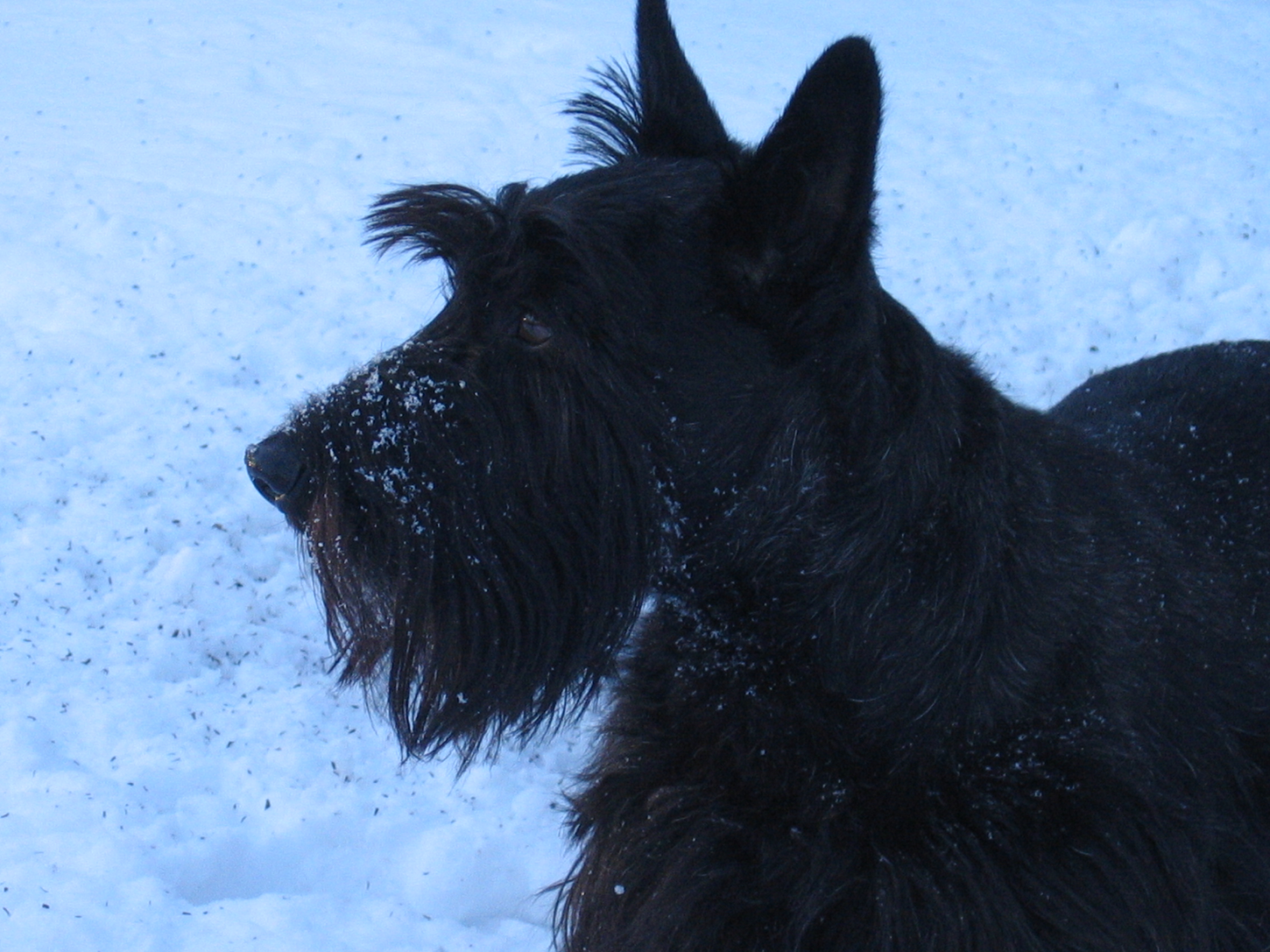
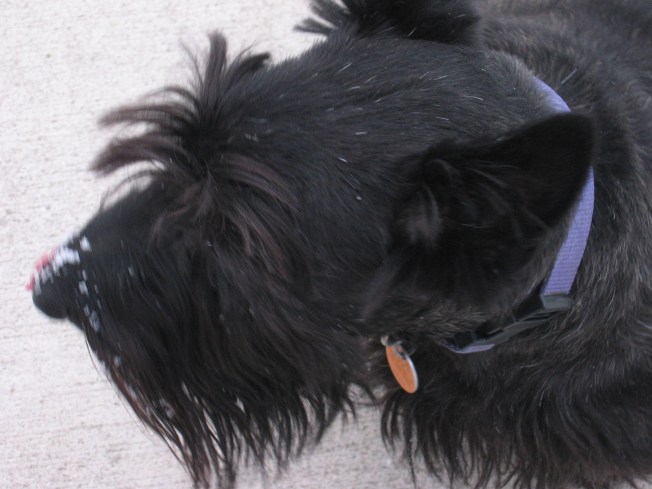
Mac, with snow nose.

A few weeks ago when I was feeling particularly blue, I ran into Higgins and his mom. Higgins is a Scottish terrier who reminds me of Mac. Like most Scotties, he’s not particularly interested in giving me more than a cursory greeting when there are bushes to sniff and vermin to patrol, so his mother and I say a couple of pleasantries to each other and then walk on. But the sight of him lifts my spirits just as much as a nuzzle from a more people-focused dog.


Z and I don’t have a dog for reasons that seem clear on some days and less so on others. This month it has seemed like a bad, bad idea to live a dogless life. I’ve followed so many dog groups and pages on Facebook that there are now more pictures of strangers’ dogs on my feed than there are of people I know.


The practical reasons we don’t have a dog for me are that we travel a lot and don’t have the disposable income right now to spend on a chic Seattle doggie retreat. The practical reasons for Z are that we have no yard and he suspects (probably rightly so) that I would not be the one popping up early in the morning to walk the dog in the rain. Also, Zimbabwean dogs are outside dogs and Z is not entirely on board with the way Americans push them around in strollers and dress them up like children. No matter how much I promise not to do these things, he doesn’t believe me.
 

ducktails

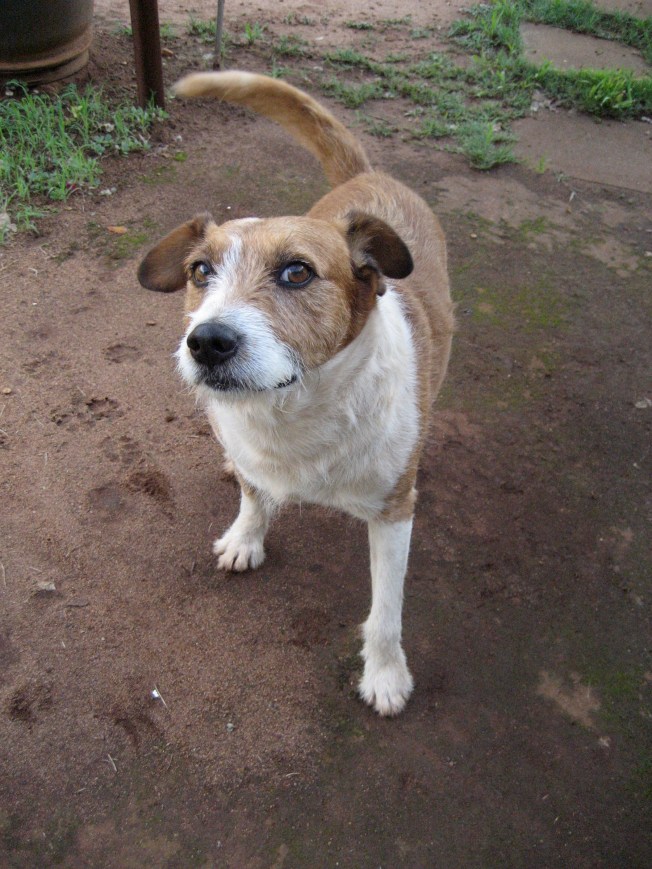
Skampy of Zimbabwe

We do have imaginary dogs: a Scottish terrier named Finley and an English bulldog, like the ones Z’s family raised when he was a kid, named Luigi. We have conversations about how we will train them, what our policies will be in off-leash dog parks, and whether or not we’ll let them eat table scraps. I do online searches about whether bulldogs and Scotties even like each other, but these dogs of ours, much like our imaginary children, are perfect: well behaved, best friends, come when called, and are terribly clever.


This next part is not a dog story, though it is about good behavior.


When I was an adolescent, Mom had one of those new-fangled decorative write-on-wipe-off memo boards on which she had written the Janis Joplin line, “Don’t compromise yourself. You’re all you’ve got.” I studied this for ages. All of those “yous” seemed inelegant to me, plus I wasn’t entirely sure what it meant or what my divorced, hard-working mother was warning herself against. Eleven-year-old me understood the concept of having to compromise between two ideas or two desires and settle on something in the middle that is mediocre. I understood having to compromise to get along with my gaggle of boy cousins, who always seemed to want to be outdoors when all I wanted to do was stay inside playing with our Six Million Dollar Man and Bionic Woman dolls. (That compromise usually looked like me doing what they wanted because there were more of them and I was the only girl until I was ten.)


But I wondered, how do you compromise yourself?
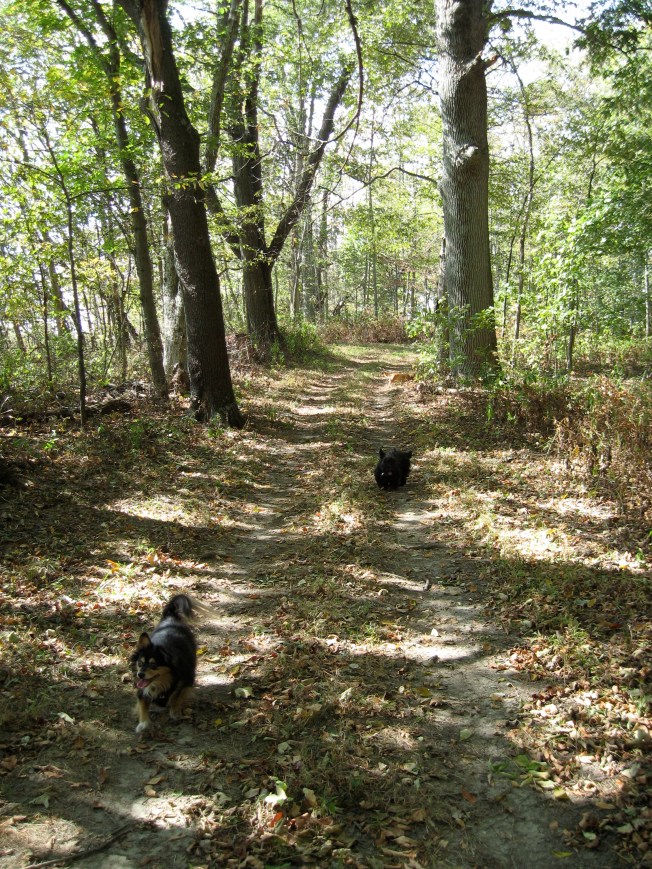
 

img_1251

Mac and Lilly, being themselves on a ramble.

Because I’m from the Midwest, I am “nice.” Or I have a nice veneer anyhow. As I’ve written about before, to be Midwestern—at least from my perspective—is to get along with those you encounter, to smile when they say something you disagree with (or make a joke of it at the very least), to purposely not hear them when they say something rude or bigoted or misogynistic, to help someone move house with a smile on your face even though you’d rather be doing just about anything else with your Saturday, and periodically, you have to pretend that watching some truly untalented kids play T-ball in a cornfield on a sweltering evening is as good as life gets.


Is this a compromise, this good behavior? To tell these little lies, is that compromising myself?


I ask, because I’m heading to Indiana this weekend for the holidays. For the last few weeks, I’ve been walking around Seattle with the equivalent of an ACME safe hanging over my head, but it’s easy enough to feel a kinship with the people here whose paths I cross because I can see—sometimes almost literally because of their gender or skin color or disability—that they too have ACME safes over their heads as well. But I don’t know what I’m going to see or how I’m going to feel when I get home surrounded by people who don’t think they have ACME safes over their heads. Will the nice kick in? Will I growl at them? Will I hide in the house and go the Emily Dickinson route?


Once when I was a child I was at the Indianapolis Art Museum in the Impressionist gallery, and Mom and the adults we were with had moved ahead. I was hanging back, mesmerized by a small bronze sculpture, a figure of a person. I reached out and touched the toe. It was so beautiful and full of mystery. In an instant, a very businesslike (but not unkind) security guard walked past me and said, “Please don’t touch the art.” My hands snapped like I’d touched a hot stove, and I clutched them behind my back for the rest of the visit, afraid that I’d get mesmerized by another sculpture or painting. I was mortified that I’d misbehaved in this cathedral of culture. I didn’t even confess my sin to Mom.
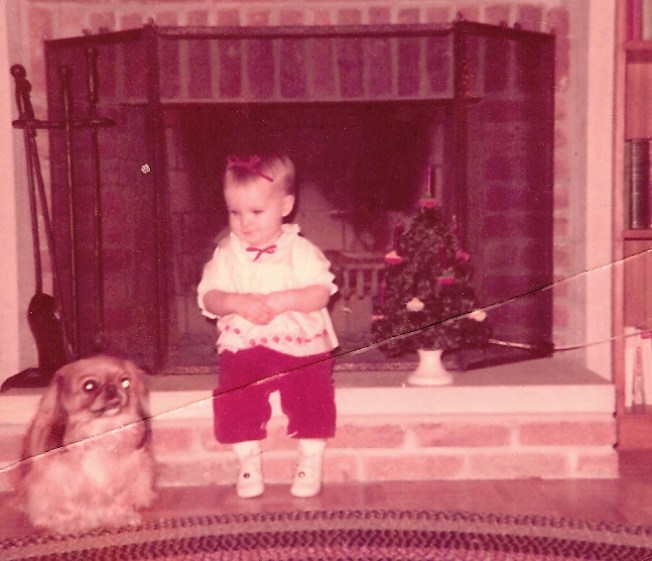
 

bethxmasting

Future art toucher with Ting the Pekingese.

I tell you this so you’ll know that I know how to behave in an art museum. I am quiet. I touch nothing. I keep my critical comments to myself if anyone is within earshot.


This fall while Mom was here, we made our way to the convention center, which has rotating artwork lining the halls of the open third floor. As luck would have it, it was my favorite exhibit that comes around yearly of children’s book illustrations.


The Washington State Convention Center is no art museum. It’s often full of tourists and conference goers or people like me who primarily use it because the escalators make a trip from downtown up to First Hill effortless. Most other people there are oblivious of the artwork as they crowd their way from one conference session to another. The day we went it was relatively empty, so we could linger where we wanted without bothering anyone or being bothered by others.


bestducktail

Bubbles of Zimbabwe

All of the art is easily accessible with the exception of two short sections where there is a ramp with handrails. The incline is almost non-existent and I suspect the handrails are there purely as decoration, in case there is a lawsuit should someone fall. On the one side of the floor, Mom and I both stepped behind the railing so we could look more closely at brushstrokes and signatures. On the other side, just as I popped behind the handrail, the security guard—who sits on a stool by the restroom to make sure only conference attendees use the toilets there—told me I wasn’t allowed behind the rail.


I popped out obediently, but I looked around the expanse of the third floor with an eyebrow raised and asked her why not. What was so special about these five pictures that I couldn’t get as up-close to them as I could the others? I happily follow rules if they make sense, but this was senseless.


She settled onto her stool to tell me in great detail why. Two sentences in, it dawned on me she wasn’t a docent and the longer she talked, the more apparent it became that  everything she said was made-up. There was no logic involved, so I started to walk away. She raised her voice, calling me back sharply, “Do you want to know the reason or don’t you?” It was said in that voice that a couple of really officious teacher’s aides had used when I was in elementary school, as they tried to cow us into submission even though they knew (and we knew) they had no real authority over us.


I said, “Sure,” but I could NOT bring myself to turn my face or my attention back to her. What she was saying was boring and nonsensical. I let out a single non-committal noise, which she could interpret as understanding if she chose (but which secretly meant, “please shut up; you’re talking crap”). Finally, she was quiet and I moved on to the next set of rail-less illustrations.


img_0012

Mac & Luther, best buddies, would have sniffed beyond the handrail.

Mom was ten paintings behind me, and I heard the woman say something to her like, “That’s okay. I get it all the time.” Later, Mom insisted the woman was responding to Mom’s “thank you” and that she had not apologized for me. To the best of my knowledge, Mom has only ever lied to me about Santa Clause, so I’m forced to believe her. But when I heard that woman speak to my mother in that tired, nobody-respects-me voice, my face flamed and I felt nauseous because I knew—regardless of what Mom had said or what the toilet monitor was referring to—that I had embarrassed Mom with my rudeness. The Beth she raised is a person who would nod her head, do as she was told, and smile politely even if she knew she was right and the speaker was wrong. That Beth was raised to bite her tongue while ill-behaved children mistreated her toys. That Beth was raised to be, above all else, polite. I didn’t have to perform song and dance numbers for people. I didn’t have to eat vegetables. I had next to no chores. My single job as I was growing up was to be well-behaved, a guide that until now has served me well.


Yet here I was, a middle-aged woman, being shirty with a woman whose job monitoring the public toilets of Seattle could not have been pleasant.
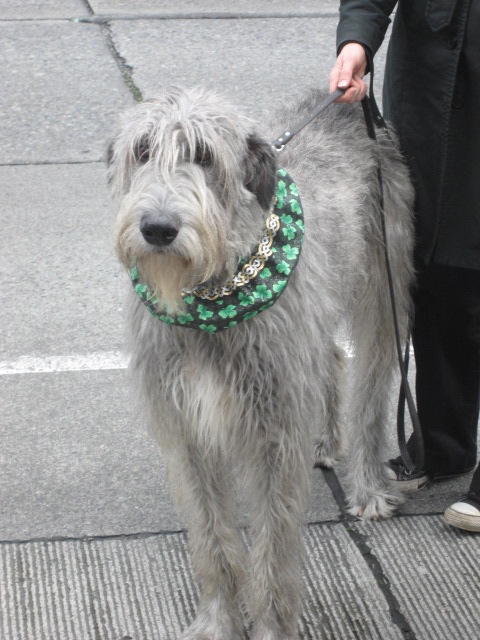
 

img_0798

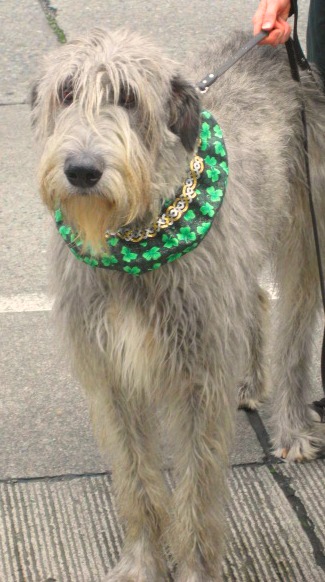
Seattle Irish Wolfhound, perhaps the most dignified dog on Earth.

Later, I made some excuse for myself to Mom about how living in the city has started stripping away my manners. That when you are daily surrounded by so many people who want to talk over you, cut into a line in front of you, hoot their horns because they think they know best how you should be driving your car or crossing a street, you lose the nice.


But probably the stripping away began before I moved to Seattle.


Several years ago a friend told me I wasn’t as nice as I thought I was. I can’t remember what it was in reference to, but it took me aback. This was in the days before therapy when my default setting was “how can I be the person who will most please you?” instead of being myself. I never thought of myself then as “nice” but certainly as someone who tried to give people the version of me that they most seemed to want. Slowly, layers of façade came off over years of talking to a shrink. Some people didn’t notice. Others did and didn’t like it.


img_0276

Man and dog in Central Park, big rain, no dark clouds.

So here I stand at the tail end of my own annus horribilis. No, my palace didn’t burn down, but it has been a year full to the brim with medical bills I didn’t ask for, a family health crisis that was terrifying, dead celebrities I’m missing, humans being ungodly to each other across the globe, Native Americans having to withstand tear gas and rubber bullets to protect their own water, forest fires raging in one of my favorite spots in Appalachia, a country—my country—making my husband feel unwelcome and my brother feel unsafe, and a president-elect who demonstrates with his own mouth and fingers the worst human qualities on a daily basis. And what I’m finding because of this year is that the last layer of that Midwestern filter has been peeled away.


After having talked to other female friends, I’ve learned that I am not alone in this. One friend who rarely cusses can’t keep the profanity inside herself. Another told me she’s done being bossed around by people or forced to rise to their expectations of her as a woman. A third, who has never been a gun nut, is seriously thinking about buying a firearm because she’s tired of not being taken seriously and thinks her state’s open-carry law might make her words have more weight. Others felt rifts around their family Thanksgiving table that they aren’t sure will ever be repairable.
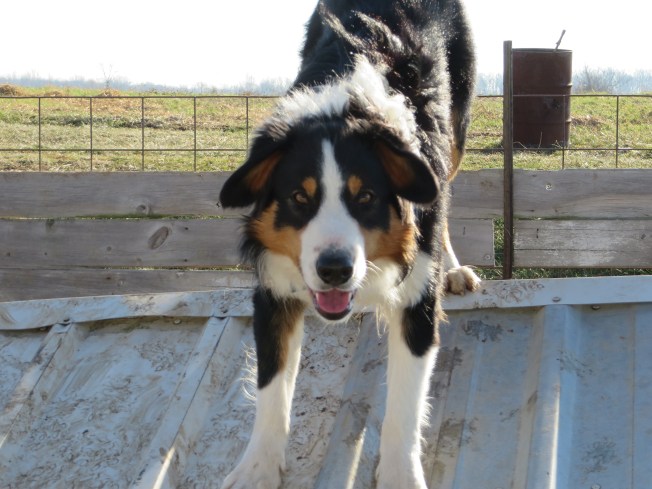
 

img_0678

Hoosier Shepherd

My friends and I are being gentle with each other, but to the outside world, we are less so. At the very least, we are wary and self-protective.


So this trip to the heartland is going to be interesting. I’ve never been in Indiana without the bit of “nice” jammed between my teeth. Will I growl at people? Nip at their hands? Stick my head under the sofa with my backend to the world? Or will I fall back into old patterns without meaning to? Who knows.


bubbles

This is not a dog, but the same principle applies.

What I’m hoping for is to find some dogs to spend time with because the only real light I’ve gleaned from the world in the last three weeks (especially since the Gilmore Girls reunion was a little disappointing) is that dogs are always just 100% themselves. They don’t put on airs. They’re great judges of character. They are completely oblivious to politics. No one is their president.


They’re just content to be.


img_0389

Scottie puppy, Salthill Prom, Galway

I’m going to try to be. To enjoy my mother who knows my heart and shares my sadness, who gave me the twin messages of the importance of good behavior and not compromising yourself, and now the two are duking it out.


There might be some misbehavior. There might not. But right now, it’s Dog Time.

bethcryingbrowniehat

Be forewarned: this is what a tantrum from me could look like.


The Sound of One Hand Complaining

Standard

rgsmutiny

One of my elementary school classmates maintained a certain level of grime on his hands that was masterful. How a kid managed to have hands and forearms that looked like he spent his days elbow-deep in a car engine instead of doing multiplication tables, I never figured out. His sister was squeaky clean, so it seemed like a personal style choice rather than a desperate living situation, though in the school I went to, either was possible.


In 5th grade, our teacher decided that hygiene should be on this kid’s list of accomplishments, and so there was a day when he was sent to the sink to scrub his hands in hot water. When he was done, he looked—for what might have been the first time—at the veins that pulsed beneath his pale skin and he said with alarm, “Mr. Moore! My guts is showin’!”


I don’t really like body talk. In fact, I don’t like thinking about my body’s inner workings at all. Sometimes, I can feel my heart beat and I wish it would stop so I’d be less aware of it, until I realize that a stopped heart would be counter productive to my general enjoyment of life. I’ve gone off entire, delicious meals because a dinner companion chose that moment to describe in detail some wound or ailment.


All this to say, I understand this kid’s alarm at seeing his own visible “guts” or even the idea that he had innards at all. And also to say, excuse me if I don’t go into a lot of detail telling you about how two weeks ago I ended up in the ER across the street with an impassable kidney stone, my first ever overnight hospital stay since my own birth, and two knifeless surgeries, one of which decimated the thing with sound waves. The RN said the stone was the size of a 2-carat diamond, but I imagine it the size of the Death Star and those sound waves as the laser shot from the X-wing fighter that brought Star Wars to a satisfying conclusion.


img_5876

I’m proud to say I walked to the ER instead of wasting precious fossil fuels.

What led me to this sad end to summer besides a genetic predisposition to kidney stones and a Midwestern diet rich in red meat? Here’s an idea.


Like most belief systems, I’m rarely in with both feet. Or if in with both feet, I’m only wading and never let the water rise past my navel. I’m a Christian of the sort that means something to me but would not impress the Pope or Ted Cruz. I’ve read books on Buddhism and tried meditation, but after a few minutes I always determine that thinking my thoughts is infinitely more preferable than thinking nothing at all, so I give up the practice. I have two yoga tapes and took a class once, but the only pose I mastered was corpse.


A couple of decades ago, I started reading Mind Science guru Louise Hay’s books on positive thinking The Power is Within You and You Can Heal Your Life. In general, it agreed with me. It just makes good sense that if you spend your life sitting around kvetching about what you don’t have/can’t do, you aren’t really doing anything that’s going to help alter that reality. It was uncanny to me how if I looked up my ailments on her handy healing chart, the thought-sin I’d committed almost always sounded exactly right. For example, I kept having accidents that required stitches on my feet, and sure enough, on her chart, this indicated a fear of moving forward, which seemed an accurate diagnosis since I was in my 30s and still living with my folks.


But then five months after Z and I got married, I got a diagnosis that could have been potentially devastating, and I felt angry that according to Louise Hay, I had caused this myself with my crappy thought patterns of self-blame and failure to enjoy life. (FYI, the least helpful thing you can ever say to a person who has just gotten a shitty diagnosis is that they probably got it because they ate the wrong food or had the wrong thought. Here’s what you should say: I’m sorry. This sucks. I am here for you. Tell me how you’re feeling, and if you don’t feel like talking, would you like to borrow my dog and scratch its ears? That’s it. There’s no reason to say anything else or try to solve an unsolvable problem.)


So Louise and I parted company. Until two weeks ago, when I looked up kidney stones and read: “Lumps of undissolved anger.” Also because I’d had to delay the Death Star blasting that first week because of a urinary tract infection and had to take high-powered antibiotics that put me off my food for ten days, I looked up UTI too and read: “You are pissed off.” My old friend Louise may be on to something.


Below, please find photographic evidence as to why this kidney stone was my destiny.


Exhibit A: Summer in Seattle


rgsferrysailboatmtn

Yeah, yeah. It’s beautiful. But when it’s 98 degrees out, I don’t care.


Temperature-wise, I’ve had little to complain about this summer. But we did have a heat wave the week before my unfortunate situation, which left me stuck in the house for days. I was unwilling to venture out because of the heat, because I was barely dressed, but mainly, because my hair looked like this:

rgsbethbadhair

That is clean hair there, in case you were thinking it looks like I need a shower. And I’m giving you the “artistic” Warhol filter because at this age, I prefer not sharing photos of myself in which I am not wearing sunglasses. (Another thing to be ticked off about: my disappointing middle aged under-eye area.) My world is soft focus whenever possible.


Aside from the heat, I am bitter that I haven’t been back to Indiana to see Joy, my fabulous friend and hair-do doer, hence the truly deplorable state of my roots. Also, there are at least eight strands of grey in there now and I am NOT happy about that development. NOT HAPPY AT ALL.


Exhibit B: Sky Theft


img_5879

Oh, goody! Another building that looks like all the others where there used to be a view of Queen Anne. Thanks, Skanska.

In case you’ve missed the news reports or the high pitch of my whining, Seattle has been having a building boom . Our neighborhood alone has approximately twelve of these “Notice of Land Use” signs and if the signs aren’t there it means they’ve been taken down and the cranes and bulldozers have moved in. (Note: every sign has been tagged like this, which I like to believe is a subtle form of protest and not simply graffiti artists looking for a canvas.)


rgsproposedlanduse

None of these tags are mine. I swear.

The most recent one to go up is next to the cathedral’s little garden, where St. Francis stands guard over the tomatoes and lettuce. I don’t eat anything in this garden because I don’t really believe in vegetables as a food group, but it’s presence makes me smile when I’m out walking, and now, it’s going to be a high rise a full of chic pods no one who currently lives here will be able to afford. (I’m feeling increasingly like the Gallaghers in Shameless in how much I loathe gentrification, how much I’d like to take a baseball bat to these signs or set a car on fire. But don’t worry. My fear of incarceration is much higher than my desire for a neighborhood garden or an unobstructed view of the sky.)


I have not been able to wear sandals all summer because there is so much construction in Seattle that there is debris everywhere. The three walks I’ve had in flip-flops have resulted in splinters and more of a hobble than a healthy stride, so now I’m clunking around First Hill in matronly shoes with support and sturdy soles.


Also, all of this construction has left our little 1920s apartment building with a mouse infestation, and these are not timid country mice. These are bold and ballsy mice who peer at Z from the kitchen with a “What are you lookin’ at?” expression on their little faces.


It turns out, I prefer my mice in the artwork of Beatrix Potter, wearing trousers and sipping tea.


Which brings me to:


Exhibit C: Neighborhood Art


img_5815

I guess it gets cold at night?

One of the delights on First Hill is the Frye Art Museum. There are a lot of reasons I like it—though I don’t go often enough—including the fact that it is only three blocks from our apartment. Also,  I get overwhelmed in standard-sized art museums but this one is bite-size, thus perfect for my attention span. Also: FREE. Also, the first time I went there they had an R. Crumb exhibit and I find his cartoons hard to look away from though I don’t necessarily want to hang Mr. Natural on my wall.


The Frye is on a tree-lined block and adjacent to another cathedral-filled and tree-lined block that I particularly love because when I’m walking there, I can imagine First Hill before its soul was snuffed out by buildings and sprawling hospital complexes. I can imagine fancy families leaving their fancy houses (now almost all replaced by big apartment buildings) and strolling to mass, enjoying the view of Elliott Bay with Bainbridge Island in the distance (now blocked by skyscrapers unless you stand in the middle of the street and look quickly before the #12 bus hoots at you).


So four weeks ago when we were on our walk, Z and I sauntered past this construction site behind the Frye, I was livid: another 20-story buildling, more people in the neighborhood, probably some trees taken down, more grit in my shoes.

img_5820

I can hardly wait to see what this will be.


Oh, how I growled. And then I saw this:


img_5817


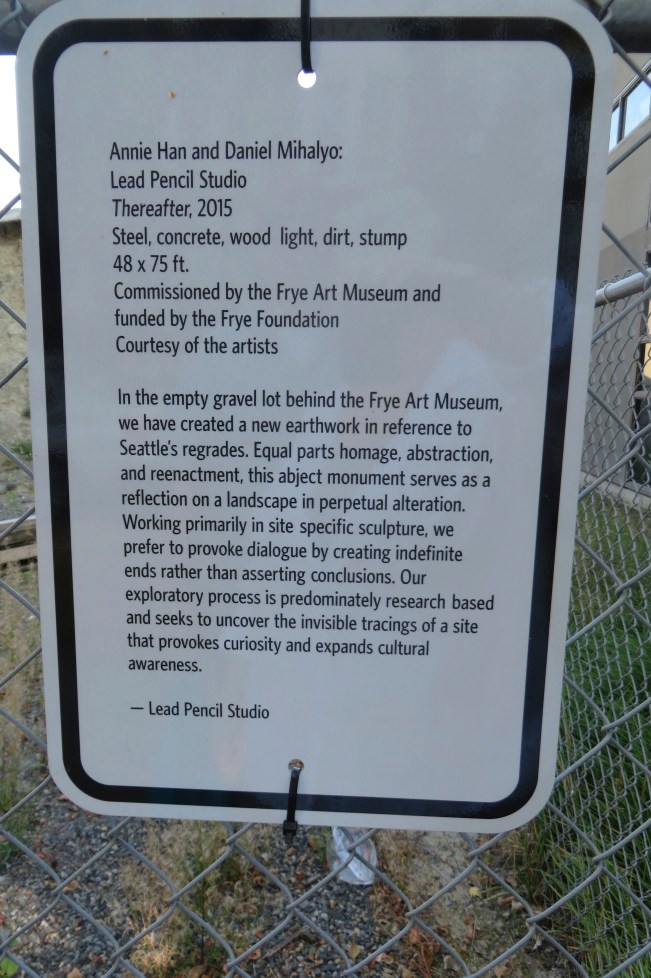
That’s right, folks. This here pile of dirt with the security light and the crumbled hunk of asphalt is actually genuine, bonafide art.


To recap…


Art:


img_5824


Not art:

img_5867

See the difference? Me neither. As if the city isn’t going through an ugly enough growing phase, please, by all means, use your art to make it even uglier. This is like giving your gawky eleven-year old an extra big pair of horned-rimmed glasses and suggesting a diet that will increase the acne he already has and then maybe, for added fun, a hairstyle from 1952 and a pocket protector.


And now, I find I must return to my recurring beef, also related to neighborhood hideousness:


Exhibit D: The Seattle Parks Departmet


rgsfirsthillpark

First Hill Park, an oasis in the concrete.

Seattle has some gorgeous parks that put the best parks in other cities to shame. It also has some innovative parks, like nearby Freeway Park, that literally put a lid on a little section of I-5. It is very shady, walled by cascading fountains that drown out the sounds of the interstate and of the city (and your screams), and a thick carpet of grass, which we don’t see much of here in the heart of the city.


For me, cathedrals and parks in a busy city serve the same purpose: they are a respite from the busyness and ugliness of urban life where a person can get in touch with with the divine, whether natural or theological. They are quiet havens where a person—particularly an introverted one—can recharge and prepare for more time spent in the overcrowded, concrete jungle. They are spaces that are open to all, regardless of race or social class or mental stability.


The only reason I slightly prefer a park to a beautiful old cathedral is because dogs are allowed in parks, though I do miss the smell of incense.


So, to be clear: Beth loves parks. Also, Beth watched all the seasons of Parks & Rec, so understands what the Leslie Knopes of this world are up against in terms of budgetary constraints, public safety, and community involvement.


img_5845

The only thing this color makes me want to do is go swimming.

That established, the Parks Department sometimes makes dubious choices, like the previosly blogged about Parks to Pavement project (which, I’d like to note, grammatically, should be called “Pavement to Parks”), wherein perfectly good parking spaces (pavement) are stolen, painted a hideous shade of turquoise, and some folding-chairs-in-bondage are set up (“park”). They are not shady. They are not peaceful. You are basically sitting in traffic, praying to God that the plastic poles they’ve screwed into the ground will keep you safe from the cars whizzing by. My “favorite” is the one on our street that is a mere five feet from the lush and peaceful Freeway Park. You know, a real park and not a parking space. A parking space we can no longer use the ten times a year we rent a car.


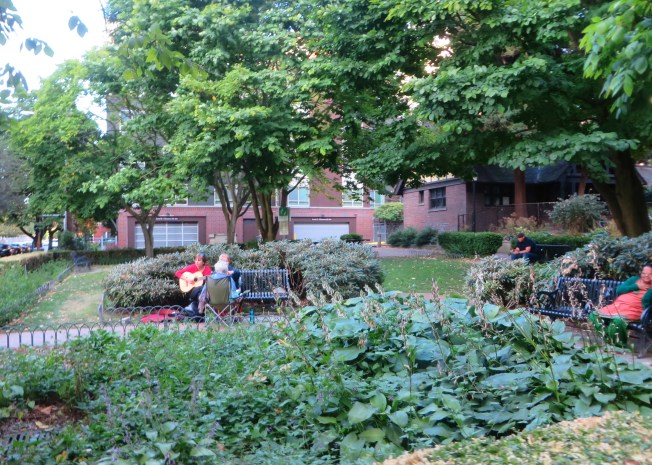
This summer, signs went up in the real park, the little neighborhood First Hill Park (above), that it was going to be renovated. The park sits next to one of the few remaining old mansions that used to flourish on First Hill in the 19th century, and when you walk past it, it feels old world. It also gives you the notion that the Stimson-Green Mansion has an actual yard. There are trees. There are stately black benches and lights. It’s pleasant to look at.


img_5837

Stimson-Green Mansion, a pleasant reminder that First Hill used to be beautiful.

That said, it’s a bit problematic in that because of Seattle’s large homeless population, it is often inhabited by people who have made it their home for the day or the night. Which stinks. It stinks for them that this is how they have to live and it stinks because there’s no way anybody else is going to send their kids there to play. Nor are Z and I going to pack a picnic and set up camp amongst the needles and trash for an afternoon and greedily gobble ham sandwiches next to people who maybe haven’t eaten today. So we just walk past it and admire the beauty and eat our ham sandwiches in the privacy of our own home.


Except now there have been meetings and the Parks Department is trying to figure out how to make the park more vibrant and usable. (Read: how do we entice non homeless, non IV drug users into our green space, thus making it less pleasant for the people currently using it?) There have been several meetings and reports, and what’s going to happen is something like this:

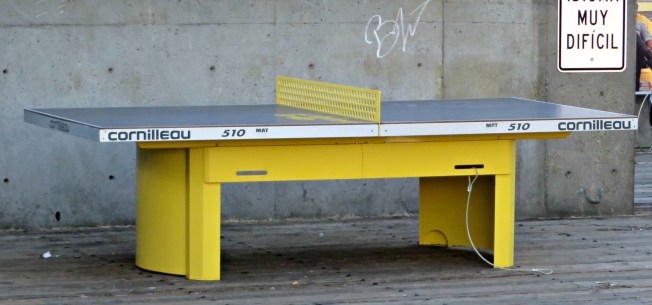
rgspingpong


That’s right. In what used to be a gorgeous, green, London-esque park, there is going to be a ping pong table. Or a shuffleboard court. Or some children’s play equipment. Some of the green will get dug up so some seating for movie nights and concerts can be put in place. Probably flowers and bushes will be ripped up. (There is talk of a dog water fountain, and I wouldn’t mind seeing that.) So, sigh. Good bye beautiful little park I like to walk past. I wish we were channeling our monies and energy into solving homelessness instead of just putting a ping pong table over the top of it.


Exhibit E: No Smoking

img_1387

Our building has gone no-smoking. Z and I are both non-smokers. He’s asthmatic and I’m legitimately allergic to cigarette smoke, so this should be a good thing for us. Our apartment gets smokey because we’re next to the front stoop where people like to congregate on Saturday nights and light up, and the hallway often smells like a Grateful Dead concert since pot was legalized here a couple of years ago. So we aren’t particularly sad about the building’s new smoke-free policy, though, because we are children of smokers,  we both do have a lot of sympathy for those who just want to get their nicotine fix but have to dance around the city trying to find a spot where they can do it that isn’t 25 feet too close to a door or open-air restaurant. Ever since the hospital across the street made it’s campus smoke-free, we’ve felt equal parts sympathetic to the folks in scrubs loitering outside our door and annoyed that the hospital cares about the health of their patients and staff but not so much about the health of their neighbors who can’t have their windows open in 90 degree heat.


Anyhow, we thought the building’s new smoking ban might be a boon, but instead, it’s just wrecked our coping mechanisms. Some people are breaking the rules (smoke in the hallways and on the stoop) and others are trying to follow the letter of the law by standing 25 feet from the front door which is right under our open front windows. (And this is to say nothing of the commuters who congregate in front of the building for three hours at night waiting on the express bus, smoking the cigs they’ve been banned from having all day and talking loudly on their cell phones.) So, we’re currently in a lose-lose scenario because our old plan of closed back windows and open front ones no longer works. Basically, to keep our apartment in our non-smoking building smoke free, we’ve got to shut all the windows and pant in front of the fan.


I guess we could go to the park and play ping pong to get some fresh air.


Exhibit F: Facebook

rgsfacebook

Facebook has taken great joy in reminding me what I was doing a year ago. Z and I have been having a quiet, working summer at home with the smoke and mice instead of a jetsetting summer visiting the countries we love. It hasn’t been a bad summer, but it hasn’t been as glorious as a week in London, a week in Wales, and two weeks in my beloved Ireland. Yet every day, there is Facebook, with an update of all the good times we could be having if only someone would invent a time machine and take us back to Galway or Aberystwyth.


But really, if you want to know why I got a kidney stone bigger than my engagement ring logged in my innards, here is the reason:


Exhibit G: Millenial Rejection


img_5869

Please, feel free. Pick the meat right off my bones.

Nobody likes rejection. I’m not special in this regard. But earlier in the summer I read a call for a residency for writing and teaching that I really wanted. It was a long shot. I don’t have a huge publication list behind my name, but I knew I could give them what they wanted for their student-writers who need feedback. I’m beginning to see that as much as I believe I was meant to heave a keyboard beneath my fingers or a pen in my my hand, I also was meant to work with people on their own writing: to help them find their voice, patch the holes in a plot, say something more authentic or more beautiful than they’ve already said. I’m good at it. I am not a particularly confident person, but I know this is one thing I do well. And when I’m working on someone else’s writing, that’s all that matters. I’m not trying to figure out how to get them out of my office so I can get back to my own writing. I’m not trying to figure out how I can use their ideas for my own gain. I’m just 100% committed to whatever it is that they are committed to. (Even if some of their crappy sentences make me groan internally.) When I’m teaching or mentoring, I feel exactly the way I do after Thanksgiving dinner: completely sated. Only I don’t need larger pants.


When the rejection came, I was disappointed. I might even have cried, not because I didn’t get my way or didn’t “win,” but because I really really wanted to be in the position of pouring over someone else’s writing and helping them shape it again. As I said in my last post, I’m beginning to realize how much I miss my students, and this seemed like a way to stop that missing.


Then I re-read the form rejection letter, and I got angry because it was badly written. There were grammatical errors, but what bothered me more was the careless way it had been written with no thought to word choice or intent. It sounded like it was written by someone who didn’t  read instead of by someone who purports to love writing. And then when I did further investigation and saw a photo of the group who had likely made the decisions, I felt angry that they all looked about twenty-three. Of course twenty-three- year-olds can make good choices. (I like to think the anaesthesiologist I had last week who appeared to be about twenty-five was capable of accurate and lightening-quick decisions anyhow.) In this case, however, seeing all those judge-y, line-less faces, all I could think was what in the hell do you know about what good writing and good teaching is?


I raged for a day and then I did the reasonable thing and put some plans into action so I can get what I want (re: writing and teaching), and then just while I was about to feel satisfied with my quick recovery rate from disappointment and anger, I threw up. Between waves of pain, Z and I trekked up the hill and across the street to the ER to find out what Louise Hay could have told me if I’d just looked at her book: You have a kidney stone because you’ve spent the summer pissed off, and you were so pissed off, you created a kidney stone too big to pass.


Now that my figurative guts are showin’, everything seems brighter and more pleasant. The weather cooled and it’s possible to imagine a few months with the windows shut, blocking out smoke. Z reports from his solo walk today that the dirt-pile artwork was carted away. Based on Facebook’s over-zealous announcements, we’re nearing the end of last year’s happy memories. I’m a few days away from a trip to Indiana where I will see people I love and miss AND have my hair cut and my roots (and those eight strands of grey) covered.


I’m writing. I’m editing. I’m not throwing up.


I’m alive.


img_1379

Get-well flowers from Leibowitz coupled with painkillers and Z’s ministrations made it all tolerable.

A Horse with No Name

Standard

Ponygirl

Today, I came into my writing studio, cracked open my laptop and flexed my fingers, ready to roll. Yesterday, in my notebook, I’d jotted down a genius idea at the bottom of a list of things I’m thankful for and I was sure that genius idea was going to make the words flow at record speed. I scrolled down the list anxious to be reminded of what had inspired me and made me feel so confident. Those words:


Horses aren’t arbitrary.


Well, that was disappointing. I thought it was something better than that. Something that maybe actually made sense.


I am not a horsey person. I read one horse book when my adolescent friends were six books deep in that series about the wild horses of Chincoteague. I inherited a ceramic horse collection from someone who had outgrown it, but I never went through a horse phase like a lot of girls do, unless you count my beloved rocking horse, Charger, who betrayed me by getting too small to ride.


I’ve ridden exactly one non-plastic horse, a pony really, and I did not feel like we were of one mind. I did not feel whatever it is that horse people feel. The view was nice and I wished I had one, but that was largely about transportation because I was six and a horse could take me anywhere I wanted to go.


What a horse could not do, however, was make itself comfortable in a one-bedroom upstairs apartment.


I’m in awe of people who ride horses regularly the way I’m in awe of people who ski. It looks like fun at some level, but skis and horses have always struck me as situations you only think you have control over, and so I’ve given both a miss. Life is precarious enough in my mind without me putting my body on something that could gallop me over a cliff or skid me into a pine tree.


For these reasons, I don’t think of horses as metaphors when I’m writing because they mostly just aren’t in my consciousness. They’re lovely and powerful and I like the way they smell when I have occasion to smell them once every five years when I find myself in the horse barn at the Great Darke County Fair. But I’m more of a dog and cow person. Maybe a monkey person if I’ve had caffeine.

Not a horse. (Also, not my dog.)

Not a horse. (Also, not my dog.)

My first cousin once removed would ride her horse from her parents’ farmhouse down to my great-grandmother’s when I was a kid, and it seemed to me, the equivalent of Glinda the Good Witch of the North arriving in her giant Oz bubble. It was the stuff of fairy tales—much more magical than my boy cousins driving up the gravel road in a motorized child-sized car (also amazing, but incomparable). We played hide and seek once and none of us could find Carol because she was hiding in the barn with her horse. Perhaps it was shadowy enough to keep her hidden in that old barn that leaned so far to the south that it had to be propped up with a pole (we were warned repeatedly not to go into it and repeatedly we went in anyway), but I think it was something else. Carol and her horse were like one entity. We could not find Carol because there was just one creature in that barn and it was “horse.”


Around the same time, a friend of a friend told me the sad story of having to say goodbye to her horse. (She was moving or the horse had to move, the specifics I have forgotten, though—because she was a rare creature like I was in the early 1970s, which is to say a child of divorce—I blamed her loss of horse on her parents’ failed marriage). Her horse was long gone when I met her, yet she spoke of how on the last day with it, she sat in the saddle wearing some special riding hat, maybe covered in flowers, and her friends stood around her and sang. Her longing for the horse was still palpable. It’s been decades since this vicarious heartbreak, but still, I imagine her there, sitting on a horse I never met, weeping because her other half was taken from her.


Leibovitz recently did a photo shoot with her beautiful 16-year-old daughter in a beautiful, ethereal dress on a beautiful chestnut horse. Though it pained me to see Baby Leibovitz looking all grown up, it pleased me more to see her—at this age, as she’s just figuring herself out—on one of the horses she’s loved since she was a  tiny girl and she was looking very much herself.


Also, I just watched a Martin Clunes documentary on heavy horses (watched largely because I like Martin Clunes and not because of the horses), so I can only assume this “genius” phrase of mine was inspired by these two recent equine-related occurrences—a photo of a favorite kid and a documentary narrated by “Doc Martin”—but goodness knows what I thought I’d do with Horses aren’t arbitrary when I wrote it down. It doesn’t really inspire the Great American Novel. And clearly “blog about horses” isn’t even possible since right now I’ve said all I have to say about horses and we haven’t moseyed down the trail towards anything close to a point.


Okay. Here’s a point.


I’m stuck. My non blog-writing has been refusing to shape itself into anything resembling coherence. I sit (sometimes) at my gorgeous desk with my city view surrounded by all of my helpful books about writing and other books full of writing that inspires me, and yet I am stuck.


Also, there is a perpetual reel of conversation in my head (maybe you’ve noticed) of how I miss home and the city makes me nuts, but then when I consider leaving the Pacific Northwest, I feel unhappy too. Leave this weather and Puget Sound and the mostly snow capped mountains? Why would someone want to do that? I’m zinging between wildly happy (Z inspired, largely, though I’ve read some good books, written chunks of things that please me, and just discovered that Mom has the doctor’s thumbs-up for a visit to us) and angry and/or weepy. (Last week I yelled at a total stranger who was walking like a sloth while reading her phone, serpentining along the sidewalk in such a way that no one could get around her. Her obliviousness enraged me and made me feel trapped, so I growled as I finally stormed past her, “Either walk or read your damn phone!” Z just laughed at me. The woman passed us further up the street, still seemingly oblivious, but her phone had been tucked away. I am not a yeller at strangers unless I’m in my car with the windows rolled up tightly. Yelling is not the Midwestern way! The city is turning me into an animal!)


I spend too much time looking backward instead of forward even though if you asked me (you’re asking, right?) I would tell you that this moment right now and the moments surrounding it are absolutely the happiest period of my life.


Also, fall is approaching. I’m three years out of teaching. While I don’t miss lecturing, obsessive faculty meetings, or some administrators who will remain perpetually in my Little Book of Hate, I miss my students. God I miss them. I miss talking to them about their writing and how to make it sing. I miss watching them take some truly deplorable crap and sculpt it into something beautiful. I miss them popping into my office to talk about their ideas or ask for advice. I miss hearing their thoughts about some piece of literature, telling them mine, and all of us seeing the text in a new way. I miss recognizing people in some other major during  first year comp and knowing they were meant to be in my classes, and then later having the satisfaction of them stopping by my office to say they’re thinking of switching majors to English. And later still, seeing them in their last semester, finishing up a creative writing portfolio or an Honors Thesis that exceeds both of our expectations. I even miss having those dreaded conversations during advising sessions about the uselessness/utility of an English degree.


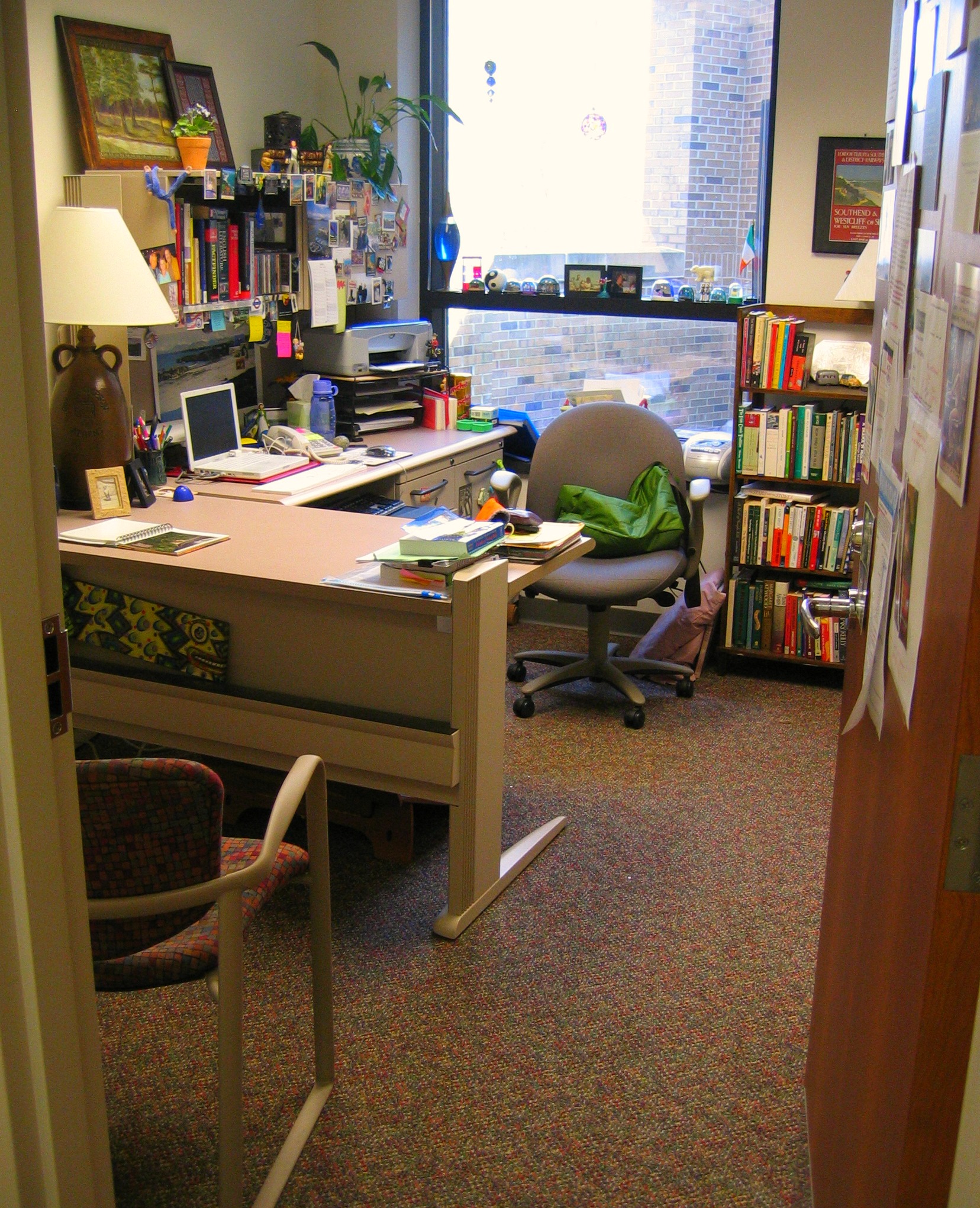
My first and favorite office.

My first and favorite office.

In short, I don’t really know who or what I am these days. It might be a midlife crisis. Or it could just be something I ate.I’ve always been better at knowing what I’m not than I have been at knowing what I am.


Things I know I am not:

  • inclined to work with numbers, in sales, or with bodily fluids
  • an extrovert, an athlete, or a savant
  • a lover of noise, reptiles, or clowns
  • likely to eat vegetables, follow trends, or brush my hair on the regular


So that’s where I’m starting.


It occurs to me that the reason I’ve remembered these horsey stories for forty years is not because I particularly wanted a horse myself, nor is it because I wanted to be like my idol mystery-solver/horseback riding heroine, Trixie Belden. I don’t even want to climb upon a horse for a photo op (largely because I’m unsure that horses really want to be climbed upon in the first place).


No. The reason I can still see my cousin on her horse or imagine the friend of a friend weeping on a horse I never met is because I quite liked the idea of being a horse girl.


Horse girls always know exactly what and who they are. Their heads are full of horses and there is no dissuading them or convincing them that an Irish Wolfhound is nearly as big and just as good. They love their horses so much they don’t mind mucking out a barn, swatting horse flies, or doing those 800 things you have to do to keep a horse happy and healthy (things I used to know when I was reading Trixie Belden). There’s no question there. They want to be on the back of a horse, or standing next to a horse with curry comb, or in a house that is adjacent to a barn in which a horse resides.


Even now, when I run into my cousin at Meijer or see a Facebook post from that friend of my friend, the first thing I think: horse girl. And the second thing I think: I wish I knew myself as well as you always have.


Horses aren’t arbitrary.

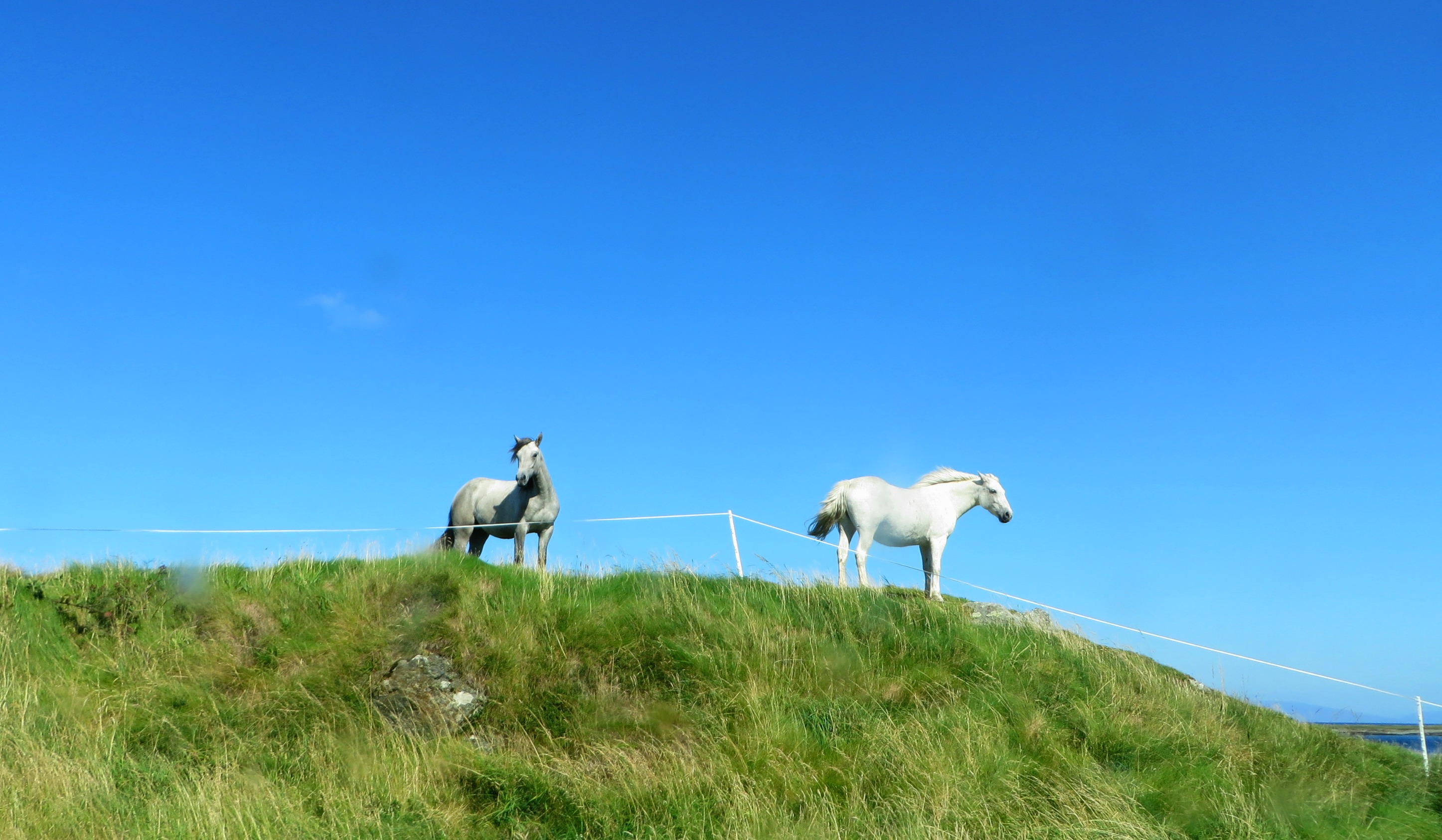
Connemara Ponies, Renvyle, Ireland

Connemara Ponies, Renvyle, Ireland


Of Minutiae and Lack of Momentum

Standard


RGSrockunicycle

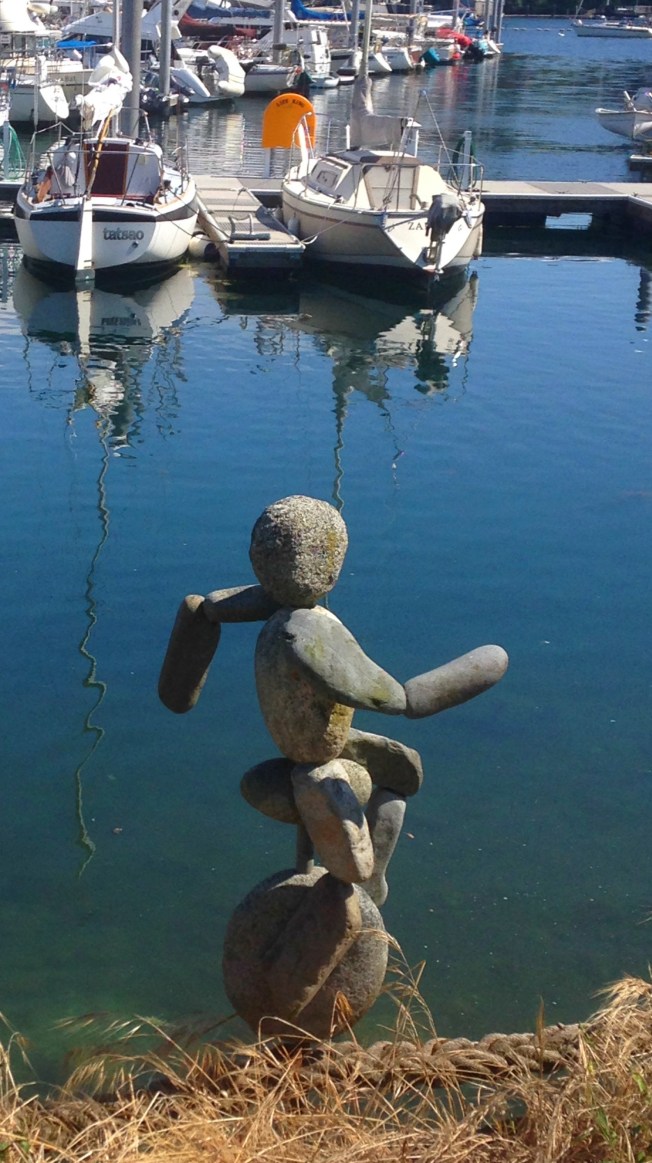
Ethan Currier’s rock art, Bainbridge Island, WA


I’ve been waiting for a day when the news isn’t so horrendous that I can blog about frivolous things without feeling superficial, but it’s becoming apparent that I could be waiting a very long time for that day to dawn. In the interest of not letting the terrorists, racists, misogynists and general practitioner haters “win,” I’m just going to write. Just going to go right on as if in the midst of the world ending it’s perfectly reasonable to be talking about things like houseguests and having to pretend the trolley system in Seattle is a viable means of transportation and how my friend Jane nearly ruined my life by forcing me to read The 12-Week Year. Forgive me.


Aside from all that ails the world, here is my list of beefs today:


  • It’s supposed to be in the 80s next week and you know how much I hate heat.
  • Hudge invited us to an outdoor movie tomorrow night, which sounded like fun, except I pretty much can’t be outside in the evening anymore unless I go in full-on beekeeper garb to ward off mosquitos; I am the sad combination of delicious and allergic.
  • The high-rise across the street from us is putting in new windows. Did you know that installing new windows requires a buzz saw at 8 a.m.? Me neither. Also, at the rate of two-windows-per-day, it’s going to be a loud, peace-less summer here on First Hill.
  • The election. The mean memes. The idiots.
  • People on Twitter are shouting that little Prince George should be sent to jail because in his just-released 3rd birthday photos, he appears to be feeding his dog Lupo some ice cream. He’s 3. His parents aren’t idiots. I’m guessing if it was intentional, then it’s probably a vet-approved iced doggie treat, but even if it wasn’t and Lupo licked that lump of ice cream, dogs eat truly terrible and disgusting things on a daily basis. The likely result will be either nothing or a single puddle of dog crap that someone (who is not the Duke or Duchess) will have to clean up. This is NOT animal cruelty. (What do people get from this online righteous indignation? I imagine them walking around all puffed up and proud of themselves after posting their “wisdom” but they’re really just self-satisfied idiots who can’t read a situation. Kind of like the warriors who “liberate” dogs trapped in cars even though the dog in question is not in distress—because it’s November—and the owner has been gone all of two minutes.)
  • A mouse is trying to move into our apartment.
  • Why DID Seattle try to sell us on the perfection of above-the-traffic monorail travel at the 1963 World’s Fair but then choose in the 2000s to cast their lot not with the monorail—a futuristic and therefore superior mode of travel that shows up in virtually every sci-fi movie ever made—but instead with a nod to yesteryear and a streetcar that holds fewer people than a bus and is stuck in the same rush hour traffic that all the cars and city busses are in, except on a track so it can’t even navigate obstacles? Mind the gap.
  • Someone washed and dried what appears to have been the innards of a hamster cage in the communal machines in our basement and didn’t bother to clean out the woodchips, animal fur, and chocolate chips. (I’m pretending they are chocolate chips. Please don’t tell me they aren’t chocolate chips.)


IMG_0636

Graffiti encouragement, Seattle


Jane, who is one of my oldest friends from college, suggested that I should read Brian P. Moran’s The 12-Week Year, and it is exhausting me. The principle behind it is good: most of us put off goals and projects until the 11th hour, so instead of giving yourself a long time to get something done, give yourself a short time and impress your friends and neighbors with how much you have accomplished.


In theory, it agrees with me. I am a procrastinator by nature and almost anything I’ve ever accomplished in my life—from a master’s thesis to stacks of student papers graded—happened in that magical eleventh hour when suddenly my thoughts, my energy, and my ability to solve problems would somehow work together to get me across the finish line just before the due date arrived.


In practice, I’m having to make out goals and lists of tasks, and then do those tasks to accomplish the goals, and then assess my progress on the tasks and the goals both daily and weekly. It is seriously cutting into my relaxing time. I’ve never been particularly good at anything close to a long-range plan, which explains in large part why I forgot to have children and have never really achieved the perfect capsule wardrobe.


The fatal flaw in my embracing of the 12-week year, however, was my idea that Z might like it too since he isn’t teaching this summer.


Z is much more task oriented than I am. He gravitates toward routine and is a creature of habit. The salad days of our summer are now over because of my stupid suggestion. No longer do we stay up until 3 and sleep until noon. No longer do we lounge on the couch watching episodes of “The New Girl” we’ve already seen twice. No longer do I have graham crackers and beef jerky for breakfast, because he’s got me on an oatmeal and banana system to help with the 12-week goal of “better health.” Do you know how much less fun this breakfast is than Pop-tarts or a bowl of Lucky Charms? (If he were writing this, he would tell you that the oatmeal has to be nuked so I’m basically eating an oatmeal cookie and we’re sharing the banana. Also, he would want you to know that I am very dramatic.)


After the banana, when I’m just starting one of my eight-page emails to Jane or a witty Facebook update, he ushers me next door to the writing studio, where he sits down and instantly goes to work.


Mac used to have to scratch his bed for five minutes and then turn in circles three times before settling down to sleep, and I’m similar with writing. Only I’ll spend about an hour putzing around online or reorganizing my paper clips and Post-it pads. Often, I have to re-read something I’ve already written years ago and consider its merits and failures, or read something someone else has written to get in the right frame of mind. And then I have to sit and think about what I want to write.


I could spend DAYS doing this. It is hard, hard work, the trying to write, and the results are inconsistent. Sometimes, while I’m trying, I actually do write something. But sometimes, at 6 o’clock, Z will slam shut his laptop and say, “I’m done” and he’s accomplished 15 things and I’ve still only written two sentences. Correction: two sentences I hate. Maybe I’ve also doodled a picture of Virginia Woolf in my notebook if it’s a really good day. He’ll ask me what I’ve done with my time, and I have absolutely no idea. No. Idea. I sat down. I started thinking my thoughts and now it’s 6 p.m.


Until we started this program, Z had no idea how much time slips through my fingers. He’d come home from work, ask what I’d done all day, I’d say, “I wrote” and because I had no goals written down where he could see whether they had a check next to them or not, he was none the wiser. Possibly he was suspicious since in the three years since I quit teaching and started working for myself he has never come home from work and had me place an entire manuscript into his hands. But now, for sure, he knows he is married to the least productive person in Christendom.


Last week I was reading a novel in which two women accidentally killed a man (he wasn’t very nice, so it was no great loss) and they had to clean up the mess and hide his body before the lady of the house returned home. It was set in the 1920s, so there was no Roomba or Dyson sweeper, no Lysol wipes, and I can only assume neither of them were doing Crossfit, so the heavy lifting had to be hell. Yet somehow, through sheer determination and hard work, they moved his carcass out of the parlor and into the alley, cleaned up all evidence of scuffle and bloodshed, and hopped into bed pretending to be asleep when Madame returned an hour later.


As I was reading it, I did not think what a tragedy it was. Nor did I feel fearful about what would happen when the cops discovered the body. I didn’t even worry about the bits of bloody apron that got buried in the ash pile, just waiting to be discovered. Instead, all I could think was, I must never kill anyone because I wouldn’t have the energy to clean up the mess.


A good life lesson, perhaps, but probably not what the author was going for.


And since I’m confessing all of my sins of laziness and haphazard lifestyle choices, let me add that last night I got an email from the Seattle Public Library requesting volunteers for homework help with school-age kids who are speaking English as a second language. As soon as I saw it, I realized that I probably ought to volunteer because I don’t do much of anything for the local community except complain to the parks department when they make bad projected plans for existing green space or steal parking spaces, paint them blue, and pretend it’s a park.


rgsparklet

Ridiculous “park” five feet from real park with trees and water fountains.

So it is with great shame that I confess to you now how relieved I was to discover at the bottom of the email that the closest library within walking distance was not participating in the program. It was like the most glorious snow day radio announcement of the 1970s and ‘80s liberating me from a day of school: all the free time I thought I was going to lose was suddenly mine again!


Other joys this week: aside from recommending books that are quality-of-life-ruiners, Jane and her family flew cross country and came to my noisy, congested, but sometimes glorious city for a few days. In another life, I should have been a tour guide. I love offering people suggestions about what to do, leaving helpful maps on the coffee table, having some candy bars in a dish waiting for them. I love introducing my people to new places.


IMG_1219

Space Needle, Seattle

Mostly though, I just loved having them here. I may be six years deep into this Seattle experiment, but it feels so good to have people around who know me in the context of my natural habitat, where there is no need to explain myself, apologize for my Midwestern-sized butt or Midwestern values or the way I say “pen” and “pin” so they sound like the exact same word.


I don’t have to work so hard to hold back my essential self, in other words.


It felt good to talk to them. To see their offspring growing and thriving. To take them on the Bainbridge ferry and stand on the bow of the upper deck and look down at a woman with dreadlocks holding her pet duck up so it could enjoy the sea spray. To have mutual friends from college over for a dinner that was nicely cooked and presented by the Great and Talented Z, so the whole lot of us could sit around reminiscing about life when it seemed less violent and ugly. It was violent and ugly then too, but we were young enough to believe that with Bono’s three chords and the truth and our own starry-eyed optimism, things were going to get better.


Some things did get better. When I went to college, Apartheid was still a thing. LGBT students on our campus had to keep themselves closeted or could be kicked out and they certainly had little hope of having rights equal to their straight classmates once leaving campus either. AIDS was still a death sentence instead of a chronic condition. When we graduated—we women of Anderson University—we’d be making 65 cents to the dollar that our male classmates were making, and now we’re up another thirteen cents (though we’re spending most of that on waxing). If people are being harassed by anyone because of the color of their skin, gender, the uniform they wear, their accent, etc., we’ve often got access to video coverage, shining a light on injustice and sent out over the internet while it happens. We’ve had our first black president and our first female presidential nominee.


We’ve seen the surface of Mars.


It’s easier (and sadder) to look back at all the things we were too naïve to know then: that the Challenger wouldn’t be the worst televised national tragedy in our lifetime, that terrorism would become real to us, that we’d get mired in a 15+ year war that shifts geography but shows no signs of stopping, that something as magical as the internet would highlight some of our ugliest human tendencies.


We didn’t even know what a Kardashian was or that they’d be trying to weasel their way into our homes on a daily basis.


IMG_5794

A girl and her duck.

When asked if the glass is half full or half empty, I’m inclined to recognize that what you have in your hand there is half a glass of something to drink, which is better than nothing but not quite as good as full-to-the-brim. But with the company of Z and good friends, my glass was full this week, even with buzz saws across the street, hamster cage dumpings in the washing machine, and the realization that I’m too lazy and discombobulated to clean up a crime scene.


Peace be upon us.


RGSthesound

Puget Sound


Politics and Religion

Standard
photo 5

Whitewater United Methodist Church (Photo courtesy of Val Jennings)


Midwesterners often live by the adage that you should never talk about politics or religion. If we don’t live by it, we’ve heard it enough and have probably kicked ourselves at least once for bringing either topic up in “mixed company” only to have the conversation fall flat or get heated in un-enjoyable ways. Were I a better arguer, then maybe I’d love the challenge of heated debate or see such discourse as entertaining, educational or satisfying.


But I’m not.


I don’t enjoy strife. Z once got in an argument with a peace protestor by Westlake Center, and I skedaddled half a block away from him so I could avoid hearing whatever words he shared with the tired-looking woman with the “Give peace a chance” sign scribbled on cardboard. I’m not sure what I was afraid of: Z is not rude OR hawkish, but he does like clarity and finds idealistic platitudes useless and so wanted to know what giving peace a chance looked like to her in regard to the quagmire the Middle East had become. Still, I didn’t want to hear their words even if it was a pleasant exchange.


Were it not unseemly for an adult person to put her fingers in her ears and sing “la la la la” whenever there is a disagreement, I would do it.


At home in Indiana, I basically know the rules. I can have a religious or political discussion with a good friend who I already know basically believes what I believe. I know that with my extended family or friends who have differing beliefs, we can ignore uncomfortable topics (the best choice, really) or, if we are feeling brave, each say one conflicting thing politely to the other before we start talking about something innocuous like pie. The objective of these exchanges is that everyone knows there is no ill-will even if someone’s belief system is faulty. The closest I ever got to a political argument was when my uncle, the farmer, sputtered about how difficult the EPA was making his life re: what weed killer he could use on his crops, as if somehow my first-ever vote in the presidential election of 1992 a few months before had caused his headache. Of course even this wasn’t an argument. My uncle said his piece and I said, “Hmmm. I hadn’t considered that,” and then the subject got changed, though neither of our minds did.


But this political cycle is like the beast from the Book of Revelation, thrashing around, wreaking havoc where previously there were harmonious relationships. Usually, during the primary season, people who are not on the podium are relatively civil to each other as they try to figure out who would best lead their party of preference. They say things like, I don’t know, I kind of like the look of _______. Have you listened to him? and they save the ugliness for the second half of the year when they want to tear the opposition from limb to limb. But with the help of social media and everyone’s lack of tolerance and increased righteous indignation, this has been the some of the most stress-inducing six months of 2016 (and I’m  including the parts of the year where beloved pop icons died of drug overdoses, terrorists killed people trying to have a good time/do a hard day’s work, and my mother had a stem-cell transplant). One political party has almost completely imploded and the other has turned against itself like one of the more grizzly battle scenes from Game of Thrones.


Most of these battles are being fought in the media or on social media. Certainly, my own shouting fits and blood pressure spikes have only come from Facebook feeds and comments sections and not from any “real” interactions with humans. I don’t want to suggest that before Facebook was a regular part of our lives that we were a polite and genteel culture, but surely we’ve gotten ruder, haven’t we? And more full of ourselves? More certain that we are right and if we say something over and over enough times, everyone else will eventually be forced to agree with us because our logic and our words are so superior? Also, I’m not sure what convinced us all that our opinions actually matter and must be heard, like we’ll shrivel up and die Wicked Witch of the West style if we don’t speak our minds.


There’s got to be some diagnosis in the DSM-V that explains this lunacy.


A couple of weeks ago while I was talking to Mom on the phone, her call waiting went off and she came back, a bit breathless, and said that the church was on fire and she and my stepdad had to go. I sat around the rest of the afternoon feeling like I was waiting on a health report from someone who’d been rushed to the ER. The church is in the middle of the countryside and I knew the prognosis probably wasn’t good; it takes time for firefighters to do their job when they’re called in from the small neighboring towns and villages miles away. Later that night when she reported that the church was still standing but charred on the inside nearly beyond recognition and likely a lost cause, and later still when the photos rolled in, I cried. It felt like a family member had died.


I haven’t been in that little white church for probably two decades, and I haven’t attended services there since I was 19, but I always imagined it would be available to me. It is the oldest Methodist church in Indiana, nestled on the outskirts of a teeny village in the country, started at the time of circuit riders. It’s the church my mother and I started attending right after my maternal grandfather died unexpectedly and we were trying to find our way in the world without our patriarch. The church we started attending just before she and my stepdad started dating. It’s the church my great-grandmother went to and the church my great-great-grandparents attended. One particularly hot Sunday morning when I was bored during a sermon, I looked out the opened stained-glass window at the field behind the church and I could imagine the generations before me sitting there, so much hotter in their long dresses and suits, staring out the same window, their horses tied up outside, shuffling feet and nickering.


For me, the church was a source of great love and great conflict. Any church for me is that way, really, but this is the church where I came of age and where I first felt those tugs in opposing directions. I longed to belong, but never fully did. I was a divorced kid in a congregation that mostly wasn’t. I was an introvert in a congregation that, it seemed to me, preferred people not too timid to stand up and perform some service. I was living in the city and everyone else was from the country. I played the piano briefly when we lost our much more accomplished accompanist, but I wasn’t really a musician, so even that didn’t feel like the right fit. Plus, I’d spent more Sundays in mass with my father’s family than in a Protestant church until that time, so while I liked the deviations from the script that the Methodist minister took for dramatic effect or because he felt spiritually led to do so, I missed the comfort of the ceremony, beauty, and sameness offered at the Catholic Church.


There was an awful lot of politics in the church. People who thought they ran things. Other people who did a lot of the daily maintenance that kept the church running but got none (and asked for none) of the credit and had none of the say. People who had strong opinions about what the youth of the church should or shouldn’t be doing. People who had opinions if you skipped church to go to a Cincinnati Reds game. People who assumed that because you went there you must believe exactly how they believed and vote exactly how they voted. I’d feel crabby some Sundays, but then as the service came to a close we’d all stand to sing the doxology, say our goodbyes, and before getting into our cars and heading home, a sort of peace would descend that felt an awful lot like belonging. Like maybe despite the differences, we were all on the same team. And we were. If someone was in crisis, there were the prayers, the casseroles, the quiet concern.


In retrospect, I suspect I was just an emerging feminist trying to figure out what exactly my place was in an institution—or, at least, certainly a little country church—that liked it best when a person fit into a role. Though no one expressly told me my role was to be a good girl until I was a wife and mother or that I shouldn’t be overly interested in the leaders of the Women’s Movement or worldly concerns, it seemed to me that that was the track I was supposed to be on: one that didn’t ask too many questions, shake too many boats, or rattle any cages. So what to do with the secret knowledge that I spent as many Sundays in the sanctuary thinking lewd thoughts as I did concentrating on God? What to do when I felt cantankerous when someone made a request of me about performing some activity (lighting candles, speaking on behalf of the youth group in front of all those people, babysitting in the nursery) that I didn’t want to do? As a female, shouldn’t I be compliant and happily subservient? What to do with the realization that while I wanted to be one kind of person (a good, church-going, rule-following woman who read mostly Christian books and listened mostly to Christian music and shied away from anything too earthly), I also wanted to be myself (someone who devoured all texts, dipped toes into a variety of musical genres, and maybe rubbed up next to a boy I might not marry).


I never did make peace with that quandary, but eventually, my desire not to feel controlled outweighed my desire to conform.


I’m not sure what my little country church has to do with the 2016 election except on Facebook I read today that I can’t be a Christian if I vote for a Clinton and I also hear regularly in Seattle and online that if I were really a humanitarian—and surely that’s what Jesus was—then I would have chosen Sanders and not a “criminal” as my candidate. My “favorite” criticism this year has been the implication that by voting for a woman, I’m clearly making my choice based solely on our shared gender and have not relied on logic. As if I’m too feather-brained to realize I shouldn’t vote for someone for whom I hadn’t done some research and weighed the options.


All of that external judgment shares the same quadrant of my brain as my earlier internal conflicts in church. To be good? To be unapologetically myself? It isn’t lost on me that I’m still just as conflicted about being “good” and getting approval now as I was then, but also just as determined to be true to my own beliefs. The best example of this conflict hashing itself out is my choice this election season to wear a tiny, dime-sized button with a vivid pop-art picture of Clinton’s face that I pin on my purse and can cover up with my hand if I know the person viewing it will get too riled up. I’m not proud of this compromise, but it’s a good Midwestern coping mechanism as deeply ingrained as my need to be viewed as good and my desire to be an independent entity.


When I was home this winter, my stepdad would return from Sunday services, and I’d want to hear the news. The church, which was ten times larger when I went there, had dwindled down to a congregation smaller than ten and there’d been talk of closing. When I imagined it in February, I didn’t picture a tiny congregation of which my seventy-year-old stepdad was the youngest member. When I imagine it today, I don’t picture its now-charred remains. Instead, I imagine it when I was 16: people in every pew, friends of mine lighting the candles up front and our plans for the evening’s youth group activity being written about on the week’s program, my step-grandfather leading the singing as my step-grandmother plays the organ or piano, a message I’m half listening to while staring out the window or trying to catch the eye of a guy I have a crush on, maybe communion, an offering, another prayer, the smell of thousands of earlier church services, the doxology that ended it all so well (and that maybe we should be singing to each other now until after November to remember we’re all on the same human team): God be with you ‘til we meet again/by His counsels guide uphold you/With His sheep securely fold you/God be with you ‘til we meet again.


photo 5 copy

(Photo courtesy of Val Jennings)


Hoosier Ecclesiastes

Standard

rgsbottle

For the last ten weeks, I’ve been in Indiana, sleeping in the bedroom of my girlhood home while my mother recuperated from a stem cell transplant. It’s a pretty scary and significant medical ordeal if you are unfamiliar with it, but she was in good hands at IU Health in Indianapolis. The day my stepfather and I brought her home with her brand new immune system I felt like I got a teensy inkling of how nerve-wracking it must be to bring a baby home from the hospital for the first time. Everything seemed like a danger. I got on Facebook and threatened to taze anyone who stopped  to see her or even thought about breathing their germy breaths on her. I fielded all calls because she didn’t have the energy to answer. (A bath would require a two-hour nap afterward, so there was no bonus energy for entertaining even her favorite people.) I stayed away from everyone myself—even perfectly healthy friends—because I was afraid I’d catch some bug  and give it to Mom.


I did my best to assure her that she’d feel like herself again eventually—as the doctors had promised—even though I had absolutely no idea what I was talking about and Mom clearly knew it. Also, the Domestic Arts are not really in my skill set. I rubbed all knobs and switches with antibacterial wipes as if I were sprinkling the house with holy water. I had to try to figure out what food would taste good to her, and then felt like a failure (but also slightly relieved because it required no cooking) that the main thing that she could tolerate was Cherry Garcia. There was the ER trip after she broke out in hives for no good reason and the ensuing fear that she was rejecting a platelet transfusion. There was the frustration of her not acting quite like herself—no interest in TV, in conversation, in reading—and worrying that my “real” mother would never come back. There was the night my step-dad ended up in the ER and then the hospital for a few days and I felt torn between which parental unit I should be with—there’s the true curse of the Only Child…there’s only the one of you to go around.


Then there was the date of my return ticket to Seattle at the end of three weeks and my sense of impending failure: what sort of daughter leaves her mother to answer her own phone, fend off visitors, and go to a germy grocery to buy her own Cherry Garcia? I’ve never completely come to terms with the normal guilt I feel from moving to the other side of the country, but now? Ugh. At night when when I was alone in the bedroom of my teens, I’d feel cranky with myself that when Z and I got engaged eight years ago I didn’t at any point think that I could say, “Yes, of course, I’ll marry you, but I’m not leaving Indiana. We’ll buy a house with more square footage than any apartment we could ever afford in Seattle and we’ll learn about things like caulking and lawn mowers together and I’ll teach you to hate Daylight Savings Time, appreciate Mellencamp lyrically,  and to be more tolerant of the 14-haired mustaches so popular here on  Hoosier youth.” But I didn’t say any of those things then, hence the post-transplant-impending-flight-back-to-Seattle frustration.


Fortunately, Z is always clever, thoughtful, and clairvoyant about my feelings. He called one night to say he thought I should stay in Indiana awhile longer and since his sabbatical would be starting soon, he’d join me for a few weeks in Indiana. (Right now we will not discuss the state of my feminism—weak, apparently—and how I needed him to make this decision instead of me making it for myself. I’ll save that for some later blog post when I’m feeling more self-fulfilled and we can all just laugh at silly, silly Beth and her inability to name the thing she wants. Ha ha ha. But let me tell you, there were tears.)


Z arrived and went with me on my regular trips to restock ice cream and we all watched reruns of “King of Queens” every night. Mom started to laugh more and to want to eat things not made by Ben and Jerry’s. After she got the okay from her oncologist, we’d go out for dinner and I quit looking at her as if she were a toddler about to put a bobby pin in a light socket. Z and I took a road trip to Minnesota to see a friend get married. I texted Mom photos of every state line we crossed, interesting roadside attractions, a church where Laura Ingalls Wilder attended, landscape photos so she and I could try to scientifically determine if the flatness of Iowa was equal-to-or-greater-than the flatness of northern Indiana. She seemed interested in the world. When we got back a week later, there was a massive stack of books next to the sofa; she’d read every one of them while Z and I were away. Suddenly, when we’d enter the room, she’d be peering into a book through the $1 bright green reading glasses we stuck, as a lark, in her Easter basket.


I don’t know how you parents do it—not crowing about every achievement your child has made—because I was telling complete strangers, “Mom is reading again!” while they looked at me with confusion. Seeing her stack of recently read books is one of the sweetest sights ever. She was back. I won’t say it made it easy to leave her a week later, but it definitely made it easier.


It was a weird trip home. One of those strange moments in time where great joys (a mother on the road to recovery, the announcement of a cousin’s new baby, good health news from Zimbabwe about Z-ma who had been living under a potentially very dark medical cloud, another family friend whose post-cancer surgery scan was all clear, young people counting down the days until their driver’s licenses/ graduations/weddings) bump up against terrible sadness. There was a lot of drama and loss in the local community while I was home, and it was not lost on me that while I got to leave on the happy note of a mother who was nearly herself again , some of my cousins were called in to be with their own mother who is critically ill.


It was two-and-a-half months full of all the things that make being human glorious and terrible.


So now I’m three days back in Seattle, and I’m suffering my usual culture shock. Monday morning I was lying in my old Indiana bed, looking out the window at the long shadows of the trees in the backyard that were stretching west towards a cornfield, listening to birdsong, and feeling amused by a cheeky cardinal who desperately wants in my parents’ house and hangs on the screen, peering in, flapping his wings. This morning in Seattle, I woke to the bus out front that idles there during rush hour, waiting to dump off a host of workers at the neighboring hospitals. Outside my screen, there’s been one domestic altercation, one woman weeping because something unfortunate happened to her backpack, and at least five sirens. And let me not forget the early morning leaf blowers because at some point cleaning the street and sidewalk with a near noiseless broom became passé and you apparently aren’t really cleaning anything if you don’t have a leafblower strapped to your back causing a racket before the more artistic types among the citizenry are ready to get out of bed (ahem). Since I’ve moved here, there’s never not the sound of traffic, dogs, humans. There’s never not something unfortunate in the street to step over: trash, dog crap, or someone passed out in a doorway. If a bird were tweeting here or pecking at the window, I’d never hear it.


This is not to say I hate the city. In a week or two, I might like it again. No doubt the next time I leave it, I’ll feel a little blue about being parted from its company.


But today is not that day, and the news that Prince just died—thus sealing the door on the vault of my youth forever—isn’t helping. Other people who knew the intricacies of His Purple Majesty’s guitar licks and the nuances of his lyrics will be writing about him for the next weeks with passion, but I was never more than a middling-level fan who knew his major hits, his full name, can quote a line or two from Purple Rain, believed his Super Bowl halftime show to be the best in memory, and who still feels happy if one of his songs comes on the radio. But I don’t deserve to say much about him because I haven’t put the time in. I never went to a concert. Never read an unofficial biography. Never really “got” his movies. Didn’t follow his Princetograms. I’m glad that his music was playing as part of the soundtrack of my life, and I’m glad that when I hear one of his less-played, more raunchy songs, I still get the devilish thrill I did when I was a teenager as I sing along, that I’m still waiting for my mother to say, “Beth Lynn!”


And I’m glad that I never go to a wedding without mentally finishing the officiant’s “Dearly beloved…” with Prince’s “we are gathered here today to get through this thing called life.”

An electric word, life.

photo


The Ill-Planned Grand Tour Part VIII: Connemara, A Castle, and Cromwell’s Barracks

Standard
rgsconnemaraposter

A better person would have taken a non-reflective photo for you.

There’s an old travel poster hanging above our bed back in Seattle that says Connemara “Ireland This Year”, and since we got married, it has been a daily reminder that this wild and wide-open hunk of Ireland has been on our to-do list. Kerry’s landscape might be green and lovely, and the lush mountains and charming villages dotting the countryside of Wicklow might make it a big tourist destination, but Connemara haunts my dreams.


It is moody in places and feels desolate in others, I often don’t know if I’m looking at rocks or sheep, but it stirs my soul and calls to me every couple of years. Once I’m out there, I don’t even necessarily know what to do with myself, but I’m happy to be looking at bog cotton and the barren mountains and little thatched cottages that look like something from a dream of Ireland instead of the real thing. As Z guides the Galway Hooker along the narrow road, he says, “It’s a lot browner than I imagined,” and I’m so in love with where I am, that I don’t feel like I have to apologize that there are fewer of Johnny Cash’s forty shades of green here than in other parts of the country.

rgsconnemara cottage

Connemara and a few of Johnny’s 40 shades.

A decade ago, I spent a week at a castle with a group of writers with ties to Aspen Words. We were at Kinnitty Castle in the Midlands and though it was lovely there and I had one of the most enriching writing experiences of my life—studying under novelist/memoirst Hugo Hamilton and spending a day and evening with novelist Colum McCann—I felt let down not to be in Connemara. When I arrived at the castle, which had been in existence in one form or another since the 13th century, I felt off my game. It was not in the Ireland that I was most familiar with, and the others in the group were all older than me and richer than me. We had in our midst, amongst others, a couple on the Fortune 400 list and a countess. The first night, alone in my four-post bed, staring out the Gothic window, I was near tears and ready to head home because I felt so out of place. But then my cousin Mary called me to see when I’d be coming “home” to County Galway, and suddenly, I felt not so alone and more than a little spoiled that I would let myself get into this low state when I was staying in a castle in very princess-y accommodations. Never mind I didn’t have a second home (or even a first one) and hadn’t been a major donor to a presidential campaign.


That week at Kinnitty was grand. Hugo Hamilton’s writing workshops changed the way I led my own, I realized that despite the size of their stock portfolios the people in this group really were just people, and I made a few friends. The owner of the castle chatted with us one night in the dungeon pub about the various ghosts in residence, and he seemed a little too pleased that a ghost hunting show had come to the castle to film paranormal activity. Later though, talking to two different members of the wait staff, the tales of haunting seemed more legitimate. One server said she refused to go in the banquet hall alone and reported that someone down in the Dungeon Pub had seen a hooded monk there. It felt like the perfect setting for a murder mystery like Ten Little Indians, where one by one, various guests are picked off.


IMG_0251

Kinnitty Castle, 2005

With Kinnitty as my only Irish castle experience, I’m not sure what to prepare myself for when Z and I pull off the N59 in Clifden looking for Abbeyglen Castle Hotel where we’ll be spending the night. As we wind our way up the drive and spill into an overflow parking lot, the buildling is impressive enough there on the hillside overlooking the little town and the estuary that eventually spills into the Atlantic. It’s more Victorian than I’d imagined, and with its helipad and tennis courts it seems more like a stately home. It’s too early to check-in, but when we enter the lobby it’s clear that it is more 19th century than actual archers-in-the-turrets castle like we were clambering around in Wales. Though it is much bigger, it gives me a sense of Fawlty Towers at first glance, perhaps because there is a parrot near the reception desk that says, “Goodbye” whenever guests walk past.


IMG_4557

Abbeyglen Castle Hotel, complete with throne to greet you and a piece of our luggage.


Mary has recommended the castle restaurant for our evening meal where, it seems, you eat what is being served for the night instead of ordering from a menu. I am a picky eater with the palate of a four-year-old and the delicate stomach of an octogenarian, so after we walk back into town to kill time, we phone the front desk multiple times to see what will be on the evening’s menu so we’ll know if we need to make alternate plans. Every time we call, we’re told to call back later because the chef hasn’t decided yet what he’s serving. On the last call, the receptionist says brightly, “Whatever it is, I’m sure it will be lovely. It always is!” We decide that a better plan for us might be to have an in-room picnic, so we walk to the nearest Clifden Gas-n-Sip and piece together the makings of a meal, and then head back to check in. Later, when we finally get the final word on the menu, it was the correct choice (for me anyhow–I am not a duck confit kind of person).


rgsabbeyglengrounds

Abbeyglen Castle grounds looking towards Clifden

Our room is massive with a canopy bed, a fireplace, wing-back chairs, and a bathroom that our living room in Seattle would easily fit into, complete with a claw-foot tub where I spend an hour soaking and pretending my lady-in-waiting will be ushering me into a velvet robe when I get out.

rgsabbeyglenbed2015

The bed I’ve been looking for my entire life.

We watch rugby in our room, sitting in the worn wingback chairs by the fireplace, our feet propped on the single bed that randomly juts into the sitting area, and nosh on our meal. Z says, “This place is an interesting combination of ‘posh’ and ‘worn’, isn’t it?” It is. But I feel strangely pleased by this combination and by our dining choices. It is comfortable, and I don’t feel haunted or homesick at all. Also, there is supposedly a tie in our family lineage to Eleanor of Aquitane, so that canopy bed is feeling like my divine right even if we are in Ireland instead of England or France.


rgsabbeyglenroom2015

Abbeyglen Castle room with bonus single bed.

What does make me homesick, however, is the lack of room wi-fi. After dinner, we head to the lobby to check our mail. Though I know it is “ugly American” behavior, I feel indignant that I should be staying in castle where the website boasts fine amenities, but then I have to sit in the lobby with all the other guests glued to their screens. I grumble. It feels like an airport, as if we’re killing time on Facebook before our planes take off to their disparate destinations. That said, I am wearing my glorious green cape, which makes it feel slightly more glamorous than the all Internet Call Shops I used to have to frequent on my Irish trips.


11949551_10155997339230156_354896854962877761_n

My kingdom for a hotspot.

We leave early the next morning for the teeny town of Cleggan and the ferry that will take us to Inisbofin, an island hanging off the western coast and a favorite spot of mine since I went there ages ago with another group of writers and poets Mickey Gorman and Gerry Donovan. Because we’re so early and the ferry doesn’t leave for a couple of hours, we wander into a pub next to the field where we’ve been directed to park, ask if they mind if we sit with our luggage, which still seems too huge despite John and Mary having reduced our load by half. We sip early-morning-appropriate beverages, eat crisps—the only food on offer at this time, write postcards, and wander outdoors to introduce ourselves to the neighbor donkey. While I sit there, I think about my fantasy of living in a small village and how idyllic it would be, but then simultaneously realize how much I’d feel like I was in a goldfish bowl with everybody down the pub knowing your business. There’s no pleasing me.


rgscleggandonkey2015

Cleggan welcoming committee.

Finally, we roll our bags down to the dock to catch the ferry. A decade ago when my mother and I made this same trip, we stood at the back of the small boat like a pair of lunatics, getting soaked from the waves that splashed us, and cackling with glee as the boat heaved and ho’d through the icy Atlantic. I’ve been telling Z that the ride will be rough, but when we arrive at the dock, the boat is much larger than last time and it turns out we’ve had rougher rides on the sedate Washington State Ferry System than we will on this one.

rgsShellEonferry2015

ShellE, regular stowaway on all my journeys, enjoys the Inishbofin ferry.

We opt to sit out front and look at the mountains, the craggy cliff faces, and eventually as we nose our way into the island’s harbor, Cromwell’s barracks from the 16th century, where supposedly Grace O’Malley, the pirate queen, once lived. (Grace O’Malley seems to have lived a great many places in the west of Ireland!)


rgscromwellianbarracks2015

I prefer thinking of this as Grace O’Malley’s castle instead of Cromwell’s barracks, but suspect there is more historical accuracy in the latter.


On my other two trips here, I’ve stayed at the Doonmore Hotel, high up on the hill, partly because it was the only hotel on the island. On one of the rainy, gloomy days Mom and I were there, the power was cut while repairs were made to the cable that brings the electricity to the island, a relatively recent development: the island wasn’t electrified until the 1980s. So Mom and I poked our noses into the hotel lounge to see if it was a place where we could pass some time, and as luck would have it, the owner, Mrs. Murray, was there. She ushered us in, commanded someone to bring a pot of tea and biscuits, and we settled in for the rest of the afternoon, getting to know her and learning about the island hotel life. It was one of those delightfully happy accidents that happens to me only in Ireland. Because of this fond memory, I can’t say what made me book our room at the newer, closer-to-the-docks, Inishbofin House Hotel, but I did. Nearly as soon as we arrive there, who do I spy but my cousin Brendan (Catherine’s brother), who has been working at the hotel for the summer. Another happy accident I wouldn’t have had the benefit of if I’d been true to the Doonmore.


rgsbofinheather2015

Inishbofin, heather and sheep/rocks.


Our room has a view of the harbor, and it’s glorious out. Possibly the most beautiful day I’ve ever seen on all of my visits, and therefore I cannot explain what compels me to leave my camera back at the hotel when we venture out. I have no photographic evidence of how sunlight hits every surface in a perfect, magical way, and scenery looks like it was fabricated by a Hollywood prop department. But it’s true. Everything sparkles and shines.


rgsbofinbay2015

Inishbofin, view from our room.

I grew up with access to the country—spent summers frolicking in the cow pasture at my grandparents’ farm, played with kittens in the hay mow at my aunt’s farm—but until I am on Inishbofin, it is a quality of freedom that I forget ever having had. (Possibly, because there are no parental units here warning us off of a particular walk or activity, it is actually more free than those childhood rambles.) If you asked me what there is to do on the island, I would be honest and tell you the truth as I see it: absolutely nothing. And it is glorious.

rgsbofinflowers2015

Inishbofin

There are cars on the island, but they aren’t really a worry and the drivers seem to know that tourists will be gawping in the middle of the road. (Plus, Irish drivers are at least 80% more careful and polite than in the US, even on the mainland.)

rgsbofinroad2015

The narrow roads of Inishbofin.

So we walk. We talk to cows. We watch sheep scuttling across a distant hillside as a dog nips at their heals. We stop at an old cemetery and marvel at the Celtic cross gravestones marking the resting places of centuries of island dead. When we get to the water I’m shocked by how the best descriptor for its color is sapphire. It’s windy and too cold to comfortably wade, so we find shelter next to a tall rock, eat a packet of crisps, and try to soak up all the beauty. We’re on island time and the ocean air relaxes us better than any drug could. We eat supper in the hotel restaurant and sleep well.


rgsbofinbabydoll

On the island, we sleep like babies, but fortunately not like this one, found lashed to a post on one of our rambles.

The next day I’m determined to see the seal colony on the other side of the island. On the last two trips here it has been a failed goal due to weather or lethargy, so Z and I pack our lunch, grab the map that has little on it other than three trails we can take. I pick the one with “seal colony” written along the far coast and we start walking. On the way, we pass the public school, where the children have painted murals depicting the history of Inishbofin, including the 1927 Cleggan fishing disaster that is mentioned in all of the island literature because it was so devastating, the island getting electricity, and a mysterious panel from the 1960s called “The Cocoa Years” that leaves me hankering for a café and an explanation, neither of which is forthcoming.

rgsbofincocoayears

The Cocoa Years predated the Electricity Years. Which would you pick?

The ground on our walk is uneven, rocky most places and then surprisingly spongy when we reach the bog—from which turf is cut to heat island homes. There in dark peat someone has spelled out with small rocks, “Aisling, will you marry me?” and someone, one hopes not Aisling, has spelled out beneath it a rocky “NO.”


rgsbofinbogproposal

Maybe next time DON’T propose in the bog?

We reach the seal colony, and there they are, waiting on us, bobbing up in greeting. I peer west and pretend to see America. We settle down on a rock, ready to tuck into our picnic when the midges start biting. We move. They follow. We move again. There’s no getting away from them unless we keep moving, so we have a walking picnic instead, munching and traipsing across the hillside. It’s not part of my magical dream and we’ve walked about six miles so I had been looking forward to sitting down for a while, but I can, on occasion, still tap into my inner Girl Scout and adapt to changes of plan.


rgsatlanticview

Amerikay is out there somewhere.

The place is covered in sheep and thus, sheep crap, but it is my idea of heaven. We run into very few people, so the walk is desolate (other than the sheep). I spin in circles with my arms outstretched, Julie Andrews style, and sing the first few bars of “The Hills are Alive” and Z just shakes his head.

rgsbofinhills2015

Steep hill, sheep crap, midges–yet I couldn’t be happier here.

I love being out here with no place to be, no one pushing us along to the next tourist site, no sense that I should be dong something better with my time. In the front of my journal, I have written “You are here; this is now.” It’s meant to remind me not to live in the future or the past, but I daily fail to live up to this goal and distract myself from the present with some memory or plan. Even if we are at a beach somewhere lovely, I often find that I’m troubled because I feel if I close my eyes for a nap or pick up a book to read, that I am somehow not fully taking in the moment. But on this day, hiking around these sheepy hills? This day, I reach my goal.


rgsbofinwalk2015

Inishbofin.


As we walk along the edge of the island, we can see the derelict buildings on Inishark in the distance, an island that is no longer inhabited. We hear the water crash against the rocks below us. A colony of big rabbits has threatened to take over the island, and I’m happy to see so many of them only because I’m not an islander and don’t have to deal with the havoc they are wreaking.

rgsbofinbunny2015

A Bofin Bunny.

As we make our way back towards civilization, we pass the Doonmore and I say hello to it and think good thoughts about Mrs. Murray. By the time we make our way back to the hotel, we’ve hiked twelve miles and we’re both in need of Advil, but this day will be one of my favorite memories of this entire trip. In the evening, a traditional céilidh band is playing, and I nudge Z away from the room and towards the music for what to me is the cherry on the top of a perfect day.


rgsbofincottagehorse

Inishbofin cottage

Before we arrived, I assumed I could comfortably make this my last trip to Inishbofin in lieu of future trips to other islands I’ve never investigated, but after today, I’m not sure I’ll ever be done with this outpost. And what I don’t know yet but learn the next day when we leave the island is that Mrs. Murray has just died and as we are sailing back to the mainland tomorrow, her body will be returning to the island one last time. This is no “happy” accident, but even so, I feel weirdly lucky to have been on Inishbofin, thinking of that afternoon tea with her eleven years ago, when her own island story was ending. It’s a melancholy thing, but it warms me.

rgsbofinsheeponhill

The Ill-Planned Grand Tour, Part VII: Galway, a Girl in a Cape, and a Dream

Standard

RGSHookerwHouses2015

When I was newly out of college and driving into town to work at the public library—a job I thought I’d love but didn’t—I’d often find myself giving tours to imaginary people riding in my Dodge Omni. I don’t know who the people were or why I thought they’d care about the historic train depot or the various beautiful but poorly attended Victorian churches in my little Midwestern town, but I’d sometimes arrive at work completely uncertain of how I got there because the intensity of my gig as an imaginary tour-guide had made time disappear.


It never occurred to me that this was odd behavior for a 23-year-old woman to indulge in. Certainly, it makes one wonder why I was in hot pursuit of a fiction degree if my imagination couldn’t cook up better fantasies than driving figments around my hometown and pointing out the Tiffany windows at Reid Presbyterian Church. When my college friends (real humans, not imaginary) would visit from out of town, I’d often figure out routes to drive them from one of our two historic neighborhoods to the other, explaining about Richmond’s Quaker heritage, telling them about how at some magical point in its history there were supposedly more millionaires per capita in Richmond than anywhere else in the U.S. I’d point to the old mansions that more recently had been turned into mortuaries and B&Bs as evidence. My friends always indulged me even if they were bored out of their minds.


This wasn’t Richmond-exclusive behavior. I did the same when showing people around my college and grad school campuses, around Chicago after I’d spent years there with some regularity, and eventually around Ireland. Not only did I offer tours to family and friends, but on two occasions I invited people I’d met in other parts of Ireland to come with me to Galway so I could show it off. As an introvert, this behavior was out of character for me: inviting people who were very nearly strangers to come with me on a sacrosanct trip to Galway? But it felt like a venial sin if not a mortal one not to introduce them to this city I love and then point them into Connemara.

RGSGalwayBoatHouse2015

I’ve dreamed of giving Z the Grand Tour of Galway since before we were even a couple, so the minute we get off the train I’m hurrying him towards the luggage storage at the station so we can maximize the few hours we have before checking into our B&B. He is heavy laden with suitcases, but even so, I am an oversized border collie nipping at his heels to hurry him along. It is frustrating that we need lunch before my formal tour can begin because there is so much to show him and so little time: in three days we’ll be heading into Connemara and the next leg of our adventure. Already, I’m regretting that I didn’t schedule an entire week here in the City of Tribes.

RGSGalwayHookerdrink2015

Free of our luggage, we go across from the station to a pub that looks like it’s been there for two centuries even though I know a decade ago it was a nightclub with sleek, modern decor. It’s deserted, except for the barman who is friendly and fills us in on the upcoming sporting events that have Dublin, Galway, and neighboring Mayo full of excitement for rugby, Gaelic football, and hurling.


Galway is not, perhaps, the most Irish of Irish towns. Historically speaking, it was more English than Irish with a helping of Spanish influence. The course of Irish history was never changed significantly because of anything that happened here, and other than Claddagh rings (those rings with the heart and hands and crown that Irish Americans love), not much is exported out of Galway to make it noteworthy. Yet the twisty old Shop Street, the rapidly flowing River Corrib, the churches, the area by the bay called the Claddagh? It all calls to me. If I don’t get there every few years, I start to twitch.

RGSCladdaghsign2015.jpg

My plans are thrown into a tailspin when we leave the bar and find ourselves standing in Eyre Square in the midst of a heavy downpour. Because I had all those years of imaginary tour-guiding in the 1990s, I know that the hallmark of a good guide is one who can adapt to circumstances. I hurry Z into the shopping center across from the open park square. He hates shopping centers and is no doubt disappointed with my choice, but I nudge him towards the back where the medieval wall that used to surround the city still stands, incorporated into the heart of the mall. On the one hand, it’s an historian’s nightmare to have something so noteworthy jutting out of a Pennys. On the other, were this wall in America, it would have been ripped down with little thought of preservation. We admire the quirk of it and then head towards the Vodaphone store to see if it’s possible to make our English cell phone magically Irish. It isn’t. The woman who delivers the sad news is so charming that we don’t really even mind forking out the money for another phone. She tells us that the store across the way might be able to help by cracking into our English phone (they can’t) and refers to them as “the likes of them over there” with a dismissive head nod. Though it’s not a phrase unique to Ireland, with her lilt, it sticks with me for the rest of the trip and I try to figure out ways to work it into my own conversation. Phone in hand, we venture back out where the rain has disappeared as quickly as it arrived.


RGSMallWall2005

Medieval wall-in-the-mall as decorated for Christmas, 2005.

Petra House is my favorite B&B ever, and that includes some posher places I’ve stayed in Ireland and America over the years. It really does feel like a home away from home.  Over a decade ago I randomly picked it out of a Rick Steves’ tour book when my mother and I were in Ireland, and now it is the gold standard to me of what an excellent B&B should be like: tasteful accommodations, a spotless room, a delicious breakfast, and friendly hosts who make you feel you’re being looked after. Mom and I both had crushes on the owners, Frank and Joan, a couple who embody the “thousand welcomes” that Ireland is famous for. At one point, Joan and my mother were talking so animatedly that they could have been mistaken for girlhood friends, and Frank endeared himself to me on my second visit two years later, when he saw me at the breakfast table and said, “Ah, last time you were here, you were with your mother and were leaving us for Inishbofin. You know, the new dock they were building burned down right after you were there.” This visit is no different, and when Z and I leave in three days time, Frank will walk us out to the car, hand us road maps, tell us to be careful on the narrower, rougher roads of Connemara, and generally make us feel like we’re forlornly saying goodbye to a family member. Other than all meals with my cousins at the end of our trip, we won’t have another meal as delicious as Joan’s either.


RGSHooker2015

Galway Hooker venturing towards Galway Bay

The three days we are in Galway, I walk the legs off of Z. I want him to see it all immediately. Admittedly, I tell some fibs so he readily agrees to walks that are three times as long as he is led to believe. I walk him along the River Corrib, the canal, to the cathedral, the Claddagh where we see postcard-perfect Galway Hookers (red-sailed boats that were used to haul turf to the Aran Islands but now seem to be used to sail tourists around in circles). There is an extra long walk along the Salthill Prom overlooking Galway Bay and the rocky moonscape of the Burren across the water in County Clare. I force Z to sing a chorus of Steve Earle’s “Galway Girl.” When we reach the end of the promenade, I insist that he “kick the wall” like a true Galwegian. Here, I am disappointed that where there was once just a wall and where you could imagine decades of citizens kicking it instinctively, now there is a donation box sloppily cemented into the wall for some charity wherein I’m meant to deposit euros for the privilege of the kick. In protest, I do not deposit coins ( also because I think we might need to take the bus back to the town center because we’re knackered from the walk) but I do spend the rest of the day feeling guilty and uncharitable.


RGSCorribview2015

View from our damp dock picnic perch

Perhaps my worst sin against Z is the day I lead him on a long walk past the university to the area where I lived for a summer so we can have a picnic by the river. The walk takes longer than planned, Z is hungry, and when we arrive, the picnic table that had been there over a decade ago has been removed in an attempt to make the youth of Galway behave themselves. The view across the river is still lovely—with the city behind us, we look out across fields, at some oldish stone ruin and larger house. A boat tour glides past us and we wave, happy to be less touristy than the people on the boat. I feel momentarily victorious that I’ve brought us to such a lovely spot, but then, as we lower our middle-aged bones to the dock so we can eat our sandwiches along the river, it starts pouring with rain. Z has a look of annoyed resignation on his face. He’s a trooper though and never says a word about the inconvenience of our lunch, or even the annoying walk to and from our destination during which I have lamented at every turn all the changes that have befallen the UCG campus since I was there last. The biggest sin, as far as I am concerned, is that the pub where the writer Dermot Healy once bought me a pint is no more (much like Dermot Healy himself). But I also lament the trees in the wooded area through which I’d walked to class every day like a modern, thirtysomething Red Riding Hood; they’ve been chopped down and an athletic center built there. It all feels like a travesty of justice. The place should have been laminated after I left. Buoyed from his lunch and a lessening of rain, Z happily sits with me in the inner courtyard of NUI Galway that is modeled on Christ Church at Oxford and lets me reminisce about the summer before I met him when I was here.


RGSUCGCourtyard2015

In the UCG courtyard, recounting past glories


Z has some research to do on this leg of the trip as well, and the half hour he turns me loose to interview someone, I make a beeline to a shop I like. Within two minutes, the clerk has dropped this rich green cape thing (don’t even think about calling it a poncho) over my head and clearly it is meant for me. Another clerk comes up and says it matches my eyes and when I tell the likes of them that we’ll soon be spending a night in a castle, they both nod their heads and say, “Sure, you’ll be wanting this to wear while you sit by the fire with a glass of wine.” This trip has not been about the buying of mementos, but even so, I’m an easy mark. I hand over my money and the clerk hands me the bag. I’m only half way out the store before I’ve tugged it on—all of this within five minutes of having said goodbye to Z. To my credit, it’s lovely and I do not look as ridiculous in it as I did on the first trip when I bought a thick Aran sweater and insisted on wearing it daily even though it was summer and the sweater was heavy enough to be a winter coat. (Mom wears it as a coat now actually.) I have no doubt any Irish person passing me on the street must have thought then, “Americans are ridiculous.” On this day though, I can only imagine they are all admiring my new purchase and assuming I’m a native Galwegian. When we are reunited, Z grins at me and shakes his head when he sees me sashaying up shop street in it. Because he likes to name things, he dubs it “Capey” and it becomes a sort of family pet for the rest of the journey. Did you pack Capey? Don’t spill Ribena on Capey! Don’t leave Capey behind?


RGSGreencape2015

Z with spendthrift wife, elderly passerby, and the beloved Capey


We do the things I always do when I am in Galway too. We poke our noses into the restaurants in the Latin Quarter trying to select the best one. We go into my favorite sweater shops and fondle sweaters we aren’t going to buy. We look in the windows of jewelry stores at Claddagh rings we’ve no use for since I seem to already own three and Z refuses to wear one. We go into St. Nicholas Collegiate Church, a 14th century church said to have been visited by Cromwell. We look at the Spanish Arch and I tell Z about how Columbus popped by Galway when he was off on his exploring adventures. I point out Lynch’s castle, now a bank, where the mayor of Galway hung his own son, who had killed another young man, and the mayor became a recluse afterward. Sometimes serving justice is a heart breaker.

RGSGalwayLatinQuater2015

Galway’s Latin Quarter, geared up for the big match

We go to Charlie Byrne’s Bookshop and buy books we’d have to work hard to find in America, including the latest Jack Taylor mystery by Ken Bruen that is set in Galway. Z and I are both big fans of this brutal series, and I know now that he’s seen the city, the books will be even more (horrifying) fun—I’ve spent these three days reminding him of plot points and where I think Jack Taylor lives, where various crimes unfolded, etc. As we’re checking out with our purchases, I spy a Charlie Byrne’s tote and Z gallantly tells the clerk I’d like one; the clerk even more gallantly says, “No charge.” In no time, I’ve filled it with books and postcards and pieces of detritus and added it to the increasing pile of luggage hogging our room at Petra House.


RGSCharlieByrnesInterior

Oh, Charlie Byrne’s–you never disappoint!

On our second night in the city, Z is presented to my cousin Mary and her husband John, who have driven into town to meet us at the hotel where their son Eoin is working for the summer. I see Eoin first, and am shocked that he has grown approximately 12 feet since last I saw him. On my first meeting, he was in “junior infants” (kindergarten) and finagling sweets out of his mother when we stopped to get petrol. It is a real joy to reconnect with all of them since I haven’t seen them for six years, and a greater joy that at the conclusion of the evening when Z and I are snuggled in at Petra House, he tells me how much he enjoyed Mary and John, and I shortly receive a text from Mary telling me that they approve heartily of Z and are happy to see me so happy and healthy. The next night, we have dinner with Mary’s niece Catherine—my “little” second-cousin-once-removed–who introduced me to nearly every cow on her grandfather’s farm when she was about six and now she is a grown-up college student who loves to read and has a wicked sense of humor. Another delightful evening with family, and I feel so happy that all those years ago I was uncharacteristically nervy enough to demand that my grandfather give me the address of his cousins in Ireland so I could claim kin and be the first member of our little American branch of the tree to meet them. What a lucky day for me.


This day is also a lucky one for Z and me because John and Mary take half of our ridiculous amount of luggage back to their house since we’ll be seeing them again, thus relieving us of the Samsonite albatrosses that have been weighing us down. There’s a ferry ride to an island in our near future and I don’t want to be seen as the ridiculous Americans with the steamer trunks for a two-night stay in the Inishbofin House Hotel.


RGSGalwayCathedralWindow

Galway Cathedral window

On our last morning in Galway, Z and I walk down the hill to pick up a rental car—a little red one that we dub the Galway Hooker—and head back to Petra House to settle our bill and collect our luggage. Because I have trouble with The Leaving, I want to insist to Frank and Joan that they tell their next guests they have to find other accommodations because we’re staying another eight nights and just forego the next leg of our adventure. They’ve made us feel so well taken care of, that I even feel a little nervous leaving. Who will be looking after us once we pull out of their driveway? Surely, we need looking after.


RGSGalwayCathedral2015

Galway Cathedral


Though I’m looking forward to the next leg of our trip—some of it familiar to me, some of it brand new territory—I am loathe to leave Galway. We’ve hit the highlights, but you can’t really settle into a place in three days. I’m lucky to have had those days, but I am greedy and want more. No matter how much time I get here, I always want more. A week. A month. A year. I’m not sure how long it would take me to tire of Galway, but I’d really like to push those outer limits.


After Frank has kicked the tires of the Galway Hooker and waved us off, we head west into Connemara. We’re out of Galway in a matter of minutes, and I distract myself from the sadness with self-congratulations that I was clever enough to have married a man who is used to driving on the “wrong” side of the road as I now have a built-in chauffeur. We wind around the bends and I feel giddy to be doing this with Z, pointing out favorite places of mine from past trips and oohing and aahing over sights I’ve never seen or have forgotten. Though I haven’t hung up my tour guide cap entirely, from this point on, there will be a lot less of me giving Z mini history lessons and a lot more of us discovering places together. Abbeyglen Castle, here we come.


RGSGalwaySwans2015

Galway’s iconic swans


On Ownership and the Naming of Things

Standard

IMG_0684

“He brought us joy, and we loved him well.  He was not ours; He was not mine.”

                                                                                                   –Karen Blixen in Out of Africa

Upon seeing that I had put a borrowed dog in my engagement photos and in my wedding, a friend of mine said something a little too snarky and disapproving  about how the dog wasn’t even mine. Because I’m a good Midwesterner, I did not say what I wanted to say, which was, “Bite me” and instead pretended I didn’t hear. In the legal sense of the word, the dog was not mine so long as his owners—family friends for whom I had been petsitting for for two decades—were alive, though I’d asked them to sign a document addressed To Whom It May Concern stating that should they both be eaten by lions while on safari, their most recent Scottish Terrier would belong to me. I couldn’t stand the thought of this bright-eyed creature being sent off with someone who knew him or loved him less well than I did, like some poor protagonist from a gothic novel.

One of the repeated struggles of my life—and maybe you are the same—is that the labels that we put on relationships never seem to accurately or completely encompass how we experience those relationships. The labels make the person or quality of love seem mundane, like any old parent, husband, pet when we know them to be something larger than that, more unique, special. I move easily between speaking of growing up as an only child but also of my two brothers (half brothers who arrived a state away when I was nearly an adult but to whom I hate referring as “half brothers” because it makes them sound somehow less significant). I have cousins who, in my mind, are siblings or best friends. My mother has always been more than just a mother because she and I kind of grew up together and can talk for hours about whatever we’ve just read, seen, or thought, and I can’t quite categorize that…are we more like siblings? Friends? Or just run-of-the-mill parent-child and I’m delusional? I’ve had friends who in some ways felt like spouses. And I’ve got a spouse who has so transcended my idea of what “spouse” means that there should be some other word that denotes him…a word that shoots sparks and sings.

Mac, never on the right side of a door.

Mac, never on the right side of a door.

And then there is the above-mentioned Scottish Terrier: Mac Harvey, Macadoodledoo, Macaloo, Mackie. My fairy god dog. His humans–people who over the years themselves became indefinable, something closer than friends, a different kind of family–adopted him as a puppy only after I promised to babysit him while they were overseas for several weeks. They invited me over to meet him the day he came home, and like most Scottish Terrier puppies, he was 90% ears and 10% dog. Puppies are not hard to fall in love with, and he was no exception, though within weeks, it was impossible not to believe he was exceptional. He was something more amazing than someone else’s pet that I had to let in and out the door 37 times a day. I’d cared about his owners’ other pets—I’d wept when they died—but when Mac came into my life, I became 100% a dog person, 100% his. He’d get bored and string toilet paper and chewed magazines pieces throughout the house, and I couldn’t get mad. He’d hog the bed. He refused to come in at night after his curfew and I’d worry about the coyotes I was sure were out there waiting to bite into him. He once ate some of the papers I was grading so I had to go to class and confess, “My dog ate your homework.” But he never once felt like an obligation or a job. He was always a delight, even when he made a poor decision like Beth’s new bra = chew toy.

He arrived at a crossroads in my life thirteen years ago. My father had recently died. I’d returned from a transformative summer in Ireland. A few months before his arrival, the nature of the world had gotten scarier and more paranoid because of September 11th. I was a year deep into therapy that had me naming what I wanted out of life for the first time—to say without apology that I wanted a partner and maybe a baby and a writing career. And also, I’d just met a Zimbabwean co-worker who I was sure was meant for me though he didn’t know it yet. I’d toss Mac into my new car—the first car I’d paid for myself—and we’d drive around town, his snout poking out the crack of a window, and he felt like mine and it felt like the life I’d been meant to have, a woman and her dog, looking for an adventure.

Mac with a side order of snow.

Mac with a side order of snow.

My first weekend with Mac, I called my paternal grandfather to see if I could bring the puppy over to meet him. Grandpa loved Julia Roberts movies and dogs unequivocally, and I couldn’t wait to introduce him to Mac, who was still so small that he sometimes tipped over when he hiked his leg. But when the phone was picked up at Grandpa’s house, it was my aunt’s shaky voice instead of Grandpa’s, and she said tearfully, “Oh, Beth! Grandpa died this morning.” That weekend Mac and I hosted my cousins at what was one of many family gatherings at his generous humans’ house for a modified wake. He distracted us from our grief and won our hearts when he took, very gently, tiny bites of a muffin offered to him by one of the toddlers, as if he knew that she was a more delicate creature than the rest of us and her soft flesh could be pierced by his sharp puppy teeth. (He was also very tolerant when later she shut herself into his kennel.) From this first introduction and subsequent family gatherings, more people fell in love with him. One cousin deemed him “cool”, another made him a Christmas present, friends came to stay with me in no small part because they’d get to spend time with him, and those among them who weren’t dog lovers would leave saying, “I’d have a dog if I could have one like Mac.”  Even while Z and I were in Ireland two months ago, my cousins there who’d come to stay at “the dog house” for a week twelve years ago, asked after him and showed me photos of their young son playing with him on the floor. Eoin and Mac were great pals that week. Now Eoin is in college.
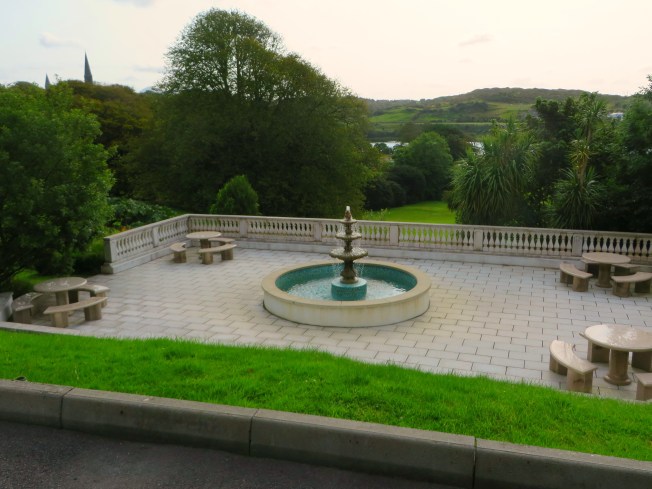
Because Mac’s people traveled a lot, I stayed with him multiple times a year. He slept in the middle of the king sized bed I slept in, nudged me awake at ungodly hours to go outside and police his yard, he’d jab at the back of my legs with his strong snout to hurry me along in his supper preparations. We walked on “his” campus at Earlham, where he was well known and strutted around, a sort of stately gentleman about town (when he wasn’t terrorizing squirrels). Though all the experts talk about how headstrong terriers are and how they should never be let off a leash, Mac was sensible, had been well-trained, and almost always came when called unless a particularly delectable rabbit was in the underbrush. His parents gave him freedom and full run of the campus, and so I let him off leash as soon as we were a safe distance from the road, and he would race around the paths and grass like a mad man. He delighted the students who were homesick for their own pets, treed every squirrel who dared step on his grass, scampered in the woods behind the main campus, and would attempt to sneak into the building where his dad taught. He and his three good dog friends—Lilly, Phoebe, and Luther—would occasionally meet there for a ramble, and he’d be so excited at the prospect of being with his little pack that he’d start howling before I’d parked the car and let him out to to tear off with them, happy to be with his own kind. A few years ago, my cousin came down to visit with her new, very teeny and adorable dachshund, and while we walked the campus, everyone oohed and aahed over little Zoe instead of the now greying Mac, who stood patiently while she was in the spotlight, reminding me of how I used to feel as an only child when other children were in my domain. Mac was tolerant of and polite to Zoe all weekend, but when he saw her and her mother drive away on Sunday afternoon, his tail wagged extra hard and he did two victory laps around the driveway, his only-dog status restored.

Favorite spot in the bed.

Favorite spot in the bed.

I’ve written here about his antics, his refined tastes for bottled water, how he’d put himself firmly between me and Z or between me and whatever new baby someone had dragged into his house to establish his ownership of me. He was clever and would play hide and seek with a bone: I would hide it, he would find it, he would hide it—walk me around the house, barking encouragement—until I found it. We’d do this for what felt like hours and he rarely tired of it. He often spent holidays with my family, so there he is in our Christmas photos and Easter photos, on the fringes of baby showers, wakes, reunions.

Ever hopeful.

Ever hopeful.

My friends with children had to regularly grit their teeth when they would tell me a story about their kids and I’d respond with a story about Mac, as if the child and the dog were equal entities. But he did feel like my baby. I was always looking for the toy that would please him and enhance his intellectual development, talking to him as if he were an adult human. I felt his shame the day he had a bout of gastrointestinal distress while on his campus walk and had to be brought home sitting in the backseat in a garbage bag, with just his head poking out, and then had to suffer the further indignity of having his backside scrubbed. I had to take him to the vet more than once because he wasn’t acting like himself, and I felt the anxiety that “real” pet owners and, I’m guessing, parents of human children, must feel whenever their own ones are sick and cannot say, “This is what hurts, you fools, FIX IT!” As he got older, I worried about his aches and his pains, how many more visits I’d have with him. In the five and a half years since I got married and moved across country away from Mac, I flew home multiple times specifically to stay with him because I didn’t want him in a kennel. Fortunately, Mom was often able to stay with him once I left town, so he did not often have many sleepovers with strangers. While in Seattle, if I met dogs on the street and stopped to scratch ears, I’d say to their owners without feeling like a liar, “I have a dog back home in Indiana that I miss so much.” Z and I added a leg to a trip to California specifically to visit him and his parents, who were wintering in Palm Springs, and we were rewarded with a lengthy “talk” from him that seemed to indicate his delight at seeing his extended human pack in a place he’d never encountered them before. On that visit, he proudly walked us from room to room, giving us a tour of his part-time home.

Photo credit: Susanna Tanner Photography

Photo credit: Susanna Tanner Photography

This is Mac with me and Z on our engagement photo shoot at the old train depot in my hometown. Does he look like he is not my dog? Does he look like he’d rather be anywhere else in the world? Is it crazy that I invited a dog that was not mine to share one of the most important days of my life a few months later? Oh never mind. These questions are rhetorical. I really don’t care what anyone thinks—it’s what I wanted and I have no regrets. Maybe it was a selfish thing to have asked his parents to bring him, to insist he be in my wedding without knowing if he wanted to do it. He seemed to like the attention that his red plaid bow-tie commanded and the treats that awaited him at the end of the aisle, but possibly it was overwhelming with too many people in too foreign a place. Yet he felt like part of my family and I couldn’t imagine the day without him.

The Best Dog

The Best Dog

Mac and I happened to be together five months after I got married when I was awaiting the news of whether a crappy diagnosis I’d just received was going to be survivable or would cut short my newly-wedded dreams, and he seemed to instinctively know that I needed him curled up beside me, and after awhile, when he felt I’d wallowed in sadness and anxiety long enough, he’d nudge me towards the door, we’d go for a walk, and I’d be reminded that none of us knows the measure of our days and so we have to enjoy each one as best we can. If dogs teach us anything, surely this is the lesson, over and over and over again.

IMG_0019

Louis CK says that when you bring a puppy home to your family, it’s really just a countdown to sadness. Which is kind of what this blog has been. Mac turned thirteen in January, and lived twice as long as any of his owners’ previous Scotties. Because he had a brindle coat, people had been accusing him of being an old dog when he was still young, but he had gotten greyer, deafer, and finally, sick. My mother got to visit with him one last time yesterday, and I am both sad and relieved that I was in Seattle and so didn’t have to say goodbye this morning before he was sent—as Pa Ingall’s tells Laura in By the Shores of Silver Lake about Jack, their brindle bulldog—to the happy hunting ground.

In other things I cannot properly name besides those relationships that mean the most to me, I’ve never been a willing namer or acceptor of death. Maybe it is my Christian upbringing. Maybe it is simply denial. But in my mind, my father is still playing golf somewhere in Dayton, Ohio, and has just refused to get a cell phone thus rendering himself temporarily unreachable. All four of my grandparents and an amazing step-grandmother who lived to be 99 can’t figure out the computer to send emails. Eventually, we’ll be in each other’s company again, I think to myself, as I go about my day after a memory of one of them flashes into my consciousness. This separation is only temporary. It’s unfathomable to me that I won’t see my dearly departed again, so I refuse to attempt to fathom it. On days like today I’m not sure if belief in an afterlife is a matter of faith or stubborn refusal to face facts, but I’m glad for the faith or the stubborness that dwells in me and makes some future meeting a possibility.

As far as I am concerned, Mac is chasing squirrels, awaiting his next treat, anxious to play hide-and-seek, ready to fight me for the dead center of the bed,  and letting out a howl of glee when he sees Lilly, Phoebe, and Luther.   Maybe I can allow for this scenario because I am not the one looking at his empty dog dish or his toy hedgehog, never to be retrieved from his  basket again. Maybe this is the true signifier that he was not mine. My grief is large, but for his parents, it is larger.

Thirteen years ago when his parents asked if I’d be willing to watch the puppy they were considering, would I have answered any differently even if I’d known then how the absence of a little dog with a big bark could wreck me? Of course not. How lucky was I that they let him consistently be  in my life and seemed tolerant of what they must have always known: that in my heart, he belonged to me.

The Ill-Planned Grand Tour, Part VI: A Little Irish Anxiety

Standard

IMG_4677

Before Z, there were other loves. Z and I do not speak their names because he is a jealous husband in the best kind of way, and though I am perhaps more curious, he knows at heart that I am wickedly jealous myself. He is a Scorpio (“jealous” being one of the main descriptors in your better astrology books) and I have a Scorpio Rising and a Scorpio Moon (“double jealous,” I guess), so it is an arrangement—burying our heads ostrich-style to the pre- Beth & Z past—that works well for us. It probably works best for me because Z does not write personal essays or keep a blog where he occasionally feels an urge to mention some former object of his affection. He is also not confessional by nature, whereas I, well…you’ve read me. I might not tell you all my details over lunch, but somewhere, they are being typed into an essay or post.


There is one photo of him going to a formal dance in high school with, he tells me, “a family friend”, and I’ll admit it, I hate that girl whenever I see that photo. She’s probably a lovely person and could now, easily be my daughter, but I can’t help myself. (Frankly, when he tells the story about the six-year-old twins who used to fight over who got to carry his school bag when he was in first grade, I don’t much like them either.) So I’m not really sure how Z handles it when I accidentally mention an apartment in Chicago I used to frequent in my twenties where my art-student boyfriend lived or how Z felt the night we watched a documentary about the famous-ish brother of my high school boyfriend, and there, in the middle of the show, said boyfriend appears looking uncomfortable in front of the camera, staring through dark sunglasses right into our living room.


Irish Ferries Club Class which looks the way I imagined the Love Boat's Lido Deck.

Irish Ferries Club Class which looks the way I imagined the Love Boat’s Lido Deck.

But this is all old news. Z and I are all about being in the present moment, and the present moment has Ireland on the horizon. As Z and I board the ferry in Holyhead and the horn sounds as our three-and-a-half-hour journey across the Irish Sea commences, I have butterflies in my stomach. My palms are sweaty. I get ratty with Z while we try to find the Club Class area that we paid extra for so we’d have free wi-fi and complimentary snacks. Z looks at me bewildered. We’ve had a lovely trip so far in England and Wales with none of the tiffs or dramas other couples might expect, and we’re about to start the last two-week leg of it—the part certain to be the best from my Irish-American perspective—and I’ve turned into a shrew. I bark at him as he (ineptly, I think) reads the ship map to try to locate this Brigadoon of spaces on the ferry, a place no elevator nor staircase seems to want to take us. I stomp around. Roll my eyes. Huff. We can’t get to Ireland fast enough and somehow it seems he is impeding our progress, even though he is not piloting the ferry. In the end, his “inept” reading is correct and he ushers me into the quiet, sparsely populated club room, and we settle into a comfy booth at the front where a vast bank of windows gives the impression that we are at the world’s best drive-in movie. I take a few deep breaths. It doesn’t take long into our three-and-a-half hour journey before a grey silhouette of Ireland comes into view. My eyes fill.


I met Ireland for the first time when I was 32. My college friend, Anaïs, and I booked a week there without knowing much about it other than we both had some vague family ties there, both listened to U2 and Sinéad O’Connor, and had read Ulysses together in a college Modernism class, taught by a bore of professor who refused to let us read any female writers because he didn’t believe any women had written anything worthy of being studied. We also both liked the idea of Guinness. At the time, I’d recently begun writing letters to my paternal grandfather’s first cousins in County Galway who farmed the land where my great grandmother grew up, and the only real itinerary Anaïs and I had, other than a vague plan to go to Dublin and Belfast–the only names on the map we really knew–was to get ourselves to Galway to meet my kin.


I don’t know when I fell in love with the place exactly—whether it was love at first sight or if it took a couple of days, the whole week. Nor do I remember the catalyst: did the light hit it just right when we were riding on a bumpy bus through Connemara or was it the smell of my first peat fire or the sound of the voices? Regardless, I fell deeply, madly in love with the place. I’d spent the whole of my adult life thinking what was missing was the perfect boyfriend or an acclaimed writing career, but what had actually been missing was an entire country where for whatever reason, I felt most myself. On that first visit, I stood in the ivy-covered quadrangle at the national university in Galway and vowed that I’d take classes there, and two years later, I did: studying Irish poetry, scribbling  some halting poems of my own, but mostly, loving Ireland up. Two years after that, I brought my half-brother over to celebrate his 21st birthday, then my mother, then I attended a writing workshop at a haunted castle, a spring break with my friend Belle, and so on.


I was hooked, body and soul. I studied the history, read the literature, taught classes on it, carried Edna O’Brien’s suitcase through the Denver airport after an Irish-themed writing festival in Aspen and thought—all the while trying to make clever conversation with her—“this suitcase is going to Ireland”(only it wasn’t: Edna O’Brien lives in London). The only way I could talk about Ireland was with the over-exuberant language of the infatuated, which shamed me because it made me seem like just another American with an idea of Ireland in her mind (leprechauns and rainbows and Aran knit sweaters) who could just as easily be talking about any vacation destination. Like a teenager whose parents believe she just has a crush, I wanted to stamp my foot and shout, but you don’t understand—this is real! Even so, if I heard a commercial for the Irish tourism board come on, I stopped what I was doing and stared at the television, haunted that it was playing “our” song by the Cranberries. I listened to heart-wrenching Celtic music and wept for no real reason. I refused to wear any perfume but the sweet Irish lavender I special ordered, and every day when I dabbed it on, I’d be transported to what felt like the life I should have been living.

Irish Ferries ferry

Irish Ferries ferry

As Z and I watch Ireland get closer—stuffing our faces full of free fruit, muffins, and Jacobson’s crackers—I am conflicted. On the one hand, I cannot wait to be reunited with my beloved. On the other, Z is my beloved now, and I am afraid he will not share my affection, will not like the idea of Ireland as a sort of sister-wife in our marriage, afraid he will point out all the ways it is sub-par (the showers are almost always more complicated than they need to be for starters), afraid he’ll see me differently after meeting the place: who is this woman with the irrational obsession with a somewhat grey and rainy landscape?


And also, my last tryst with Ireland was not my best. Six months before Z and I got married, I spent a summer residency for my MFA program in Dingle. I was without my normal klatch of friends and with, instead, a group of people I didn’t know. I’d just said goodbye to Z for the entire summer, and I was so homesick for him that every morning in the half-light before workshops started, I’d walk half a mile to a phone box to call him in Zimbabwe for a few minutes just to help me get through the day. Furthermore, though I kept it to myself, I was having issues with shortness of breath and vague chest pains that I now know from a slightly disgruntled nurse were not “mini heart attacks” but panic attacks about the impending nuptials and move across country. In other words, I was not fully present for Ireland, and Ireland knew it. After the residency, I met my cousin and her daughter at the Shannon Airport to introduce them to the country I loved, but something was off. None of us were as bouncy and excited as I imagined we’d be, swilling Guinness at trad sessions, traipsing through monastery ruins, standing over the bones of our great great grandpeople. We were glad to be together, but we all had our own internal wars being waged though on the surface, all was well.


I was relieved to get back to America after that last trip, and I don’t even remember saying a proper goodbye to Ireland or any promises to return soon. The best I can compare it to is a romance that you know is faltering and you aren’t sure if it is worth fighting for or if it should just become a shoebox full of memories. Maybe my time with Ireland was over. Maybe my head had been turned too much by Z, by the mystery of Zimbabwe that was now on my radar.

Dublin from the Irish Sea

Dublin from the Irish Sea

As Dublin gets closer, Z squints and says, “But where are all the buildings?” A week ago, we were in London with a skyline so bizarre and full of both tall buildings and cranes making more tall buildings, that Dublin’s low-to-the-ground profile must be a surprise to him, and I feel instantly defensive of it, but also disappointed that it is disappointing him before we’ve even landed. The only thing we can really see are the twin smokestacks of the Poolbeg power station, but already my brain is seeing the Liffey as it moves through the docklands and goes under O’Connell Street, the country as it stretches west towards the place that is always my destination: Connemara. My gut clenches. If Z is disappointed before we’ve gotten off the ferry, how is he going to feel about the rural bits I love where there is nothing much but sheep, rocks, a pub, and the random “Up Galway” banner? I send a sort of prayer across the remaining expanse of water directly to Ireland: Please be good to Z, I implore. I need for him to love you a little. For me, that is what is on the line here: if we have a bad time, if Z does not take a fancy to Ireland, this could conceivably be my last trip to a place that has felt like my heart’s home for nearly twenty years.


When the ferry docks, it takes forever for us to be let us off the ship, and the anticipation and anxiety builds. Finally, we work our way through customs, as usual, a process that is quicker for me with my U.S. passport than it is for Z with his Zimbabwean one but even so, within fifteen minutes we’ve gotten our passports stamped, our luggage collected, and a taxi hailed. I sit forward and peer out the window, like some kind of over-eager Labrador retriever. As the cab moves through the docklands, I look for the spot where ten years ago Mom and I walked in the dark of the night with a Swedish woman we’d just met to U2’s recording studio; this unlikely trio of groupies stood outside until nearly midnight, hoping to get a look at the band. We heard them recording songs for the next album, saw Bono’s wife drop someone off (not Bono), and caught a glimpse of the top of Edge’s knit cap when he stuck his hat out the door, but that was the extent of that night’s adventure. Now, the docklands look quite different. They seem more vertical than the last time I was here, less tatty. As we move into the city center, I have to ask the cabbie the name of the two new bridges that are crossing the Liffey: one, the Samuel Beckett Bridge, which is lovely in that it looks like a harp but strikes me as something a little too Irish for Beckett himself to approve of, and the Rosie Hackett Bridge, which is named for the founder of the Irish Women Workers Union and which pleases me more even though the bridge itself is no work of art. Z peers out the window; it’s all new to him.


I ask the cabbie, “What else has changed in Dublin in the last six years?” (How can six years have passed since I was here?). He sighs at the traffic jam we’re tangled in because the semi-final for the Gaelic football game just ended in a draw—fans pour into the street, most wearing Dublin’s light blue, but a few in the red and green jerseys of Mayo, both sides celebrating, sure their team will win the re-match in a week—and he chuckles, “Nothing much.” The Angelus bells start to play on the radio, which he turns up and we sit quietly there in traffic, penitently waiting as each bell strikes, despite the cacophony outside the cab as the revelers revel. After the last bell chimes, he turns the radio back down and explains that he’s going a roundabout way to our hotel to try to get through the crowd, and it pleases me that I am familiar enough with this little hunk of the city to know he’s not padding the fair and is getting us there as best he can.

The Liffey

The Liffey

Our hotel sits on Bachelor’s Row, just across from the River Liffey, and the city tugs at me before we’ve ever checked into our hotel. In the mere day and a half we have in Dublin, I’ll drag Z to my favorite spots—touristy, all, but I will be an unapologetic guide. I march him up to the General Post Office (GPO) and force him to admire the bullet holes still in the façade from the 1916 Easter Uprising that—in an overly simplified blog-sized history lesson—was the beginning of the Irish Republic. (Think July 4, 1776 in Philadelphia, only with gunfire and men shortly to become martyrs for the cause of independence.) I never come to Dublin without buying stamps here, even though there’s now a machine outside built into the building façade where you can make your purchases. I like being inside, imagine the noise and the barricades and the smoke and people willing to die for a little freedom.

The G.P.O. always makes me start humming rebel songs.

The G.P.O. always makes me start humming rebel songs.

From there, we head to Trinity College, another of my regular pilgrimages. The campus is beautiful—a walled respite in the heart of the city—but the real reason I’m there is to see the 800 A.D. illustrated gospels depicted in the Book of Kells on display there. Every day, a page is turned, so though I’ve seen the scrolled letters and intricate knotwork that decorate it six or so times, I’m always seeing something different. What is always the same, however, is the disorganized crowd of people around it, all jockeying for a prime spot right in front of it. It’s a frustrating labor of love when it’s just me, but because Z is here, I want to push people out of the way so he can have a few precious minutes admiring the craftsmanship. Finally we, push our way into position and refuse to give up ground until we’re satisfied that we’ve properly admired it.


My annoyance with tourists around me (always “they” are tourists, whereas I see myself as having some divine right to be there) disappears as we climb the stairs that spill us out into the Long Room of the Old Library. It smells of books and knowledge and mysteries unsolved. Though it takes my breath away, I normally walk through it quickly after a few cursory photos that simply cannot capture the vastness or atmosphere of the place because I am gift-shop bound. But on this trip, Z and I are not in the market for trinkets, so we linger over each case, read the placards hanging up for the display about myth and folk tale through the ages. We sit on a bench and soak it all in, and it is, no contest, my best ever visit to this library because I am just there and not anticipating our next move or the Book of Kells tea towels and key rings calling out to be purchased downstairs.

The Long Hall

The Long Hall

We do the other things you do when in Dublin: we wander down Grafton Street, which is a shopping area where buskers are often attracting attention with their songs or puppet shows; we try to pick our favorite of the distinctive Georgian doors on the townhouses that surround St. Stephen’s Green; we meander through both St. Stephen’s Green and Iveagh Gardens in the rain, exclaiming about the beauty, the dampness, the half-breed Scottish terrier that defies description in that it is equal parts cute and hideous.  In Iveagh Gardens, we traipse around a hedge maze, though the hedges have not yet grown much higher than our knees, and we are perplexed when we get to the center and find a sundial, which seems a useless thing to have in a shady park in a climate that tends toward cloud. We search for an ATM that isn’t opposed to Z’s bank card to no avail, and then briefly wonder what the rest of our trip might look like without cash in hand. I convince him—as I have convinced others—that’s there’s really no need to go to the Guinness Storehouse because it’s gotten too chic and sophisticated since my first visit, when it still felt kitschy. We eat Mexican, Italian, and a full Irish breakfast. We saunter around the Liffey, stand at the peak of Ha’penny Bridge and watch the night lights dance on the water.

The Liffey

The Liffey

Both nights there, I drag Z through Temple Bar looking for the Ireland v. Zimbabwe rugby poster I had seen in a pub there in 2003 that felt cosmically placed specifically so I’d remain focused on him despite the fact that my confession of love had fallen on his somewhat clogged ears just a month before. I had visions of taking a photo of 2015 Z standing next to the poster as a sort of triumphant conclusion to my earlier, more forlorn and very single trip, but alas, the poster is nowhere to be found lo these twelve years later, and though the most likely reasons are the pub in question has redecorated or I had taken too much drink the night I saw it because it was my half brother’s 21st birthday and only ever imagined it, I’m convinced it was one of those weird synchronicities that only Ireland delivers where you see the thing or meet the person or hear the bit of information that you most need at that very moment. And certainly that poster and a few other of these mystical occurrences on that 2003 trip kept me hot on Z’s trail even though he’d tried to gently put the kibosh on my love.

Temple Bar, where IS that poster?

Temple Bar, where IS that poster?

I regret that we have budgeted only two nights in Dublin. Though Z has professed to like Ireland, I hear an unsaid “so far” in his voice that worries me. As me make our way to Heuston Station with our mountain of luggage so we can head to the western edge of this country I love, I begin to worry again. What if after Dublin, the rest of Ireland will pale in comparison? What if he doesn’t fall in love with Galway’s twisted streets and Spanish Arch and raging Corrib River? What if he sees Connemara as a rocky sort of wasteland? What if he doesn’t like my cousins? What if, what if, what if…?


Like the ferry ride two days before, as the train lumbers through the Midlands towards Galway, my anticipation of arriving in my favorite bit of Ireland begins to override my fear that Z will not fall in love. My throat constricts as soon as we are out of the city and the countryside and villages speed past the window. As the fences surrounding the rolling pastures begin to change from wire to stone, as the sheep become more plentiful, as the train stops are names more familiar to me: Ballinasloe, Attymon, Athenry, it seems likely that I will come unhinged with excitement. I will never understand why Ireland affects me this way, and still does after all of these years, but I am glad for it. I want Z to love this place as much as I do, but as we pull alongside the estuary that spills into Galway Bay, I begin to believe that even if he hates it—and why would he anyhow?—my ardor hasn’t dampened. It is still mine and I can love it enough for the pair of us.

Iveagh Gardens

Iveagh Gardens