Category Archives: Travel

Reading Between the Lines

Standard

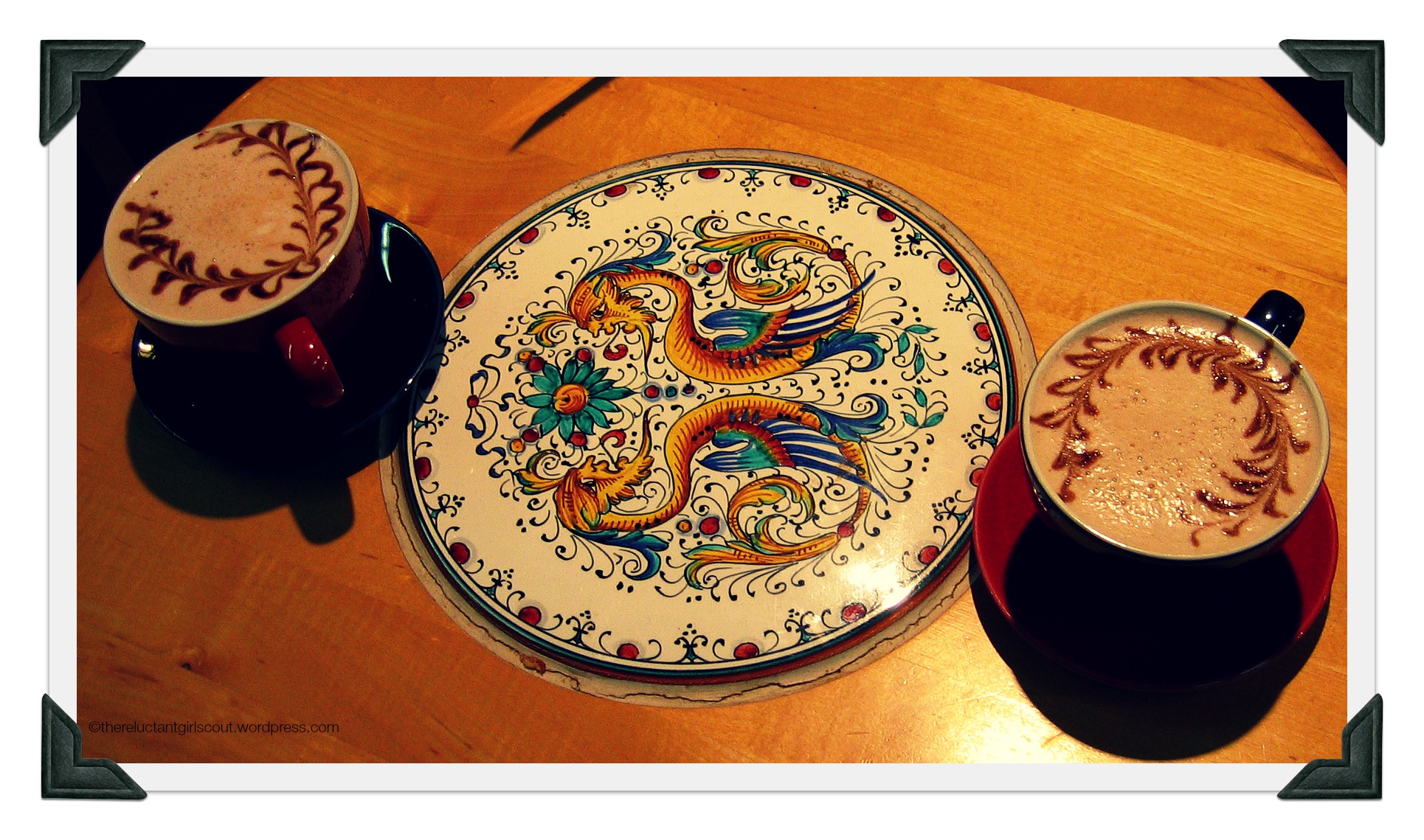
cocoa

Today, my only job in the whole world is to make edits to an essay I wrote on Joan Didion’s “Goodbye to All That” so I can resubmit it to a nice editor at a new journal on the study of creative nonfiction.


My. Only. Job.


I do not have to do dishes. Laundry can wait. I have no tiny noses or bottoms to wipe, and Z will not be expecting a four-course meal when he gets home from work (mainly because he knows I can’t cook). My editing projects are either done or not ready to be started.


No one is expecting me to finish a TPS report at the office. There is no office.


More specifically, this job is not even a complete overhaul of an essay. The editor said after the first five pages that my essay “roars.” I don’t exactly know what that means except “to roar” sounds like the opposite of “to suck” so apparently most of the essay is on the right track, which means 13 pages of it are okay. Maybe even good. But those first five pages? Meh. I’m not bitter about this criticism. I’m a big fan of revision. But I’m clueless as to how to fix these pages, never mind on any given day I write five page emails to Jane before my eyes are fully open. (Tuesday two weeks ago was extra easy because we had a lot to say about Reneé Zellweger’s surprising new face).


Also, I’m sitting in the café at the Elliott Bay Book Co., a place I normally delight in. Everywhere I look there is someone on a laptop that looks like mine, though with cool ironic stickers that I’m too chicken to put on my own MacBook, and none of these people appear to be blocked. In fact, right this minute, I’m just paranoid enough to believe that every one of them to a person is also writing about Joan Didion and doing it far better than I ever could.


I’m realizing now that writing in a bookstore is not good for my psyche. I can see all those books on the shelves, with all their perfectly published words, taunting me. What’s your problem? they seem to be saying. Just get it done.


But I can see this writing day for what it is: over. Instead, I’ll tell you about other words on a page that came somewhat easier and had recent fruition.


Back when I was just giving up on my quest to earn all the Girl Scout badges ever, I started reading teen magazines. My favorite was ‘Teen, which had very informative columns that offered advice on love and friendship and sex. I also read Seventeen, though I found its fashion advice dubious because it was too avant-garde for Richmond, Indiana. (Sweatshirts paired with skirts weren’t happening yet, and I could never believe that red and pink should be worn together—colors should be complements and shouldn’t be reminiscent of Valentine’s Day.) In one of these magazines, you could send in your name and address and be paired up with a pen pal.


It wouldn’t be my first pen pal. Mom had carefully arranged for me to have a Swedish one because she had had a Swedish pen pal when she was my age and she felt they were superior (and there was a lovely array of Swedish candies and doo-dads that got sent my way on the holidays from Cecelia—so, good choice there Mom)! Through a Trixie Belden fan club, I’d acquired a fun-loving girl from Colorado whose dachshund Barney I was jealous of (I lived in a “no pets” apartment with a “no pets but fish” mother). Through school, I acquired a West Indian, and two Canadians, one of whom seemed to delight in copying out sexy passages from trashy novels I wasn’t yet cleared to read and another who sent me a photo of herself with a goat. The most exotic was Glenda from Zambia, who came via the TV show, Big Blue Marble. I loved getting her thin, light blue airmail envelopes and reading about a world so different from mine that it could hardly be imagined. With Glenda, I was concerned that she was in danger of being murdered by Idi Amin because I didn’t fully understand the vastness of Africa (or even that Africa wasn’t a single country). After a few months or a few years, all of these pen pals and I developed differing interests and the letters got fewer and further between until they disappeared completely. I tried reconnecting with Cecilia a decade ago and managed to find her, but she admitted her English was not what it used to be and since I had not learned Swedish, there was nowhere to go with the old friendship except fond memories of her colorfully decorated envelopes and the Carl Larson inspired life I had imagined her living.


But my teen magazine pen pal, C., from a province in Canada that was roughly above my head (how I thought about geography in 1980, sadly no joke), was something different. We were a good pairing: both introverted, goodish girls, book-inclined, and studious. We wrote each other dutifully about the classes we were taking, the books we’d read, the music we were listening to, and for some reason a tradition that has stuck ‘lo these many decades, a list of Christmas presents received. Our letters might have become less frequent as we got older, but we both made an effort to write at least at Christmas to check-in. In retrospect, I think it was my first experience with what would later become a weird sort of computer-age norm: talking to a total stranger about your life and developing this odd sense of knowing them even though you’d never really met them.


Five years ago when Z and I were compiling our wedding guest list, I have no idea what made me ballsy enough to send an invitation to someone I’d never actually met. Who does that? But it seemed weird not to send C. an invitation when technically, she’d been my (pen) friend longer than any of my real life friends who would be there. I never imagined that she and her husband would brave the winter roads to come to our December wedding, but they did. I’d like to say that as soon as we saw each other it was like we were reunited long-lost friends, but the truth is, there were a lot of people at the wedding, my tiara was cutting off my circulation, and I’d had too much to drink to be a proper good hostess. I did, however, feel honored that they’d come, and because I am the sort of person who is often in awe of other people, during a few of my more “aware” wedding moments, I was envious of her sophisticated dress and the ease with which she and her husband glided around the ballroom. (Z and I had exactly one dance move that we put on repeat for the duration of our first dance.)


Last week, C. and her husband incorporated a visit with us into their travel plans to the Pacific Northwest. She texted me updates as they—more adventurous than we have ever been—hiked Mt. Rainier and through the Olympic National Park and ate meals that my bland, 4-year-old-inspired palate would not even consider. We met them for dinner in Belltown on the first night, and I admit while I was excited at the prospect of actually getting to spend time with the real person, I was also wishing there were some sort of pill I could take that would give me an evening’s worth of extroversion and gregariousness. C. and I are clever introverted women, however, who married men with communication skills, so they got things rolling for us, and soon it did not feel at all like strangers meeting for dinner. This night turned into two more meals together during their time in Seattle and some good conversation.


The thing that most struck me after we’d said goodbye on the last day of their visit was that I was saying goodbye not to a new acquaintance but to an old friend. C. was exactly how I’d imagined her for all these years, not because I’m wickedly intuitive but because she’d represented herself so well in the letters she’d written over three and a half decades. I knew what she looked like from photos and our brief interactions during our wedding weekend, but I wasn’t at all surprised by those things you shouldn’t be able to tell about someone you’ve only ever corresponded with: how she carried herself, how she spoke, her quiet but quick wit, the way she and her husband interacted. I felt what can only be described as deep affection for the pair of them–these “strangers”–as they walked down our steep hill towards the lightrail that would carry them  to the airport and then back home to Canada.


If you ask me, telling yourself true is the best writing any of us can do.


Betty MacDonald Had a Farm, E-I-E-I-O

Standard

RGSSketchBook

Mom is visiting us for three weeks, and to celebrate her birthday, Z and I decided to treat her to an overnight on the farm of one of her favorite authors. Betty MacDonald wrote The Egg & I, her memoir of time spent on the Olympic Peninsula raising chickens, in 1945. A movie was made from the book and starred Fred MacMurray and Claudette Colbert and was followed by a string of “Ma and Pa Kettle” movies that were based on back woods characters Betty described in her book. (She was later sued by people who believed she had based the unflattering but beloved Ma and Pa on them). Though I’ve never actually read this particular book, I grew up feeling like I knew the author. Mom was often reading passages from one of the books and telling me anecdotes from Betty’s life as if they were old friends. (The author died in 1958.) I did, however, read her series of Mrs. Piggle-Wiggle books, which I was convinced were the American answer to Mary Poppins, so I had my own “Betty love” going on.


When Z and I stay somewhere, we study the descriptions and photos on VRBO and airbnb as if we are buying the property instead of just staying there for a night or two. I’m pickier than he is and because I’m what they call a “Highly Sensitive Person” I’m affected negatively by ugly things or dirty things or even spaces that seem too much to belong to someone else. My ideal spot to stay is one that looks like one of those little IKEA display rooms, where you can imagine living your life without having to think about how anyone else has maybe trimmed his toenails on the sofa.


So when we’re looking for a weekend getaway, Z will often find a spot he thinks looks perfect, but I’ll see a throw pillow with a color scheme that makes my skin crawl or a poster of an eagle on a back wall, and I’ll insist we keep looking. I can’t express this enough: I am not a princess. Really, I’m not. But I have a lot of feelings and other people’s things affect how I feel and when I’m on a little vacation, I don’t want to have to deal with turmoil inside of me just because a chair is scratchy or there is bad lighting. I had to quit going into antique stores a few years ago when I realized I always left depressed and a little obsessed about how wasteful and tacky we are as a people. So online photos of potential digs have to give me a good vibe before I’ll send the payment information.

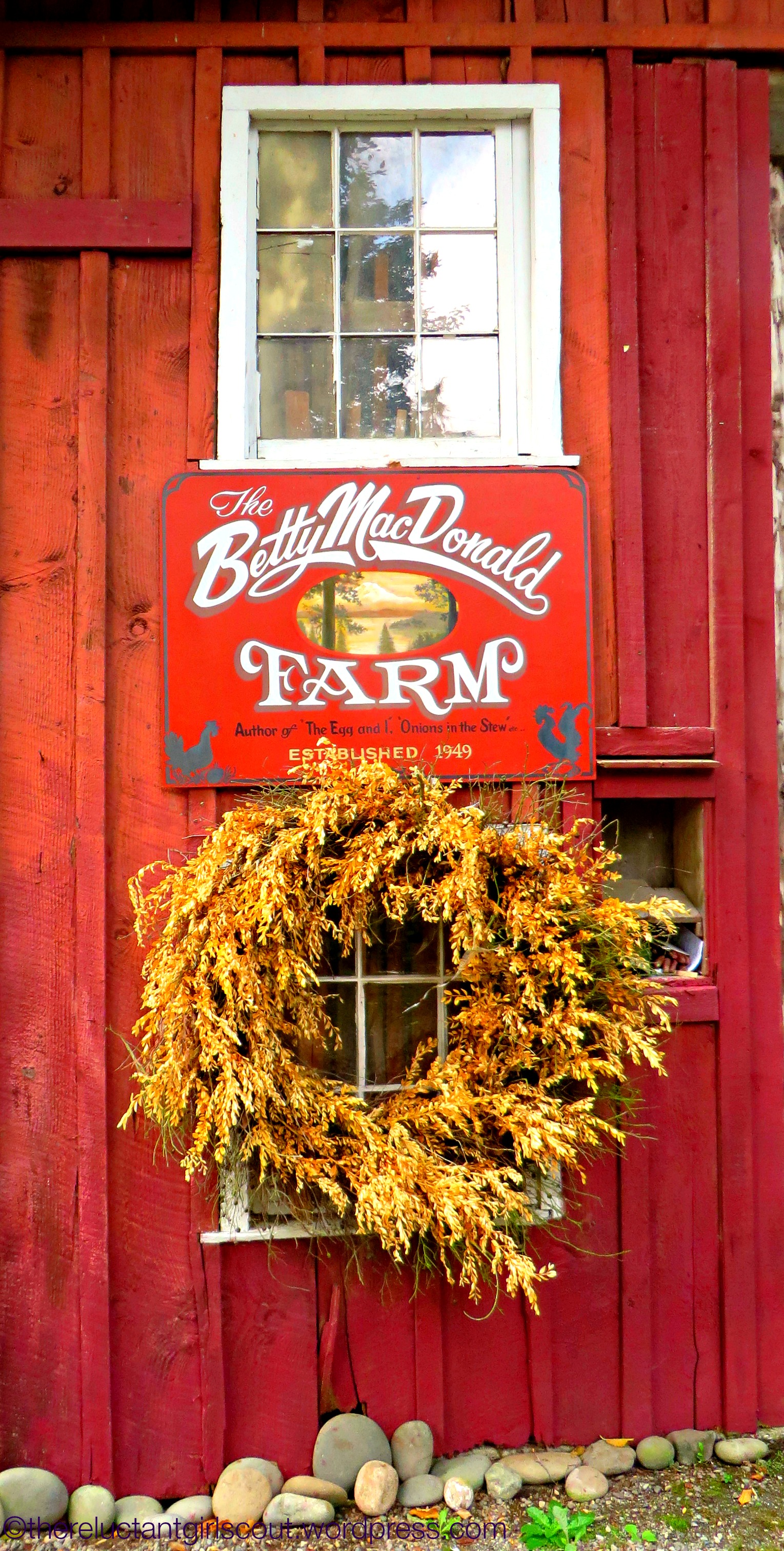
rgsbettymacdonaldfarm

The Betty MacDonald Farm Bed and Breakfast website has a few beautiful photos, but it’s a little short on specifics. So when Mom and I arrived after a twenty-minute ferry ride from West Seattle, we didn’t know what to expect. Finding it felt like an adventure in itself because we weren’t exactly sure where we were going and other than a very generic “LODGING” sign on the main road with an arrow, Vashon is not a neon-light or billboard sort of place that will direct you anywhere. You “discover” things on the island, which is part of its charm. Other things you will discover: quiet and an easy slowness that would be honked out of existence in Seattle.


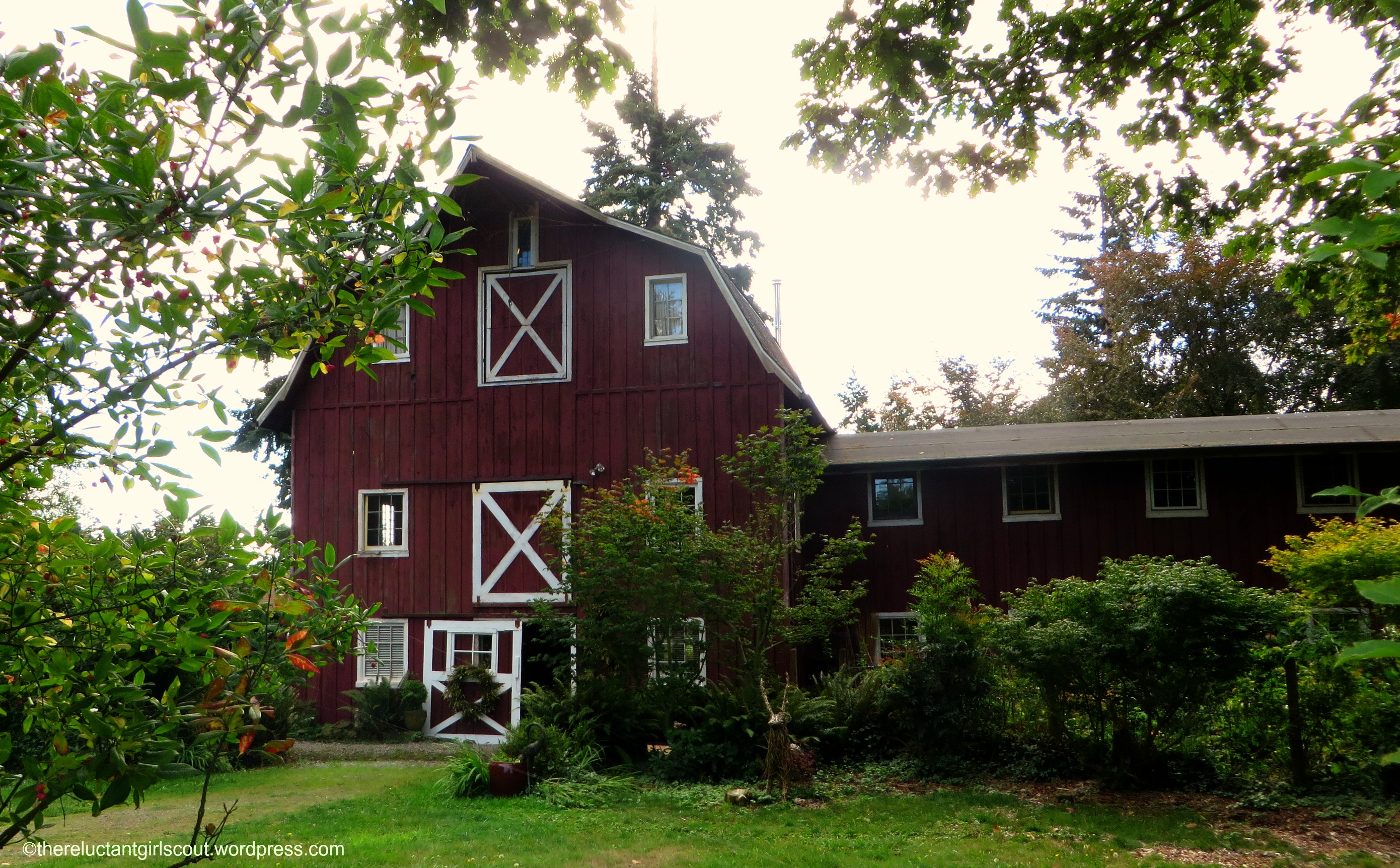
We were greeted by the owner, Judith, who gave us brief directions up to the third story of the barn and a warning to shut all the doors to keep the animals out, particularly a mother raccoon and her babies who had been trying to find some indoor accommodations. Mom and I hauled our bags up the multiple stairs, and as I was dragging my stuff up, I was thinking, “Oh, geeze. We’re staying in a barn.” Now, it was clear from the website that we’d be staying in a barn, I had specifically made a reservation and paid to stay in a barn, but somehow in Seattle I was imagining something less barn-y. No spiders, no feeling of the hundreds of chickens that used to live there, something in the shape of a barn but with dry-wall and track lighting to illuminate my way. (Before you judge me, please re-familiarize yourself with my camping adventures through the ages here and here.)


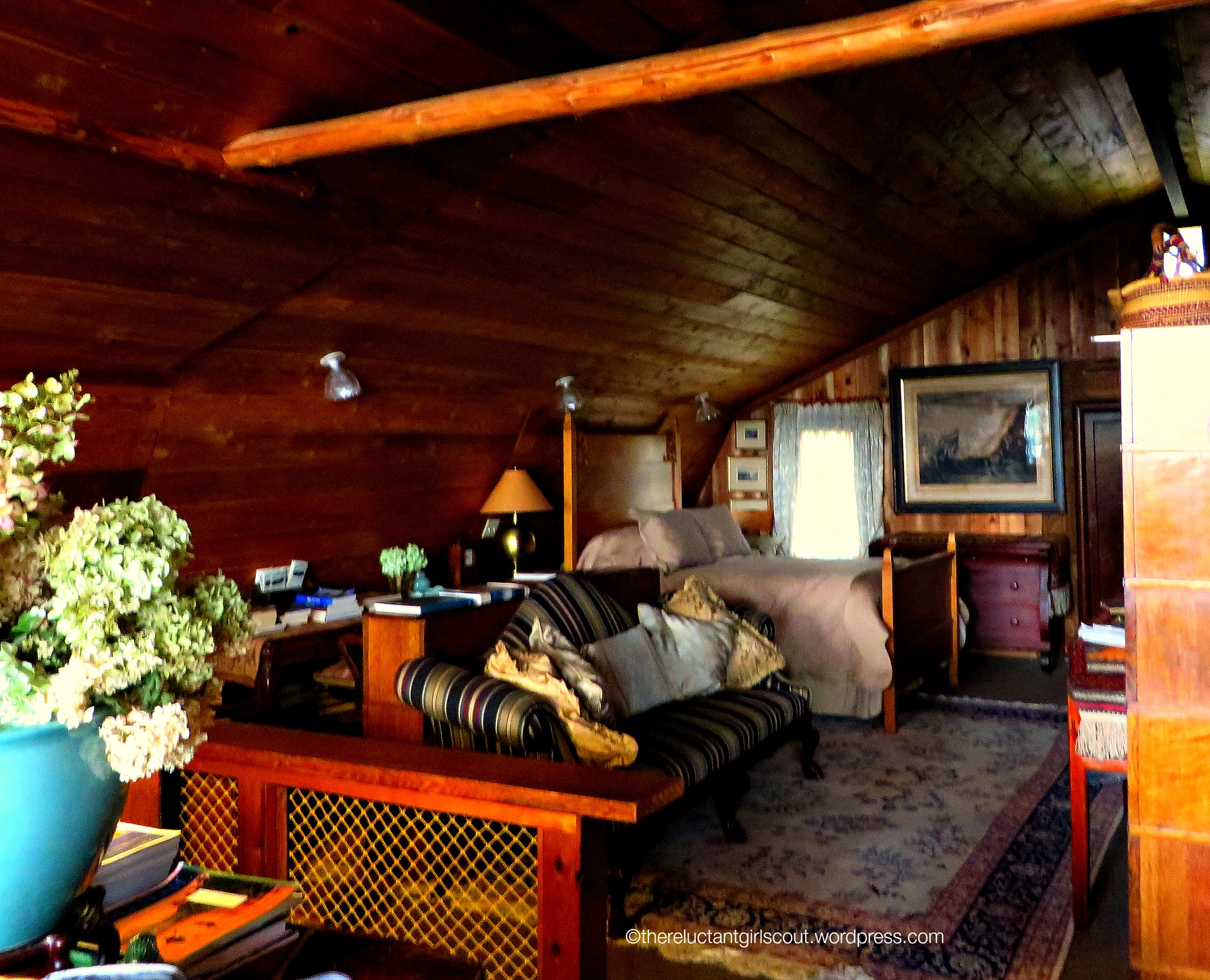
And then we popped up into the loft and we instantly moved from “barn” to “antique store.” The loft was vast as it was literally the barn loft that went from one end of the three-story barn to the other in a big open space. It held a full kitchen, an antique bed, various gorgeous bits of tables and chests and bookcases, this giant dual-couch construction made out of wood and covered with woolen carpets that looked like it belonged in a bunk house on the range, a wood stove, and a table laid out with Spode for our meals. There was not a horizontal surface that wasn’t covered with books, and the bookcases were all full as well. Good books. Books you wanted to lose yourself in, or at the very least flip through and then order a copy for yourself. The couches faced the wall of windows, which overlooked the six-acre farm, Puget Sound, and the idea of Mt. Rainier that was out there under the cloud cover.


rgsmacdonaldloft


Initially, I sat on the sofa staring at the view with my lips pursed, uncertain if I should be pleased or disappointed. The bunk house couch was surprisingly comfortable. The view couldn’t have been better and I loved being in this “writerly” space, but there was absolutely no way for my highly sensitive brain to pretend that this place was the blank canvas of a slicker vacation rental cottage. There was absolutely no way to imagine that it was my personal living space because it was so filled with the owner’s belongings. So I kept sitting there, thinking.


Mom was excited, soaking up the view from the balcony, as well as a good bit of weather since it was misting a little bit. When she finally had to come in because it got too wet and cold to reasonably sit outside, she started foraging for books, creating a huge stack in front of herself, and then curled up on her section of the bunkhouse sofa and started reading.


Imagine Mt. Rainier in the distance. We did.

Imagine Mt. Rainier in the distance. We did.

The books were too hard to resist. My lips un-pursed a little. I got my own stack, and we spent the night reading and talking, and never did get around to watching The Egg & I video that the owner had at the ready should we want to steep ourselves in Betty MacDonald’s life a little more.


I’m not sure when exactly the scales in my brain tipped towards “pleased.” The quiet and view certainly worked some magic on me. And the sheets in the little bedroom helped because I’ve never felt anything so soft and crisp (except for the impossibly fluffy towels that were waiting for us in the bathroom, along with robes and African baskets filled with everything we could need to pamper ourselves). Possibly the fact that Mom, who was on the other side of the door sleeping in the main loft got momentarily freaked out because something was on the roof, and then we fell into hysterics like we were at a slumber party when we realized the sound she heard was not the mother raccoon trying to break in but was really just me turning the pages of a Country Living article about Corbin Bernsen’s house.


No, I think it happened well before that, when I was looking at all the stacks of books, and all the little nooks and crannies where you could cozy up with a book or a writing pad. It is hard not to hanker for a good reading and writing space, and this one was the best. The place is too unique to turn your nose up at it. Plus, it was clean and our every need was anticipated. By the time I fell asleep I felt like I was spending the night at my grandmother’s house, cozy and well-cared for. And when I woke up the next morning after a perfect night’s sleep on a very comfortable bed, I felt sad that we’d only booked the single night.


Mom and I sat on the porch the next morning so entranced with the view and the books we wanted to skim before leaving that we failed to shower and make ourselves breakfast. Showering and eating could happen after check-out time when we’d made our way back to the grit of the city. (Z would be none the wiser about our slovenly choices because he’d still be at work.) We begrudgingly packed up our things, tidied up after ourselves, and trudged down the stairs to the car.


The Betty MacDonald Farm B & B

The Betty MacDonald Farm B & B

I made my way over to say hello to the adorable Irish terrier who lives on the property and ran into Judith. I asked her a few questions about the farm and the island, and she started what turned into a fascinating history and horticulture lesson. Mom joined us, and an hour later we knew how to get a start of hydrangea, more about Betty MacDonald’s life, more about the history of the island, the personality of Irish terriers, and the property itself. We even got a peek of the cottage on the ground floor so we could see if we’d like to stay there in the future. (It was cozy too and called to us, including a beautiful old claw-foot tub, perfect for reading that was situated in the bathroom surrounded by windows so you could read, sip some wine, and stare at the Sound and Mt. Rainier. If we ever tried to book a weekend there and couldn’t get the loft, we’d be perfectly happy in the house.) It was the perfect ending to a delightful 24 hours.


By the time we climbed into the car and made our way back to the ferry, I was solidly in love with the place and wondering when we could come back. I’ve no doubt that there are people who arrive on the farm and don’t adjust to its quirky self and wish they’d stayed in one of those IKEA-furnished cottages where everything is new and personality-neutral. But for me, I was glad I was able to hit the pause button on my own peculiarities and enjoy the gorgeous peculiarities of the Betty MacDonald Farm B & B. I sincerely doubt that I’ll ever find another place like it, and isn’t that what we should be out here doing? Acquiring unique experiences instead of the cookie-cutter ones?

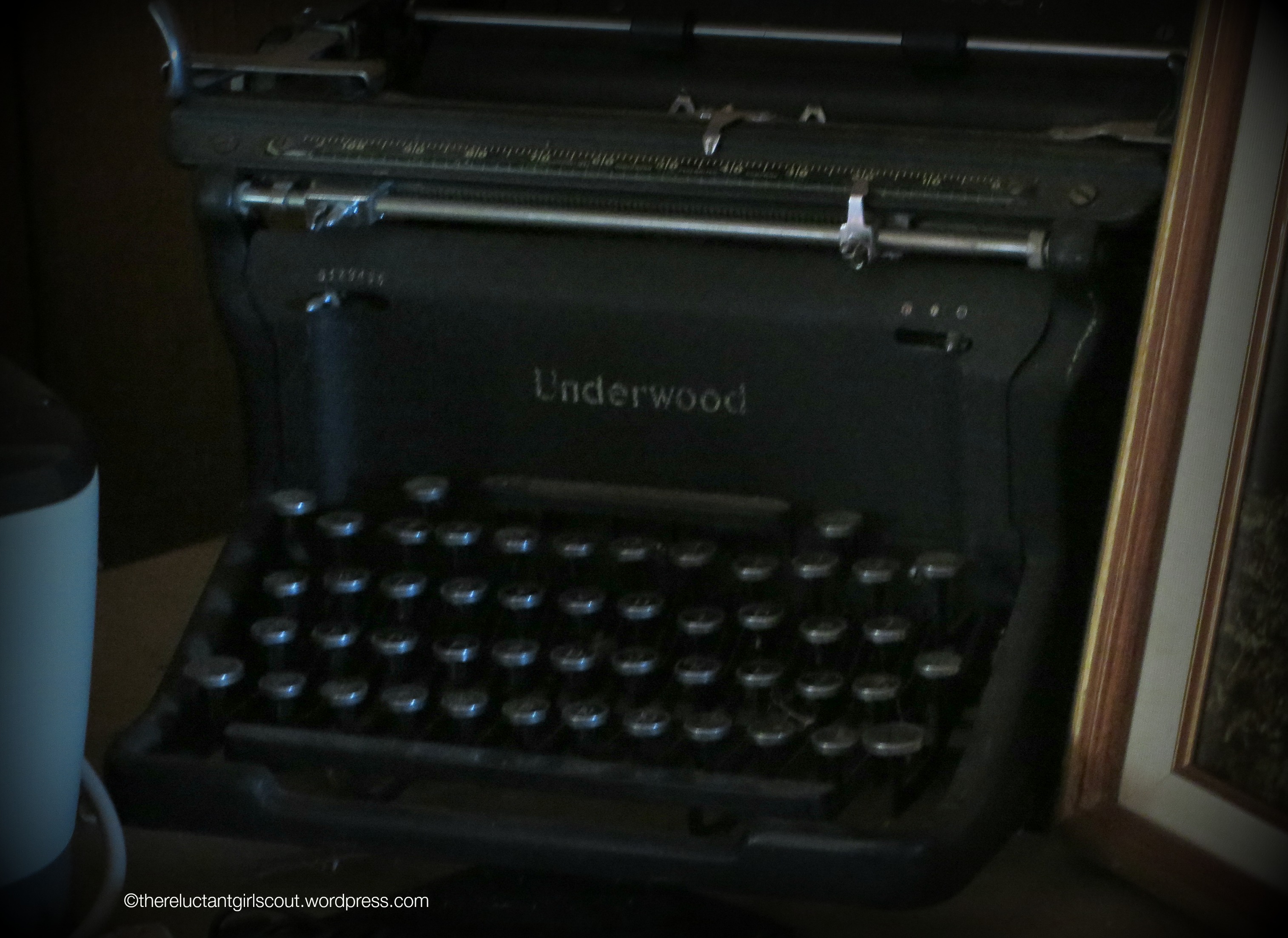
Betty MacDonald's Underwood

Betty MacDonald’s Underwood

Flashback Friday: Secret World

Standard

Wednesday, October 25, 2006

[FYI, this entry covers my inaugural trip to Seattle to help my friend Z celebrate his birthday. Keep in mind, at this point, I’d resigned myself to the notion that he wasn’t interested in me as anything other than “good buddy.” I’d been in love with him for four years and the boy just would not budge.]

There’s a reason why Meredith Grey’s hair is so flat and lifeless on Grey’s Anatomy. It turns out, everyone’s hair, especially mine, is flat and lifeless here. I assume it is the weather (rainy with a chance of rain), yet it seems like that would lend itself more to frizz.

I’m here visiting my Zimbabwean. I like saying that. It makes me feel like Meryl Streep in Out of Africa when she refers to the people she makes work on her farm as my Kikuyu. He’s teaching here, and I am in his bed. Before you get notions of me, spent from a night of international passion, you should know that while I was in his bed, he was on the an egg-crate mattress on the floor of his living room.

I ruin all the best romantic scenarios I create for you by telling the truth.

My college friend Jane emailed that her eleven-year-old son came home from school yesterday and said, “I’m just starting to realize that girls have their own secret world, and it’s FREAKY!” The Zimbabwean and I laughed and laughed over that last night when I read it aloud, but I could tell he has no idea. No idea despite advanced academic degrees that we women have secret communication-interpretation skills no Navajo code-breaker could ever crack. So when you open his refrigerator and see he has two Cokes and a package of Dubliner cheese, just for you, you swoon a little even though you’ve sworn off swooning over this particular man. When you lament how awful and Meredith Grey-y your hair looks and he says, “I don’t think so” it is, after several mental contortions, the equivalent of his saying, “Your hair is as the sun shining on the Zambezi, and I wish to spend my days basking in both the glow and beauty of it.” When he refers to his apartment as “our apartment” it is as if he has said, “I want to share my living space for the rest of my days with no one but you.” When he says, “I took off the roll of scratchy toilet paper and bought you the kind that those bears use” it’s as if he said, “I love you so profoundly that I want only the very best—softness, absorbency, and four-ply bathroom experiences—for you.” In this sick, sad world, even his choosing to sleep on egg crates instead of in his own bed with you seems like a declaration of love.

Poor eleven-year-old boy. How can he ever learn to cope in a world where half the population is this indirect, this given to fancy. . . this freaky?

So, Seattle. We walked over half the city last night and so I’m reserving judgment until we rent a car tomorrow and investigate it when my feet don’t hurt. It’s nice. Lots of coffee. The people are friendly. Somehow I had in my head that it would look and feel like Vancouver, but it turns out it’s a whole different place. Yesterday, my Zimbabwean took me to Pike Place Market. While I don’t like fish and do not like to smell them, eat them, watch them, or see them manhandled by the stall vendors, it was a unique experience. Also, there is a lot there that is not fish. Like huge bundles of fresh flowers for $4, and hippies selling art, and little dogs in plaid raincoats, and jam sampling, and fudge sampling, and street musicians singing protest songs (just protesting in general, with an undertone of “This war is unconscionable” and “George Bush sucks” thrown in for good measure), and all sorts of useless crap you don’t need like Oscar Wilde action figures, “Aunt Flo’s Tampon Case,” and cardboard cutouts of William Shatner. From there, we went to Ye Olde Curiosity Shoppe, where you can buy other useless things and see oddities like mummified human remains and a stuffed two-headed calf. We took a bus to the Space Needle but opted not to go up because it cost $14 and was cloudy. My cousin G suggested I go up not because the views are spectacular or because it is a piece of post-Populuxe history, but because she didn’t go up when she visited in the spring and apparently the only thing people ask youwhen they hear you visited Seattle is, Did you go up in the Space Needle? I will wait for a sunny day. Or at least a day when there is a chance of sun.

Last night we walked up a San Francisco style hill to see his university. He wanted decorating suggestions for his office as some big wigs are coming to campus today, but it is a hopeless cause. I suggested he buy a plant and an Edgar Allen Poe action figure from Pike Market, but other than adding some doo-dads like that, it is a hopeless sea of glass and giant industrial office furniture in the space of a broom closet. While there, I met the man who hired Z, and he tried to entice me to their wine and cheese reception this afternoon. I will, instead, be buying a birthday card and maybe a cake or some gift-ish thing for Z’s birthday. Extroverts never seem to get that the invitation to spend three hours with total strangers whom you will never see again is like a prison sentence.

After that, we walked up Broadway in search of food and so I could see, as Z put it, “the freak show.” It’s a street that apparently delights in the counter-culture, so in the space of a single block you can see goths, hipsters, drag queens, the heavily made-up, heavily tattooed, significantly pierced and spiked, as well as people randomly dressed like super heroes.

Sadly, the freaks were not out, either because it was too early in the evening or two middle-of-the-week. I will have to save those human oddities for another day, though clearly I’ve got my own little freakshow happening right inside my head and don’t have to walk up any hills to get a front row seat.


St. Paul Snapshots

Standard
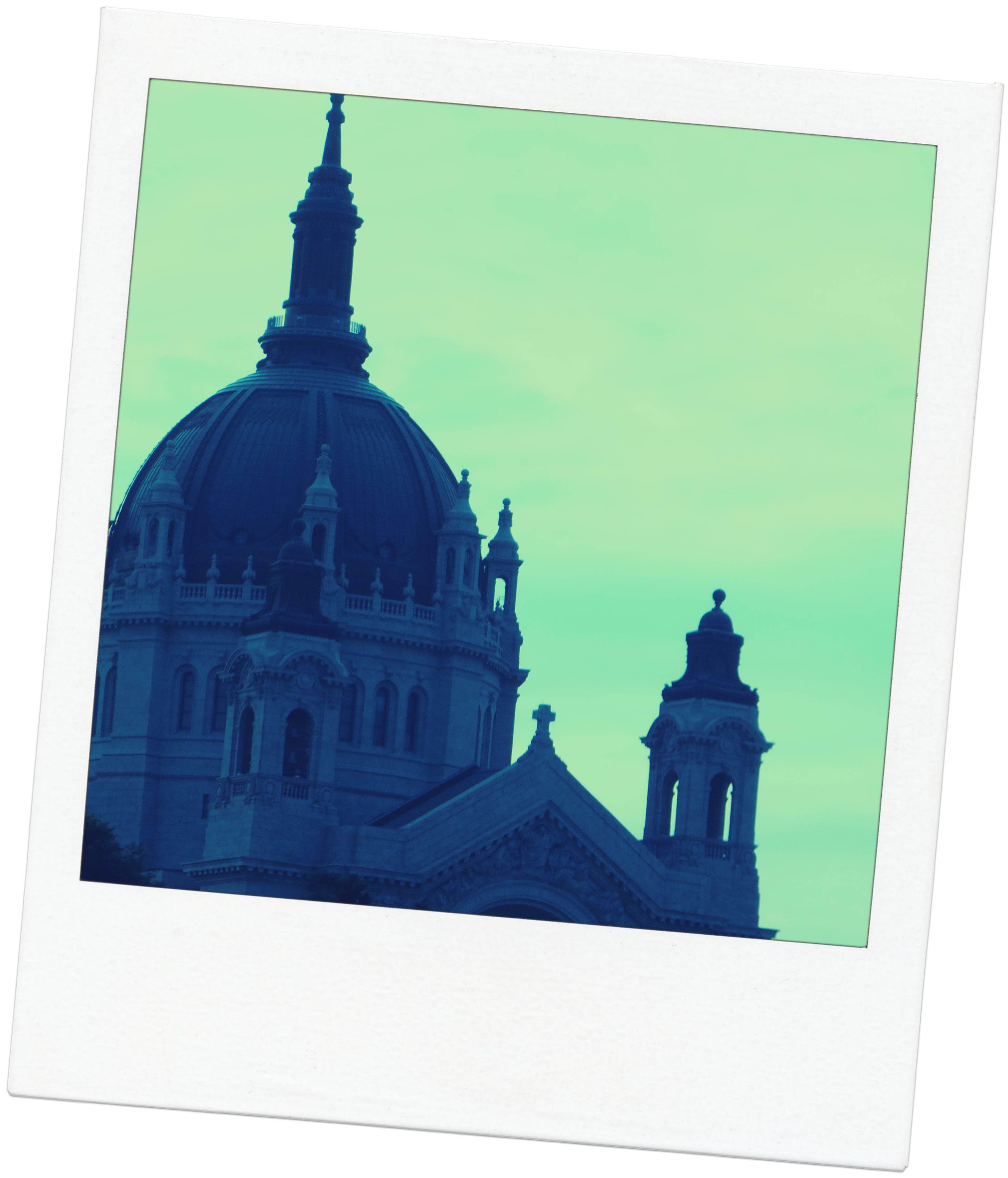
St. Paul Cathedral

St. Paul Cathedral

When I am in Seattle, the Midwest exists in my mind as a singular place where everyone has a shared sense of values, habits, conversational tics, and driving styles, and where the landscape is a sea of rolling hills and horizon dotted with cows and corn. There are specific things about Richmond, Indiana, that I miss, but often enough, what I miss is that less specific country called the Midwest.


So when Z and I visit Minnesota, where he spent the first twelve years of his American life going to college and grad school, I am often surprised by how foreign it feels to me because I am expecting it to be Indiana. Last week we flew into the Twin Cities in order to attend the wedding reception of one of Z’s college roommates, and though in the first couple of hours I was bouncing around at all the things that were magically familiar (the landscape! the manners! stores that sell plus-size underpants!), before long, I started noticing the differences. Only I couldn’t quite name them; I only knew that I was not yet fully home.


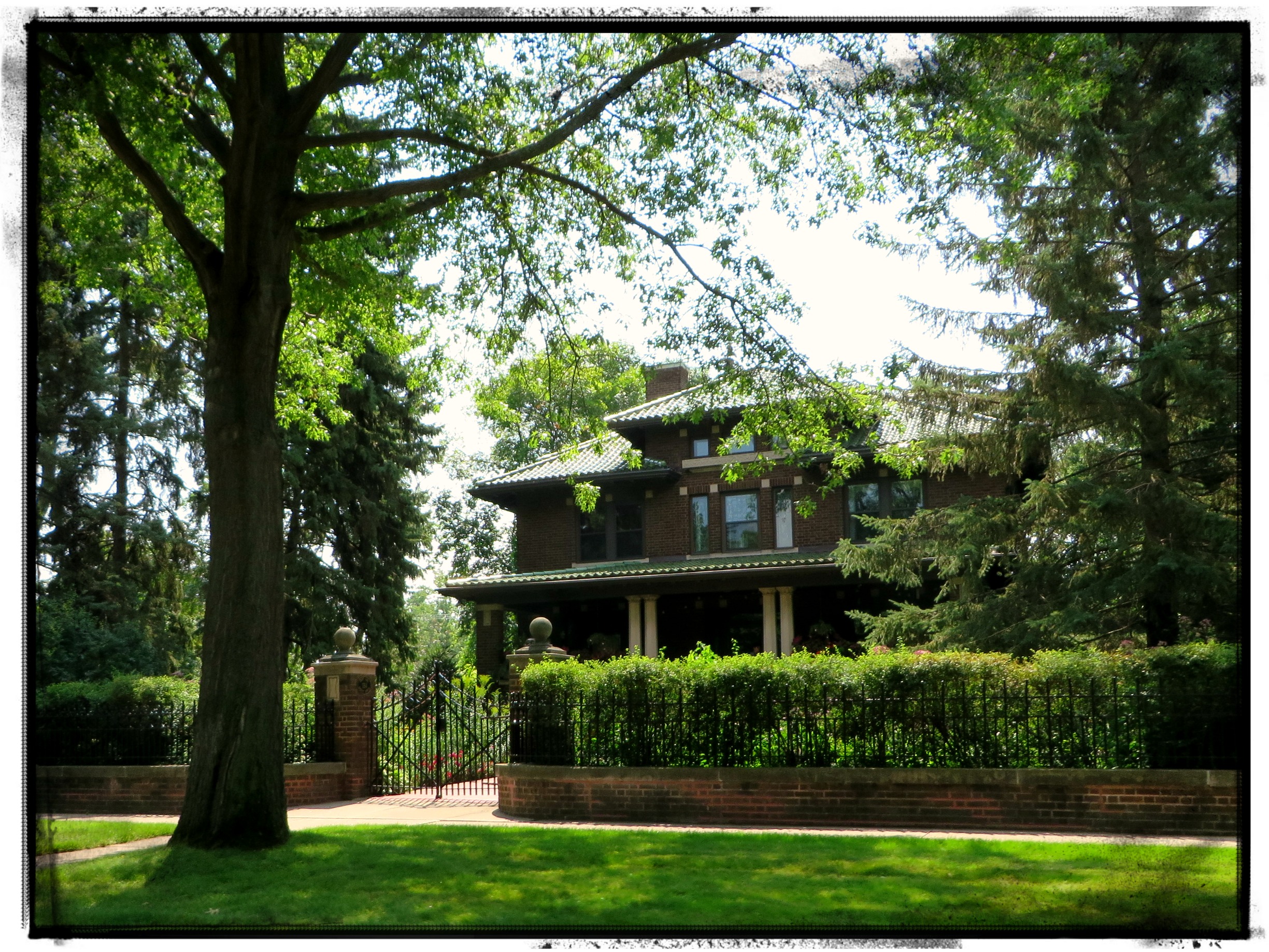
The houses there—things that appear to have been designed by students of Frank Lloyd Wright–line tree-filled boulevards on Summit Avenue and other similar routes and are different than the brick Federals and turreted Victorian and mid-century ranch houses that fill my hometown. The grocery chains are different. People seem more mannered but also a little more distant (in a polite way) than at home. A phrase like “You betcha!” takes me aback when I first hear it because I realize it isn’t just a quirk of the characters in Fargo. The accents are almost the exact opposite of the southern twang and drawn out syllables that let’s me know I’ve ventured into my particular county in East Central Indiana, where the inhabitants often have connections to Appalachia.


House on Summit Avenue

House on Summit Avenue

And frankly, every time I’m in the Twin Cities, I’m completely shocked to re-discover that the Mississippi River is not just a southern entity.


Another thing that surprises me is the realization that Z has rich memories from his time in St. Paul and though I’ve heard the stories multiple times and met many of the players, those memories—no matter how diligent I am in imagining them—will never be mine.


The best cure for this ailment of mine is usually to make new memories, so we got to it. We visited with old friends at favorite haunts (no trip to St. Paul is complete without breakfast at the St. Clair Broiler), walked around his old campus to see the changes there (campus bookstore moved off campus—do not approve even if it is next to Garrison Keillor’s bookstore!), drove an hour to the little town where the wedding reception was (we got lost and there was some verbal abuse directed at Siri) and enjoyed an evening of nuptial revelry before heading back to the cities.


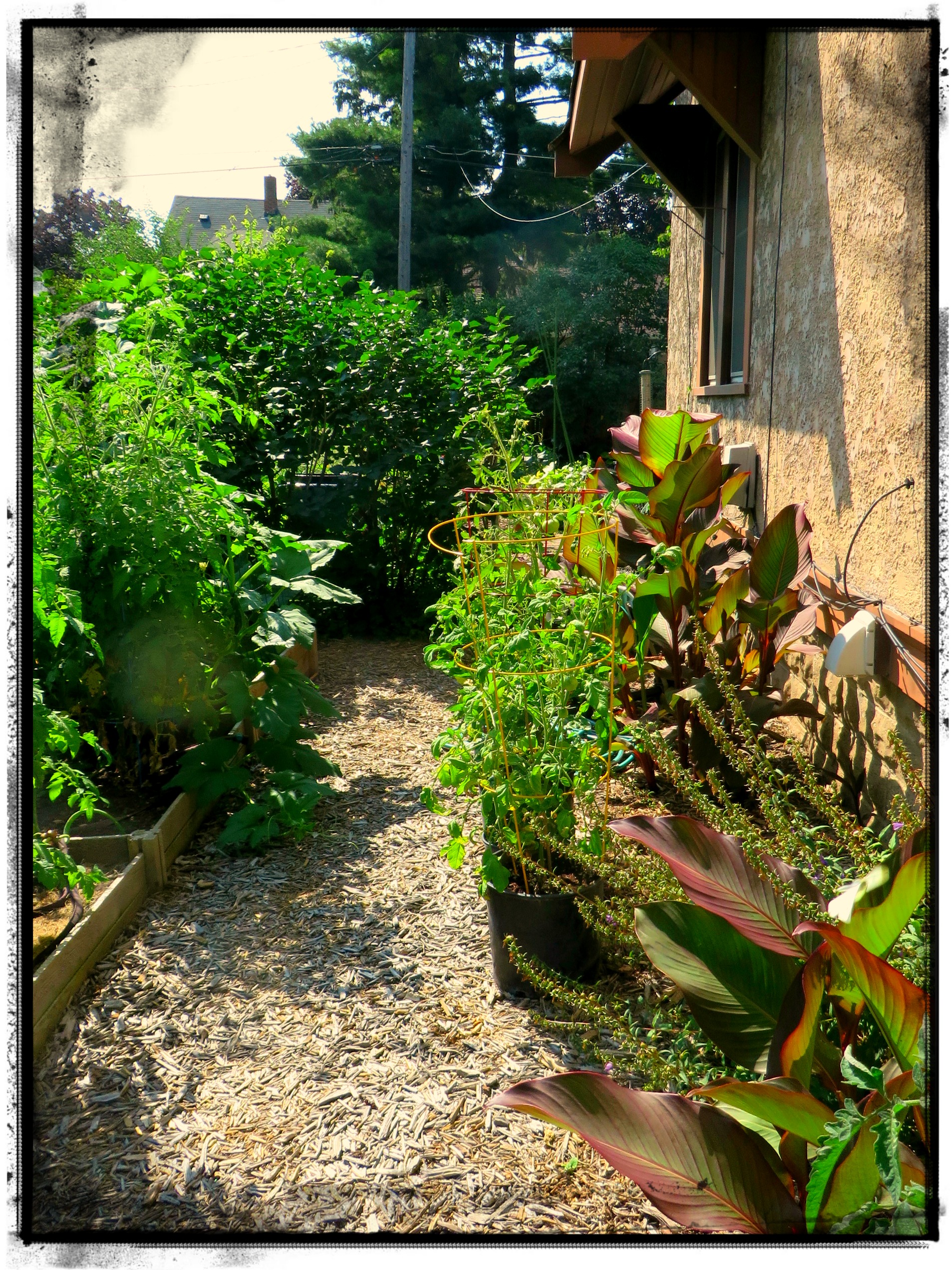
For this trip to St. Paul, Z’s old friend McGregor hosted us at her new, adorable house, which we found much cozier than the hotel we usually Priceline when we are in the cities. She has a lush garden because she was born with “green fingers” as Z-ma calls it, and were I not mosquito averse, we would have spent more time in it. It was charming and cozy and I say this as a person who generally does not notice things like gardens because I prefer being indoors.

Path into McGregor's Garden

Path into McGregor’s Garden

We played Scrabble and chatted and some of us (ahem) were coveting her hardwood floors and woodwork. She and Z caught up on the people they have in common and again, I felt those little jealous fingers tickling me under the chin. It’s ridiculous really. I have good friends. We have had good times. But somehow, his history seems 3-D in Surround Sound and mine is more like a Viewmaster reel. He lived in an apartment once with plumbing problems so severe that one had hold an umbrella while using the toilet. I never had an apartment with quirky facilities!


Z's former leaky apartment.

Z’s former leaky apartment.


One place we visit every time we go to St. Paul is this lovely shop called Irish on Grand. If you love Ireland and miss Ireland like I do, then going to a shop like this and talking to the proprietor makes you feel almost like you are there. I don’t need any more Irish sweaters, pottery, jewelry, or other Celtic doo-dads, but I feel better just knowing if I have a sudden urge, I can get them there. When we stop in for a visit, we always buy whatever Tayto Crisps (best potato chips ever: my favorite, Smoky Bacon) they have available and then get either a book or a new CD. Once, I loved a band I’d discovered there so much that I accidentally bought the same CD on the next visit. On this trip, I opted not to buy any music just to be safe.


Irish on Grand--excellent shop for Eire-ophiles!

Irish on Grand–excellent shop for Eire-ophiles!

As luck would have it, we happened to be in time for the Minnesota Irish Fair on Harriet Island. It’s reportedly the biggest free Irish festival in the U.S., and so we boarded a shuttle marked Galway and made the short trek to the festival, which was just getting under way.

Minnesota Irish Fair 2014

Minnesota Irish Fair 2014

We were a bit too early to see the revelry that looked bound to happen later in the weekend when Gaelic Storm and The Water Bhoys performed, but it was still a good time. I got to pet two hot-looking Irish Wolfhounds in the Celtic Canine tent. Between roasted corn and drinks, we also managed to see some Irish step-dancing, though admittedly, instead of focusing on the performances, I spent more time lamenting that the costumes had gotten so garish (sequins! neon knotwork!) and the wigs had grown more ridiculous in the decade and a half  since Riverdance hit America  and the Irish dancing resurgence began.

Nicki Minaj should wear this--not an adorable 10 year old celebrating her Celtic heritage.

Nicki Minaj should wear this–not an adorable 10 year old celebrating her Celtic heritage.

At one point, I had to keep redirecting myself to watch the footwork instead of the wig of the dancer in front of me who had yet to perform. Despite the visual assault, the dancing was remarkable.

Irish dancer "hair"--so springy! so lifelike!

Irish dancer “hair”–so springy! so lifelike!

Irish dancing always chokes me up, and I don’t know why. I’ll be clapping and having a good time, and then all the sudden there is a tightness in my throat and I start sniffing so the tears won’t spill over. It must be genetic.


Minnesota Irish Fair 2014

Minnesota Irish Fair 2014

On the last day in the Twin Cities, we sat in McGregor’s backyard amongst the flowers and vegetables watching Z go through a tub of his things that McGregor has been storing for a decade or so. She and I were keen for Z to whittle down the items he had in storage, but then when push came to shove, as he threw things away, we’d exclaim, “But you don’t want to get rid of those!” even if “those” was just a pair of old rugby socks. He just shook his head at us. As he chucked letters and menus from awards dinners into the trash, I rescued the best so he’d have a semi-accurate historical record of his past. He has two more tubs to go through on our next trip. Maybe by then, McGregor and I will be willing to let him let go of more memories.


And thus begins our summer sojourn back to the Heartland.


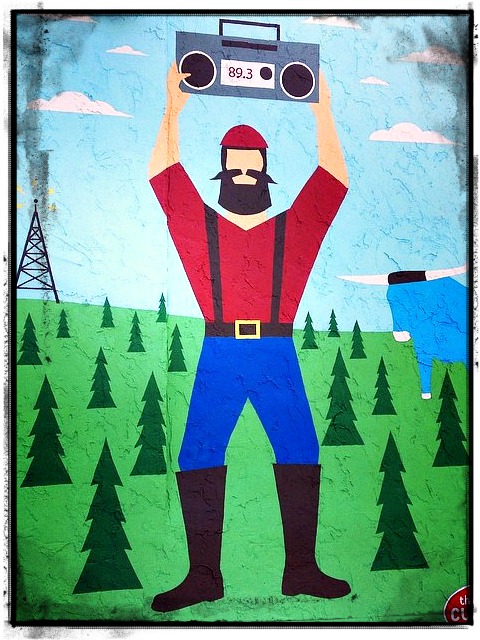
Paul Bunyan; Cusack style.

Paul Bunyan; Cusack style.


Flashback Friday: Little Brownstone on the Prairie

Standard

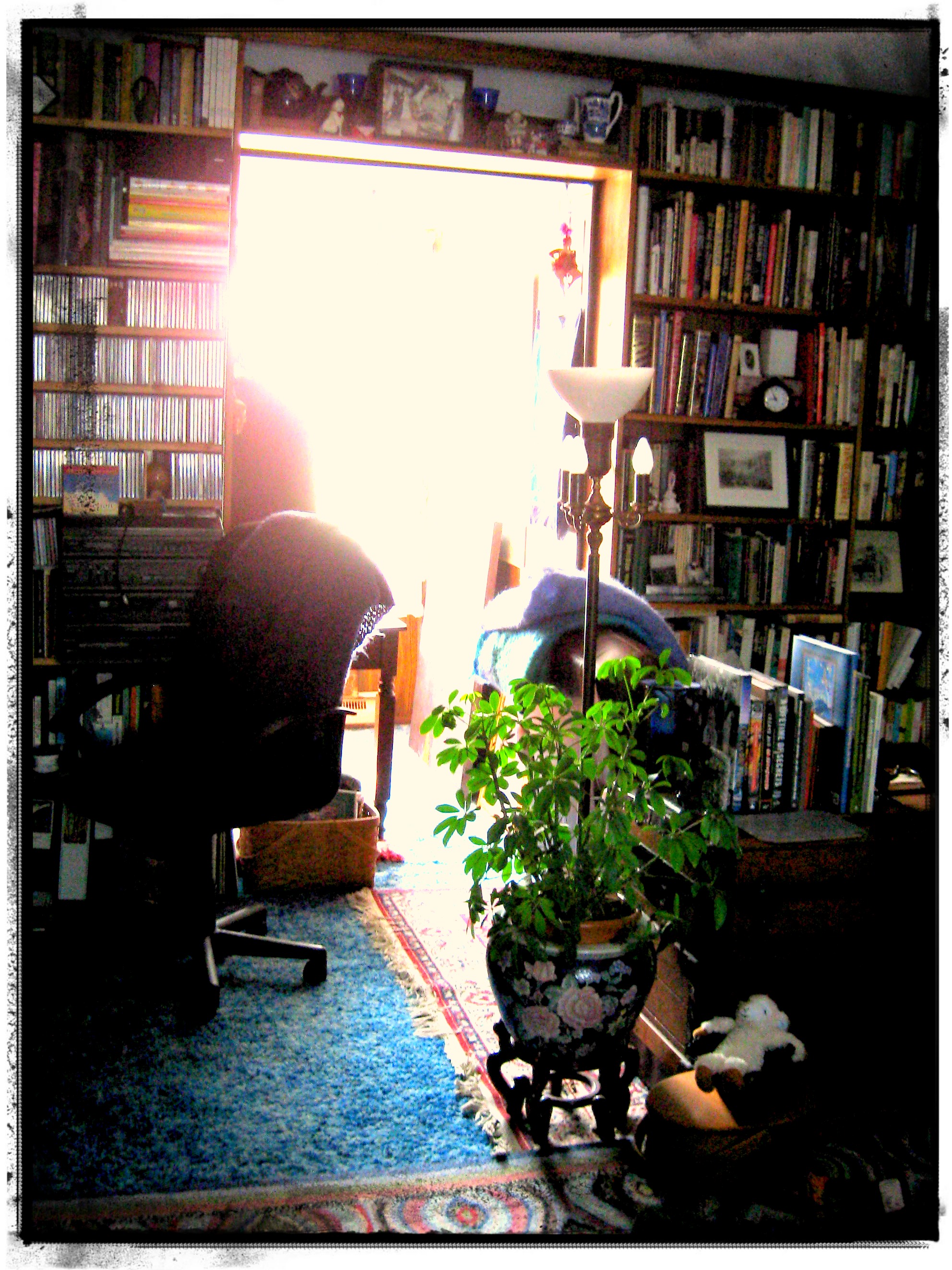
rgsroom

[Oh, the irony of this post from eight years ago, particularly when bumped against the one from earlier this week.]

 15 July 2006

Last night I was feeling “troubled” about my silly life as I went to sleep, which is a fairly frequent occurrence. Usually the troubledness has to do with my age, my living situation, my marriage/partner/dating and motherhood status. Other things get factored in based on the latest magazine article I’ve read or Dateline exclusive I’ve watched. Last night, after messing with a picture shelf my mother and I were hanging above my desk and trying to figure out which of my 20 works of art I was going to hang on the little hunk of wall that is left in my room, I was feeling particularly freaky. I have friends who are bitter because their houses aren’t brand new and don’t have granite countertops or swimming pools or room for a home office, but all of them have managed to get more than four walls to hang things on.


This isn’t about some people being luckier or having more than me. I know if I wanted to make it a priority I could maybe get myself eight walls, so I’m not talking about jealousy here. If I wanted to give up the frequent flying and the handmade furniture and the Sundance catalog jewelry, I could buy a little house and hopefully have enough money left over to pay a boy (preferably a shirtless one) to come and do things for me like hang picture shelves. I could.

Anyhow, I woke up this morning, looked at all my stuffed-full bookshelves and realized, I’m living in a brownstone circa 1945. I always imagined living a writer’s life in a big city where I couldn’t afford anything but a bedsit so all of my worldly possessions would be in the one room, and for reasons that are unclear, I always imagined doing this in the post war era. And now I realize that’s what I’ve got. Only without the city, without radiators (thank you, Jesus), without loud neighbors, and without a book contract. I AM Helene Hanff. I am whatever the bookish sister’s name was in My Sister Eileen. I just can’t go walk my dog in Central Park (partly because I don’t have my own dog), and I still have not developed a taste for coffee and cigarettes, both of which figure prominently into my 1945 brownstone fantasy.

Also, in this fantasy, I have a throaty laugh and I know how to dance.

I really am amazed by people who figure out how to settle into a place. At almost 40, I’m still trying on locations for size. For instance, I now know I do not want to live in Aspen, even if I do become a billionaire. In fact, you can scratch ‘anywhere in Colorado’ and ‘the Rockies’ right off the list of possibilities. It’s gorgeous there. The quality of life is good. I understand the fervor of John Denver’s Rocky Mountain High, but it is not my place in this world. There is too much sun and too many people happy to be outdoors, risking their lives on guardrail-less roads, in treacherous rapids, and while battling wildfires.

While I was at Aspen Summer Words, my friend Heather drove me up Independence Pass so I could see the Continental Divide. On the way up I told her how beautiful the landscape was and she said, “I know. When I see these mountains my heart just opens right up.” My heart wasn’t opening–not for those mountains–but I liked the emotion with which she spoke. It’s how I feel about the West of Ireland, Chicago, East Tennessee, London. There are places you belong and places you don’t belong and I live in fear that I’ll accidentally end up in a place where I don’t belong, where my heart not only won’t open up but instead will seize because of the ugliness or inhospitably of the people or landscape. For instance, the two hours I was waiting for my return flight from Phoenix, I kept thinking, “This is a dead place. People aren’t supposed to live here.” Yet people do. And some people love it. My grandparents loved it. But they sure didn’t pass those genes down to me. (Nor the genes that would make camping seem like a good idea, for that matter. Nor the ones that would make me good with money or able to cook.)

When I figure out how to get myself to 1940s Manhattan, I’ll let you know.

Getting in on the Ground Floor

Standard


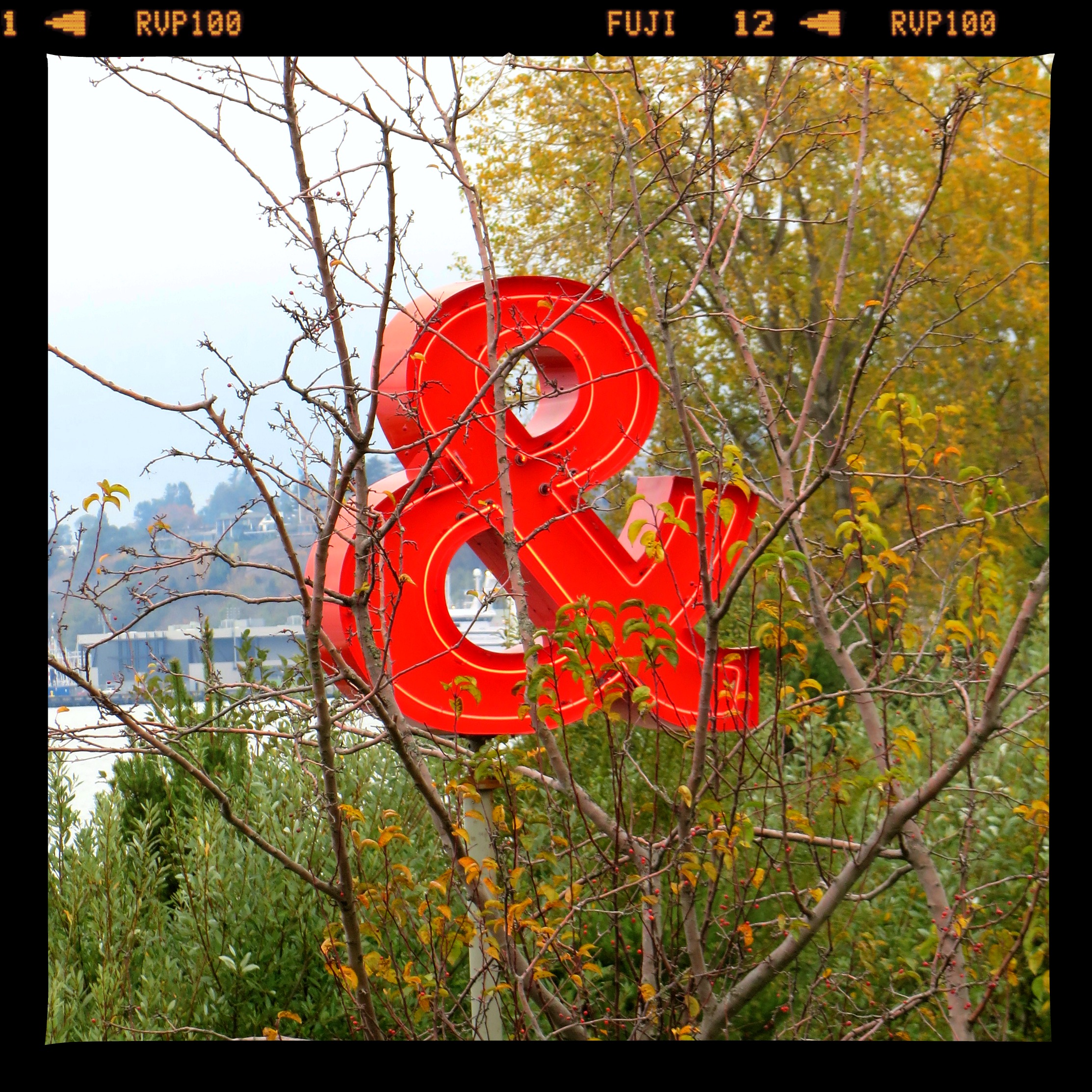
"Love & Loss," Olympic Sculpture Park, Seattle

“Love & Loss,” Olympic Sculpture Park, Seattle

On the flight to Indiana, the woman sitting next to me asked me to watch a video about a company she works for because she felt like it could change my life. She was young, friendly, dressed to the nines, and I liked her watch, so I agreed. The product itself was intriguing—it was some sort of natural compound that has been scientifically proven (and even talked about on a network investigative news show) to improve health and longevity—but the point of the video was not to sell me the product so much as to sell me the company. Just as my brain was thinking, This is a pyramid scheme, the video said yes, this could be called a pyramid scheme, but then insisted that all business is a pyramid scheme with a CEO at the top raking in the big money and the peons at the ground floor doing the grunt work, and it was said so enthusiastically that I was momentarily forced to believe it was true and that I should get in on the ground floor. Everything is a pyramid scheme. Pyramids are awesome! Fortunately, my better sense prevailed (around the time Donny Osmond appeared on screen, though he was looking remarkably well-preserved) and I was able to muster up the courage to tell her I wasn’t interested. Pyramid schemes only work if you get in on the ground floor, and it was pretty clear to me that this pyramid was already 3/4 built.

She turned her attention to the guy sitting next to her. I spent the remainder of the flight bouncing between pity for a woman gullible enough to believe she’s going to become independently wealthy shilling snake oil, and pity for myself because I never can wholeheartedly buy in to a cause or a product or a belief system. I might attend services, but I never drink the Kool-Aid, and while some might say this is smart, what it really means is that I’m riddled with doubt on a lot of levels.


On the return flight to Seattle, I was relieved not to be sitting next to someone trying to sell me something. My seatmate looked like a high school senior and was expressing annoyance that the fleece she’d ordered hadn’t arrived in time for her trip. She told me she would be spending the next two weekends with friends, hiking around the Pacific Northwest, and during the week she’d be at a conference. She looked like maybe she was a dolphin trainer or something, so I was surprised when she told me she had an MBA from Carnegie-Mellon, lived in D.C., and did something that sounded vaguely important and international. I’d love to tell you what her job was, but I didn’t understand what she was talking about. She was speaking clearly and wasn’t using polysyllabic jargon, but the words that she strung together made no sense to me, and what’s more, I couldn’t get my brain to shut off while she was talking. Instead, inside my head was a roar, This is just a girl and she knows more about the world than you do. This girl is going places. This girl has a plan for her life.


She told me about this artist community in Mexico where she’d done an internship and where a lot of Americans emigrate, and my brain roared, This girl knows about a place you should know about but don’t. I asked where she’d done her undergraduate work, and it was a college that I’d considered for about 15 minutes when I was 15 before I knew about things like “out of state tuition”. I asked how she liked it, why she chose it, and she explained that she’d picked it solely because of its excellent intern program in D.C. because she knew she was interested in international business and the nation’s capitol would be a good place to do that. My brain roared, When you were thinking about that college, it was only because you liked the way the campus looked in the brochure photos. What’s wrong with you?


She wasn’t intimidating. She didn’t seem particularly wise. She asked me if I thought it was crazy that she’d come to Seattle without a raincoat or an umbrella. (Answer: duh, yes.) She was just a person, young enough to be my daughter probably, but full of information about the world that I don’t have. I was relieved when she plugged in her earphones  and started watching the in-flight movie, which was Spiderman, if for no other reason than so my brain would quit roaring at me.


It was a weird way to bookend my trip home. I went in feeling smarter than the posh, pyramid sales person, and I left feeling old and dumb (and pessimistic about a stranger’s choice of outerwear for nine days in the Pacific Northwest). As I walk around Seattle, where the average age is something like 30, I’m feeling past my prime and not nearly clever enough. I’m going to have to spend this first week back in the city Googling things like “Gen X” and “generational beliefs” and “multiple intelligences” and figuring out all the ways I’ve still got it going on.


Hopefully, after the research is in, I won’t come to the conclusion that I made an error in not signing up for a new career with Donnie Osmond and the anti-aging pyramid sales woman.

Trying to Step in the Same Stream Twice

Standard
Santa Barbara

Santa Barbara

We hadn’t been in Santa Barbara for nine years when we arrived there last Wednesday. When we did the math and counted out how long it had been, we were both surprised. It has lived big in both of our memories all this time, and when we exited the highway and found ourselves cruising up Cabrillo Boulevard towards Hotel Oceana where we’d be staying, it felt to me like no time had passed at all. Maybe a few months.


In 2005 when we were still just friends, Z, who’d been in Zimbabwe for a year, returned to the U.S. to teach as a visiting professor at a college near Santa Barbara. Other than a deep affection for my Malibu Barbie collection in the 1970s, I’ve never been California-inclined. I had this notion of it as a place that was too thin, tan, sunny, and plastic to ever make me happy. So when Z invited me to spend my spring break with him all those years ago, let us be clear: I was going to see him, not to soak up the sun on some shell-strewn beach. I would arrive in Santa Barbara ready to assess the situation and see if he’d budged an inch since the year before when I’d told him I was in love with him. I even bought myself a new orange bra because I felt with such a thing beneath my clothes, I would subconsciously become more alluring and magnetic than I really am. It was huge and day-glo and I had to be careful what shirts I wore with it because it was not a bra to be trifled with. Even so, Z remained impervious to the super powers of my undergarments, despite the fact that at one point when we were on a trolley in San Francisco, my blouse came unbuttoned of its own volition and I accidentally treated about 30 strangers to my bright orange satin-encased breasts.


Z stared out the window, oblivious.


The trip nine years ago involved a mixture of emotions that started and ended with longing and confusion on my part. We were both happy, I think, to be back in each other’s company, exploring a new location, investigating the old mission, driving up Highway 1, sifting through bargain bins at what may have been the world’s most affluent Goodwill ever, and walking the beaches. Oh, the beaches! But then somewhere in my head I’d hear Kate Bush singing, “The thrill and the hurting/ This will never be mine,” and the aching would start. I’d wonder how much longer I could sustain our friendship in the face of it. Then he’d say something funny and we’d start laughing and I’d forget the hairline fracture in my heart.


I don’t understand time travel, but the first day of this 2014 trip, I felt as if time wasn’t linear after all. It seemed reasonable to me that we might bump into our younger selves, that maybe I’d see us on East Beach and I’d be able to take 2005 Beth aside and say something encouraging like, “Just hang in there—he’s worth the wait and right now he’s just moving on African time.” Or better yet, I had this notion that somehow I might be able to turn back time and reclaim those days that were lost to us. That there would be a puff of smoke and we’d get sucked backwards, and get our party started sooner rather than later. (It should be noted that in my memory, we are way younger than we were nine years ago, and I was much thinner and looked more like Malibu Barbie than I do in now or then. Also, we’re wearing really attractive swimwear and we’re much better coiffed than we are in real life.)  It’s just so lovely and magical there on the beach in Santa Barbara that it seemed entirely possible that either of these things might happen.


Poor Z! That first day, I think he was wondering if he’d made a mistake, bringing me back to Santa Barbara because I was acting like we’d returned to the scene of some crime. I was given to sudden storm clouds of regret that would form behind my eyes, and worse, torturing him with jabs about what he’d been missing out on back then (for instance, I no longer have that orange bra and he never got to see it). He was good natured about my ribbing. At some point on Wednesday night, I realized I was ruining now with my incessant reflection on then and what could have been. I mean, honestly, can you imagine having to listen to Elizabeth Bennett complain about how Mr. Darcy didn’t love her quickly enough, as she sits on the veranda at Pemberley? Please. Even I was getting tired of me. Frankly, I’m getting tired of me recounting the story here.


View from our Hotel Oceana room

View from our Hotel Oceana room

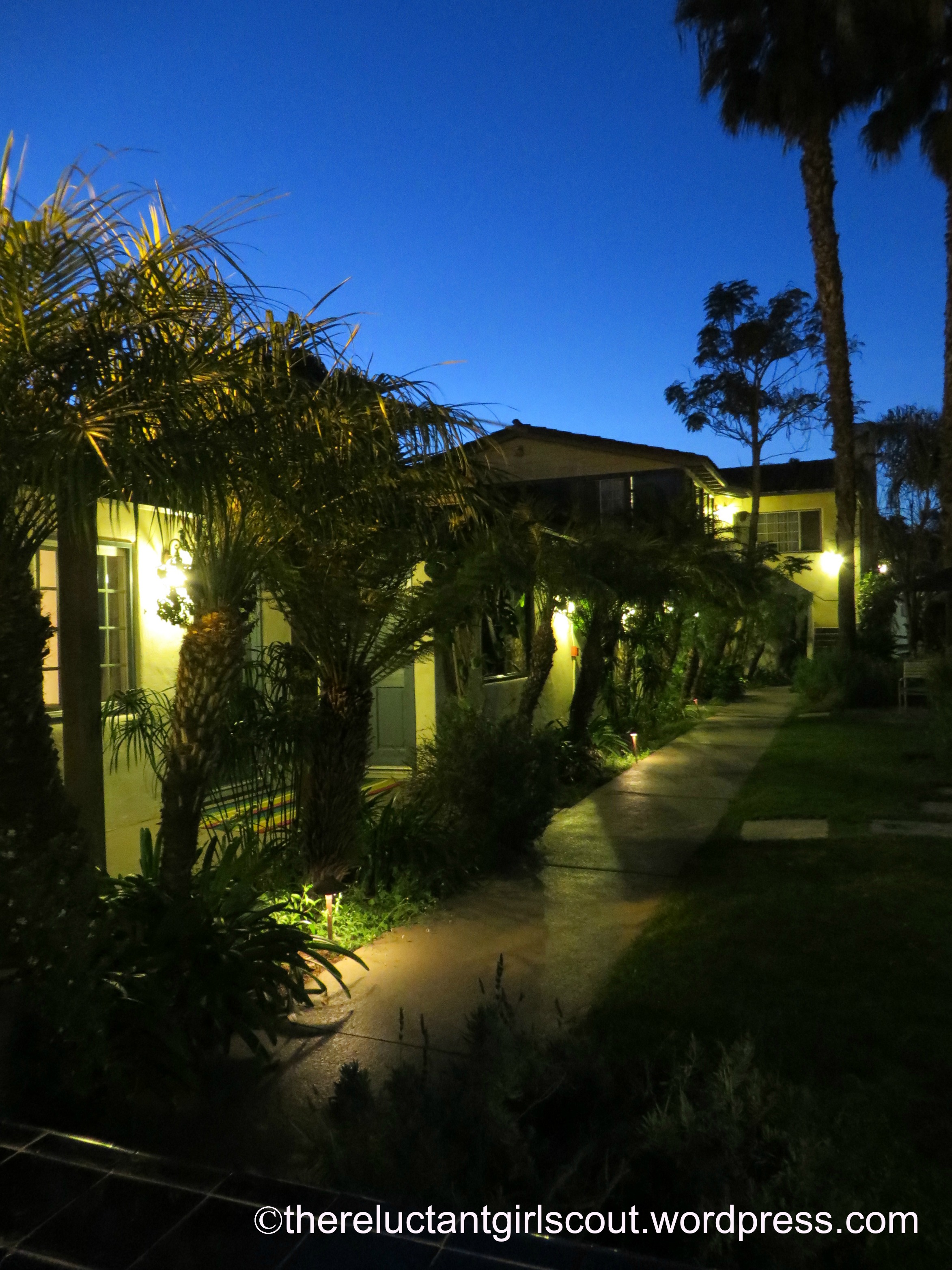
Eventually, I shut my mouth and directed my line of sight on the present. Hotel Oceana was delightful. It was right across from the beach and we splurged on a room with a view. Aside from the view, I was smitten with the Spanish style courtyard that the rooms opened up on. A fountain tinkled. Humming birds flitted around the stralizia. Even the opossum that was creeping up a tree right at eye level and scared me half to death seemed quaint.  When it isn’t a 100 degree humid summer day in Indiana, I’m always struck by the magic of how you can live your indoor life outdoors in climates like this one.

Hotel Oceana courtyard, Santa Barbara

Hotel Oceana courtyard, Santa Barbara

We speculated on the lives of the people in the neighboring room who left their door open, and when we peered in all we could see was a sea of plastic bags—we still can’t decide if they were some sort of bag people/hoarders or if they just did a lot of shopping and weren’t very tidy or safety conscious. We walked on the beach, laughed at the Californians who were bundled up like it was winter as we shuffled around in shorts and flip flops,  and said hello to a host of dogs. We drove out to Z’s old campus and poked around to see how things have changed since he was in residence. Then we investigated his old neighborhood to see what houses survived the fires a few years ago. Finally, we went to his old Von’s grocery store and lamented the fact that Jonathan Winters is dead now so there was no chance of running into him the way Z used to. We had apps with his former boss in an Irish pub and caught up on nearly a decade’s worth of events. Our last night there, we walked on the beach under a full moon, the way you do when there is a beach and a full moon available to you.


Maybe all the time travel I need in this life is the realization that when we are together, we have fun, just like we always do, always have done. Even before we were us.


Moonlight, Santa Barbara

Moonlight, Santa Barbara

(P.S. Should they make a movie of my life posthumously, would one of you please try to secure the rights to that Kate Bush song? I think it would work really well in the “longing for Z” sections of the film.)


Flashback Friday: The Sea is Wide and I Cannot Swim Over

Standard
[In this final installment from Ireland, I pack my bags for home and try to make sense of the personal and the political.]

Monday, March 27, 2006

There’s something about leaving Ireland that makes it imperative that you listen to all of your favorite Van Morrison songs immediately. Lucky for me, I had several on my iPod and so could begin the lament on the long train journey from Waterford to Limerick before I ever got on the plane. I started with ‘Carrickfergus’ where the line about Kilkenny had new meaning to me, and ended with “Won’t You Stay.”

The last day in Ireland was a drizzly one, so it took awhile to get moving. I have about a sixty minute tolerance for museums of any sort, so even though I’d been warned to have three hours for the Waterford Treasures museum, I had to walk around the town centre, poking my head into stores, getting dew kissed from the drizzle, and generally feeling a part of life there before trekking to the museum. The Irish coat I bought when I was there in November must make me look more like a native, because again I was asked for directions. This time, sadly, I had no answers.The museum is nicely done and has a remarkable amount of interactive “treasures” as well as the more traditional kind. The first thing I did was go into a little theatre where an aluminum version of a Viking ship made up the seating area. I was the only person in there and almost got hysterical when the movie started and the ship started rocking back and forth beneath me. The movie itself was silly–about a bunch of Vikings making the journey from York back to Waterford, calling out to a horned old disembodied head who must have been Odin. But the creaking of the aluminum bleacher-seat ship was worth 12 minutes of movie boredom. I was only sorry that I was alone on it and so my laughter must have seemed a bit deranged.

Probably the most impressive piece in the whole museum is the city charter, which is, essentially, a bunch of documents about mayors and city ordinances written and illustrated on vellum and then sewn together into one big historical quilt. I liked seeing man’s history presented in such a girly fashion. Which brings me to my main beef with museums and history in general. I can rarely find myself there. Sure, there might be some bowls women served food in, a beaded necklace of some ancient peoples, but mostly what you see are the stories of men. Likely, they affected the women in fringe ways, but I would prefer learning about women’s lives & that forgotten history. What shaped domestic life instead of how a political action shaped a nation’s history, or, to borrow words from the Feminist movement of the 1960s and 1970s, I am most interested in how the political shaped the personal. While I don’t care which king presented the Mayor of Waterford with the Cap of Maintenance (which, by the way, looks over much like the Hogwart’s Sorting Hat), I am curious about the woman who helped piece it together or the Lady Mayor who had a laugh with her husband after the presentation about how stupid he looked in it. (“Ohhhh. Don’t you look divine in your cap o’ maintenance, Darling.”) But those aren’t the stories we get in museums or history books because they aren’t considered important. They aren’t national or global. They aren’t worthy of being recorded. In museums, it seems, the female story is predominately relegated to who wore what and which of our dishes were used to feed the men who were fighting the wars and signing the charters. This is an old, unoriginal argument I’m presenting, and it is changing in terms of recorded _modern_ history, but it does have an impact on my level of interest in dusty relics that I pay seven euro to see.

I cruised through the rest of the museum, paying homage to anything that seemed homage worthy, but generally reassuring myself that I am not a bad person or a bad student of life if I don’t love museums, where life and stories are kept in airtight cases.

Back at the Artist’s house that evening, he showed me his artwork from the period right after his wife had died. These were all chalk pastels with mythological figures and death symbols throughout. He explained each one, which I appreciated, because it helped me understand his thought process. Talking about these pieces must have been exhausting for him, both because physically it is hard for him to get breath behind his words and also because of the subject matter. I was overwhelmed by the pain that was in them and found myself having to turn away periodically. After he had shown them to me, I asked about the sketches he did while his wife was dying and he nodded toward the cabinet where they are kept and said that his children can’t even look at them because they are too painful. At that point, the phone rang–two of his friends were taking Belle and me out for a drink–and I felt relieved to have the spell broken and to have been spared witnessing that pain. Even so, as Belle and I were driven away while he stood at the door, holding onto his wheeled-walker, waving goodbye to us, I wanted very much to hop out of the car and insist we spend the evening at home with him instead of drinking with his friends. I wanted to soften the sadness of what I’d just seen. Of course he has lived with these paintings and his grief for several years, so it is likely that I was the only one who needed the softening.

The man who picked us up was the Artist’s neighbor, a retired banker who now travels and studies languages. He drove us to the house of the other man, a sort of care-taker for a Big House that was formerly owned by the Waterford Crystal people. Gates had to be opened before we could drive in. We had drinks there and then later at a 17th century pub which sits under an ancient-looking “flyover” (overpass). We talked about politics (Irish, U.S., Zimbabwean, E.U.) and drank, then went back to the Big House for tea before heading home to our unpacked suitcases. When we got back, the Artist was already in bed, so Belle and I stayed up until 1:30 talking about life, even though we knew we had to get up at 4:30 the next morning to catch the cab that would take us to our train. Though we’ve worked together in one form or another for over ten years, we didn’t know all the bits of the other’s life, and it felt good to share

Morning came early, but we made our connections and had only an hour to kill at Shannon Airport. There were a few U.S. service men (I saw no women) walking around in their desert cammies. I felt self-conscious about my black shamrock, anti-U.S.-troops-at-Shannon-Airport button and was glad it was out of view. As much as I don’t believe in this war and don’t believe we should be involving Ireland in our nation-building, I feel none of those things about the soldiers themselves. They are my neighbors, my students, my cousins, and, if I’d been more productive on prom night, they could be my sons.

As we were in the departure hall, we could see a large line of soldiers on the other side of the glass just arriving from their trans-Atlantic flight, ready to be shipped to Iraq. As they walked by us, a few waved tentatively through the glass, and Belle and I and some others felt compelled to wave back. My God did they look young. I know this is what people always say about soldiers, but seriously, these boys looked about 14. And maybe I was reading in, but they looked a little scared too. More people waved. A few clapped. I got teary, thinking of the hardwork they were about to undertake. How some of them wouldn’t be coming home the same as they left. How some of them wouldn’t be coming home at all. I had to turn away, as I had the night before looking at the Artist’s study of grief, because the idea of it all was overwhelming. But then the cheers and chants of “U.S.A.” started and the spell was broken. Suddenly it became not a poignant, human moment, but a sporting event. Our team is best. Our team will win. Our team will trounce your team. Gooooooo team. No doubt there is need to build up the gladiators  before they go into the arena, but it rang false.

My thoughts turned to a local business owner whose marine son recently walked through that same arrivals hall on his way to be a tank gunner. She said this is what he wanted to do with his life, that this is his destiny. She told me the story of how he and a woman he’d met online tried to connect at Shannon so they could meet face-to-face before he went to Iraq. She talked about how upset the woman was when they missed each other, how touched she was that someone cared so much for her son that she would drive all the way from Dublin, just for a glimpse of him. She explained how she sent an angel statue to the woman as thanks. So anyhow, I ignored the cheers and false bravado and thought instead of these two women and this young soldier, and how though I haven’t met him, I hope he comes back in one piece, because this personal story is the one I care about. Not the oil. Not the WMDs. Not even how political boundaries are drawn or how the history books later present the events.

Maybe its juvenile of me to have this attitude, but I don’t think so. Several years ago a friend told me that he believed poetry would save the world. I couldn’t quite wrap my mind around the concept at the time, though appreciated the validation he gave to my chosen line of work. Now, I think I understand better. It’s the little moments of personal pain or joy that are recorded into the story, the song lyric, the dance, that will do the work all of our peace talks and war making cannot. It is art that will breathe life into dusty relics in those air-tight museum cases, even if it is by way of an aluminum Viking ship and bad video. It is Van Morrison telling us how he longs for the ability to swim or fly or pay a boatman to carry him back to his own ones across a wide sea.

Elegy to a Mentor

Standard
Gibb (with Beth and her 80s hair).

Gibb (with Beth and her 80s hair).

Today would have been the 80th birthday of my college mentor. All afternoon I’ve been having “Gibb flashes” and was surprised to look on my perpetual birthday calendar and see his name in parentheses (parentheses being the only indication I am ever willing to give that someone on my calendar is now dead). Somewhere on one of my often-confused brain cells, there must have been some Gibb info stored and an impulse got released to remind me to send him a greeting today.

Only sadly, I have to send it to the general populace since he died in 2006.

When I went to college, I was an art major. My whole life until then I’d either had a pen in my hand for writing or a pen in my hand for drawing, so it’s easy to see now why I was confused about what I should do with my life back then. For the first six weeks of college, I dutifully carried my art supplies to the Fine Arts building and tried not to be intimidated by the girl who wore a beret or the guy who carried a paisley purse, both of whom looked like artists while I was wearing polo shirts and sweaters with shoulder pads. I also tried to ignore how loathe I was to use the mandatory charcoal because the feel of it dragging across the paper set my nerves on edge and I preferred the delicate, fine strokes of a pen. Eventually it became apparent that the joy I felt going into the classroom beneath the art studio for my Valuing Through Literature course when compared to the glumness I felt about Drawing 101, probably meant something significant. Possibly, I would have come to this realization without Gibb at the helm of that class I’d accidentally been placed in by a disinterested advisor, but I like to think it was destiny that put me in his class and that led me to the registrar’s office before the term was up to change my major to English.

Gibb was in his 50s, balding, and had this air of an Englishman even though he was 100% American. (When I say “air” I don’t mean that he put on airs. He was just so caught up in British literature and history, that he gave off an English vibe, so much so that his perfectly American English would start to sound like English English in your ear.) More than once, the actor Anthony Hopkins has reminded me of Gibb, though not so much when he played Hannibal Lecter.

Gibb had this habit of lecturing into his yellow legal pad, as if he were talking to himself in an empty room, only occasionally looking up at one of us with a slight smile or a squinted eye if he’d said something particularly poignant about a poem or essay. He moved his coffee cup around as he talked, as if he couldn’t find the exact right spot for it, and his lectures, while full of the expected details about literature, were also chock-full of anecdotes that you’d miss if you weren’t listening, such as his  memory of the first ball point pen and how the advertisements  had said, “It can write on butter!” as if writing on butter was something everyone would want to do, or his disappointment that inaugurations never looked as good as they did after the Kennedy presidency, which he blamed on the lack of top hats. One of my favorites was about the Wedgwood China he’d won in a puzzle contest that he enjoyed because with it came a trip to England. When he told us about it, he shook his head at the memory of his daughter, who was concerned about how much each piece of it had cost. He said, “How does the price of a gravy boat make the gravy taste any better?” In his mind, it was somehow tied to what we were learning to value through literature, but to some of my classmates, he just seemed like an old guy who rambled. It was these anecdotes of his—dutifully copied in my notes right next to dates and themes of Bride of Lammermoor—that led me to the understanding that literature was life, and vice versa.

He loved pigs and had had a pet one named Jipper when he was a boy, and it would meet him after school each day. Various pig trinkets dotted the shelves which were filled with books about and by Romantic and Victorian British authors, including a tea towel with pigs on it dancing around some building blocks that spelled out ENGLISH. (My friend Bunz, once said, “Until I met Gibb, I had no idea that pigs and English had anything to do with each other.”  I’m still curious about where one would find such a tea towel.)

My fellow English majors liked him fine, but he was not one of the campus personalities around whom students flocked, those intellectual celebrity-profs who spent as much class time talking about themselves and their vast stores of knowledge and accomplishments as they did the subject at hand. Nor was he like the psychology prof in the tight Levis who was popular despite a rather crabby disposition. Gibb amused students, if anything, both because of his odd lecturing manner and the quiet jokes he’d crack in the classroom. Did my classmates respect him? I don’t really know but I have to believe they did because I can’t really stand the thought that they might not have.

Friends who were English majors were aware of my devotion to him and how I hung on his every word, and they sometimes teased me about being in love with him. It was in good fun, but it got under my skin…like being accused of having the hots for Mr. Chips or Yoda or, well, Buddha or Jesus. You just don’t do that. It wasn’t about that. Mostly, I just wanted to scoop out what was in his brain and put it into mine.

One of the regular requirements for his classes were journals, an activity that I loathed for other professors, but I knew Gibb was reading mine because he regularly praised me for the quality, and so I began writing them with more vigor because it was clear I had an audience. It was the perfect communication style for two introverts. His written commentary gave me insight into the work I was writing about, his praise gave me a little more faith in my abilities, and on one occasion when he chastised me, his words burned deep and I spent weeks mentally twisting while I tried to figure out if I had been misunderstood or if I needed to alter my perspective to align more with his.

I remember the satisfaction I felt, when I brought Helene Hanff’s books, 84, Charing Cross Road and The Duchess of Bloomsbury Street to his attention. He’d never heard of her, devoured the books, and one day when I was working in the English Department at my job as a student secretary, I overheard him suggesting the books to someone else. I felt like I’d accomplished something, to carry these two small books to this man who had introduced me to so much fine literature, the way a cat leaves a mouse on a doorstep for its master.

My junior year, he and his wife, took a group of students to England for a week. It was my first trip outside of the U.S., and the idea of seeing the England that Gibb had lectured about with him (and with my friends), really was a dream come true. Our first full day there he led us to the Tower of London, and I can still remember the sort of naïve shock I felt when I realized that the places I’d spent my life reading about were real, the historical figures were real, and even the fictional characters and places were real­-ish.

For some reason, one of my fondest memories from that trip was at Windsor Castle where I overheard his wife pointing out that St. George’s chapel was closed, and Gibb said to her, with the most irritation (and disappointment) I had ever heard from him, “Of course it is closed. Whenever we are here it is closed. Why would it be open today?” Years later when I managed to be there on a day when it was open, I was sure to remember the details of what struck me there—the photo and light burning by the tomb of the current queen’s father, what it felt like to stand directly over Henry VIII’s bones, the checkered floor, the banners—so I could give him the details in case he never did get to see it for himself.

After my graduation, we kept in touch with letters and regular Christmas cards, in which we’d always promise to get together in the near future, though we never did. I wanted to be able to report to him that I had become the next Erma Bombeck or Mike Royko (his two suggested futures for me, as if these were job openings I was likely to see an ad for), and so I kept putting off seeing him maybe, and instead reported less grand things in my letters: a new degree, a trip to Ireland, a new job teaching. In my  memory, I thanked him for what he’d taught me when I started teaching my own students, but I’m not sure I did. I hope I did. Certainly, some percentage of what I said and did in the classroom was because of Gibb.

One year his wife signed the Christmas card and there was no letter. Instead of feeling glad to hear that they were both well, I felt annoyed. Within the year, he had died.  A few weeks later, I found the previous year’s Christmas card and realized it wasn’t his wife who had signed it. It was Gibb. His handwriting looked less like itself, less sure, and the message was short, “Please come and see us!” And I wept because of those things we desperately want “do-overs” on but can’t have.

His voice cracked once when he talked about aging love in Robert Burns’s poem “John Anderson, my Jo” and it has stuck with me all of these years, how much the words on the page were alive for Gibb and should have been alive for all of us, young things that we were, so sure we’d never age.

Travel Styles

Standard

IMG_0773

My modus operandi when traveling for all of my adult life has been to pack as much as possible into a day. I study guidebooks and websites and make lists of the “must sees” and map out a course of action. I’m not rigid, or anything, but I’m always imagining what is just around the bend that I can observe. The most famous of these pack-as-much-as-you-can-into-a-single-day excursions was on the occasion of my mother’s 60th birthday when we went to New York City a few years ago, and we wanted to get as much of the city explored during our few days there.

On our last afternoon in New York, it was pouring with rain but we had just enough time to go into the MoMA before it closed. We both desperately needed to go back to the hotel and put our feet up because we’d started early and covered a lot of ground. But the MoMA? How could we not go? So we did, and we saw a lot of gorgeous and thought-provoking art, and I remember being there probably better than I remember any other art museum I’ve ever been in because I was in agony. If I’d been allowed, I would have curled up in a fetal position in the room with all the Joseph Cornell boxes and stared at them until closing time. By the time we left the city, Mom’s feet were bruised and raw and she hobbled through the airport like she was 90. She had to call in sick for two days because she couldn’t move. She was happy and had 8 million photos to document everything we saw and did, but I felt like a very bad daughter for putting my greedy need to see sites ahead of Mom’s well-being (and my own body’s protestations).

While Z and I were in Vancouver last Saturday, a large family was behind us, kind of pushing us along the sidewalk as we walked from our Sky Train station down to the spot where we could pick up the ferry for Granville Island. A couple of the people in the group broke free and moved quickly ahead of us, darting in and out of pedestrians, and one of the younger members of the family behind us said, “Why does Mom have us on a forced march?” A sibling, perhaps, said, “We’re running out of time in the city and she has things to do.”

It struck me how in just a few short years—and whether it is being married to Z or the icy hands of middle age, I cannot say—my traveling style has altered. Before, if there were 14 sites to see, I would, by golly, see them all in a single day even if I were miserable by the end of it. Z is not that kind of traveller. If I had to choose a single word to describe him, in this regard, I would say Z is content. He doesn’t want to get up early, he has no delusions about how his life will be better if he gets to see x, y, and z, and mostly he just wants to have fun. When the sight-seeing ceases to be fun, he’s ready to head back to the hotel, and he never has regrets about what he might have missed.

Oh, to be Z.

My body may be begging me for a rest and I may be snappish because of excessive tourism, but mentally, it goes against my grain not to do as much of everything as I possibly can. When I was younger and read “I Shall Not Pass This Way Again” by Stephen Grellet, I failed to pick up on how the poem was about being kind and helpful to those whose path crosses yours and instead I thought it was some sort of travel manifesto. I may never be here again, so I better do it all. But Z is laid back. He’s not ticking anything off a list. He’s having a good time, hoping for a nice snack, and just generally more content.  He has the Zen quality of Pooh Bear traveling, while I, instead, have a combined personality of Rabbit, Owl, and Eeyore. When I start making a huge “to see” list, he reels me in and reminds me that he likes to do one or two things only. So I push him to do more and he pushes me to do less, and we end up somewhere in the middle. I don’t put up much of an argument when he declares he’s ready to head back to the hotel anymore because I’m beginning to understand the merits of leisurely.

IMG_0744

So our two nights in British Columbia were not jam-packed. We stayed in New Westminter at Inn at the Quay, and had a room overlooking the Fraser. It’s a working river, so it wasn’t idyllic, but it was peaceful and we enjoyed the view until later in the evenings when the fog swallowed it whole.

Other things the fog swallowed: the mountains. What I remember from my only other trip to Vancouver several years ago was the shock of such beautiful mountains being so close to a city. The views were gorgeous. On this visit, we could have been in Kansas City if there was a lot of waterfront there. Still, lovely though.

In some ways, I’d remembered B.C. and Canada in general as more perfect than it actually is. For instance, I’d told Z how amazed he would be by how much cleaner it was than Seattle, which ended up being completely untrue. I’ve never nearly stepped in so much dog crap in my life. (The upside: loads of dogs for me to oogle, one of my favorite past times.) There was litter. Some areas were sketchier than I remembered. None of it was bad, certainly none of it was worse than what we see every day in Seattle, but it wasn’t the utopia I’d remembered, which was a good realization for someone like me to have; I always think somewhere else is better than wherever I am.

In New Westminster, we explored their revitalized waterfront, sampled some of the wares at the Rivermarket, which was right next to our hotel. At the market, on the first or “hungry” floor, you could devour a variety of local foods, and on the second or “curious” floor you could take classes, including learning a few tricks at the drop-in circus school. (We ate food but did not learn the trapeze, fyi).

We were right across the street from the Sky Train—fully automated and mostly elevated—into Vancouver. It reminded me more of the Chicago El and less of Seattle’s light rail. It was clean and quick and I enjoyed peering into the apartments and condos of people as we whizzed by to see how they decorated.

rgspublicmarketblue

On my last trip, I’d never made it to Granville Island, though several people had suggested it, so we decided this should be our destination.  I’d read about it, so knew what to expect, but poor Z was picturing a leisurely ferry ride to a wooded island like Bainbridge, instead of the half a minute Aquabus ride to what felt like the other side of False Creek. He was happy when we disembarked, however, and made our way to the public market. It was reminiscent of Pike Market (particularly in the way I got crabby after about ten minutes because there were entirely too many people there), but had more food stalls. Z was particularly pleased with the Cornish Pasty he had, and I, because I eat like a picky four year old, had spaghetti and meatballs. Delicious, but not very adventurous. (This will never turn into a Foodie blog—sorry to disappoint you.) We walked around the island for a while, investigating the artisans’ wares in Railspur Alley, and tried to investigate the little bookstore and stationery store, both of which looked delightful but were way too crowded for it to be enjoyable. Then we hopped on the Aquabus and made our way back downtown.  On the walk, we visited the museum store (and loo) at the art museum, where it was nearly closing time. The building looks lovely, even if we didn’t make it in to see the collection. We continued our walk, peering into the Fairmount Hotel, where I hoped to see the resident yellow Lab, whom I met last time I was in town, and then on to the waterfront to try to find a view through the fog.

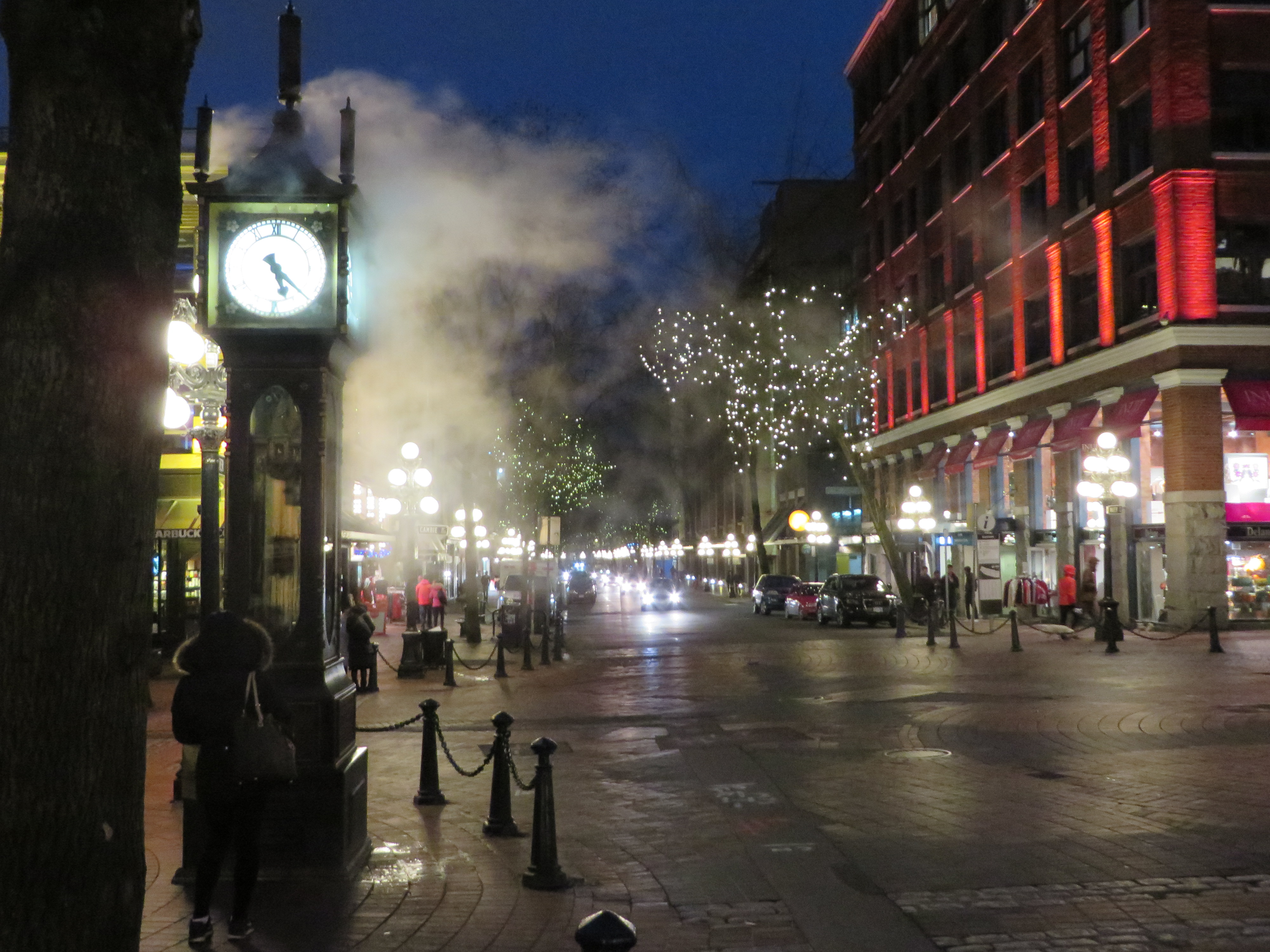
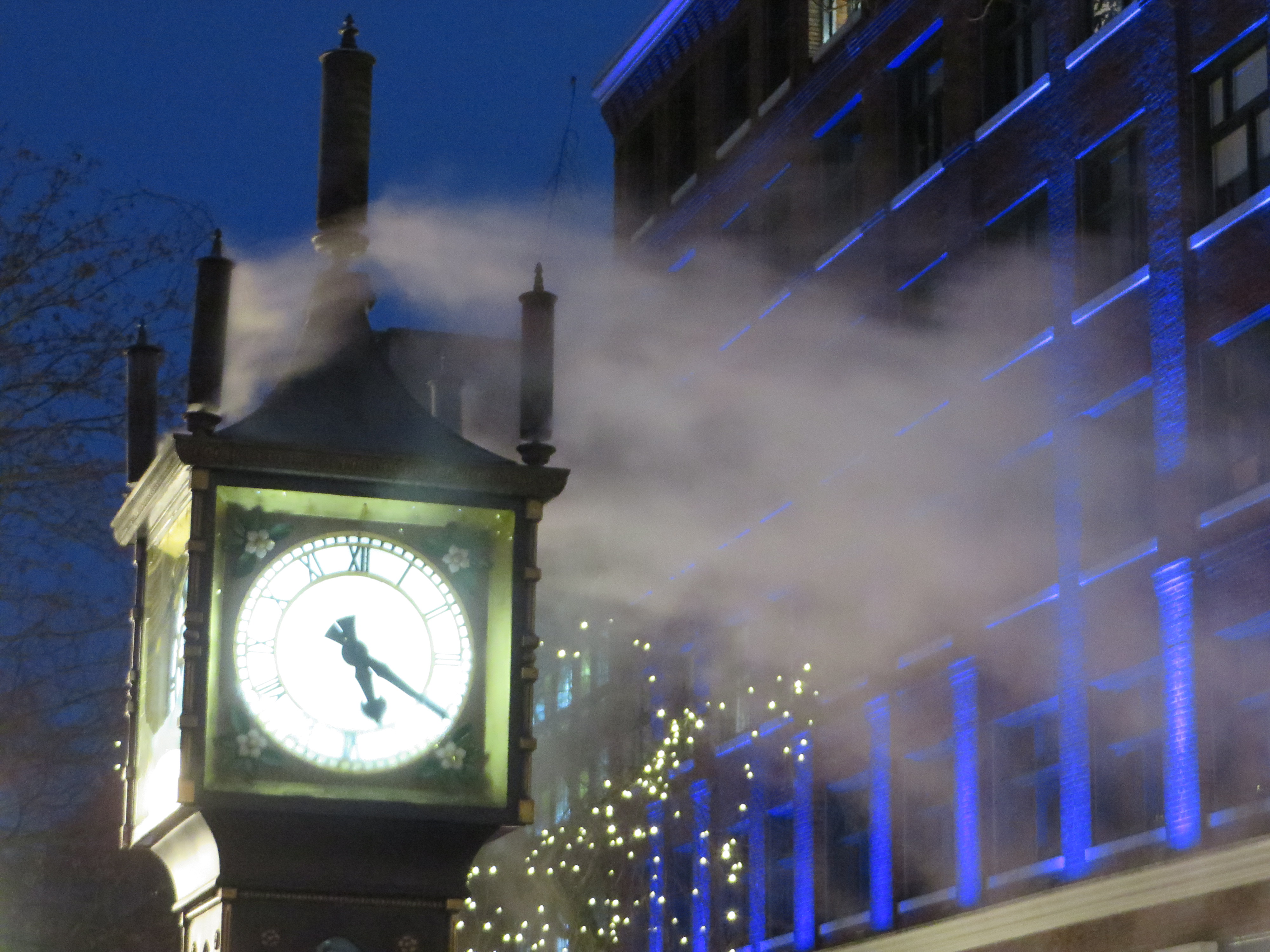
Eventually we arrived in Gastown. It was a particular favorite of mine, before I moved to Seattle and was introduced to Pioneer Square. The two places remind me a lot of each other: both have roots to the oldest part of the towns’ histories, both fell on hard times and became “skid row”, both were on the verge of being demolished when some forward thinking person realized the value, both for history’s and tourism’s sake, and the areas were saved and revitalized. Our biggest Gastown disappointment is that we’d stuffed ourselves so full on Granville Island we weren’t ready to eat dinner yet. It niggled at me a little that we were headed back to the hotel when everyone else was just headed out for the evening, but if I’m completely honest, I was looking forward to the quiet, un-crowded hotel and foggy view.

On Sunday, before heading home, we had lunch at the Dubliner Pub, which is housed in what used to be part of the penitentiary. It was cozier than you might imagine and the brunch there was delicious. We may have stopped at the Hard Rock casino for a flutter before directing the car towards the border, and we may have cleared $33 of the bizarrely plastic-y and see-through-y Canadian dollars, which we have tucked away for our next trip north.

Are there other things on our list to see in Vancouver like the observatory or Dr. Sun Yat Sen Garden (or the neighboring free park) or the scenery  we’ve been promised on the drive to Whistler? Um, yeah. But for our inaugural trip, we were content. And it didn’t hurt that we made it home just in time to see the Seahawks make it into the Super Bowl.

IMG_0769