Category Archives: Seattle

Back Home Again in Indiana

Standard
RGSBlueBottlesFall

Indiana has been clinging to a few leaves just for me, and when I wake up my first morning back home, I’m grateful for its effort. Every one in Puget Sound has been exclaiming about how beautiful the foliage is this year, and it is, but it is more muted oranges and russets interrupted by evergreens. In my part of Indiana, where the hills roll a little and there is almost as much woodland as there is farm land, the colors pop and sizzle. I’m convinced the only place where the fall leaf display might be better is New England, and I’m not even sure about that.  That could just be something the Vermont Tourism Board sells us.

In the first few days I am home my eye is so happy to be looking at a big sky and a horizon instead of layers and layers of office buildings and apartment complexes. Mom complains about how much worse the traffic has gotten since the ethanol plant opened up, and I do notice the loads and loads of grain being carted up the road in long-haul trucks, but compared to siren-infested and traffic congested First Hill, I could be on a deserted island, it is so quiet.

Don’t even get me started on the sunsets or the constellations I can see in the crisp November sky.  In Seattle, we’re lucky to see the moon because of the ambient light and the cloud cover.

This isn’t a home-is-better-than-Seattle post, in case it seems like it is. I’m not unhappy in Seattle, and like most good Hoosiers, I spent a fair share of my youth imagining an escape, dreaming of pulling what my friend Buns calls “a geographic”: moving across country with the misguided belief that a place other than home is infinitely better just by nature of not being the tired town where you grew up, only to discover when you arrive in the new place that all of your problems and quirks and failings have followed you.  So no. I have to let Washington be what it is and I have to let Indiana be what it is and quiet the ranking system that self-starts in my brain whenever I’m in a new place even if at some genetic level I feel like home is “better.”

But there is an ease of being that takes place in your native geography that is astounding. It’s as if I’ve spent the last few months with non-native speakers of English and have had to navigate the quirks of language to get my point across, and suddenly I wake up and find myself in the company of my paisanos, where a gesture is understood without explanation.  In this honeymoon phase of my visit, I’m so glad to be in the land of the un-ironic seed cap and people in Carhart jackets for reasons that have nothing to do with fashion.

My first day home I go downtown to look for something new and fun to wear to the wedding I’ve come home for. In the store, it seems easier to tell clerks that I don’t need help. I’m not navigating around hurried shoppers screaming into cell phones. (In fact, there are so few shoppers in the store I wonder how it stays in business.) When I leave, I stand on the sidewalk to take a photo of the church steeple that was backdrop to my childhood and I don’t have to worry about being in anyone’s way. While I peer out of our little apartment windows in Seattle, the world feels crowded and too full and I want to beg people to quit reproducing because there are too many of us and I am an introvert. But when I am home, there is a surplus of space. In Richmond, if you wanted to walk down Main Street with your arms stretched out beside you, you wouldn’t bump into anyone. At no time while I’m home, will my hips and shoulders be uncomfortably close to the hips and shoulders of total strangers. In Seattle, I’m amazed that we don’t all have communicable diseases because we’re always accidentally touching people we don’t know and pretending we aren’t, staring straight ahead, busying ourselves with our smart phones and creating invisible cocoons around ourselves.

The city is a petri dish.

While I’m snapping shots of the steeple, I hear an older man say, “Excuse me, young lady.” It doesn’t immediately dawn on me that I am no longer young and because I’ve been in the city for so long, I assume I’m in his way and he wants me to move, never mind the perimeter around me that is empty.  I apologize without looking at him and step back so there is more room on the sidewalk. What I’ve become used to in Seattle is ignoring people. It goes against my nature to selectively NOT hear someone talking to me, yet it feels necessary if you have any hope of getting to the drugstore without having to hand out all your dollar bills to the people asking for them on the street corner.

I look at him and he’s a bit scruffy. He has on a puffy, jean jacket and there is a box fan tucked under his arm, which is a little weird for a crisp day like this. He stops in front of me and takes a deep breath, tells me his friend, who is a landlord, just had tenants leave this brand new fan in a vacated apartment. In Seattle, there’s a chance that I’d just not hear him and walk away. But I’m home and it never occurs to me that he could be a threat or even a huckster.  I’m not even in a hurry to dismiss him.  “That’s lucky,” I say. Then he says, “The thing is, I’m tired of carrying it. You want it?”

I can hardly contain my smile at this unexpected turn of events. I assure him that I have no need for a fan but thank him for his offer. He sighs and says, “Well, I guess I’ll just keep carrying it then.”

Later, when I’m driving home, what strikes me is how easy the exchange was. I didn’t ratchet myself up to DEFCON 1 assuming the worst about him and his intentions. He didn’t hold it against me that I wasn’t interested in taking the fan off his hands.

It is good to be home for a couple of weeks, even if I’m missing Z in the process.

A Visit from Chickpea

Standard

The Great Wheel, Seattle

The thing about living on the edge of the country, far away from your people, is that when a friend comes to visit, it’s an event of note. In my case, when Chickpea phoned to say she had arrived and was out front, I ran out of the apartment, left our door standing wide open, opened the building’s door and raced down the steps to greet her. It wasn’t until the front door of the building slammed shut that I realized I’d left my keys inside.  Welcome to Seattle, Chickpea. Can I interest you in drive around town in your rental car until Z gets home from work?

Fortunately, the new maintenance guy broke his code and let us in when he saw us scratching at the glass, looking pitiful there surrounded by her luggage. He was gruff though. “I’m not supposed to do this.”

Chickpea and I met five years ago in the very first workshop of my MFA program. Because I’d read her workshop submission before meeting her—an essay on her tendency towards loudness—I was pretty sure I was going to loathe her. Excess sound annoys me. I have no idea why, when we can put people on space stations and every third person on a flight has on noise-cancelling headphones, we have yet to develop a silent leaf blower, for instance. I don’t need monkish silence, but I like quiet, and based on her essay, Chickpea and I were not going to be pals for auditory reasons alone.

I don’t know if any of you have recently re-lived junior high, but as a newbie in an MFA program, you’d be surprised how quickly you are transported back to the social anxiety and neuroses you thought you’d overcome when you were 13. For the first two days, I’d walk along the grounds on breaks, talking to Z, who was in Zimbabwe, so he could remind me of all the reasons the program was a good idea and all the reasons I should not bail prematurely. Fortunately, I’d packed multiple phone cards for this very purpose, though I knew how ridiculous it was that a grown woman would pace on the edge of Casco Bay, making repeated extremely long-distance calls to Africa for reassurance.  In retrospect, I’m glad for his gentle prodding for a variety of reasons including a lot more knowledge, a degree, and the opportunity to work with some great writers. But aside from that, I’m grateful not to have missed out on the unlikely friendships that developed there.

On the first day of my first workshop, I was anxious to see what Chickpea would look like. I had imagined her big and swaggery, entering a room with a shout and maybe banging a stick against a cowbell, so it was a bit of surprise that she looked normal and didn’t fill the room with extraneous noise. In fact, I can’t remember a single sentence that passed between us those first two days, but if someone in the workshop said something that smacked of the pretentious or that was too precious, she would look at me and make a face. Maybe just an eyebrow raised a millimeter. Before long, I was doing the same to her. Was it rude? Probably, though I had this sense that only we could see the faces we were making because they were so subtle. Was it juvenile? Oh, definitely, but it felt so good to suddenly not be alone in this literary endeavor. In those shared expressions I somehow felt I’d met a paisono, and this made me less inclined to bolt from the program. Within a few days, I was spending time with her and with her group of friends, with whom I felt similarly and strangely connected, despite the fact that they were over a decade younger than I was, and they were way more raucous.  It’s not that I’m incapable of making friends, but as an introvert and as a person who has always felt that old friends were just naturally superior friends, it was surprising how quickly these people mattered to me. The following year when I attended their senior readings and graduation, I openly wept. It was bewildering to me that people I had spent so little time with could matter to me so much.

When people visit us, I always mean to be an excellent tour guide. Seattle has a lot to offer, even when the sun isn’t out, but Chickpea and I were so busy talking about writing and relationships and things we hate and dogs we love, that the city seemed secondary. Sure, we went to the Market and to the Olympic Sculpture Garden, but we could have spent all that time in a booth at Denny’s if you want to know the truth. At least I could have. Sometimes out here I get a little lonesome for friends. Or rather, I don’t notice that I’m lonesome for friends until they are here and then I want to drink them up in huge gulps.

Summer before last, Z and I were away from the city for awhile, and when we got back, a giant Ferris wheel had been built on the edge of Elliott Bay. We didn’t know we’d been missing a Ferris wheel on our landscape, but then there it was, lit up like a blue and green Christmas tree when the Seahawks play a home game, and now it’s hard to remember what it was like before The Great Wheel was there. It makes the waterfront look a little less utilitarian and a lot more fun. Chickpea and I went up for our three spins around. Like all good Seattle tour guides, I spent much of the ride telling her all the things she couldn’t see because of the hazy sky: no Mt. Rainier, no Olympic range. Later, we would learn a pod of Orcas had been in the bay, so we could have been looking for those and enjoying what was in front of us instead of focusing on what wasn’t.

Chickpea lives on the east coast, so when I go home to Indiana, it’s not like she’s on the list of friends I’ll get to see.  When we say goodbye at the airport, it’s not like there is any schedule for when next we’ll be together, talking about the merits of Scottie dogs or why we loathe Joyce Maynard. Instead, we just have to be glad for the time we had together, make a plan for an exchange of our writing, and hope that not too much time will pass before we see each other again. Goodbye, Chickpea.

And then, a half hour later, the cell phone rings. Chickpea has missed her flight and if Z and I are inclined to fetch her, we get a few more bonus hours with her. We point our rental car in her direction and accelerate.

Remembrance of Things Bulldozed

Standard

CraneSeattle

Every time I go home to Richmond, there’s a certain sadness that comes from seeing how much things have changed. I don’t stay away long, but even so, when I come back, yet another formerly gorgeous Victorian mansion has been demolished leaving in its place a grassy lot with worn stone steps that go nowhere.  Restaurants I grew up loving have gone out of business. The hospital, parts of which were beautiful and where some of my first memories of the town are stored, has been abandoned and looks both haunted and haunting, standing there empty with its eyes poked out and its structure ravaged.  (A brief aside: those first memories I speak of were not my birth, but because my mother worked there. Before I knew that things I wanted had to be paid for, Toddler Me tried to make off with a toy toaster from the hospital gift shop.)

If you don’t look in the right places where things are still lovely, it’s a heart breaker.

I was raised to appreciate the town’s history and my heritage.  How Quakers (and ones I was related to, which gave me a sense of unearned pride) from North Carolina had made the trip northwest, in part, because they disagreed with the institution of slavery. I knew which parts of town had been settled first, how the gorgeous, crenellated courthouse had a hanging balcony even though no one had ever been hung there, and what businesses had been on what corners at a time that pre-dated me. I grew up in the oldest part of town before it had been revitalized, and I knew that the streets used to have names instead of numbers and on certain buildings you could still see the street markers embedded in the brick. Market and Marion was my favorite intersection, a block from my elementary school.  There was something about these hints at how the place used to be that made me wallow in melancholy and long for a past that I was sure was better (and more aesthetically pleasing) than my 1970s reality.

In addition to the town’s history, I’d also been schooled on family history as it unfolded in this town. I knew which Catholic church the Irish people went to and which one the Germans went to, where my maternal grandfather’s car lot had been, how my other grandfather worked at the old post office, now the site of the Indiana Football Hall of Fame, where my parents met, how my great aunt worked at  the Hoosier Store , where the furniture store had stood before it caught fire in the 1968 explosion that killed a great uncle. I could locate the place where the interurban used to run, connecting Dayton to Indianapolis. I wondered at a postal system that had two deliveries a day and what it must have been like to live at a time when a horse and wagon brought milk (and ice!) directly to your house.  I knew the location where the “girlie” shows used to be that an otherwise God-fearing great-great grandfather was reported to have visited with some regularity.

Somehow I knew it was important to remember and acknowledge this past, despite the fact that people in towns all over America had similar memories and histories. But I liked wallowing in the notion that somehow “my people” had been living life more lovely than I was, and so often I would spend as much time thinking about how it all “used to be” for them than I did noticing the present I was actually inhabiting.

One day before I got married I was driving across the new bridge, hollering to myself about how ugly and modern it was compared to the old bridge.  Suddenly, I was struck by the notion of how much simpler my life would be if I weren’t always reflecting on a past that wasn’t even mine.  I imagined it would be the most astounding kind of liberation, not to have to feel your blood pressure go up when a favorite building was demolished or when another big box store usurped the heart of downtown.  What would it be like to just live my life and not drive past the Leland Hotel without having bricks and mortar trigger a spiral of thoughts including the hotel’s former grandeur, how before it was a building, it was the site of a casket factory where my great grandfather worked at the end of the 19th century, and from there have my imagination take over with constructed memories about how hard it must have been for him to leave his parents in West Virginia, and how hard it must have been for them to leave Ireland and back and back and back . On a drive from one side of my small town to the other, I could have been crushed by the weight of other people’s histories.

And then I moved to Seattle. I missed home regularly, but after a few months I was struck by how light I felt in a city where I had no emotional attachment to anything. It’s as if the Rockies and the Cascade Mountains were holding back all the history of home that had made me broody my whole life. It was a strange sensation to listen to the news and realize I didn’t particularly care if the heavily trafficked but sort of hideous viaduct downtown was demolished. If I saw a wrecking ball, I didn’t assume it was destroying something historically important.  Instead, I’d cross my fingers that a grocery closer to our apartment was going in. Because Seattle is younger than my hometown and none of “my” people had settled it, I’ve been detached as it moves and shifts around me.

But lately…I find I’m suddenly aware of the changes that happen in my vicinity, and I  don’t always like them. Two years ago the grocery down the street that was perfect if you had a late night baking or cooking need went out of business, and I’m still bitter about that loss, but it was more an issue of being inconvenienced than feeling like the fabric of society was ripping.  And of course I was upset when two bookstores I regularly visited went out of business, but that’s how I feel about all independent bookstores everywhere that can’t compete with that other colossal “local” bookstore  (that begins with an A).

No, what I’m noticing now are much stronger negative reactions to changes like the disappearance of an entire swathe of diverse buildings in Capitol Hill—the gritty sort where you can imagine what Seattle was like before the rest of the world discovered it and started fancying it up—which have been replaced by layers and layers of living space that looks identical to the apartment tower next to it and behind it. In the seven years that Z has lived here, Broadway has become more upscale strip mall and less quirky neighborhood haven for artists and social outcasts.

I still can’t even talk about the heartache of the neighborhood Greek diner going out of business and being replaced by something Asian.

Other, smaller changes have begun to bother me: a re-configured turn lane to accommodate the streetcar that will soon be in place (a good thing, really, but still, it rankles);  a dirty-looking hookah bar, parking lot, and drive-thru coffee hut bulldozed in one fell swoop for yet another apartment tower in an area that doesn’t really affect my normal line of sight, but I find the shadows from the taller building off-putting; the removal of an authentic Mexican restaurant so a Mexican food chain could go in its place.

Last week I was mentally growling at a crane and pile of rubble two blocks from our house and realized that I had finally gone round the bend. I was lamenting the absence of what had only ever been a façade for the whole of our Seattle experience. Someone knocked down a building, left the front of it standing, propped up with two-by-fours, and the debris left behind was inhabited only by some street-smart raccoons. What exactly was it that bothered me about that particular eyesore being replaced with the promise of something more substantial (and less raccoon-y)?

The best I can figure is that what I’m railing against is having the backdrop of our history here changed. When Rick first came to Seattle and I started visiting, we were focused forward: our newly discovered love, a new city to explore, a new phase of life. Our history was miniscule—there was nothing to pin to the corkboard in our minds of “how it used to be.” It was a good time; everything was in the present tense.  We may never have gone into the Lusty Lady, a downtown hot pink peep show venue that had been hawking its wares with some hilarious and pun-filled signs for 27 years, but it was part of the landscape of our new life together, and all that mystery and hope. There’s still plenty of both of those ingredients, but some chapters have been written now. When we walk by what remains of the big pink marquis and see “Space for Rent” in place of “We Take Off More than Boeing” it feels a little as if  “Early Beth and Z” is being slowly erased.

Fortunately, new memories are being constructed here daily.

A Little Cup of Zim

Standard

RGSCederbergTeaHouseFlags102113

Sometimes on weekends Z and I get this awesome $9.99-a-day car rental from Enterprise because we’re “preferred customers.” The only time this is useful is in the winter when the tourists have gone away and there is a surplus of cars or when we are at the airport rental facility where we can zip into the preferred customer lane and by-pass the line of people, who are generally looking at us as if they hate us. (If I’m dressed well and can pretend I’m someone important, it bothers me less, but when I look like a hobo, I feel guilty because normally I’m just one of the poor slobs waiting in a tedious line right along with everyone else.) In fact, this summer right before we left for Zimbabwe, being a preferred customer was not helpful at all. We tried to return a car to a different location the day before we left to make our schedule a little less tight, and the preferred customer customer service representative basically said, “tough luck” and then had the nerve to ask, “Is there anything else I can help you with?” seemingly oblivious to the fact that he hadn’t helped me at all. Normally, I’m so sweet and placating to service people that I make myself nauseous, but because I was stressed out from packing, I had no sweetness to give this person in a call center in Dubuque who was not sympathetic to my plight. So I said very sharply, “Well, the time to help me would have been now, and you can’t seem to do that.” The thing about a cell phone is that it is not so satisfying to hang up as a phone with a cradle, where you can take out your frustration on a safe, inanimate object.

Remind me why I’m telling you this story? See, I just got all annoyed again and lost my train of thought. Okay. I think I’ve got it.

So Saturday we had a rental car simply because it was cheap, I had a baby shower to go to, and the whale bathtub that the impending baby was getting as a present from us would have been a pain to tote on the bus. After the shower was over, Z picked me up and we were both pleased that I’d scored a jar of peanut m&ms as a game prize and a jar of homemade jam from one of the hostesses, but we couldn’t figure out how to celebrate my winnings. We made no plans for the car beyond the drive to the shower. We weren’t ready for the day to be over, but driving around aimlessly seemed pointless. Fortunately, as we got closer to home (exclaiming over every red, orange, or yellow tree we zipped past), Z remembered that there was a South African tea shop that he’d been wanting to check out in Queen Anne.

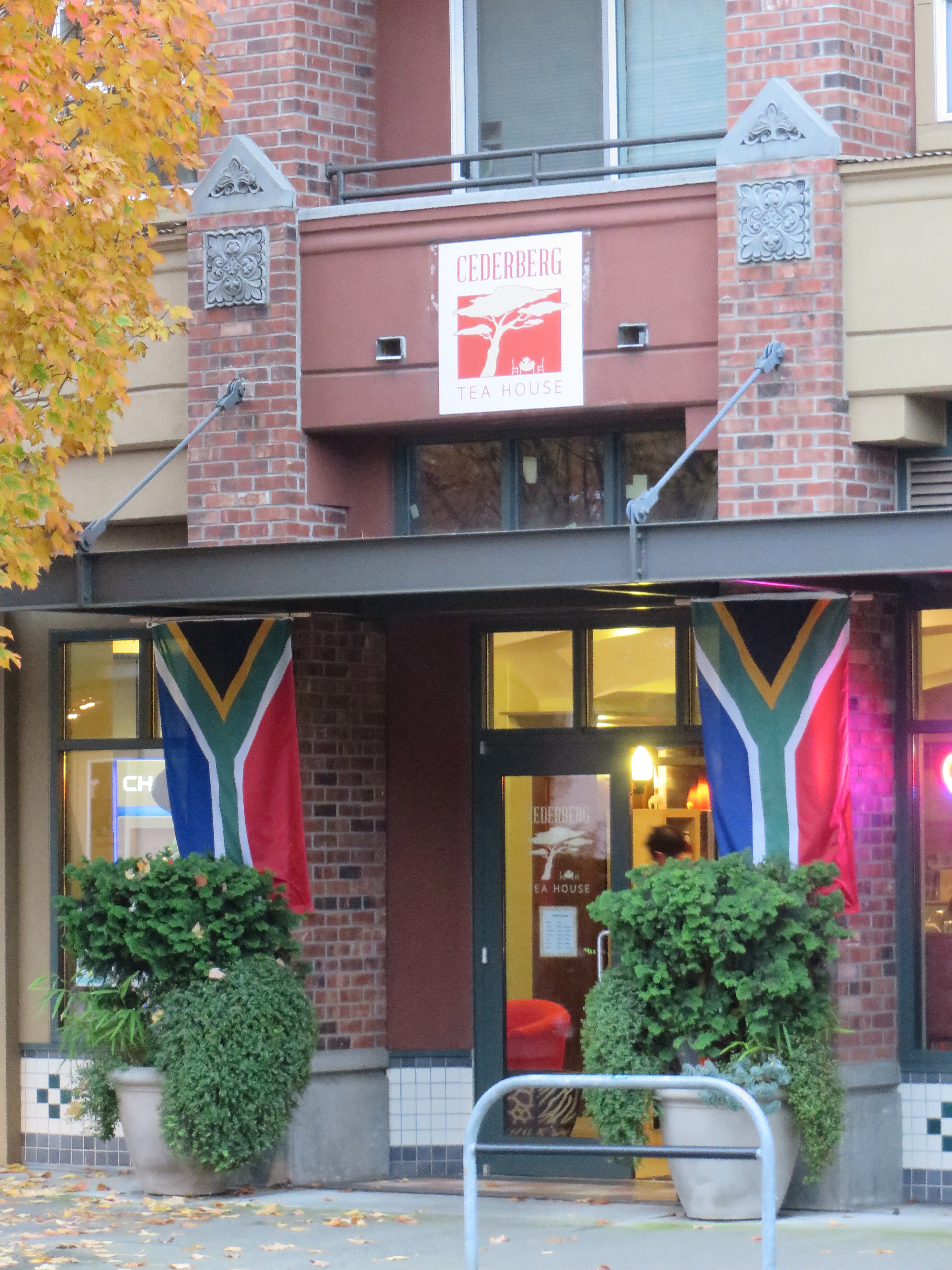
We couldn’t remember the name of it or where it was exactly, and my semi-smart phone was dead, so we were flying blind. I vaguely remembered that the front of the building where it is was “kind of roundy” and Z was fairly certain that it was upper Queen Anne at the top of the hill. So we drove and went ahead and parked in the area where we thought it might be, and we were about to cry uncle and go to Chocolopolis, which looked promising. And then I spied the South African flags. Above it was this sign, with what might be the world’s most charming business logo.

RGSCederbergTeaHouse102113

It’s worth noting here that I am about to commit one of the sins that Z hates. I am about to talk about being reminded of Zimbabwe and tasting the flavors of Zimbabwe and feeling a little like we were home in Zimbabwe. As if Zimbabwe and South Africa are the same country. They are not. They have their own cultures and customs and foods, but some of these things have been adopted or shared so for our purposes, let’s pretend they’re second cousins anyhow.  (And word to the wise, if you ever talk to Z in person, be sure to let him know how clever you are and that you recognize there is no country called Africa, that you fully recognize it as a continent containing diverse sets of people. He’ll think highly of you for making that distinction!)

In a land of coffee houses and no southern African food, Cederberg Tea House was a real treat for us to stumble upon. Rick often misses the tastes of his “real” home and goodness knows, if it’s not Pop-tart Surprise, I can’t duplicate it.  The shop was inviting. There was a good bunch of tables and chairs, plus the requisite sofa and overstuffed chairs by a fireplace. Photos of African animals lined the walls, and there were even two stands that displayed various specialty items that I’d been looking at with some regularity with Z-ma in Harare. (Who doesn’t want Eat-sum-more cookies?) My favorite thing there though was a collection of Origami African animals that had been folded out of animal print paper. Adorable.

Eet-sum-mor

The South African woman who runs the shop with her parents and her husband greeted us warmly even though it was close to closing time.  She recognized Z’s accent and so they talked briefly about home while I peered in the case at the koeksisters and melkterts. We ordered a pot of black  tea and then listened as other customers came in and the woman explained to them the variety of teas they had and their special concoction that makes a sort of tea espresso.
Our pot of tea came in a groovy pot on a contemporary tray. A delicious butter cookie each rested on the doilies under our very modern cups. In addition, we’d each ordered a koeksister.

The verdict? Delicious. The tea was good. We personally think Z-ma’s koeksisters are more delicious and certainly we appreciate that she presents ours to us in a plastic tub filled with multiples of the little syrup-soaked pastry twists, but these at Cederberg Tea House were a very, very close second, so we were not complaining.

We stayed longer than we meant to, making comparisons and reminiscing about our time in Zimbabwe last month. We studied the menu to see what we might get next time (sandwiches!).  It was a bit of unexpected fun that our rental car drove us to this weekend, and I think it may get put on the “things our guests should experience” rotation, since most of them might not have a chance to go to southern Africa. You really shouldn’t have to live your life not knowing what koeksisters taste like.

P.S. You should visit their website and read on their blog about the contest for their sign and how it went missing: http://cederbergteahouse.com/

A Beautiful Day in the Neighborhood

Standard

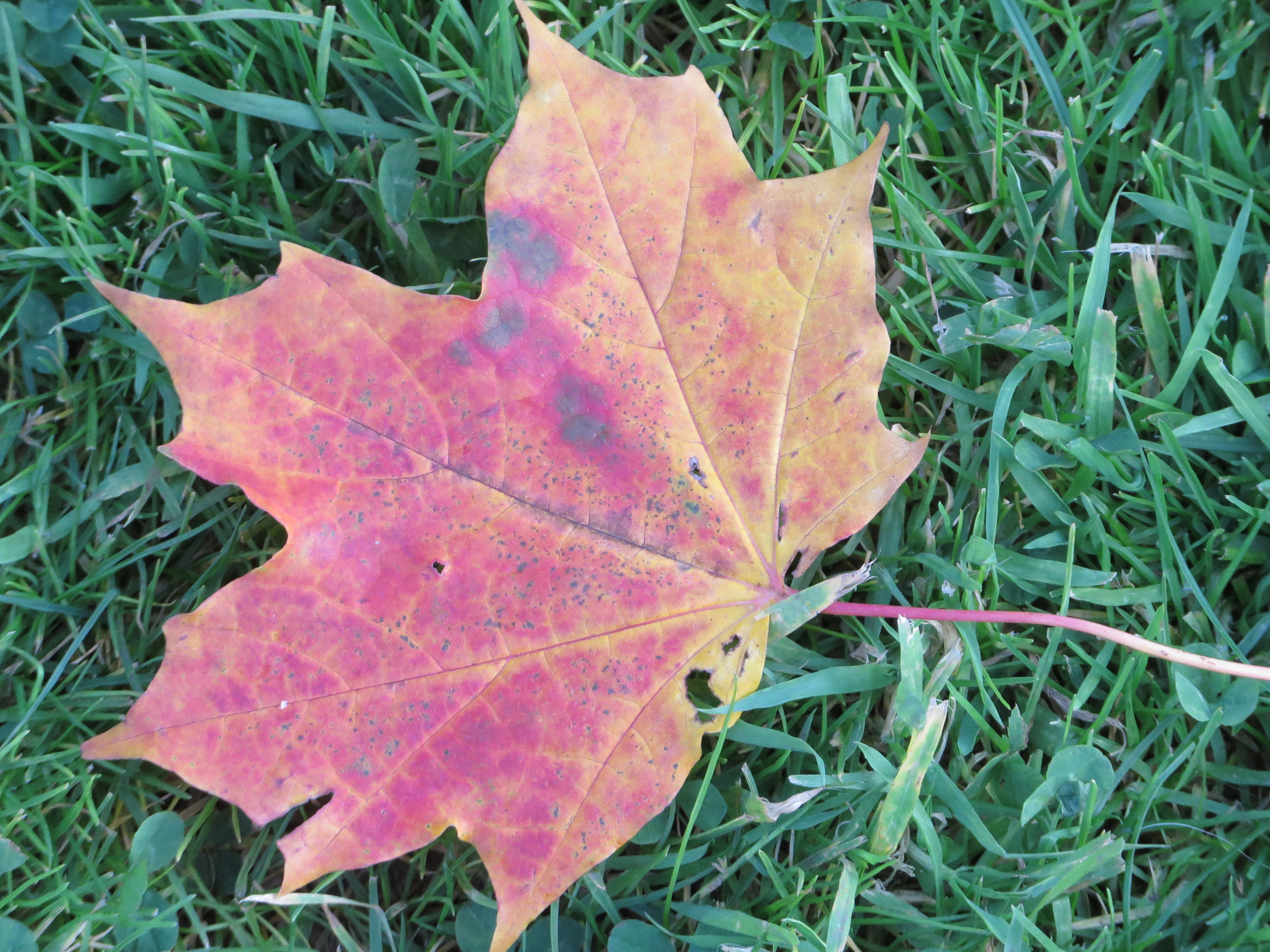
Leaf

One of the things I’ve learned to love in Seattle is a sunny day.  It’s not that they’re exactly rare here (Indiana has its fair share of grey), but when the sun is out like it was today, it’s a celebration and I don’t want to ignore it on the off chance that I won’t see it again until May.


Since I had an errand to run near Z’s campus, I decided to make an afternoon of it. I loaded my bag with a book of Lopate essays, my laptop, and my camera, and headed to a picnic table under a maple tree within sight of my beloved dog green.  Z came out of his office to give me a kiss before heading off to his class, which was also a bonus. I held my face up to the sky and I swear I could feel the Vitamin D going right into my pores. (This is not something you will ever see me doing when the temperature is above 65, by the way.)


Before I had a chance to pop open my laptop, an older guy ambled toward me. He was carrying a paper coffee cup and a reusable grocery bag, and because the sun was in my eyes, I had no idea how to categorize him: should I smile or gather my belongings and find another spot. Before I could suss him out,  he said, “Do you mind if I share this space. I’m a writer. I won’t talk to you.”


I could hardly say no to a writer who promised not to speak. Fortunately, it was a day when I was feeling great love for Seattle and all its people and not one of the days when I want to scream at passersby, In the name of all that is holy, can I not have two quiet square feet to myself for fifteen minutes? Because it was a good day, I sat beside this stranger and wrote. I tapped words into my computer and he scrawled out pages in a dark script on a steno pad. I wasn’t tempted to look surreptitiously at what he was writing, though I did glance at him out of the corner of my eye when I heard him reading what he’d written under his breath.


Some of my more extroverted writer friends have writing partners, people with whom they get together on a regular basis and sit for a couple of hours working on novels. I’ve never understood. In general, any sort of human distraction is deadly to me. I can’t imagine getting together with a friend and not spending the designated time talking about writing instead of doing the actual work. The only reason I can write with Z is because he has this willpower and focus that doesn’t allow for interruptions or distractions. (Such an annoying trait when you yourself want to goof off.)


It was a bit of a surprise when I looked up from my laptop and it was almost two hours later.  Because this complete stranger had been sitting beside me, it hadn’t occurred to me to waste time in all the ways I usually do. There was no internet surfing. No staring at the dogs. No watching passersby and guessing what their lives were like. I put my head down and I wrote. (Though it was impossible to ignore a squirrel with its mouth full of orange maple leaves that stopped a foot away from me and stared.)


The sun had started to go down and it was too cool to comfortably sit still and write anymore. Z would be coming along soon and there was a particularly bossy corgi on the green that I wanted to see up close. I packed up my stuff and the man said, “It’s been a pleasure writing with you. You’re an excellent writing partner.” I commented on his handwritten drafts and my need for the keys clicking under my fingers. He told me to have a good evening. The end. Perhaps I am capable of getting together with someone and writing so long as he or she is a total stranger. Before you know it, I’ll be writing in coffee houses just like a bad Seattle cliché.


So that’s it. One perfect fall day. If the rain comes this weekend and knocks all the leaves down, I won’t be able to complain.


Idle Worship

Standard
Margaret Atwood at Town Hall, Seattle

Margaret Atwood at Town Hall, Seattle


Sometimes I feel stuck and I have no idea how to unstick myself. My lack of traction at the moment is that for over a week I’ve been wanting to write a post about Margaret Atwood, a literary idol of mine, who spoke at Town Hall Friday before last. None of my words seemed worthy of hers. When I read her dystopian novel, The Handmaid’s Tale, in college, it changed my life irrevocably. I don’t say that easily about many books, and maybe at 20 I was ripe for change and new ideas anyhow, and her writing just happened to be what I latched onto. Shortly after I discovered her, I heard her speak, and then spent part of my twenties wishing I were more like her: cleverer, more driven, more prolific, more talented, and considered part of the literary canon.


Maybe it’s not surprising that I’ve spent ten days typing a line and deleting it, only to start again with a slightly less good line. I’m hoping I can sneak up on it sideways to see if I can get the job done.


Town Hall has nothing to do with city governance in Seattle and everything to do with culture, and though I often curse on nights when we have a rental car and can’t find parking because there is a concert or speaker there, I have to admit that one perk of being in Seattle and living on First Hill is that Town Hall is a single short block from where I live.


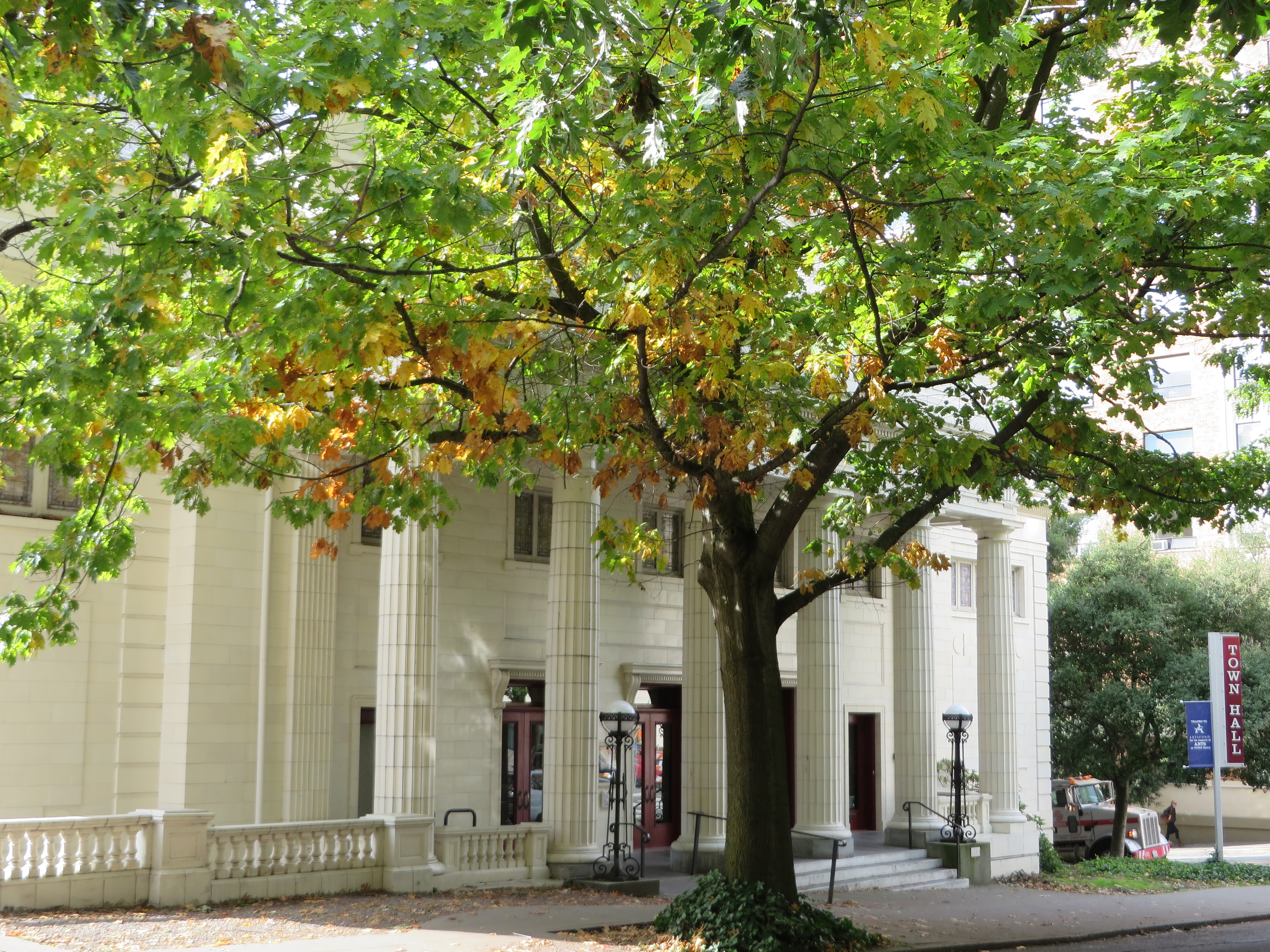
The building itself is gorgeous. It’s a Romanesque revival-style (former) church built nearly a century ago in what was then Seattle’s first suburb but now feels more like downtown. In the late 90s it was turned into a cultural center for music, readings, cultural discourse, etc. Outside it is an expanse of white with huge columns. Inside it’s all arched auditorium, groovy old light fixtures, and open space. (My only beef with it is that it has old wooden church pews and while that was not a problem at an hour-long author event, the nearly three hour medieval music concert awhile ago felt like it lasted six. But the pews do look good!) Town Hall is one of those places I admire when I walk past but completely forget. I’m often discovering two days after the fact that some author or speaker was in the house. When I do managed to go inside, I’m inevitably annoyed with myself for having been away so long.


Town Hall, Seattle

Town Hall, Seattle

Perhaps it’s not surprising that I like being inside of this space. When I travel, I love to find an old church or cathedral and sit on a pew for a while and look up at the arches and think my thoughts while other tourists mill about and the more penitent pray. And though there’s no preaching in this structure, it still has that churchy feel.


I grew up with a firm belief in a Christian God, though because my father was Catholic and my mother was a Protestant who was prone to sometimes follow the suggestions of friends and neighbors about what Protestant church was best, my church attendance was a smorgasbord of liturgies. I had no idea which one was “right”, (though a few were convinced that all the others were wrong), but I found the ritual in each fascinating, I loved, particularly, sitting in the oldest churches in my hometown imagining the generations of people who had sat there before me.  One of my favorite periods was when we went to the century-old Presbyterian church with the gothic arches and Tiffany windows. I often left these various church services with a simultaneous sense of wonder and envy that the congregants in each church seemed to feel that they belonged there. On a rare occasion, I’d feel a little fresher.


If I’m honest, I was bored a lot when the ritual stopped and the preaching started. I’m not the best listener if the topic doesn’t interest me, and I’m a particularly bad listener if someone is trying to boss me up, which seemed to be a recurring theme in many of the churches I went to during my formative years. The ones I loved most were heavy on ceremony and the ones I liked least were those obsessed with the End Times.


The only time I ever felt the sort of belonging that I imagined others felt, was when in my thirties I was on a quest in Chicago to find the church where Madeleine L’Engle–my first contemporary literary idol–had gotten married. I was in a stalled relationship and was being pushed from all sides to make a decision about whether it needed to be totaled or have the engine rebuilt, and I suspected that if I was in the church where L’Engle had married the man that she would write about so lovingly in her Crosswicks trilogy, I could figure out my future. This really had nothing to do with God in that if L’Engle had gotten married in Lincoln Park, I probably would have headed there and sat on a park bench for an hour with a squirrel while I tried to come to some conclusions about where my life was headed.


Though I went into that church, St. Chrysostoms, hoping to walk around anonymously in the quiet, there happened to be an all-day service in progress for Good Friday, which entailed readings from the clergy and long periods of silence for reflection. I sat down to be polite and tuned the readings out, but at some point realized that while there were the expected passages from the Bible being covered, there were also gorgeous passages being read from both classic and contemporary literature.  And while the passages addressed the obvious issues of sin and redemption, it was a fresh way to tell an old story and it hooked me. My synapses started firing. Suddenly I was not just looking at the architecture and wondering exactly where Madeleine L’Engle and her husband had stood or who was present for their wedding or if they used traditional vows. In fact, I quit trying to channel her at all and instead just sat in the silence that followed each reading as the words from the novels and poems reverberated inside my head. A denomination that recognized and held up secular writing as examples of beauty and testament to the human struggle seemed infinitely more holy than some of the repetitive and occasionally mean-spirited words of a man in a robe or cheap suit or blue jeans and blazer, preaching whatever his particular brand of gospel was. Who knew this was possible?


So Friday before last, Hudge and I made our way into Town Hall to hear Margaret Atwood talk about her latest book from a series I never read. Somewhere between my twenties and my forties, I’d kind of lost my fascination with her books. I’d veered away from fiction and into nonfiction waters, and her regular recent fiction about possible outcomes for our overcrowded, environmentally stressed planet didn’t sound very inviting. Particularly because while I was living in a cornfield in Indiana it seemed a very far off future, but here in Seattle it seems like maybe we’ll have to start the moon colonies sometime next Tuesday. (There are seriously too many people here.)


Now? I can’t believe I considered not going (to the reading, not the moon colony). The woman who introduced Atwood mentioned how important The Handmaid’s Tale was to her, how it changed her life, and I looked around at this former sanctuary full of women and men of all ages and races nodding their heads, and I was transported back to the late 1980s when I first held the book in my hands and realized feminist wasn’t a dirty word, when I realized that a few of those churches I’d found myself in as a child had been selling fear instead of comfort and could have been rough drafts of the theocracy that wreaked havoc in the lives of the women in Atwood’s novel. Or when I realized that words could be powerful.


Margaret Atwood herself came out, clutching her purse to her side, as if, perhaps, one of us might leap up on stage and steal it.  She never did set it down, though she seemed to instantly warm to us. She had this look of amusement on her face, like it was fascinating that anyone would have bothered to come hear her. When I counted up how long it had been since I last saw her and realized it was twenty years, I was shocked to see how unchanged she seemed to be.


Everything out of her mouth was either hilarious or wise, or both. She reminded me of my favorite sorts of college professors—that is, I wanted to write down everything she said in my little notebook but I couldn’t write quickly enough. I can’t remember specific nuggets of brilliance or inspiration to report here, but I do know she managed to make her responses to tired questions sound fresh and thoughtful.


At one point, a young woman asked if a story she’d heard about Atwood’s time at Harvard when “girls” weren’t allowed to use one of the libraries was true. Atwood repeated the question in an overloud, comedic way, making her voice reverberate throughout the auditorium. She talked briefly about how, yes, it was true, and that the work she wanted to read there was modern poetry, but because she was unable to scan those shelves, she went instead to a different library not afraid of admitting women. There she found a bounty of Canadian literature, the implication being that it shaped her writing in significant ways. She had done what women had been doing for centuries: she found inspiration where she was able and discovered something she might have otherwise missed. The young woman commented on how calm Atwood seemed about this. “How are you not angry?” she asked.


Atwood spoke in the same, comedic, loud voice, “Because I am ooooold.”


There was something striking about seeing this young woman, full of righteous indignation, at roughly the age I was when I first read The Handmaid’s Tale, Atwood, full of the wisdom and experience of her seventy-three years, and me, pig in the middle.  When I saw her at 25, I wanted to BE her, but all of these years later, I am content to be myself, even if I’m not famous, haven’t won any literary awards, and don’t have a Wikipedia entry for myself. Though I admit she’s the kind of older woman I’d like to grow to be.


I’m still not satisfied with this post. My threads aren’t pulling together as tightly as I want them to.  Other than the architecture, I’m not sure why hearing Atwood at Town Hall in Seattle reminded me of the churches of my youth or my first realization that I was more comfortable in spiritual practices that ask questions instead of those that give rigid answers. All I know for sure is that when Hudge and I got caught up in the crowd as it exited the building, it was like the end of a good church service. I felt electrified and blessed.


First Day of School (and I Feel Fine)

Standard
Beth writes.

Beth writes.

Because it’s nice out, I decide to go to Z’s campus midday, write in the library, and meet him after work. I have a couple of errands to run nearby, so I load up my bag with my computer, a pad of paper, five pens I won’t use, and the promise that if I don’t stop at Cupcake Royale, I’ll let myself buy something (another pen or notebook) in the campus bookstore before I get to work. I run my errands, wave at Z when I pass his office window, and make my way past the grassy expanse where a delightful array of neighborhood dogs races around, happy to be dogs outside with other dogs. This is perhaps—with the exception of Puget Sound or Lake Washington—the happiest spot in all of Seattle to me, and whenever I see well-loved and well-behaved dogs frolicking here, I pray that campus security will continue to turn a blind eye to the flagrant off-leash rule breaking because it’s good for my soul.

The campus is busier than it has been all summer, and as I zip into the bookstore and see the line, I remember why: it’s the first day of classes. Of course. I won’t be buying any unnecessary writing equipment today because the queue for textbooks snakes around the store. When I go outside, it finally registers that these are students making the campus more lively than it has been for months.

And then it hits me: this is the first fall in eighteen years that I haven’t had my own classes to teach.

Z’s campus has never been mine. My teaching was in Indiana in my hometown. Though in my youth, I’d probably had fantasies about teaching at some tree-covered east coast college, as an adult, I never really imagined teaching anywhere else. I loved working in a place where I knew and understood the community as well as I knew myself. I loved teaching the children of people I’d gone to high school with. I loved walking across campus or running to that bookstore or library and saying hello to ten different people I’d known for years. It was my home.

But I wasn’t counting on Z or how he is my real home even if his GPS coordinates and the coordinates of my hometown are two thousand, three hundred and seventeen miles apart.

After we got married, I taught courses online for the same school, returning multiple times a semester for work obligations, and lived with a foot in Indiana and a foot in Seattle. It was a weird existence. When people would ask me where I lived, I had a hard time answering. In retrospect, I realize I’ve always been the sort of person who pulls a Band-Aid off a millimeter at a time instead of in a single, painful rip, and this move to Seattle has been no different. That is, until May when I resigned and began this new stage of my life in earnest.

Hello. My name is Beth. I live in Seattle.


Z and I decided that if ever there were a year to discover if I liked the life of a full-time writer, this was the one. I’ve got multiple degrees assuring the world (and myself) that I am one, I’ve been writing since before I could string multiple words together, and this will be my first opportunity not to distract myself with the writing of students in lieu of doing and promoting my own.

So here we are.

My name is Beth. I live in Seattle. I am a writer. I don’t care where you put your commas.


Still, it is very strange to be walking across this campus, looking at these 19 year olds and knowing that there are no 19 year olds anywhere in the world that I am currently responsible for educating. I can’t quite name the feeling. It’s a mélange of excitement and contentment, with just a few drops of wistfulness. Two drops. Maybe three drops. I suspect one of those drops is really just wistfulness for feeling as if I belong somewhere.

I set up shop in the library at a table that looks out at Mt. Rainier, when it can be bothered to show itself. Today is one of those days. I write for three hours, looking up at it periodically and stretching. Though I want to wander around the stacks and find books to lose myself in, it feels like the mountain is looking at me sternly and telling me to sit where I am and do my work. So I do. That thing has lava in its darkest recesses. Who am I to argue?

At six, I meet Z outside of his classroom, and we walk to the dog lawn, where I wait for him while he runs to his office to drop off his books and papers. There is a tiny ribbon of envy I feel unfurl when a student greets him by name or I picture him in his office being greeted by colleagues or grousing with them about some overlord who is causing them grief. I’m a lone wolf now and unless I want to start randomly complaining about the publishing industry to strangers hammering out novels in coffeehouses across the city, I’ll have to save my work angst for emails to writer friends.

The sun is shining. The tails of twelve dogs are wagging wildly. Z walks towards me, and we head off toward our apartment, where I have notebooks to fill and not a single paper to grade.

Things I Forget About Seattle When I’m Gone

Standard
IMG_1487

When I’ve been away from our apartment, I sometimes long for its coziness and I may even miss the hum of the city if I’ve been too long listening to crickets (or roosters).  But without a doubt, there are a host of things that I forget about the place that are a shock to the system when I get back.

  • Seattle possibly has too many people in it.
  • There are too many people having accidents and then being delivered by shrieking ambulance to one of the three major hospitals in our neighborhood. (Be careful out there, Seattle Citizens. Z and I are watching Orphan Black and your emergencies sometimes interfere with our TV viewing.)
  • Seattle is full of hills and we live ¾ up one of the steepest ones. Despite the fact that I know where the ascent is easiest, it’s still a workout.
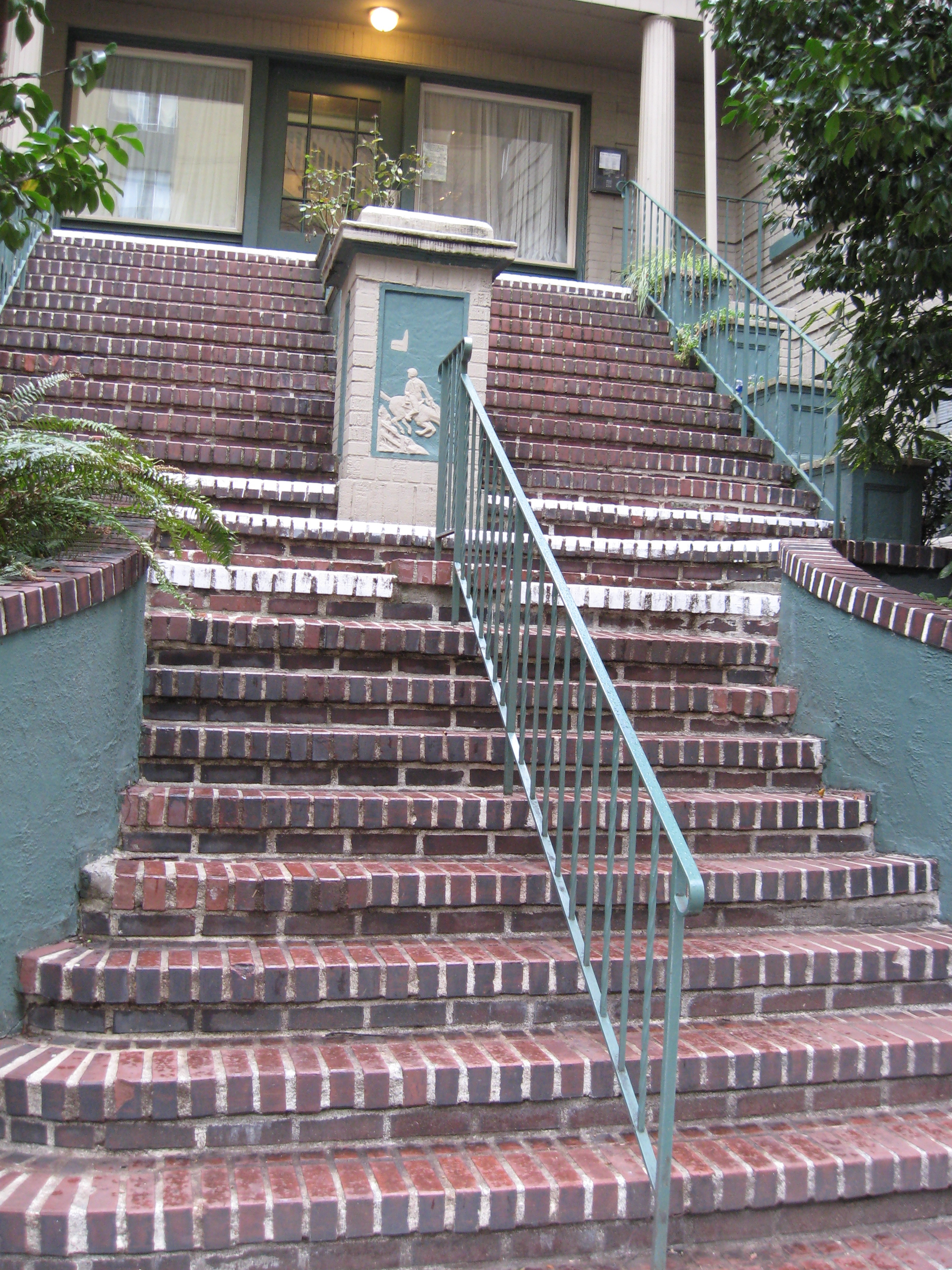
  • There are 23 steps outside our apartment building. (It feels like 53 when we’re carrying groceries.)
  • 0ur building manager is lovely but sometimes promises things and doesn’t deliver them right away. In this case, a much coveted dishwasher. Coupled with this realization, is the harsh realization that Eunice did not travel back from Zimbabwe with us, and I am the house dishwasher since Z is the house cook.
  • The M 303 bus idles outside our living room window five hours a day, starting at 6 a.m. depositing soot onto our windowsills and on onto our westernmost belongings.
  • The buzzer for our apartment building is outside our bedroom window and our building mates have a lot of noisy, late night friends, pushing all the buttons except the right ones. I try to comfort myself with the knowledge that at least Amanda, the possible prostitute and/or drug dealer, no longer lives here. The buzzer was humming back in those days.
  • We don’t have a car in the city unless we rent one, so those groceries we need must be toted up the hill (or down the hill, depending on which grocery we use).
  • We left the apartment in kind of mess.  We always do this. Departure times are a big surprise every time, and I am a time optimist.
  • Z will be going off to teach in a few short days and it’s going to be lonesome in the apartment, just me and my computer and the screaming blank page.

And then there is the weather.

My first trip to the Pacific Northwest was to a writing conference in Vancouver, B.C., in 2005. While there, I took a tour of the city and ended up on the tour bus by myself with a very chatty U.S. ex pat guide. He was friendly and answered my questions about the city and his choice to immigrate. But then I made the critical error of asking if the grey, rainy days ever got to him. The temperature in the bus dropped five degrees. He launched into a tirade about other people’s views of the climate and how wrong they were. I backtracked quickly and he warmed again, but I felt like I’d learned the first lesson of Pacific Northwest Fight Club: don’t talk about the weather.

It’s how people who live here and plan to stick around recognize tourists and fair-weather residents who stay only long enough to take in the geography and bulk up their bank accounts before moving to sunnier climes.

The truth is, the rain here isn’t that bad. We laugh when we see depictions of Seattle, like in The Killing, in which windshield wipers are cranked up to high and everyone is drenched. It’s usually more of a delicate mist, and truth be told, I’ll be happy to feel it on my so-recently-parched skin. So I’ve done my best to abide by this code of weather silence. I might complain to Z if it’s a particularly hard, cold rain, but that’s it. Were I in Indiana, I’d be Goldilocks-ing it up: it’s too hot, too cold, too dry, too damp, not enough of a freeze or so much snow I’m thinking of moving to Florida. This is my native language.. It’s how Hoosiers bond with neighbors and strangers at the Meijer check-out. But not in Seattle. There are only three times you are allowed to talk about weather here as far as I can tell. The first is if it snows in the city. The whole place shuts down, but even so, you are amused by it—it is not cause for stocking up on bread and milk and blizzard preparation mode. It’s a two-hour anomaly. The second is if there is thunder. A single thunder clap is conversation fodder for days.

And then there is the third. Unlike me and the things I forget when they are out of my line of sight, most people in Seattle never forget what once was and will be again: winter. Yesterday, the first day I’ve felt human since we got back, I climbed the hill to the Corner Café for a solitary lunch with my book. I kept my sunglasses on while I read because the sun was blinding me when it hit the pages. The server, who is always upbeat and pleasant, let out a loud sigh when she delivered my sandwich and said, looking outside, “Summer is over. It’s depressing. Winter will be here before you know it.” She sounded like a spokesperson for the House of Stark. I peered outside to see if there’d been a big shift in weather since I’d arrived 15 minutes before. It was 84 degrees and the sky was completely cloudless. I raised my glasses for a closer look and then looked back at her and asked if the weather had been bad while Z and I had been away. She wrinkled up her face, trying to remember. “No. I think it sprinkled a little last Monday.”

There is, I think, a one-week window here wherein you are allowed to complain about future weather even though the minute the rain starts, you will be so busy pretending it doesn’t exist that you won’t even carry an umbrella.

Return with an Itch

Standard

I won’t pretend I knew from girlhood that I was going to marry a man with an accent, but I will admit when I would hear about some daughter of a friend of a friend of my mother’s who had married someone from Scotland or Italy, I’d have a coal of envy inside of me that would ignite. When other young women were thinking about partners who would be good providers or who would support their careers or who would change the world, I was thinking more along the lines of: is he smart, can he make me laugh, and does his voice make my knees weak. I hit the jackpot with Z in all those departments.

His students who don’t know he is from Zimbabwe can never guess properly. They know it isn’t exactly an English accent, but they guess a variety of possible nationalities for him, some of which make sense (Australian) and others that make us scratch our heads (Belgian). Back when we were just friends, he knew I liked his accent, so if he was leaving for Christmas break or summer break, he would leave a message on my work voice mail. My favorite was, “I just called to say ‘banana.’” I’d save it for weeks. Play it for my friends. Sigh over it until he got back, and then hit delete.

Now, it is just Z’s voice. Friends will mention his accent and I think, “Oh, yeah. I do like that.” I barely even think of it unless he is razzing me about how my Midwestern pronunciations of “pin” and “pen” are identical. Then I have to remind him that he can’t say my Aunt Barb’s name without sounding like a pirate. (He tries and tries to stuff that “r” into her name, but inevitably it sounds like either “Aunt Bob” or “Aunt B’arrrrrrrb.” Kind of how Hagrid in Harry Potter speaks.)

But the minute we land in America, I realize that for three weeks I’ve been listening to softer versions of my native tongue from his whole family and set of friends. It’s jarring to hear Americans barking things at me over loudspeakers and shouting into their phones like they are walky-talkies. (Why do people DO that? Hold it to your ear—YOUR EAR—people We don’t need to hear the whole conversation.) My paisanos  suddenly sound so loud, so harsh.

What’s worse, as we stand in the very slow immigration line for folks without a U.S. passport, like Z, I realize that accent of his has a price and it costs a lot of my own  itchy, itchy time. This line is going nowhere fast. If anyone is watching me on a closed-circuit camera, they probably think I’m smuggling something illegal in my capri pants because I’m hopping from foot to foot, trying to secretly scratch my bites and it is impossible for me to stand still.  Plus, I’m pretty sure if anyone really got a load of the nickle-sized red welts on my legs they’d assume I was bringing some plaguey kind of horribleness into the U.S. and put me in quarantine immediately.

The  Americans get to go ahead of all the rest of us, and I want to cry out, “But I AM an American. I’m just standing here in this slow line because Z has an unfortunate passport and I’m being supportive!!” All I can think about is the bucket of ice water I’m going to plunge these mosquito bites into when I get to our apartment. Z tries to distract me with fantasies about the day when we actually bother to get him a the green card so the two of us can hold hands and skip through the express “Welcome Home to America” line, but it doesn’t help. Instead, I look at the grumbly Americans who have nothing to complain about zipping through the line I should rightfully be in. I can’t help it; for a minute, I hate them. What have they got to grumble about?!

Z’s scholarly specialty is intercultural communication, so he’s generally aware of the things people are saying directly and indirectly before mere mortals like me have even noticed that communication is happening. Over the years, we’ve discussed at length his particular intercultural focus, the re-entry process for people who move back from their host culture to home and the phases they go through as they re-adjust to their old lives. But while we stand in the insufferable immigrant line, I can feel the dreaded fingers of re-entry grabbing me by the throat and it is no abstraction.  By the time we get to the immigration official, I’m starting to feel really annoyed with us for not applying for that card the day after we got married in 2009. In our defense, we were busy and also, I didn’t want to give anyone in my family who had any doubt about Z’s love for me the satisfaction of thinking he was only in it for better immigration status.

The immigration official looks at Z’s passport and at mine and then back at Z’s. Our last names are different, so we assure him that we are married, and what I want to hear him say is “Welcome home.” One of the delights of traveling abroad is that moment at passport control when one of your fellow citizens looks at you, acknowledges you as one of his or her own, and says, “Welcome home.” I’m not the world’s most patriotic person, but it’s one of those moments like casting a ballot in a general election that makes my chest puff up and tears threaten to drip from the corners of my eyes.

Instead, this official looks at Z , looks back down at his Zimbabwean passport—which needs a visa jammed into it so he can go basically anywhere on the planet that isn’t Zimbabwe—and with a thick, Eastern European accent the guy says, “If you are married, you really should apply for a green card. It’s so much better.”

You think?

Things I’m glad to have in America as we navigate the airport include lines that basically work in a linear fashion and are as efficient as they can be, running water in the restrooms, lights. Also, my cell phone works again and I can call my mother and tell her I have not been eaten by a crocodile, which she appreciates. It is four o’clock and no mosquitos are coming out here and when I go to bed I won’t need a mozzie net. Tonight, when we settle down in front of the TV as we try to regain some brain function, we’ll have more channels than French news in English to choose from. These are all good things.

Yet, as we pass a tiny fluffy dog in a quilted jacket and then later, an old man hollering into his cell phone while holding a giant walking stick with an eagle carved onto the top of it, I find myself missing Zimbabwe. I can’t even name what I’m missing, except the Americans around me seem ridiculous.  For three weeks I’ve been missing people like me and now I’m amongst my own kind, and they seem so big and loud and self-important and unaware that they are blocking walkways or being rude.  This is re-entry. It really isn’t them; it’s me. Re-entering your home culture is like putting your jeans on in the fall after you haven’t worn them all summer, and they constrict you in ways they didn’t before and the legs seem suddenly wider and more untrendy than you remember. For a moment, you suspect they aren’t even your jeans.

And that’s how I feel, as we stand on the escalators, re-emerging into our American lives. I’d feel better, I think briefly, if one of these smiling faces here belonged to my family. Our existence out here on the edge of North America feels tenuous at a time like this. Who here would know if we never got off the plane and returned to our lives? No one. A few friends who would be hard pressed to contact our families if we both die of my mosquito bites.  I have this urge to glare at people who are being welcomed by large families in particular.

Our friend Hudge, who is retired from the Army, comes and gets us, though while we wait for her, we get a little ratty with each other. We have been having fun and then suddenly nothing feels like fun. I’m annoyed with my highly sensitive body that can’t handle insect bites like a normal person, and Z has to be tired of my whining and snappishness. I’ve got my giant, swollen, bite-addled feet propped on the little strip of air conditioning that comes out of the floor. My leaking plastic bags of ice have dribbled a trail of water across the baggage claim area, and I don’t care. I move my legs from place to place, trying to find optimal ice cold air since my real ice has melted. My swollen ankles make me feel 15 years older than I am.

I am the lady with ankles that hang over her shoes now. Swell.

Mostly we sit in silence and wait and wish we’d just taken a cab home because we’d be half way to our building by now. I think things like, “I will never go anywhere without snow again.” I’m mad at myself for not having taken a fresh bottle of DEET with us to Zimbabwe because obviously being frugal and using three-year old DEET was ineffective.  Z does not look as miserable as I feel, and momentarily I feel annoyed at him for having less delicious blood than I do. He could be sharing this burden if only the insects of his homeland had found him as tasty as me. At some point, I turn into Woody Allen and start obsessing about whether I’ll need to see a doctor and what this physical over-reaction to bites must mean about my immune system and how if I scratch them and one gets infected from something on this filthy airport air conditioning strip, I’ll probably lose my feet, and then how will I get to the grocery since we don’t have a car in Seattle. Will my insurance pay for one of those electric scooters, and what kind of brakes do those scooters have? The hills in Seattle are so steep. It goes on and on these voices in my head. I look at Z and he’s just sitting there, stoically. If I were him, I’d probably go sit at a whole other table away from my miserable self. Forget the green card. The man deserves instant citizenship for putting up with me when I am tired and itchy.

Hudge pulls up and we toss our suitcases into the back of her SUV. She hands us plastic containers with hot food she’s just cooked for us because she knew we’d be hungry when we got off the plane, with the added bonus of chocolate covered macadamia nuts that she got on a recent trip to Hawaii. Briefly, I wonder where the gift we got her is and immediately realize I’m too tired to try to find it. She’ll get it later.

I sit up front and the heat from the engine blows directly onto my feet and makes them feel as if there are a million tiny insects inside ankles and legs, all carrying micro-knives that they are using to liberate themselves from my skin. We are almost instantly in a traffic jam, and I’m picturing how the pothole filled roads of Zimbabwe were never this crowded. Why aren’t all of these people walking instead of driving, thus freeing up more road space for hard luck cases like me?

The entire drive is a pityfest.

Hudge is talking animatedly about everything she’s done since we’ve been gone. We’ve been to Zimbabwe but she’s out adventured us by weathering two weeks of vacation with her parents, a trip to Hawaii, and doing a stint at Burning Man. She’s well-rested and upbeat and ready to talk, and I feel like a caveman right after a bison hunt. I want to be a good friend and concentrate on the details of her trips, I want to be able to tell her the details of mine, but instead, all I can eek out is “It was good. We saw over 40 elephants,” because it takes that much energy not to scream about the itching and about the stupid Seattle traffic that stands between me and my feet’s date with ice cold destiny. When Hudge misses the exit to our house, I think I’m going to burst into tears. We will never get home. These bites will never stop itching. I am a bad friend. A bad wife. A big whiner.

Finally, we pull up to our building, unload our goods, wave goodbye to her and say what I hope sounds like a sincere thanks because I do sincerely mean it, I just can’t sound sincere because I might be dying of terminal  mosquito bite. We knock our bags into half the walls of the hallway and I swear, like I always do, that next time I travel I will pack light. How stupid are Americans, thinking they need so much luggage? And also, why is Seattle warmer than Harare was? Is this city trying screw with me?

Z unlocks our apartment door and I strip off my clothes before he has it shut and locked. If we had neighbors at our end of the hall, they would have seen me starkers and I wouldn’t have cared. He looks at me like I’ve gone off my tree, but I know if I don’t get instantly into a cold shower and calm the crazy that is crawling up my feet, ankles and calves towards my brain, I will die. I’ve been through this before. It’s just exhaustion and moving my brain and body across time zones and cultures in a 24 hour span, and the pills I’ve taken to make the itching tolerable, and the intolerable itching. At this exact juncture I don’t like the city, I don’t like this tiny shower with the curtain that grabs me instead of Z-mas lovely big curtainless shower room, I don’t like our aloneness, or that we’ve missed tea with Skampy. I cry a little while the last traces of Zimbabwe wash off of me and swirl down our hundred year old Seattle drain.

When I emerge, slightly more sane, Z has three fans pointed at the sofa and a pan of water on the floor filled with ice cubes. He smiles at me like he loves me and I wonder if he’s suffering short-term memory loss. But this is how he is: he has patience and an accent and he’s taken me to one home and brought me back to another.

I might be itchy, but I know I’m lucky. So lucky.